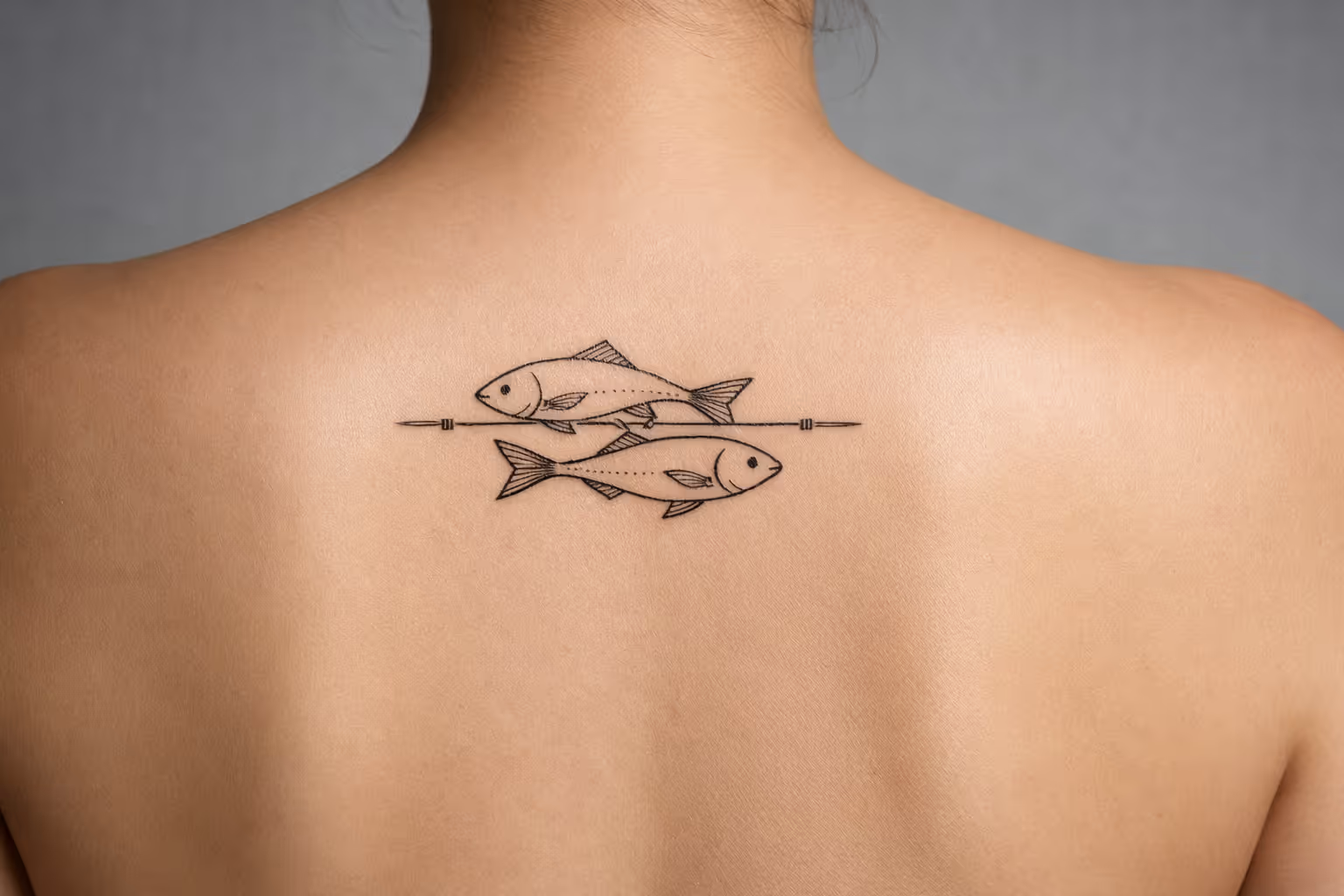
Two fish tied together, swimming in opposite directions, bound by a single cord. That image is the whole point of a Pisces tattoo: one fish pulling toward the surface and the material world, the other diving into the subconscious, held in tension by the connector between them. Pisces is the 12th and final sign of the zodiac, a water sign ruled by Neptune in modern astrology and Jupiter in the traditional system, covering birthdays from February 19 to March 20 (9). This guide covers the three design routes that actually work - the glyph, the two-fish composition, and the constellation - plus where each sits on the body and why fine-line work dominates current Pisces commissions.
✓ Pros
- Three design systems (glyph, two-fish, constellation) scale from a 1 cm micro-mark behind the ear to a 10 cm forearm piece.
- Layered symbolism including duality, intuition, and the water element offers personal meaning beyond aesthetics.
- Fine-line and minimalist styles suit professional-visibility needs and heal faster than dense color work.
- The glyph alone works well at micro scale (1-2 cm) for discreet tattoos.
✗ Cons
- Fine lines blur quickly on high-friction placements like fingers and side of hand.
- Watercolor constellation tattoos require lifelong sun protection to maintain pigment vibrancy.
- Overcrowding glyph, fish, waves, and moon motifs under 5 cm leads to illegible healing results.
- Popular rib and foot placements rank as high-pain zones, challenging for fine-line work.
What a Pisces Tattoo Actually Symbolizes
A Pisces tattoo symbolizes duality above everything else - the push-pull between fantasy and reality, body and soul, empathy and escapism - anchored by intuition, emotional depth, and creativity. The two fish aren’t decorative. One swims toward the surface (the material, waking world), the other toward the depths (the subconscious, the dream world), and the sign lives in the tension between them. People compare the Pisces symbol to Yin-Yang for good reason: two complementary opposites held in one form.
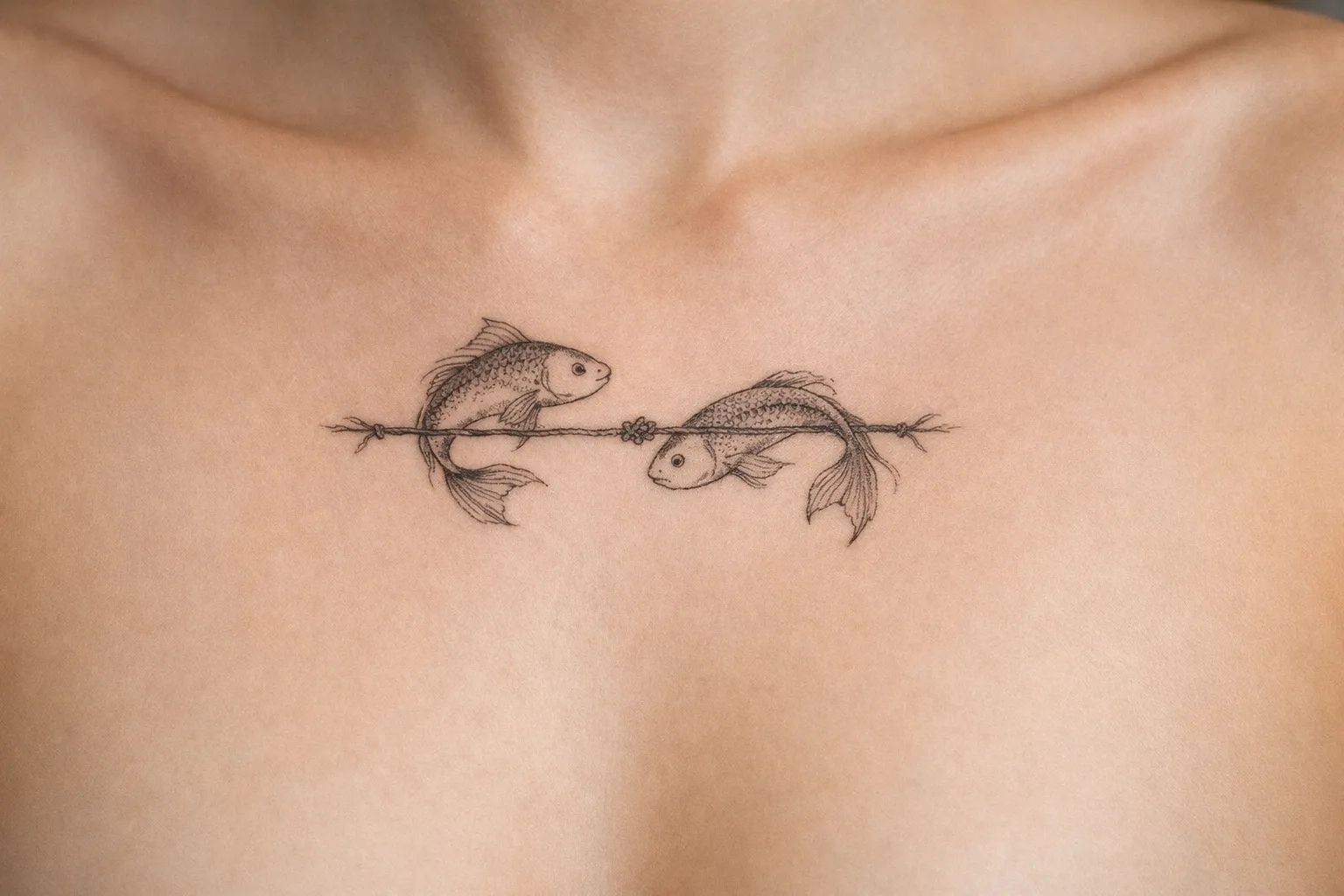
The water element gives that duality its emotional texture. Pisces sits alongside Cancer and Scorpio as the third water sign, and water in astrology maps to feeling, intuition, and fluidity. Neptune, the modern ruler, governs dreams and the subconscious - which is why moons and dreamlike, fluid motifs get folded into so many Pisces pieces. Jupiter, the traditional ruler, adds expansion and spiritual seeking, and it’s the reason a Pisces design can justify scaling up into a larger, more ambitious composition when you actually want one (9).
Being the 12th and final sign matters here too. Pisces is often framed as the sign that absorbs and synthesizes all the others - the endpoint of the zodiac cycle. That framing feeds the current studio tag of Pisces as “the artist of the zodiac,” aimed at creative, empathic, spiritually oriented clients (2). It’s marketing, but it’s marketing built on real symbolism: a sign associated with imagination, adaptability, and emotional sensitivity reads naturally as an artist’s sign.
If you’re drawn to Pisces purely for the aesthetic of two fish, that’s fine - but know that the duality reading is what the design communicates to anyone who understands the sign. The date range, February 19 to March 20, is the simplest factual anchor, and the meaning stacks on top of it (1).
The Pisces Symbol: Glyph Geometry and the Binding Cord
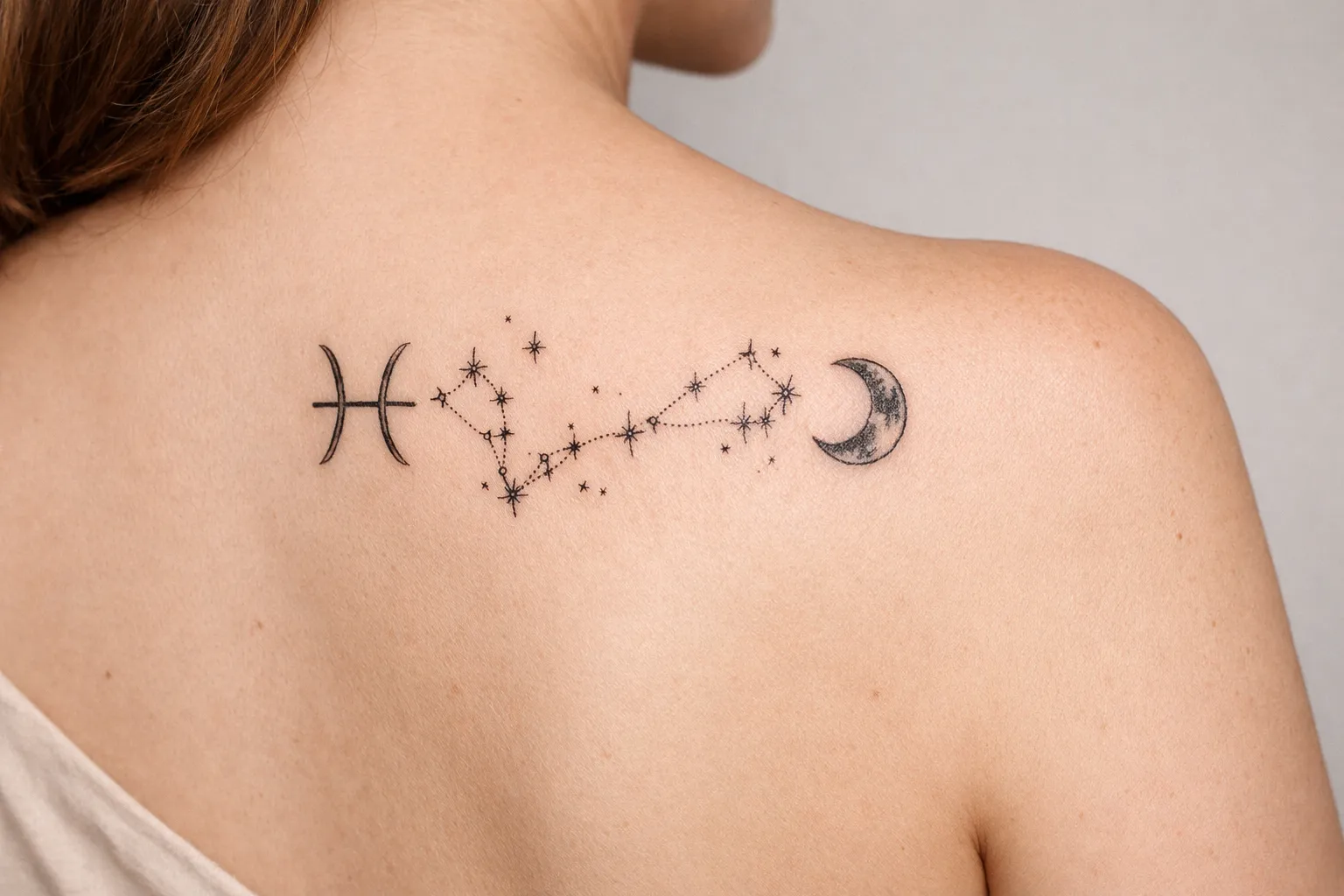
The Pisces symbol is the glyph ♓ - two curved vertical arcs connected by a horizontal stroke - and that connecting stroke is the most symbolically loaded element in the whole design (9). The arcs are the two fish. The bar between them is the cord that binds them: the bond between soulmates, between fantasy and reality, between the material and spiritual worlds. Drop the bar or thin it too far and you’ve drawn two abstract arcs that mean nothing.
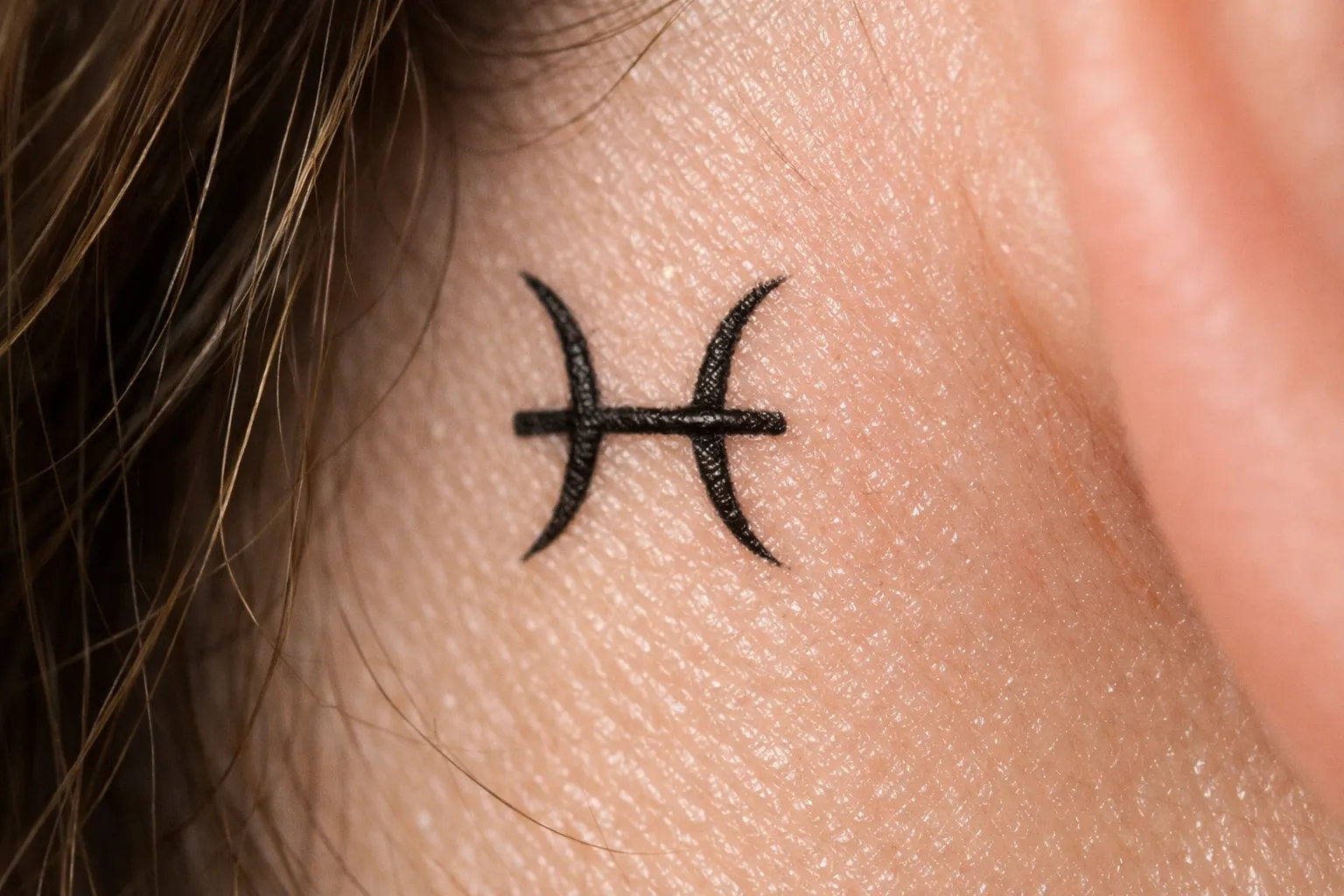
That’s the practical reason the connector matters at tattoo scale. The horizontal stroke is what makes the glyph read as Pisces rather than as decorative linework. I’ve seen artists reduce it too aggressively at micro sizes - especially under 1.5 cm - and the result is a symbol that reads as ambiguous to anyone who doesn’t already know what they’re looking at.
Confirm you’ve got the right glyph before booking, because minimalist zodiac symbols get confused more often than people expect. The Pisces glyph (♓) is distinct from Cancer (♋) and Aquarius (♒). All three are simple curved forms, and in a minimalist set they can blur together in someone’s memory. Check the exact symbol against a reference - not a Pinterest crop - before it goes on your skin.
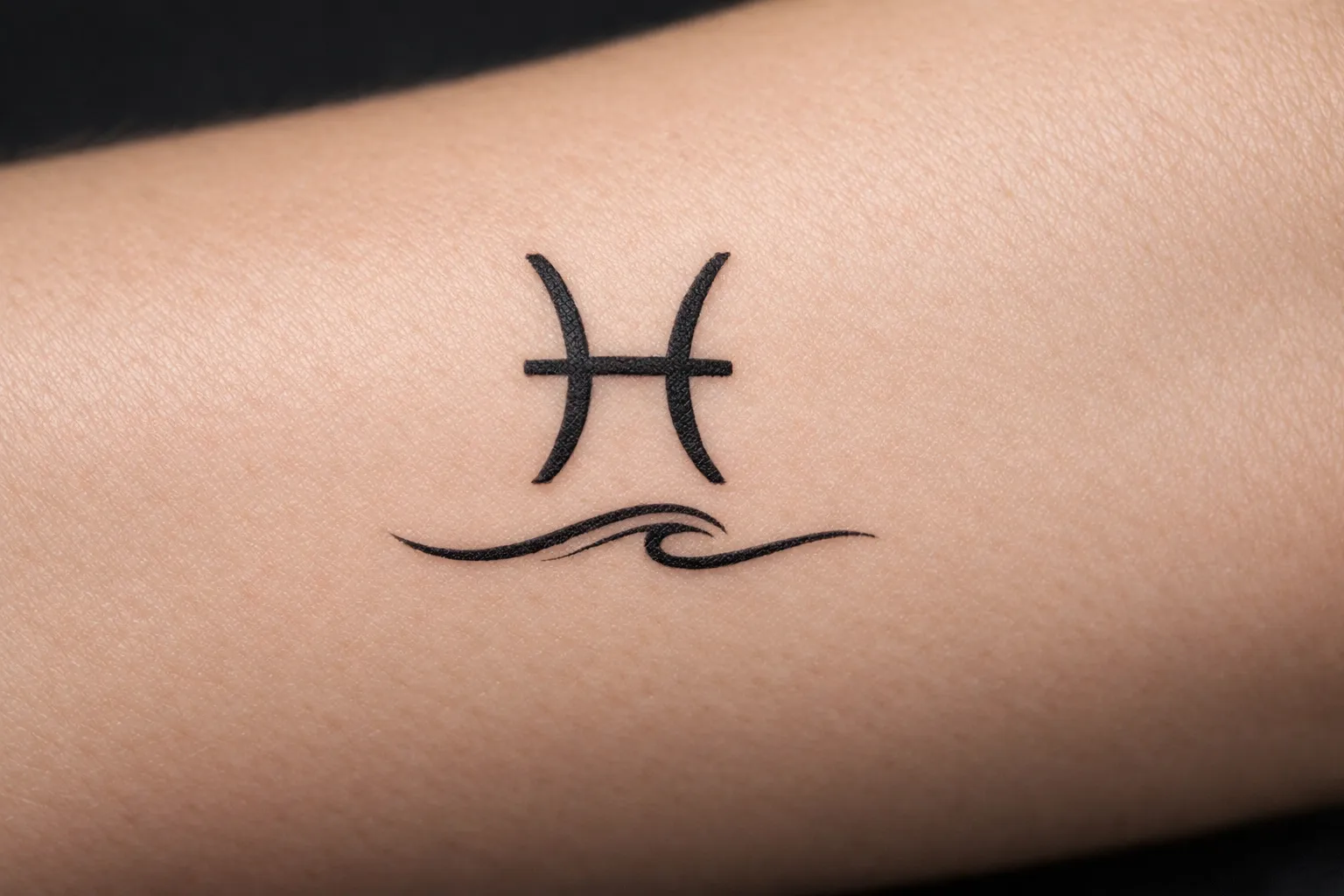
At micro scale, the glyph works well at 1-2 cm on the wrist, finger side, or behind the ear (3). But the connecting stroke needs deliberate line weight to survive healing at that size - it cannot be reduced to a hairline. Recent interpretive writing has expanded the glyph’s meaning beyond “two fish” to Pisces as a connector between worlds, which tracks with the fact that Pisces is one of the 12 zodiacal constellations recognized by the International Astronomical Union. The symbol points at both the sky and the psyche.

Pisces Tattoo Designs: The Three Core Visual Systems
Pisces tattoo designs fall into three visual systems - glyph-only, two-fish imagery, and the constellation - and each carries the same core symbolism while reading completely differently at different scales (3). Choosing between them is the first real decision, ahead of placement.
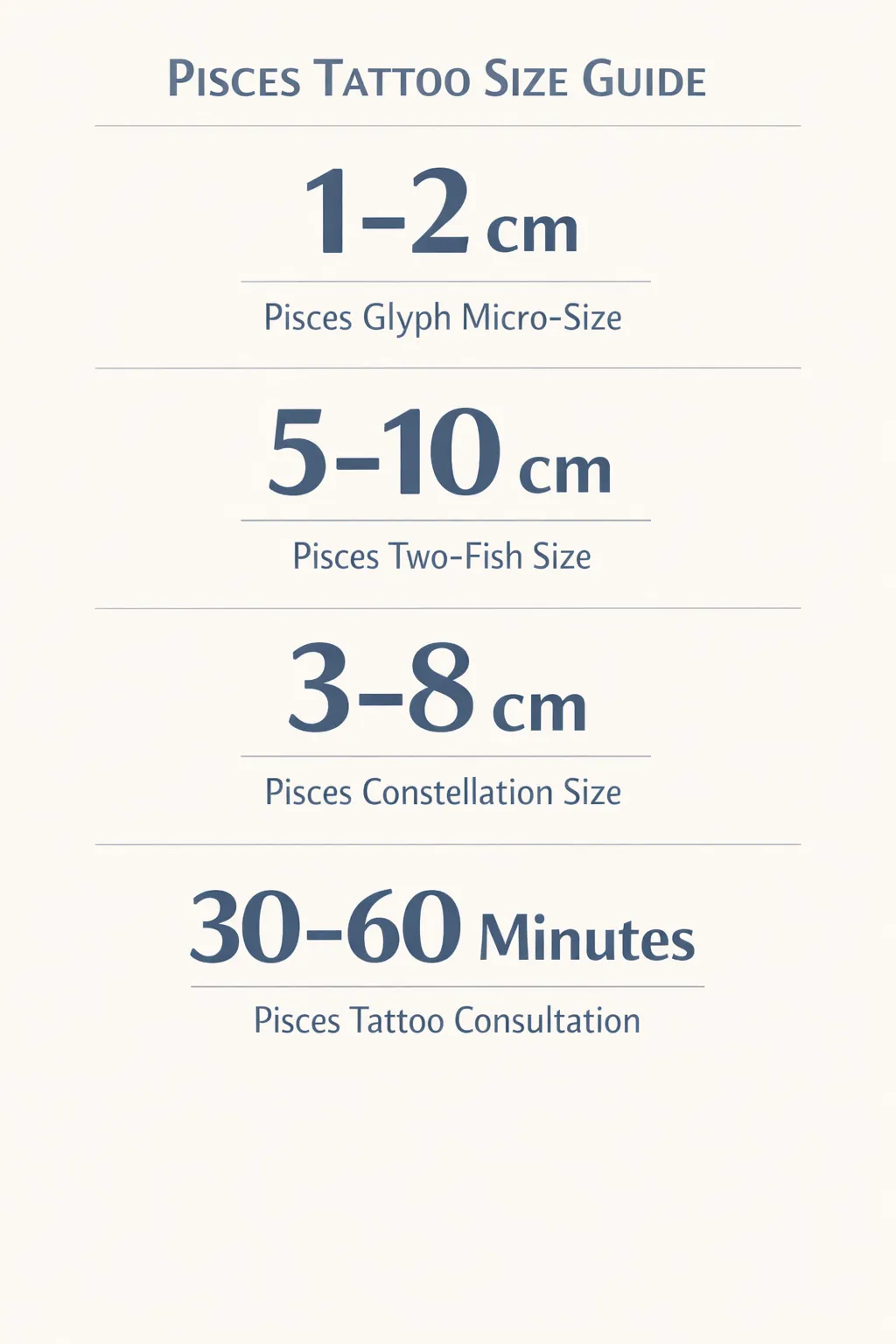 Size ranges for Pisces tattoo elements and the initial consult duration: glyph 1-2 cm, two-fish 5-10 cm, constellation 3-8 cm, consult 30-60 minutes.
You can combine them, but restraint is the rule. Stacking glyph, fish, constellation, waves, and a moon into under 5 cm produces illegible lines after healing (3). Pick one primary system and, at most, one supporting motif. Blackwork and fine-line suit minimalist, discreet tattoos and heal faster; watercolor and color suit expressive, dreamy interpretations but demand more aftercare and long-term sun protection. Here’s how each system actually behaves.
The Two-Fish Design: Duality in Motion
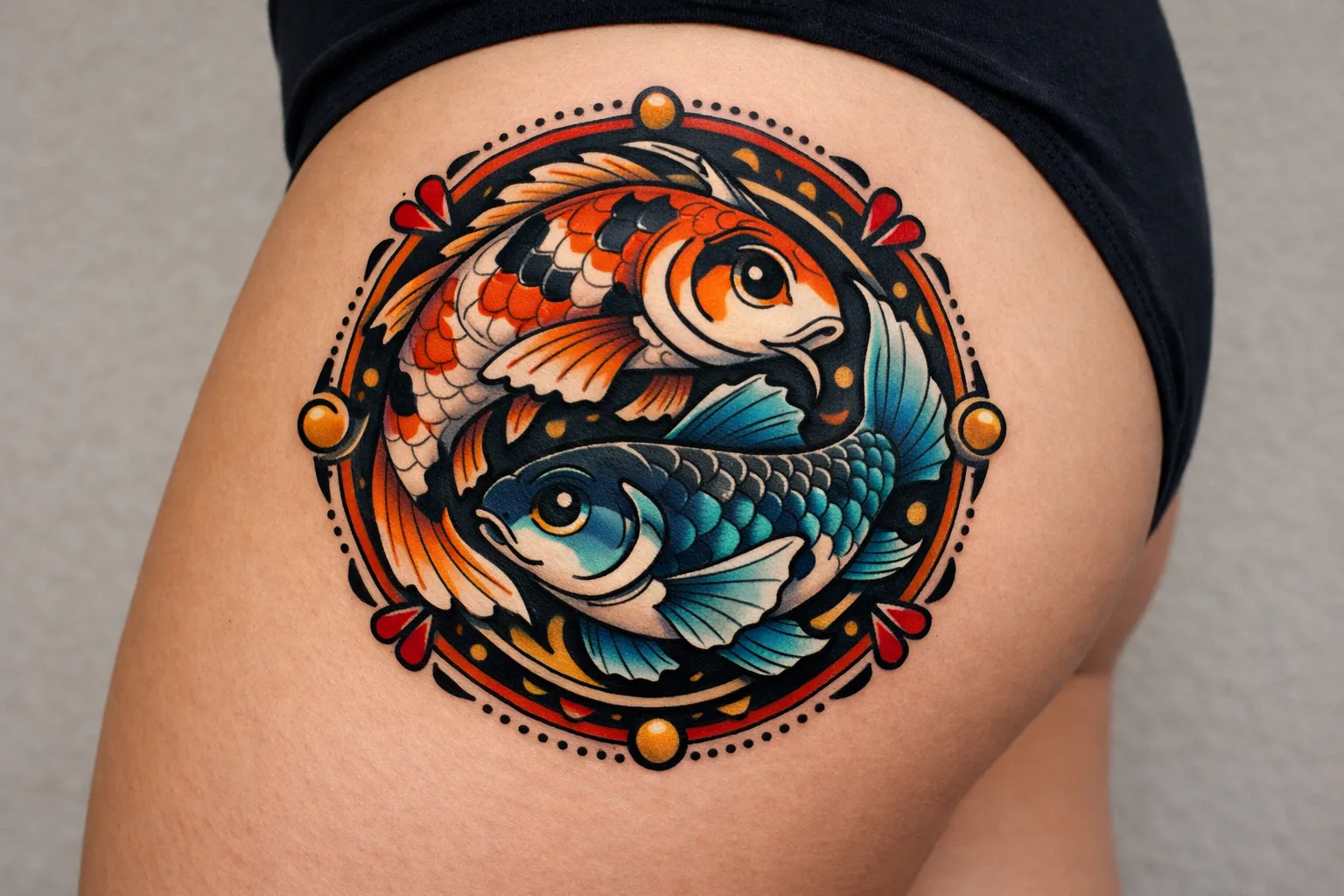
The classic two-fish composition shows two fish swimming in opposite directions, often arranged in a circle, visually encoding the Yin-Yang duality - one fish toward the surface, one toward the depths (3). This is the strongest narrative version of the design because the motion is doing the symbolic work.
Size it at 5-10 cm for a readable two-fish piece (3). Smaller than 5 cm and the fish bodies lose their scale detail and shading after healing - you end up with two blobs instead of two fish. Style options run from stylized and illustrative (clean curves, negative space between the fish) to realistic (scale detail, shading), geometric (angular forms inside a circle), and even American traditional (thick black outlines, limited palette). American traditional is a less common choice for Pisces, but it exists and it ages well precisely because bold outlines hold shape over decades.
A Celtic knot layered with the fish is a medium-sized upper arm or back option that adds eternity symbolism over the duality theme. The insider move on any two-fish piece: vary the line weight. Slightly thicker fish bodies with an ultra-fine connecting line keeps the duality readable even as the tattoo softens with age.

The Pisces Constellation Tattoo: Star Map as Emotional Compass
A Pisces constellation tattoo renders the sign as a fine-line dot-and-line star map, typically built from a small number of primary stars connected by thin strokes (3). Confirm the pattern against an astronomical chart before finalizing - Pisces is a genuine zodiacal constellation, and astrology-aware viewers notice when the star pattern is wrong or generic. I’ve had clients come in with reference images pulled from jewelry sites where the dot pattern was completely fabricated. It matters.
Size it at 3-8 cm for legibility (3). Under 3 cm the stars risk merging into each other after healing unless your artist uses deliberate dot sizing. The symbolism here leans on intuition and subconscious navigation - it reads better framed as a personal compass than as a decorative star cluster.
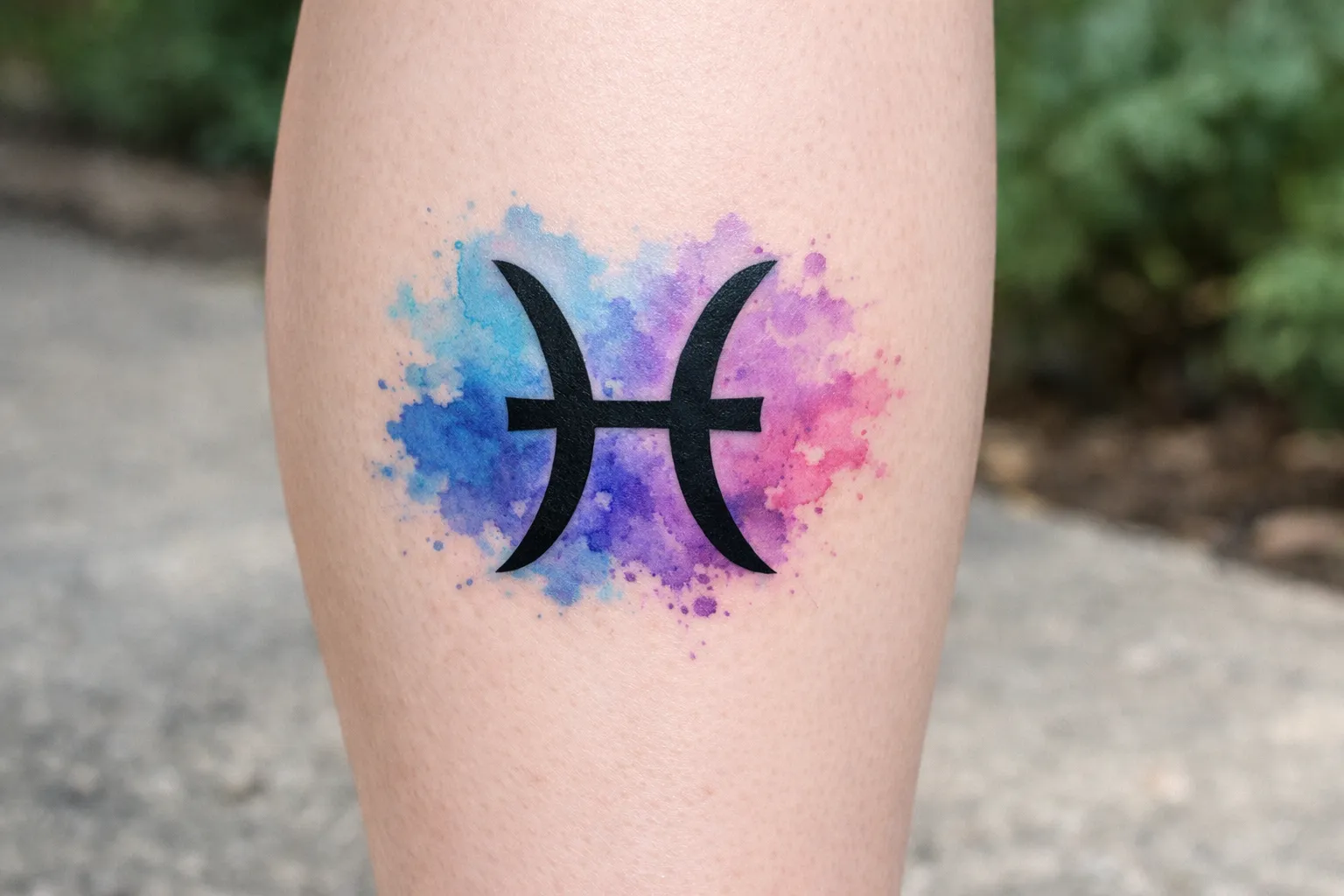
Watercolor nebula layering is the expressive upgrade: blue-turquoise-purple washes behind the star map create an ethereal depth. It requires tested, high-quality pigments and sometimes two passes for saturation, and it fades faster than blackwork without consistent SPF. Treat the negative space between stars as a feature, not a gap - the distance between the points is what makes the “distance between worlds” idea visible, and it improves long-term legibility.

Glyph-Only and Minimalist Approaches
The pure glyph at 1-2 cm is the smallest viable Pisces design - maximum symbolism in minimum space, ideal for first-timers, professional-visibility needs, or anyone who wants a subtle identity marker (3). Clean micro-detail at this size demands single-needle or small round liner groupings and a high-resolution stencil transfer. That’s non-negotiable; a sloppy stencil at 1.5 cm shows immediately.
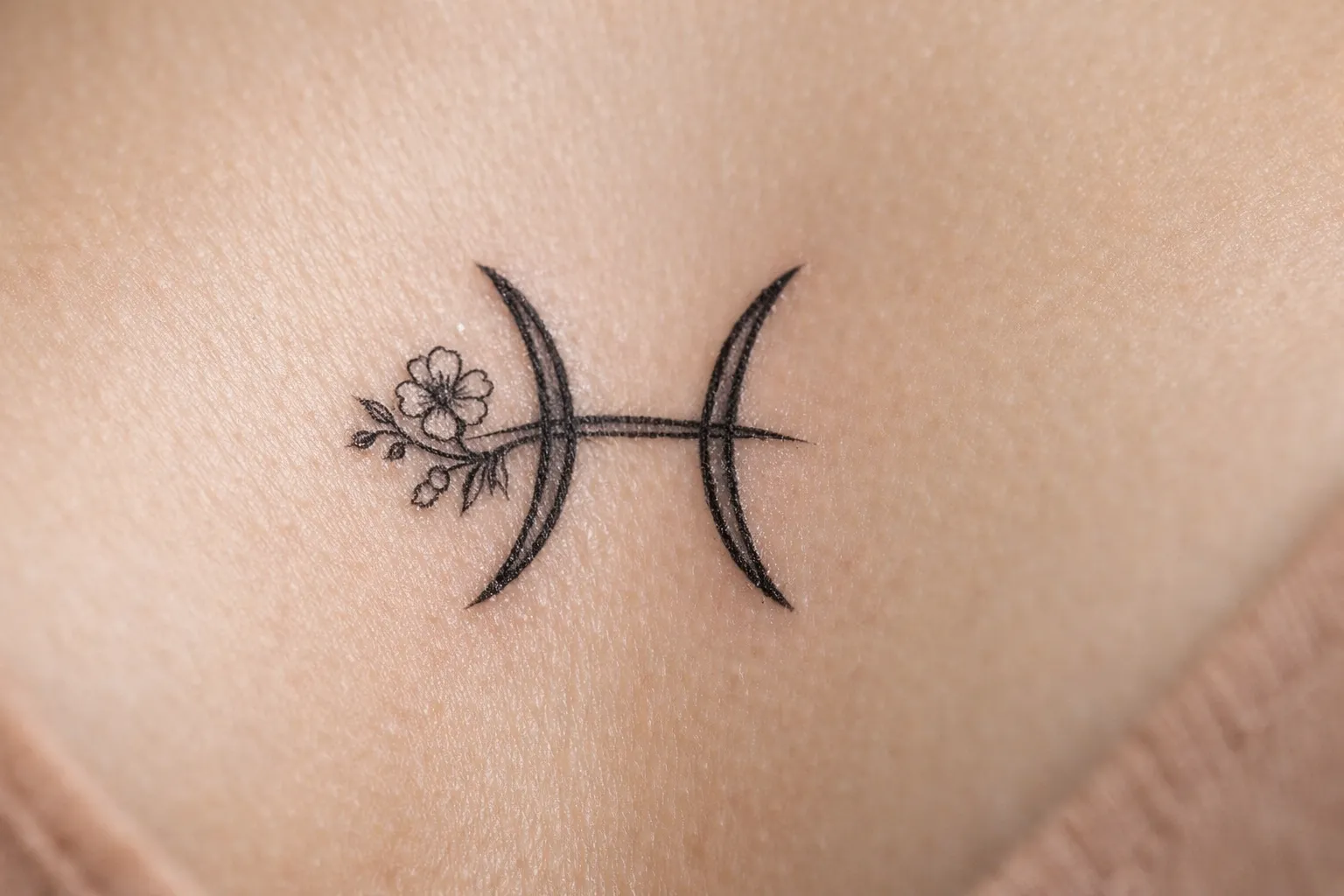
Keep additions to one element maximum at small scale: glyph plus a single wave line, glyph plus a micro-moon, or glyph plus a water lily (the Pisces birth flower). The glyph also works as part of a Sun-Moon-Rising trio - three chart glyphs in a linear or circular arrangement for clients who want their full big-three represented rather than just the Sun sign.

Water-Sign Motifs That Extend the Symbolism
Water-sign motifs - moons, waves, water lilies, mermaids, and Celtic knots - extend Pisces symbolism, but every element you add to a small design competes for line clarity after healing. The rule of restraint applies: pick one or two supporting motifs maximum.
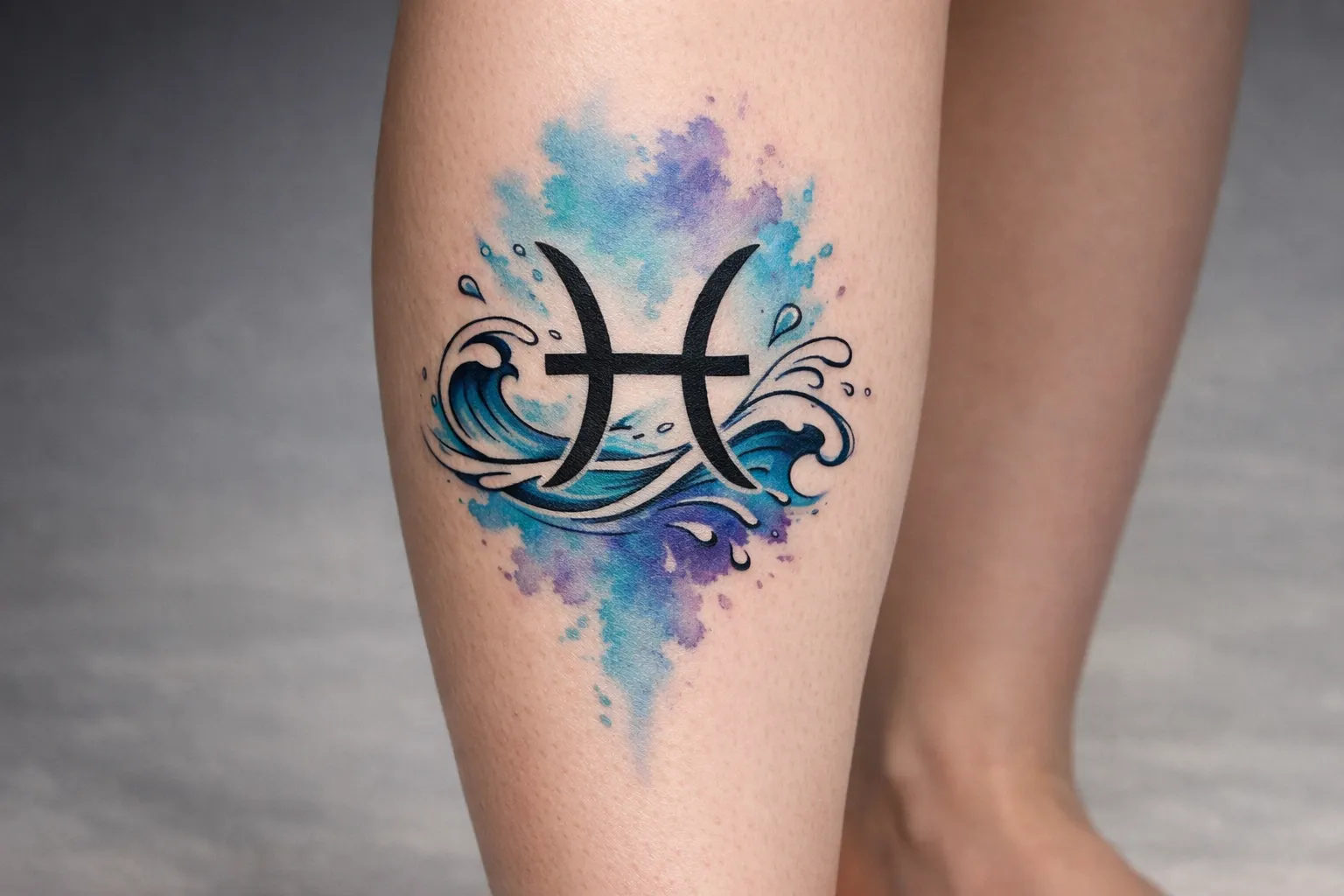
Moons reinforce the Neptune and subconscious connection (9). A crescent moon above the glyph or constellation works at small scale without crowding. Waves and water droplets emphasize the water element and emotional flow; they range from a single wave line under the glyph at under 5 cm to a full half-sleeve water scene (3).
The water lily is the Pisces birth flower and the most common floral addition, especially in fine-line work. It pairs naturally with the glyph or fish on the collarbone, sternum, or thigh, and it earns its place because it grows in water - it ties directly to the element rather than being an arbitrary pretty addition.
Mermaids are a bigger commitment. A mermaid-and-fish composition needs 10 cm or more and 2-4 hours of session time, and it amplifies the dual-worlds theme (land vs. sea) - but it requires an artist experienced in figure work, so vet the portfolio before you book. Celtic knot integration frames eternity and intuitive wisdom, and it works best as a medium-sized upper arm or back piece rather than crammed into a small wrist design. Jupiter’s association with expansion is your justification for scaling these up when you actually want a larger piece.
Placement Guide: Where Fine Lines Stay Sharp and Where They Don’t
Placement determines the longevity of fine-line Pisces work more than almost any other factor. Two variables decide it: friction and movement (how much the skin folds, stretches, or rubs) and sun exposure (how often the area sees UV without protection). Here’s how the common placements actually behave.
Pisces Tattoo Placement Comparison
| Inner forearm | Upper ribcage | Collarbone | Back of shoulder | Behind the ear | Sternum | Finger / side of hand | Top of foot | Inner wrist | |
|---|---|---|---|---|---|---|---|---|---|
| Pain Level | Low-moderate | High | Moderate | Low-moderate | Moderate | Moderate-high | High | High | Low-moderate |
| Fine-Line Longevity | High | High | High | High | Moderate | High | Low | Low | Moderate |
| Best Design Type | Glyph, constellation, small two-fish | Constellation, glyph + floral | Glyph + water lily, constellation | Two-fish, larger constellation | Micro-glyph only | Glyph + floral, constellation | Bold glyph only | Bold only | Glyph (heavier line weight) |
| Sun Exposure Risk | Low | Low | Moderate | Low | Low | Low | High | High | Moderate |
Best Placements for Fine-Line and Minimalist Designs
The inner forearm is the most reliable placement for fine-line zodiac work - moderate movement, lower friction, and easy to keep out of the sun (3). It suits the glyph, a constellation, or a small two-fish at 3-8 cm. The upper ribcage and collarbone are low-friction and easily covered, and they read as intimate and personal, which is why constellation and glyph-plus-floral combinations land there so often. Ribcage pain is higher than forearm, though - plan your session length accordingly (3).
The back of shoulder and upper back offer a flat surface with low movement, good for a larger two-fish or constellation at 5-10 cm, and the placement stays out of daily sun. Behind the ear is micro-scale only, under 2 cm, suited to the glyph or a single star; it heals well but tends to need touch-ups sooner than forearm placements (3). The sternum suits glyph-plus-water-lily or constellation compositions - low friction, but you’ll need to lie still through it, and pain runs moderate to high.
Placements to Approach Carefully
Finger joints and the side of the hand wreck fine-line Pisces glyphs. Friction and fast skin regeneration blur single-needle work quickly here - if you insist on a finger glyph, go bold, not fine (3). The top of the foot is popular for water-sign aesthetics but consistently high-pain and prone to fading from footwear friction; if you choose it, go bolder than you think you need to.
The inner wrist works for the glyph, but the skin stretches with wrist movement, so use a slightly heavier line weight than you’d use on the forearm. The ankle carries similar friction concerns to the foot - a fine-line constellation there needs to be sized at 4 cm or more to survive the movement zone.

Pisces Tattoo for Female: Delicate Compositions That Actually Hold Up
The dominant aesthetic in Pisces tattoo for female searches is soft curved linework, micro-stars, and small florals arranged in 2-3 focal clusters rather than a dense all-over pattern - the spacing is what keeps the design airy and readable. This look isn’t gender-exclusive, but the search demand for the framing is real and the technical guidance underneath it is worth getting right.
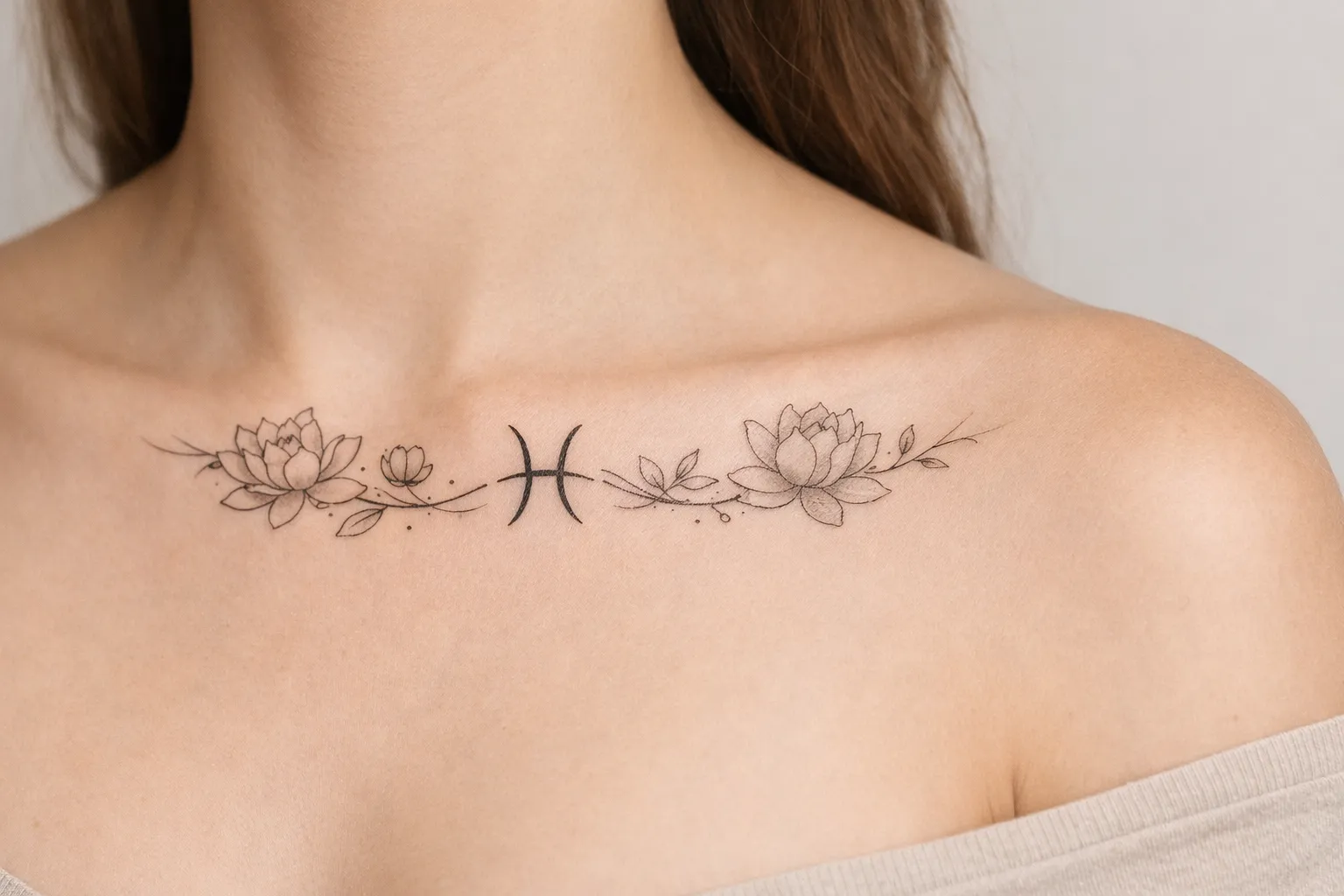
The most-requested compositions in this category are the glyph plus a water lily on the collarbone or sternum, a micro-constellation on the ribcage, and two fish in a circular arrangement on the inner forearm or thigh (3). Most of these live in the 2-6 cm range. Under 2 cm you need a specialist in single-needle or fine-line micro work - not a generalist, and not a good deal you found online (3).
Here’s the technical caveat most competitors skip: ultra-fine single-needle lines on wrists and ankles need slightly heavier weight than they look in reference photos. What reads as hairline-thin in a fresh, freshly-shot image can disappear after healing on high-movement skin. The photo you’re saving was taken the day it was done; you’re going to wear the healed version for years. Ask your artist to build in that margin.
For floral integration, use the water lily petals as a frame around the glyph rather than as a separate element beside it (3). A framed glyph reads as one intentional design. Two unrelated elements sharing skin - a symbol next to a flower with no compositional relationship - reads as two tattoos that happened to end up adjacent. These principles hold for anyone wanting delicate fine-line Pisces work, regardless of who’s wearing it - the physics of thin lines on stretchy skin doesn’t care about the search term.

Pisces and Scorpio Pairings: Two Water Signs, One Design
Pisces and Scorpio pair naturally in tattoos because both are water signs, both associated with emotional depth and intuition, and Scorpio adds transformation and intensity to Pisces’ empathy and dreaminess. Scorpio Pisces tattoo requests usually come from couples, siblings, or close friends, and the design logic is the same in every case: keep the two symbols distinct.
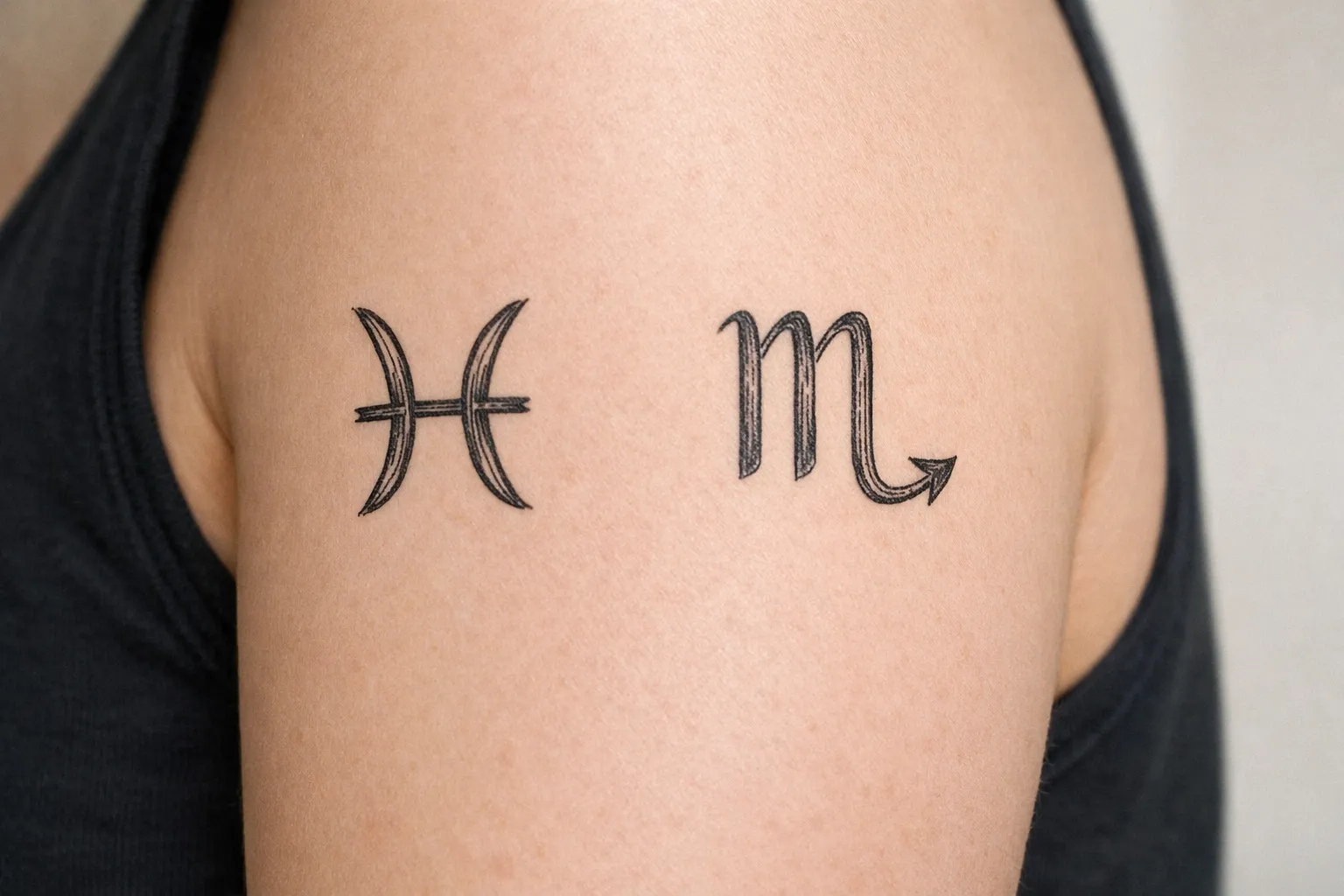
The common approaches are two glyphs (♓ and ♏) in a linear or mirrored arrangement, paired constellations in matching dot-and-line style, or a fish (Pisces) and scorpion (Scorpio) sharing a water-element composition. For a two-glyph piece, size it at 4-8 cm total with deliberate spacing between the symbols (3). For paired constellations, give each one 3-5 cm and breathing room so they don’t crowd into each other (3). Inner forearm, collarbone, and ribcage all work for both people.
Scorpio and Pisces tattoos also raise a structure decision: matching versus complementary. Matching glyphs on the same placement read clearly as a pair - good if you want the connection obvious. Complementary designs (the fish on one person, the scorpion on the other) each stand alone if circumstances change, which is the lower-risk choice for anything but a settled long-term bond.
Don’t try to fuse both symbols into one small hybrid. Two distinct symbols with space between them read more clearly than a merged form that flatters neither sign.
Personalizing the Design: Mapping Your Own Duality
The strongest personalization move is to name your own version of the Pisces duality before you choose any design elements. The two fish encode a push-pull - so what’s yours? Career vs. art, logic vs. intuition, home vs. travel, solitude vs. connection. Once you’ve named it, the design has a spine.
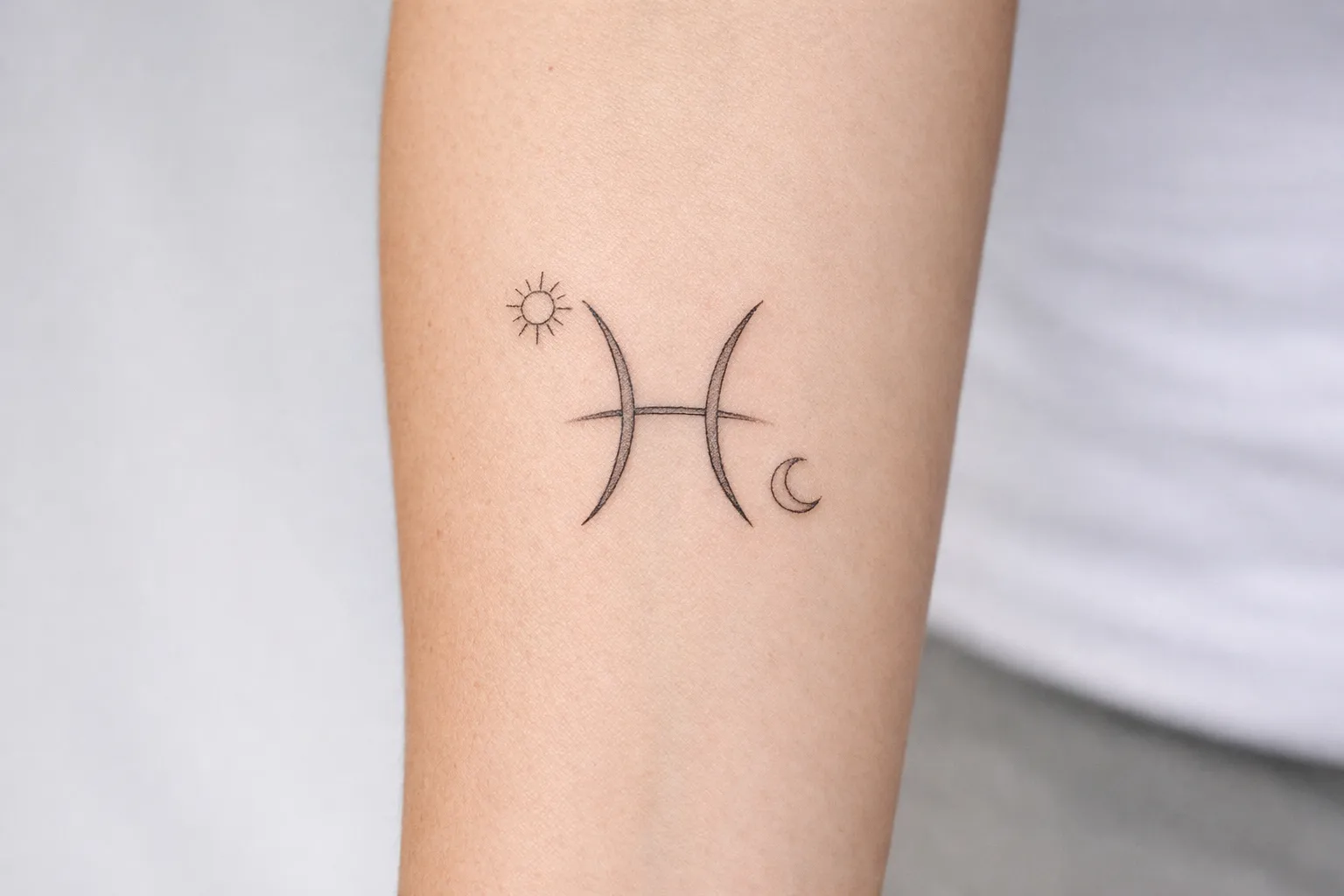
From there you can integrate representative symbols near the fish - small objects, coordinates, initials, a single word - without cluttering the composition, because each addition answers to your named duality instead of being decoration. Widely circulated fish compositions feel impersonal precisely because they often include elements that don’t map to the wearer’s actual life. That’s the difference between a personal piece and a Pinterest copy.
Constellation accuracy is a personalization layer in its own right. Drawing from the real Pisces star map - the primary points in their correct relative positions - rather than a generic dot cluster makes the piece astronomically legible, a detail astrology-aware viewers register immediately. The Sun-Moon-Rising approach goes further: pair the Pisces glyph with your Moon-sign glyph and Rising-sign glyph in a three-element composition, keeping each element around 1.5-2 cm with clear spacing (3).
Color is a personalization signal too. Put the cool hues - blue, teal, violet - closest to the fish or glyph and any warmer tones farther out; this keeps the eye on the core symbol and reads better from a 1-2 m viewing distance, which is how anyone actually sees your tattoo (2). The goal throughout is a piece that means something specific to you, not a design someone else already wore.
What to Expect: Session Length, Healing, and Aftercare
Plan on a 15-30 minute consultation for a small glyph or micro-constellation, or 45-60 minutes for a multi-element piece with watercolor or a mermaid composition. Needle time follows scale: a minimalist glyph or tiny constellation under 3-4 cm typically runs 30-60 minutes, while elaborate watercolor or wave compositions take 2-4 hours, sometimes across multiple sessions (3).
Healing Timeline for Fine-Line Pisces Designs
- Day 1-3: The tattoo is tender and weeping plasma. Keep it clean, apply a thin layer of unscented moisturizer or tattoo ointment, and don’t submerge it - ironic but critical for a water-themed tattoo.
- Day 3-7: Peel and itch phase. Do not pick. Fine lines are most vulnerable to disruption here, and one scratched scab can take a chunk of a hairline stroke with it.
- Week 1-2: Surface healing. The tattoo looks milky or slightly faded. That’s normal - not a blowout, not a sign the ink didn’t take.
- Week 2-4: Outer skin layers normalize. Avoid swimming and submersion for 2-3 weeks minimum (3).
- Week 4-6: Full epidermal recovery. Fine lines settle into their healed state; what you see at six weeks is close to the long-term result.
Aftercare Specifics for Delicate Placements
Wash with fragrance-free soap 1-2 times daily, avoiding antibacterial soaps that over-dry fine-line work. Apply a thin layer of unscented moisturizer or tattoo ointment - thin is the operative word, because heavy application suffocates fine lines and slows healing.
Sun protection is non-negotiable for watercolor Pisces constellation tattoos: blue-turquoise-purple pigments fade faster than black ink under UV, so apply SPF 30+ once healed and keep it up long-term. Before the appointment, avoid chemical exfoliants on the area for at least 48-72 hours - relevant for ribcage and collarbone spots where people commonly use active skincare - and avoid sun exposure on the planned placement for the same window so the stencil adheres cleanly to undamaged skin.
Lucky Colors, Motifs, and What the SERP Gets Wrong
Pisces’ most-cited lucky colors are sea green, aquamarine, and soft violet - and conveniently, they map directly onto the cool blue-teal-purple palette that already works best in watercolor Pisces constellation tattoos (2). If you want color in your design, that’s a practical reason to lean into those hues rather than a superstitious one.
The commonly cited lucky motifs are the moon, the water lily, and the fish (2). The moon connects to Neptune’s intuitive domain, the water lily is the birth flower that integrates naturally into fine-line compositions, and the fish is the sign itself. Here’s the honest caveat: “lucky” in tattoo content really means “symbolically resonant for this sign.” There’s no evidence a specific motif changes outcomes. What it does do is make the tattoo more personally durable - choosing symbols that align with your own reading of Pisces means you won’t tire of them.
What most “lucky Pisces tattoo” articles get wrong is listing motifs without explaining the connection. The water lily isn’t lucky because someone declared it so - it’s the birth flower, and it grows in water, which ties straight back to the element (6). Once you understand why a motif connects, you can judge whether it belongs in your design instead of copying a list.
Frequently Asked Questions
- What does a Pisces tattoo symbolize?
- Duality (fantasy vs. reality, body vs. soul), emotional depth, empathy, intuition, and adaptability - the two fish encode the push-pull between inner and outer worlds, while the glyph's horizontal cord represents the bond that holds those opposites together.
- What is the Pisces symbol in tattoo form?
- The glyph ♓ - two curved arcs connected by a horizontal stroke representing the binding cord between the two fish. At tattoo scale, the connecting stroke needs deliberate line weight to stay readable after healing, especially at micro sizes under 2 cm.
- What tattoo is lucky for Pisces?
- Moon, water lily, and fish motifs are most commonly cited; the cool blue-teal-violet palette aligns with Pisces' lucky colors (sea green, aquamarine, soft violet) and also happens to be the most practical palette for watercolor constellation designs.
- What is Pisces' lucky color?
- Sea green, aquamarine, and soft violet - these map directly to the blue-turquoise-purple palette used in watercolor Pisces constellation tattoos, making them both symbolically resonant and aesthetically coherent for the design.
- Where is the best placement for a Pisces constellation tattoo?
- Inner forearm, upper ribcage, and back of shoulder give fine-line constellation work the best long-term legibility - lower friction, moderate sun exposure, and flatter skin surfaces. Ribcage is popular but pain is higher than forearm.
- How long does a small Pisces glyph tattoo take to heal?
- Surface healing takes 10-14 days; full epidermal recovery is around 4-6 weeks. The peel and itch phase hits around day 3-7 - don't pick. Avoid swimming for 2-3 weeks minimum.
- Can you combine the Pisces glyph, two fish, and constellation in one tattoo?
- Technically yes, but not at small scale. Under 5 cm, combining all three produces illegible lines after healing. Pick one primary element and add one supporting motif maximum - the glyph with a single constellation star cluster, or the two-fish with a wave line.
- What's the difference between a Pisces tattoo for men vs. women?
- The symbolism is identical. The aesthetic difference is in scale and style preference - delicate fine-line compositions with florals and micro-stars are more commonly requested by female clients, while bolder two-fish or larger constellation pieces appear more in male-oriented galleries. Both work on any placement.
Choosing Your Route: Which Pisces Design Fits You
The decision comes down to three forks. First, which system: the glyph is the most discreet and the smallest, the two-fish composition tells the fullest duality story at 5-10 cm, and the constellation reads as a quieter cosmic marker at 3-8 cm. Second, which aspect of the Pisces duality you actually want to carry - name it before you pick elements. Third, placement, because fine-line work lives and dies by it: the inner forearm and upper ribcage outperform fingers and feet over the years, every time.
One counterintuitive note to close on. A water-themed tattoo needs to stay dry for the first two to three weeks - no swimming, no submersion - and if you go the watercolor route, those blue-teal-violet pigments need SPF for life. Plan the healing window before you book. What you see at six weeks is the tattoo you’re keeping.