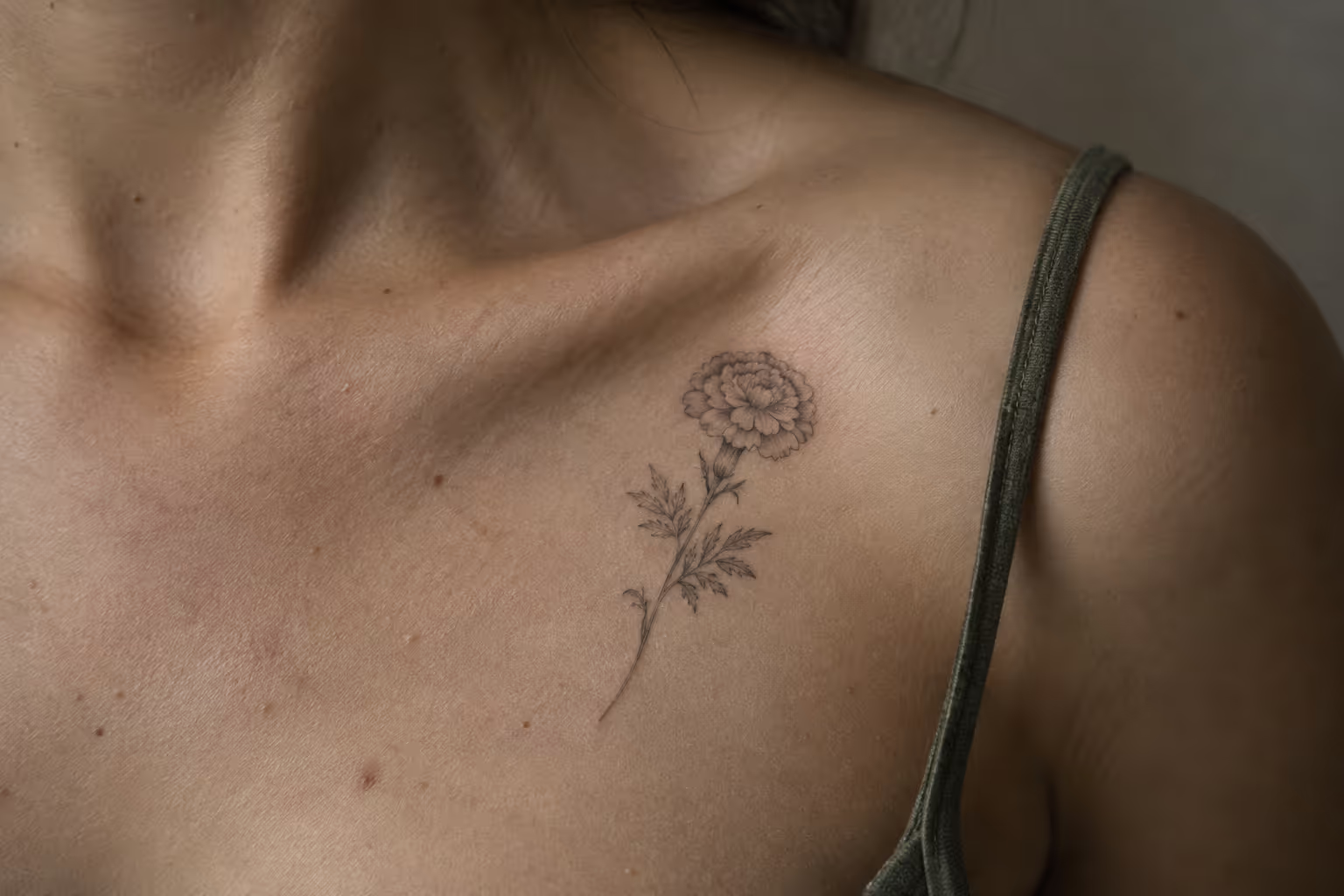
A marigold tattoo can stand for joy and warmth or for grief and remembrance, depending on which tradition you’re drawing from. Marigold is October’s primary birth flower (2), and the same bloom, under its Nahuatl name cempasúchil (6), is laid across Day of the Dead altars in Mexico (1). Before you think about color or placement, decide which of those contexts the piece belongs to. That choice drives everything else.
Here are the trade-offs before you book. The marigold works in your favor because it carries flexible meaning, has a strong warm palette, and holds up at different sizes. It also carries a well-documented Day of the Dead reference if that’s your intent. It works against you because the meaning gets misread without context, two different plants share the “marigold” name, and yellows and oranges need planning to hold their color over the years. A Day of the Dead design also asks you to get the cultural references right rather than improvising them.
✓ Pros
- Its rounded silhouette stays recognizable when simplified for smaller placements.
- A clear companion element can signal whether the design is personal, celebratory, or memorial.
- The bloom can anchor a composition without requiring a large surrounding scene.
✗ Cons
- Warm colors need deliberate contrast to keep petal layers distinct as the tattoo ages.
- The shared common name can lead to choosing the wrong botanical reference.
- A Day of the Dead design can imply cultural familiarity the wearer may not intend.
Marigold Tattoo Meaning: Joy, Grief, and Everything in Between
The marigold tattoo meaning has no single answer. The Almanac lists the marigold’s primary meanings as joy, warmth, remembrance, grief, and prosperity (3). That one list holds both a birthday card and a funeral. If you walk into a consult saying “marigolds mean X,” you’re picking one half and ignoring the other. Strangers who see the finished piece will read whichever half they already know.
The Farmers’ Almanac gives a different list: caring, joy, passion, warmth, devotion, abundance, and good fortune, and it ties the flower to honoring ancestors on Day of the Dead (7). There is overlap, but it isn’t the same list. No universal meaning exists because the marigold has lived in several traditions at once. The same almanac notes that the Aztecs held marigolds sacred, that Hindu weddings and marriage celebrations use them, and that Christian tradition offered them to the Virgin Mary as “Mary’s gold” (7).
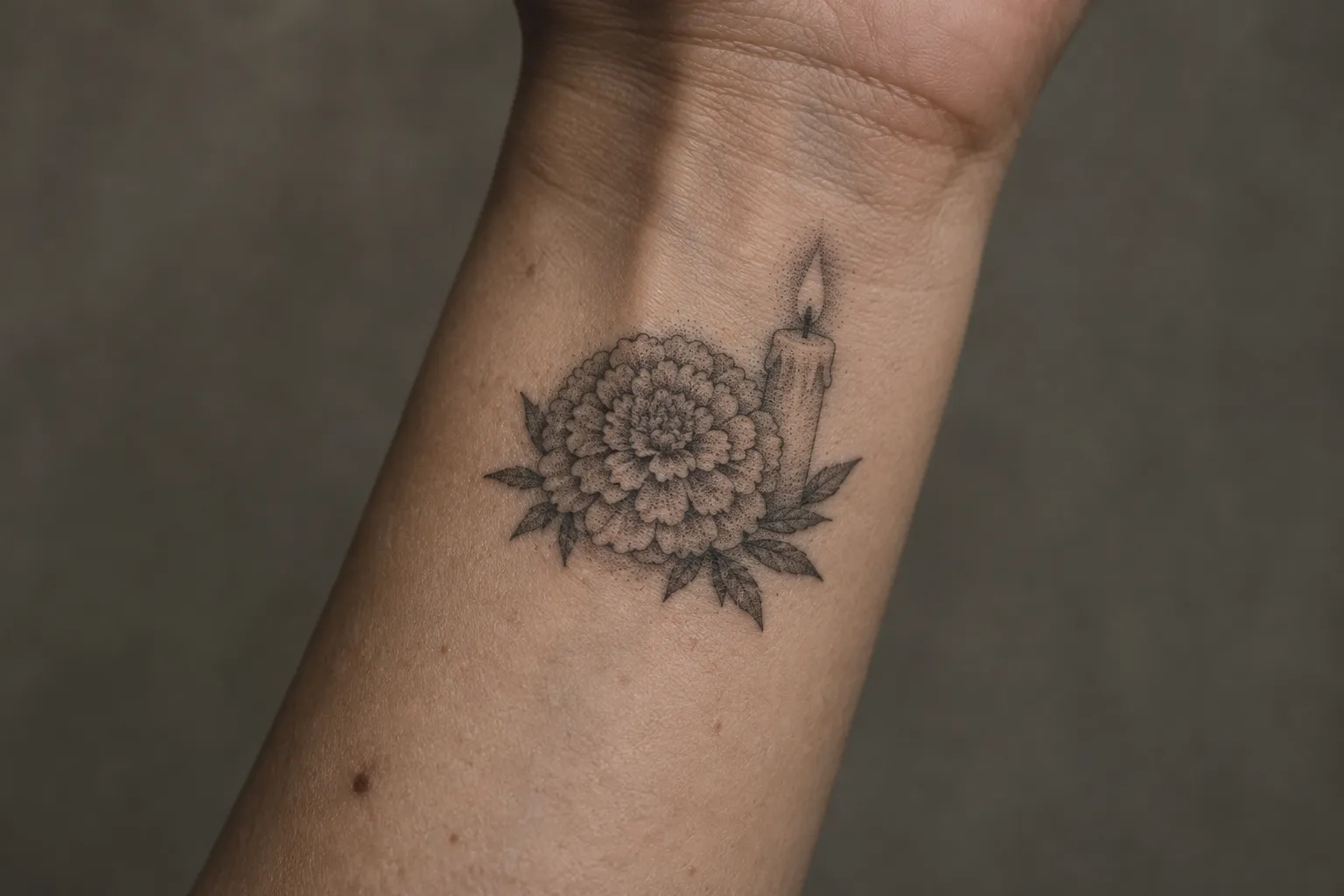
So the practical rule is this: let the design’s context decide which meaning you claim. A marigold with a date and a portrait reads as memorial. A marigold paired with cosmos reads as an October birthday. A marigold beside a candle and papel picado reads as Day of the Dead. A lone bloom with no companions reads however the viewer wants it to, which is fine if you’re comfortable with that.
The Almanac lists the common colors as yellow, orange, red, gold, and bicolors (3). The Farmers’ Almanac gives each shade its own nuance: orange for warmth, creativity, and passion, yellow for friendship, joy, and positive thoughts, and red-orange for strong emotion and devotion (7). Color is also a longevity decision, which comes up again in the styles section.
Celebratory meanings: joy, warmth, prosperity
The bright side of the marigold comes mostly from its look and its birth-flower status. It’s a dense, ruffled bloom in the warmest part of the spectrum, and it flowers through the end of the growing season. Joy, warmth, and prosperity all appear on the Almanac’s list (3), and abundance and good fortune appear in the Farmers’ Almanac’s (7).
If that’s your angle, the design usually leans open and saturated: a full-color bloom, leaves fanned out, maybe a sunny bicolor in orange and red. Nothing in the composition points toward loss. A celebratory piece also works fine alone, because it doesn’t need a second element to explain itself.
Memorial meanings: remembrance and grief
Remembrance and grief sit on that same Almanac list. The Almanac notes that marigolds “have long been associated with death and grief” and are a prominent fixture in Day of the Dead festivities, used to decorate grave sites and home altars (3). Tattoo idea pages also describe the marigold as a memorial design choice (4).
A memorial marigold usually carries a second element: a name, a date, a portrait, or an object tied to the person. That second element turns “a nice flower” into “a flower for someone.” Without it, a memorial piece can read as purely decorative to anyone but you, which is also a legitimate choice if you want to keep it private.
Day of the Dead Marigold Flowers and Altar Symbolism
On Day of the Dead, November 1 and 2, families build altars to welcome the spirits of the dead home, and yellow marigolds are among their main components (1). The Mexican Museum traces the holiday to pre-Hispanic rituals more than 3,000 years old, practiced by the Olmecs, Toltecs, Mixtecs, Zapotecs, Maya, and Aztecs (1). The marigold isn’t an add-on to that tradition. It sits at its center.
That’s the main reason a Day of the Dead marigold tattoo needs more care than a birth-flower piece. You’re referencing a living practice with specific objects and specific beliefs. The Mexican Museum also notes that altar components “vary from one culture to another” (1). Even within the tradition, there isn’t one fixed altar. Ask the family member or the person whose heritage you’re drawing from what their altar looks like, and design from that.
Cempasúchil and the Nahuatl name
Cempasúchil is the Nahuatl name for Tagetes erecta, the large American marigold (6). It comes from the Nahuatl cempohualxochitl, “twenty flower,” and twenty was the base of the Aztec counting system (12). The Almanac adds that the bright colors and smell of marigolds, thought to attract the souls of the dead, are used to create a path from a home’s front door to the ofrenda (3).
Those details translate directly into design decisions:
- Petal density. A Tagetes erecta head is a packed pompom of ruffled petals (6). A Day of the Dead piece should show that fullness rather than a flat, daisy-like flower.
- Palette. The Almanac notes that many cultures read the bright orange and yellow as the rays of the Sun, able to guide departed loved ones (3). Keep the petals in deep yellow and orange; a pastel or blue-tinted marigold drifts away from the reference.
- Scattered petals as a path. Loose petals trailing away from the main bloom nod to the marigold path laid toward the ofrenda (3). On a forearm or calf, a trail of petals running toward the wrist or ankle gives the composition movement without adding a second object.
Which altar elements pair well with a marigold design
The Mexican Museum lists the main ofrenda components as yellow marigolds, candles, photos of the deceased, papel picado (cut tissue-paper designs), and food and beverage offerings (1). The museum adds that skulls, or calaveras, are common decorations, made of papier-mâché, clay, wood, metal, cut paper, and often sugar (1).
For a design grounded in the tradition, pair the marigold with one of those altar elements rather than borrowing generic “protective” symbolism. Here’s how each pairing tends to work on skin:
- Marigold and a portrait. Photographs of the deceased are an ofrenda element (1), so a portrait framed by marigolds is the closest tattoo equivalent to the altar itself. This is technically demanding work. Portrait realism needs space and a specialist, so think a full outer forearm or larger, not a wrist.
- Marigold and a candle. A single lit candle with a few blooms at its base reads clearly at moderate size. The flame gives you a vertical line that suits the forearm or calf.
- Marigold and papel picado. The cut-paper banners give you a strong graphic border. This works well in blackwork with the marigolds as the only color, though the cut patterns need enough room that the negative space doesn’t fill in as the tattoo ages.
- Marigold and a sugar skull (calavera). This is the most recognizable pairing and the most overdone. If you go this route, bring references of real sugar skull decoration rather than generic flash, and ask the artist to keep the skull’s ornament readable at the size you’re getting.
- Marigold and food or water offerings. These are rarer in tattoos. A small cup or a pan de muerto loaf can work as a quiet secondary element in a larger composition.
Keep it to one companion element unless you’re doing a big piece. A forearm crammed with candle, skull, banner, portrait, and flowers turns into visual noise at arm’s length.
Marigold as October’s Birth Flower (and the Cosmos Pairing)
Marigold is October’s primary birth flower and cosmos is its secondary flower, according to the Almanac’s birth-flower listings (2). The Almanac explains that some months carry two flowers because cultures don’t agree on which bloom belongs to which month, and because some flowers aren’t available everywhere (2). It also mentions readers working birth flowers into tattoo designs (2).
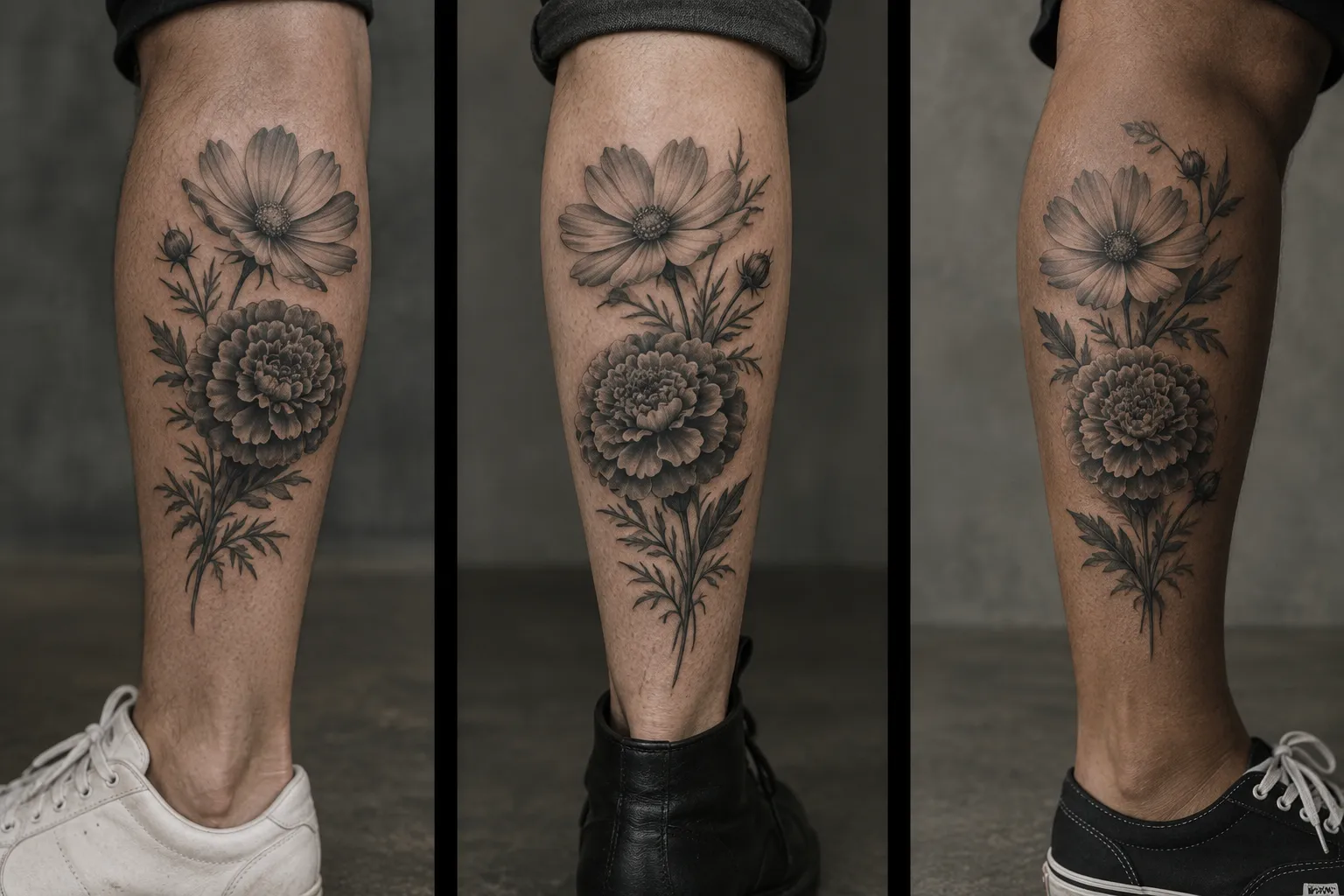
This is the route if you want a personal piece with no memorial weight. A single marigold bloom marks an October birthday cleanly. Because the flower also carries grief associations (3), some people will still read it as memorial. Adding the cosmos makes the birthday reading more explicit.
The Almanac lists cosmos meanings as harmony, balance, peace, love, and innocence, with common colors of pink, white, red, orange, yellow, and purple (3). Visually, the two flowers complement each other. The marigold is dense and ruffled, while the cosmos is open and flat, with a few broad petals around a visible center and long, thin stems. That contrast gives an artist something to work with:
- Single marigold: the simplest birth-flower option, and it holds up at smaller sizes because it’s one silhouette.
- Marigold and cosmos pair: the marigold as the heavy focal point, the cosmos as the lighter accent. Pink or white cosmos petals next to orange marigold give you a palette that isn’t all warm tones.
- Family birth-flower piece: if you’re combining several family members’ months, the marigold’s density makes it a natural anchor bloom, with lighter flowers arranged around it.
One technical note: cosmos stems are thin. In fine line they look delicate when fresh, but thin isolated lines are the first thing to soften as a tattoo ages. Ask your artist to give the stems enough weight to survive, or let the leaves of the marigold carry the structure.
Marigold Flower Tattoo Styles: Color, Black-and-Gray, and Botanical Accuracy
A marigold flower tattoo works in full color, black-and-gray, fine line, or American traditional. The common petal colors are yellow, orange, red, gold, and bicolor (3). Pick the style for how it suits your skin, your placement, and how it will look in fifteen years.
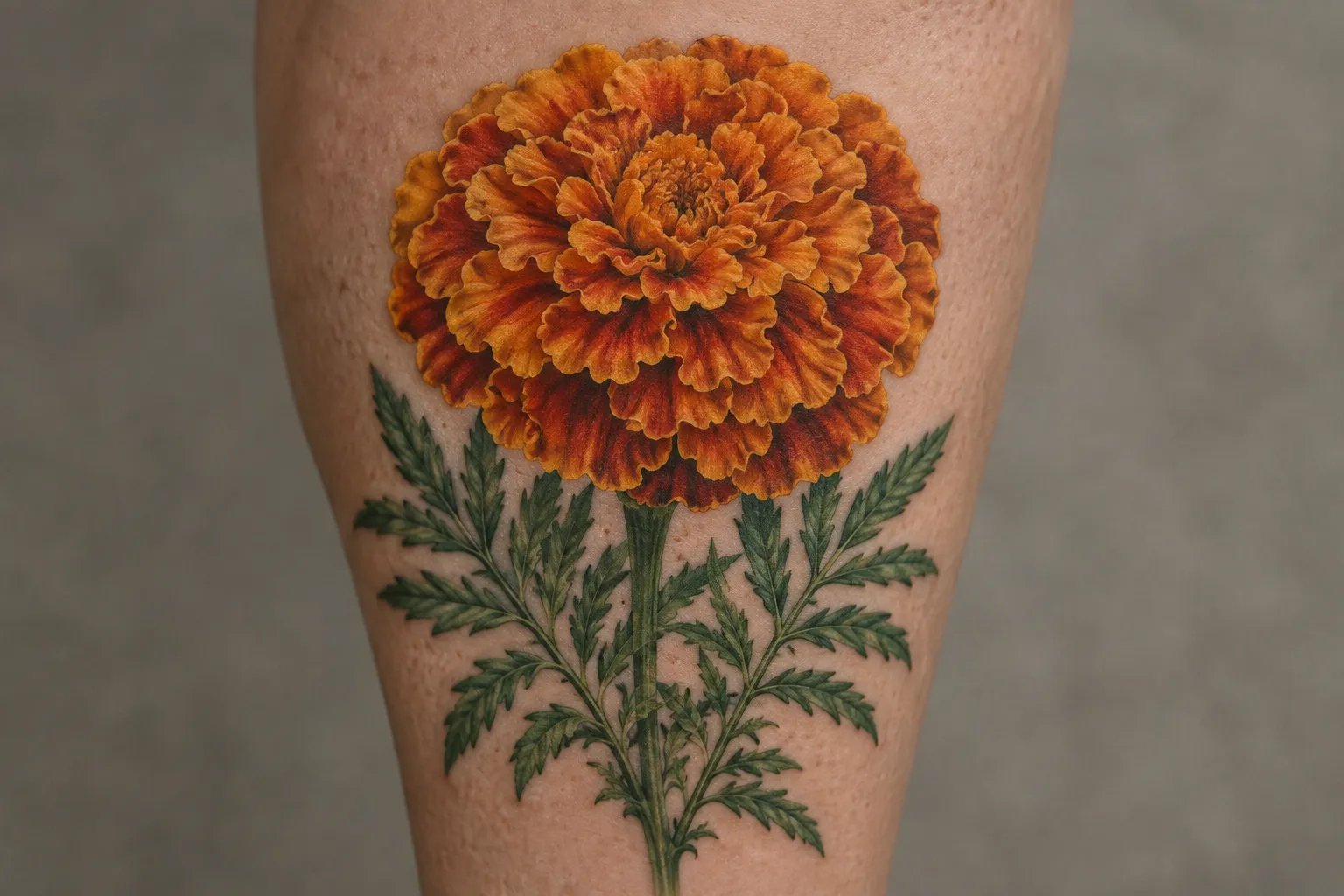
Here are the main styles and what to look for in each:
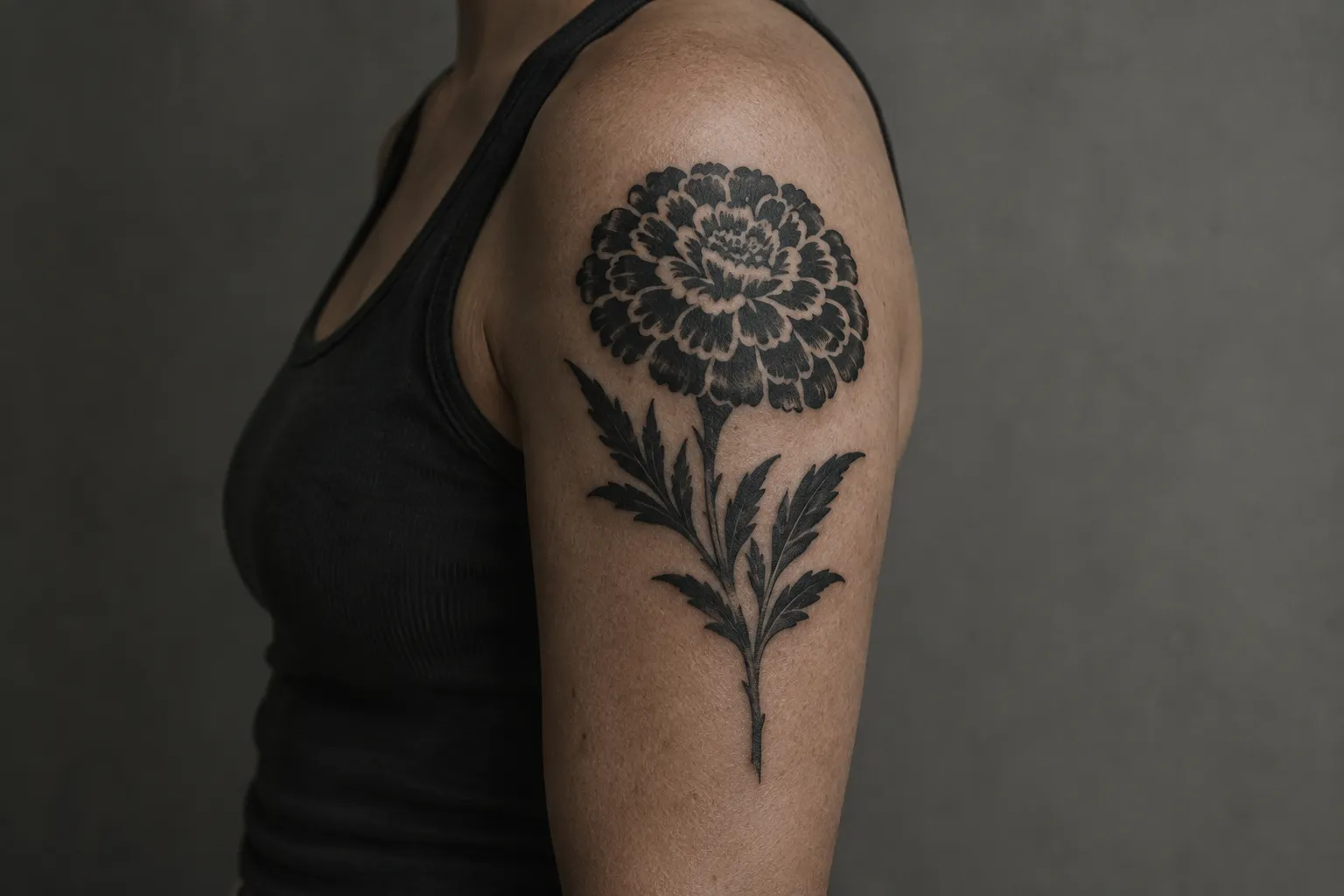
- American traditional. Hallmarks: a thick black outline and a limited palette, usually black, a yellow, an orange or red, and green for leaves. The marigold suits this style because its round head and scalloped edge read clearly behind a bold line. One marigold guide notes that the style ages well because the heavy linework keeps the structure clear as color fades (6).
- Fine line. Hallmarks: thin single-needle or small-grouping linework and minimal or no shading. It looks elegant fresh. The pitfall is detail: a marigold head has dozens of overlapping ruffled petals, and an artist who tries to draw every one at small size gets lines that spread and merge into a gray smudge over time.
- Realism and botanical illustration. Hallmarks: smooth gradient shading and accurate petal structure. These need room, and they depend on the artist having a strong command of saturation.
- Watercolor, geometric, mandala. Tattoo idea pages list these alongside realistic, minimalist, and traditional marigolds (4). Watercolor’s soft edges fade faster than hard linework and need regular touch-ups (6), so ask whether the artist will add a supporting line.
A common failure across styles is the “orange blob.” The artist packs color without enough dark contrast between petals, and the bloom reads as a round orange shape from a few feet away. Good marigold work uses darker red-orange or a black line in the petal folds to separate the layers.
Color vs black-and-gray
Color is the obvious choice for a marigold because the flower’s warmth is the point. It comes with longevity trade-offs, though: bright orange and yellow fade faster than darker inks and need touch-ups sooner (6). A pure-yellow marigold without darker shading in the folds tends to lose definition. If you want a yellow bloom, ask for orange or red-brown shading in the petal folds to keep its shape.
Black-and-gray changes more than the look. One guide reads a black-and-gray marigold as a sober memorial piece, notes that losing the orange moves it away from the Day of the Dead reference, and says black-and-gray holds its look longest (6). It suits you if the rest of your tattoos are blackwork, if you want something lower-key at work, or if your skin tone makes warm color harder to read. The ruffled petals give enough texture that a grayscale marigold still looks like a marigold.
Confirming the right marigold species with your artist
Two different plants carry the common name “marigold.” The Farmers’ Almanac names Tagetes erecta (American marigold) and Calendula officinalis (pot marigold) as the two kinds holding the October title (7). The Almanac adds that pot marigolds belong to the Calendula genus and aren’t true marigolds (3). They look different on skin:
- Tagetes erecta has a large, dense, pompom-shaped head with ruffled petals and pinnate, fern-like leaves (12). This is cempasúchil (6), the Day of the Dead flower.
- Calendula officinalis has a flatter, daisy-like head with rows of ray petals around a visible center, and simple oval leaves.
If you want a Day of the Dead marigold tattoo, and a calendula photo slipped into your reference folder, the finished piece shows a different flower from the one on the altar. Most clients won’t care. Some will, especially anyone with a family connection to the tradition.
Before you book, bring a clear reference that shows the flower form, the color palette, the approximate size, and any cultural elements you want included. Label it with the species if botanical accuracy matters to you, so the artist isn’t working from a guess.
Common Design Mistakes and Which Tattoos to Avoid
The marigold designs worth avoiding are those built on a vague meaning, invented symbolism, or too much detail for the skin area. Most of these failures happen at the planning stage, before the needle touches skin.
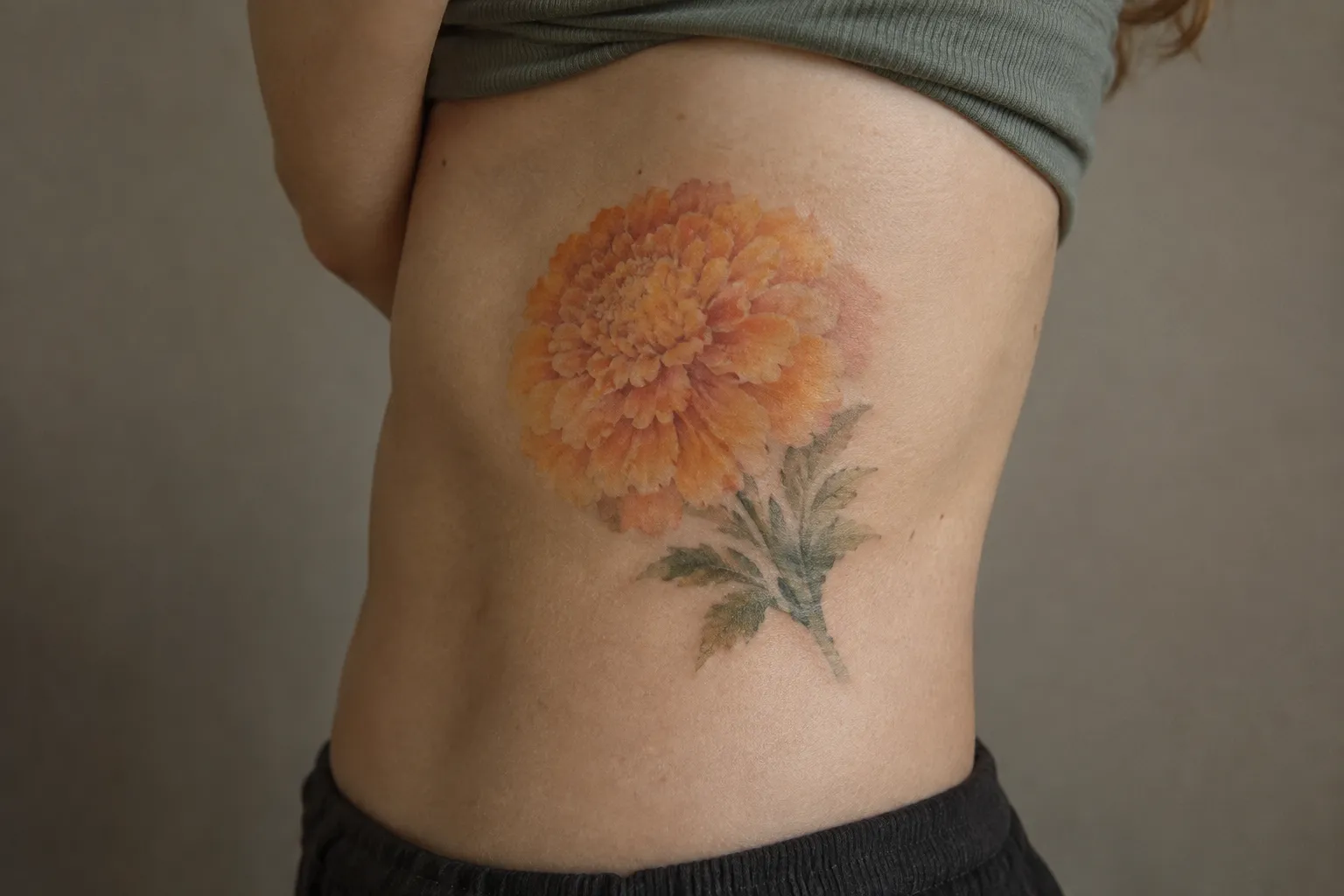
Claiming one universal meaning. The Almanac lists both celebratory meanings and an association with death and grief (3). If you tell people your marigold “means joy” and it sits next to a portrait of a late grandparent, the story contradicts itself. Name the context to yourself and to your artist.
Mixing protective folklore into an altar piece. Some tattoo idea pages list protection among the marigold’s meanings (4), and the Almanac records old beliefs that marigolds protected people crossing a river or from lightning (3). Those are separate threads from the ofrenda, which families build to welcome the dead home (1). For a Day of the Dead piece, the altar elements give you a solid basis. Generic protection imagery doesn’t.
Assuming attractive means accurate. A design can look good and still misrepresent the tradition. Read about the ofrenda, decide which elements you’re evoking, and drop the ones you added only because they looked nice in someone else’s flash.
Skipping the reference image. “A marigold, kind of orange, medium” leaves the artist guessing about species, palette, and size. Guessing is how you end up with a calendula on a Day of the Dead piece.
Shrinking detail past what skin can hold. This is the main reason tattoos age badly, and it applies well beyond marigolds. Fine petal-by-petal detail, tiny portraits, and microscopic lettering all blur as ink spreads under the skin over the years. For a memorial name or date beside the flower, size the letters by letter height, meaning the height of the whole letter: standard script at least 12 mm (1/2 in), fine or ornate script at least 25 mm (1 in), block lettering and numerals at least 6 mm (1/4 in). On the wrist, only bold script or block lettering holds.
One more mix-up worth clearing up: the marigold isn’t the only full, ruffled bloom that ends up in reference folders. Calendula, covered above, shares the common name but not the shape. Chrysanthemums are close relatives in the same plant family (7), but they’re a separate flower with their own symbolism, covered in our chrysanthemum tattoo guide. If your reference shows a tight ball of narrow, incurved petals, check whether you’ve picked up a chrysanthemum by mistake. For other blooms to compare or pair with a marigold, browse our flower tattoo ideas.
Placement and Size: Matching the Design to the Spot
Marigold tattoo size should follow the placement. One design guide suggests 2-4 inches for a single bloom on the wrist or ankle, 3-5 inches for one bloom on the forearm, and 5-9 inches for a forearm cluster (6). Those figures are planning references for briefing your artist, not hard rules. The point is that detail has to scale with the available skin.
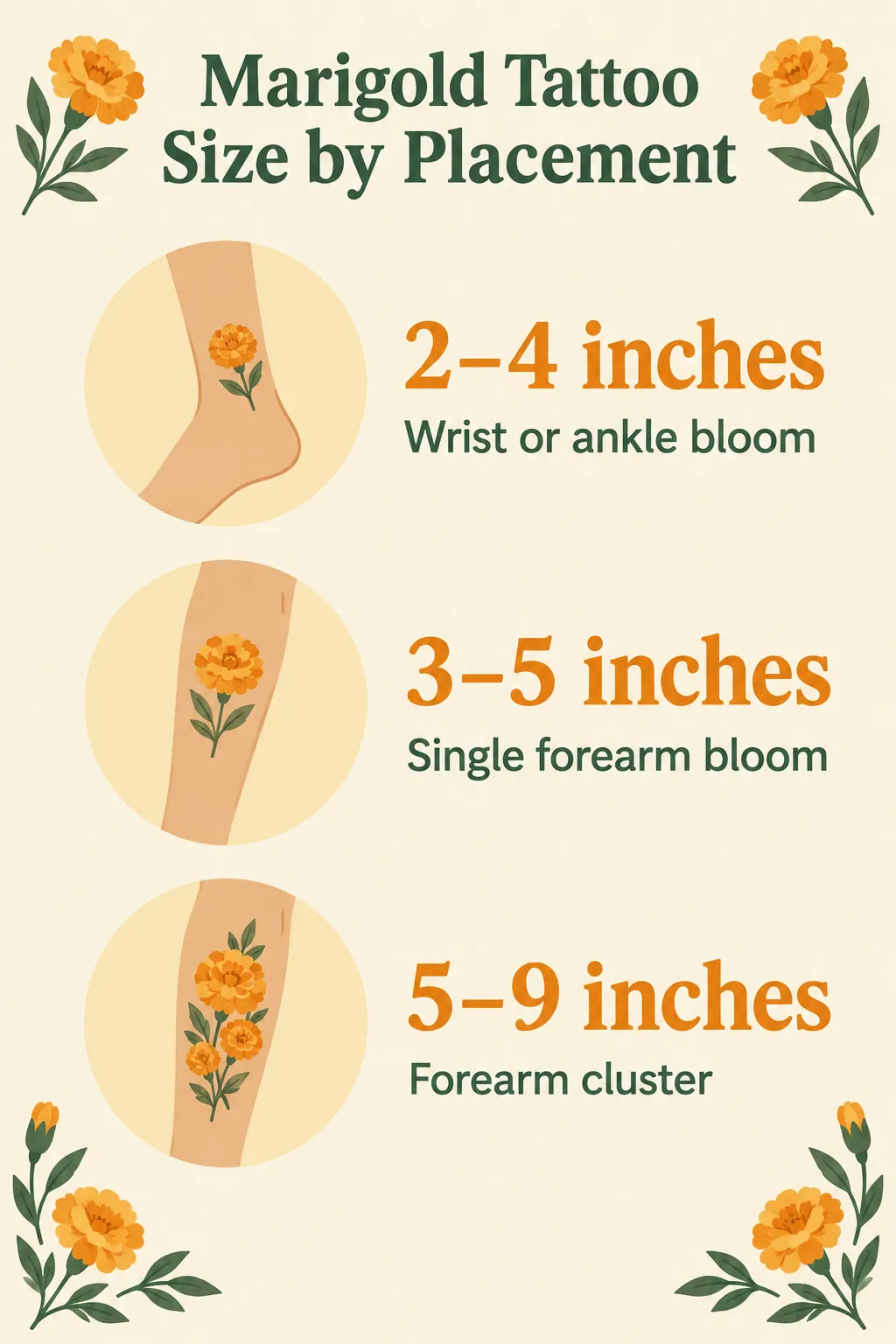 A design guide suggests 2-4 inches for a wrist or ankle bloom, 3-5 inches for a single forearm bloom, and 5-9 inches for a forearm cluster (6).
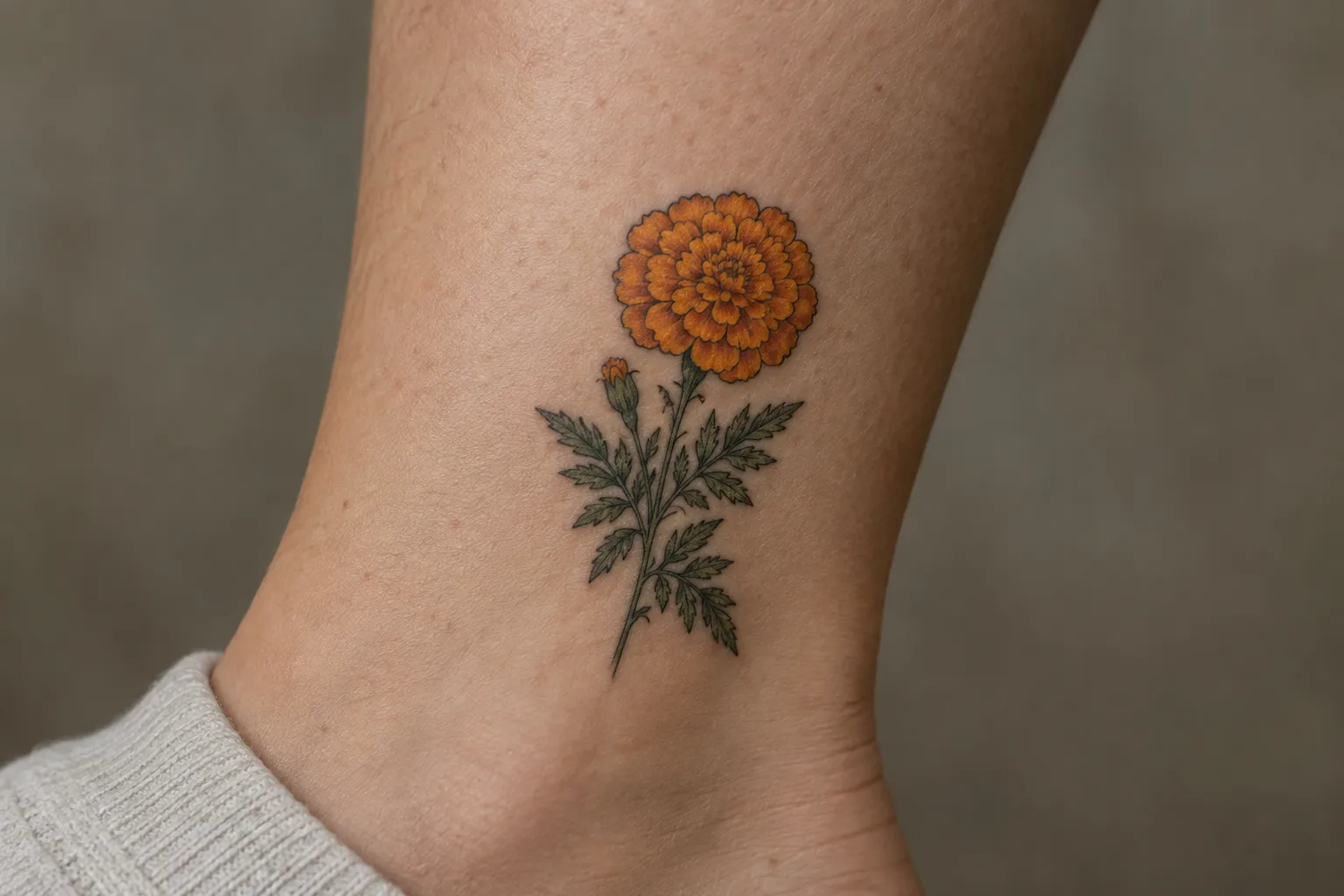
Small and minimal: wrist, ankle, behind the ear
Small placements suit a single stem or bloom with a clear silhouette. The same guide puts small single blooms on the wrist or ankle and very small minimalist marigolds on the neck or behind the ear (6). Behind the ear is the smallest of these, so a bloom sized to fit there has room for an outline and a few interior petal lines, not a full ruffled head.
What works at this size:
- One bloom, minimal interior detail. Let a bold outline carry the shape and suggest the ruffles with a few strokes.
- A short stem with one or two leaves. This gives a slight vertical line that follows the wrist or the ankle bone.
- Flat color or simple shading. Skip gradients you’d need a magnifier to see.
On pain, the same guide ranks the ankle and the area behind the ear among the more painful spots, because the skin sits close to bone (6), and our tattoo pain scale notes that the inner forearm gets sharper toward the wrist. Sessions at this size are short, so most people manage fine. The wrist and ankle also get more friction from watch straps, cuffs, and shoes, which matters during healing.
Larger and detailed: forearm blooms and clusters
The forearm is the most practical placement for a detailed marigold. It’s relatively flat, easy to show or cover, and less painful than the ribcage or sternum (6). Tattoo guides suggest the forearm for larger marigold designs (4). One guide puts a single forearm bloom at 3-5 inches and a forearm cluster at 5-9 inches (6).
At those sizes you get real working room:
- A single forearm bloom has space for layered petals, leaf detail, and full color shading with dark folds between petal rows.
- A forearm cluster can carry three or more blooms at different angles, a petal trail, or a companion element such as a candle or a name.
- A Day of the Dead composition with a portrait needs the larger end of that cluster range or more. Realism is the first thing to suffer when it’s squeezed.
If you’re going bigger than a forearm, the calf and the upper back give you more flat space. The ribcage holds a long vertical spray of stems nicely, but the same guide ranks the rib cage, sternum, and spine among the more painful placements (6).
Taking the three main options side by side:
- A wrist or ankle single bloom of about 2-4 inches (6) has limited room for interior detail. Bold outline and simple color suit it best. It works best for a minimal birth-flower marigold or a discreet personal piece.
- A forearm single bloom of 3-5 inches (6) holds layered petals, leaves, and shaded color. It suits a detailed birth-flower piece or a memorial bloom with a short name or date.
- A forearm cluster of 5-9 inches (6) has the most capacity of the three for color, linework, and companion elements. It suits a memorial composition, a marigold-and-cosmos pairing, or a Day of the Dead piece with one altar element.
Aftercare: Healing Week by Week
New marigold tattoos heal best with gentle washing twice daily using mild, fragrance-free soap, patting dry, and moisturizing twice daily, according to Cleveland Clinic (11). Follow your tattooist’s specific instructions first, and see our tattoo aftercare guide for the full healing timeline. Cleveland Clinic’s guidance also says to avoid sun exposure while the tattoo heals and not to pick or scratch peeling skin (11).
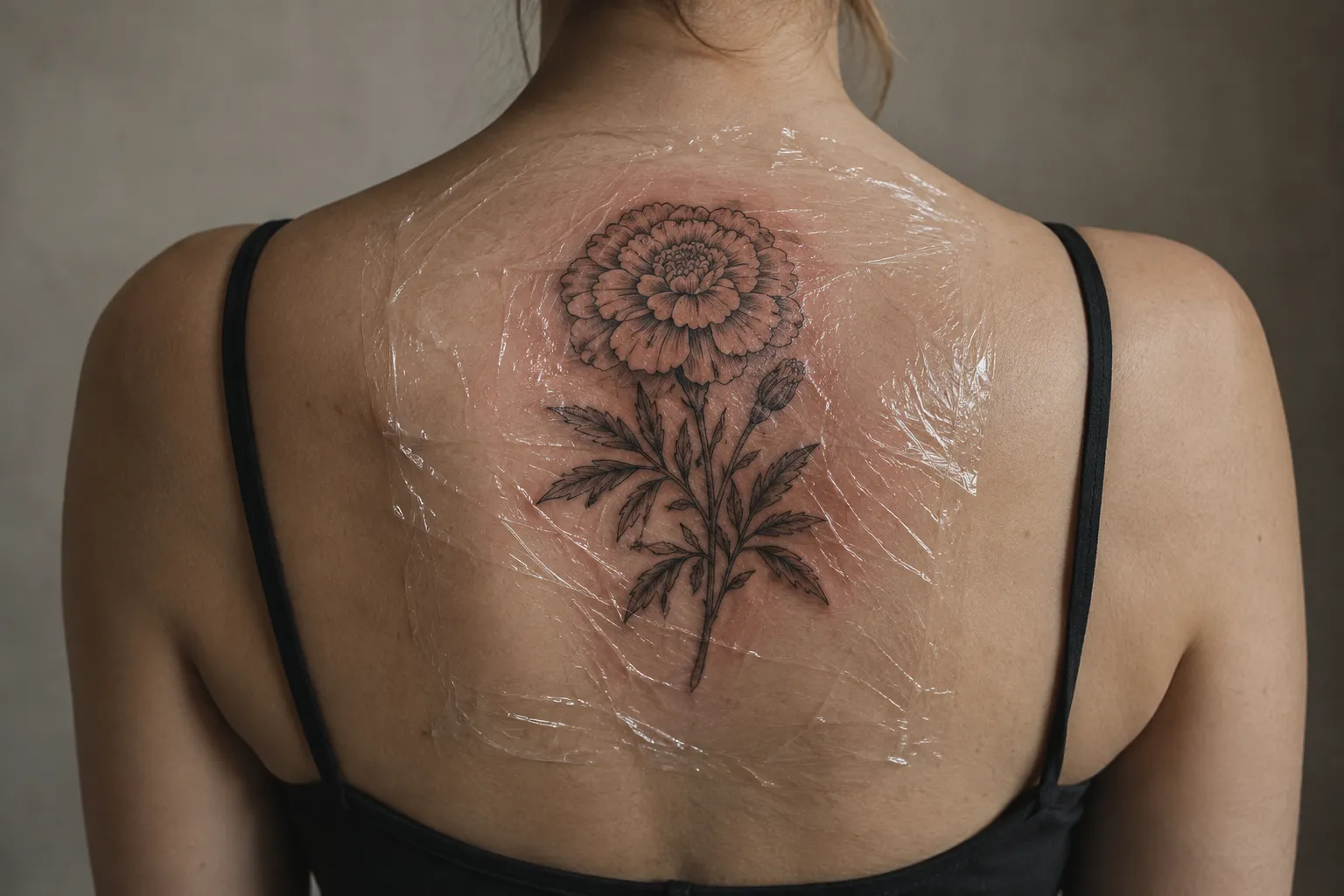
This matters more than usual for a marigold, because the design depends on warm color. Bright orange and yellow fade faster than darker inks, and sun exposure is the main cause of that fading (6).
Day-by-day healing basics
- Day 1-3: Keep whatever covering your artist applied on for as long as they told you. Then wash gently twice daily with mild, fragrance-free soap and pat dry with a clean paper towel (11). The area will be tender and may look raised. Expect the color to look brighter and sharper than it will once healed.
- Day 4-7: Keep moisturizing twice daily with a simple moisturizer (11). Thick layers trap moisture and slow healing. The surface tightens and starts to flake. Don’t pick or scratch the flakes (11), because pulling them early can lift pigment and leave pale gaps in the petals.
- Week 2: Peeling and itching peak. Keep washing and moisturizing twice a day (11).
- Week 3-6: Flaking settles and the tattoo can look cloudy or dull for a while before it clears. The surface usually looks healed around weeks 3-4, while the deeper skin keeps settling until about week 6. Avoid direct sunlight while it heals (11), which means the first 4-6 weeks. Once fully healed, use sunscreen on it whenever it’s exposed. Long term, sun is what fades yellow and orange marigold petals (6).
When redness or a rash means call a professional
According to the FDA, some redness, swelling, or warmth can occur after a tattoo. The agency advises contacting your tattooist and a health professional if healing seems abnormal or a rash develops (5). Don’t assume all redness is normal because some of it is.
Get it checked if redness spreads farther and farther from the design, the skin feels hot, or the pain increases instead of fading (11), if a rash appears on or around the tattoo (5), or if the tattoo isn’t healing the way your artist said it would. The FDA has received reports of infections from contaminated inks and of allergic reactions to inks (5).
Frequently Asked Questions
- What does a marigold tattoo symbolize?
- A marigold tattoo can signal celebration or remembrance; the surrounding design helps make your intended reading clearer to people who see it.
- What are some tattoos to avoid?
- Avoid a design whose fine details exceed the space available; ask your artist to simplify elements that would blur together at your chosen size.
- What is the prettiest flower to get tattooed?
- There is no objective prettiest flower; choose one whose silhouette and petal structure still read clearly at the size and placement you want.
- What is the traditional tattoo rule of 3?
- The rule of three is a composition guideline, not a fixed standard; use three elements only when they balance the design rather than crowd it.
- What does the marigold represent in Day of the Dead?
- Families build altars to welcome the dead home on November 1 and 2, and yellow marigolds are among the main altar elements; their bright color and smell are used to mark a path to the ofrenda. Ask the family or community you are referencing which details fit their practice.
- What colors are common for marigold tattoos?
- Yellow and orange are the classic choices, with red, gold, and bicolor blooms also common; ask your artist how contrast and skin tone affect the legibility of pale petals.
- Where can you place a marigold tattoo?
- Choose a placement based on the detail your design needs; small areas call for a simpler silhouette, while portraits and dense compositions need more room.
- How painful is a marigold tattoo?
- Placement matters more than the flower: the outer forearm is generally easier than the wrist, ankle, or ribcage, where skin lies closer to bone.
Pick the Context, Then the Size and Spot
Start by naming what the marigold is for. If it’s an October birthday, consider pairing it with cosmos (2). If it’s a memorial, add a name, date, or portrait. If it’s Day of the Dead, pair cempasúchil with one of the altar elements the Mexican Museum lists (1). Then confirm the species with your artist, Tagetes erecta or Calendula officinalis (7), and bring a reference showing form, palette, and size.
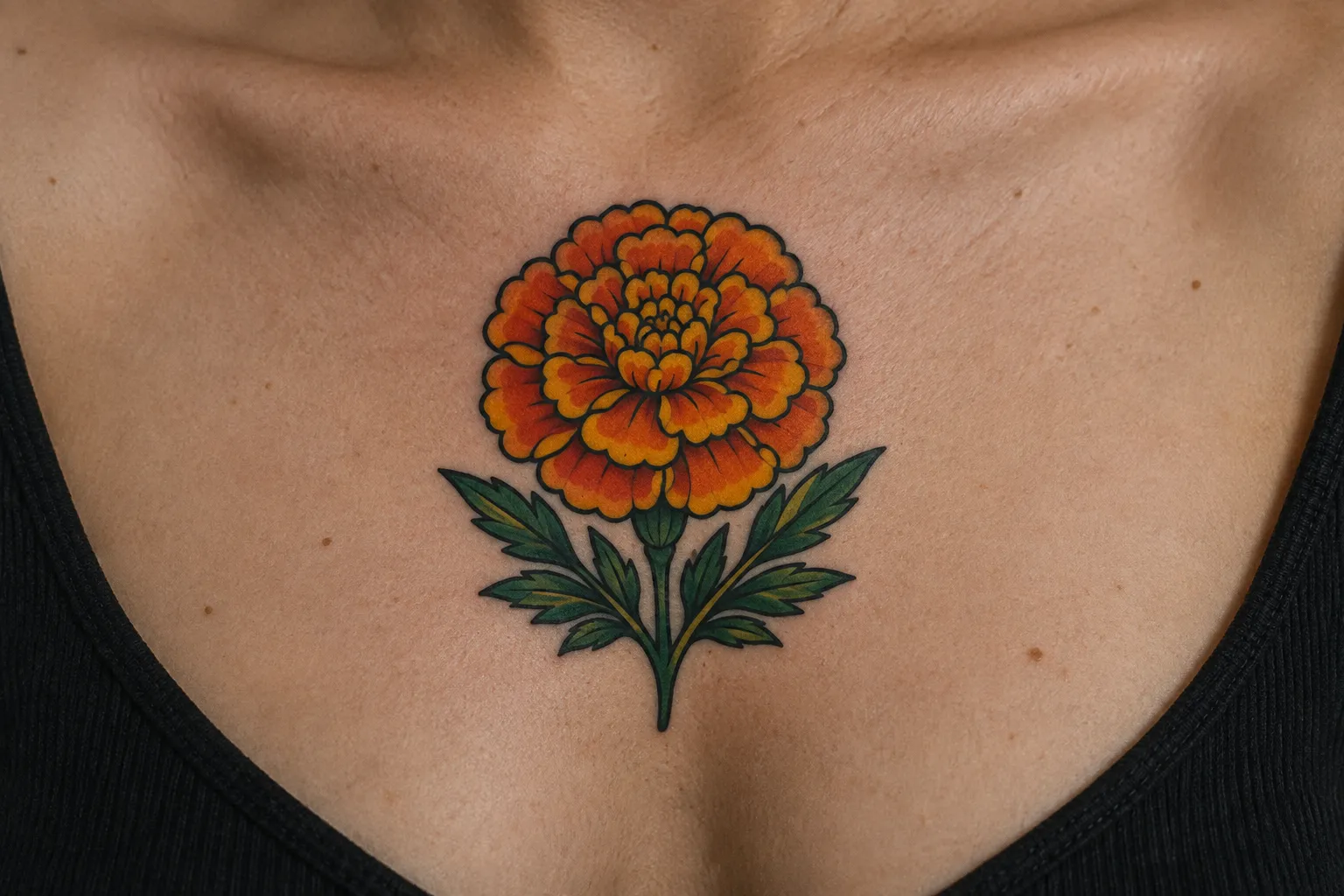
Size the design to the placement, using the guide figures above as a starting brief (6). Choose bold outlines and dark petal folds if you want the warm colors to stay readable. Once it’s done, wash and moisturize twice daily (11), keep it out of the sun, and call your tattooist and a health professional if a rash or abnormal healing shows up (5).