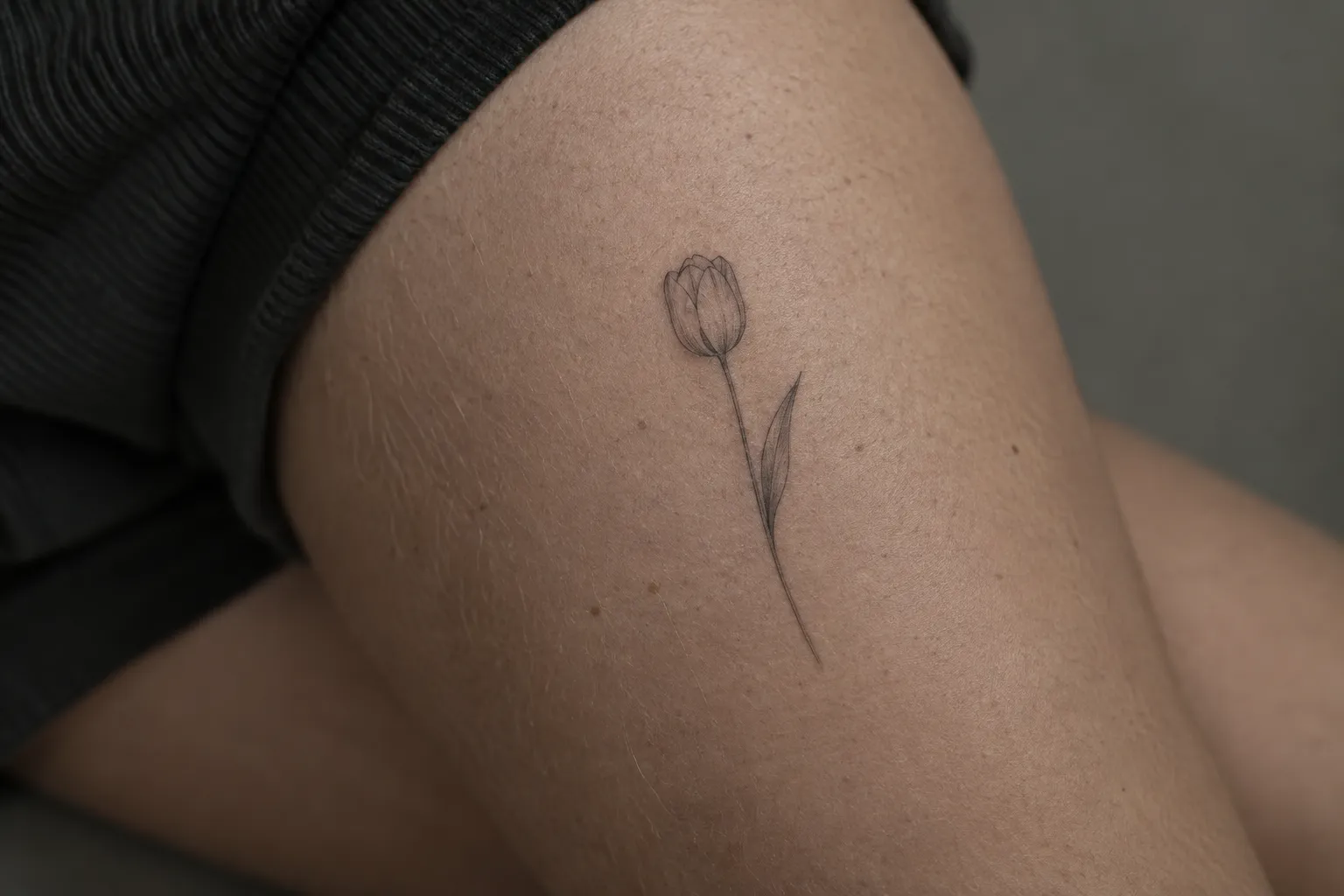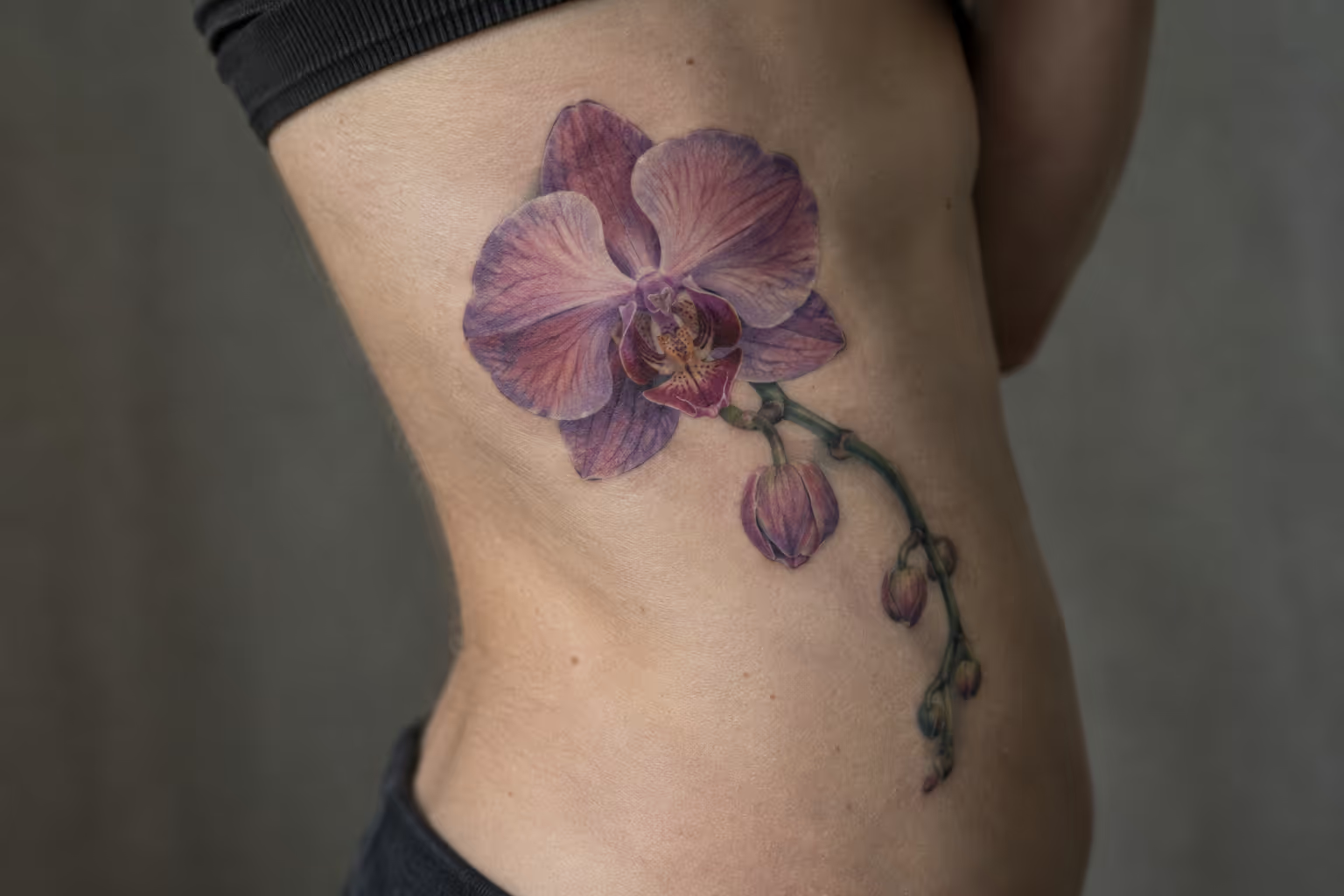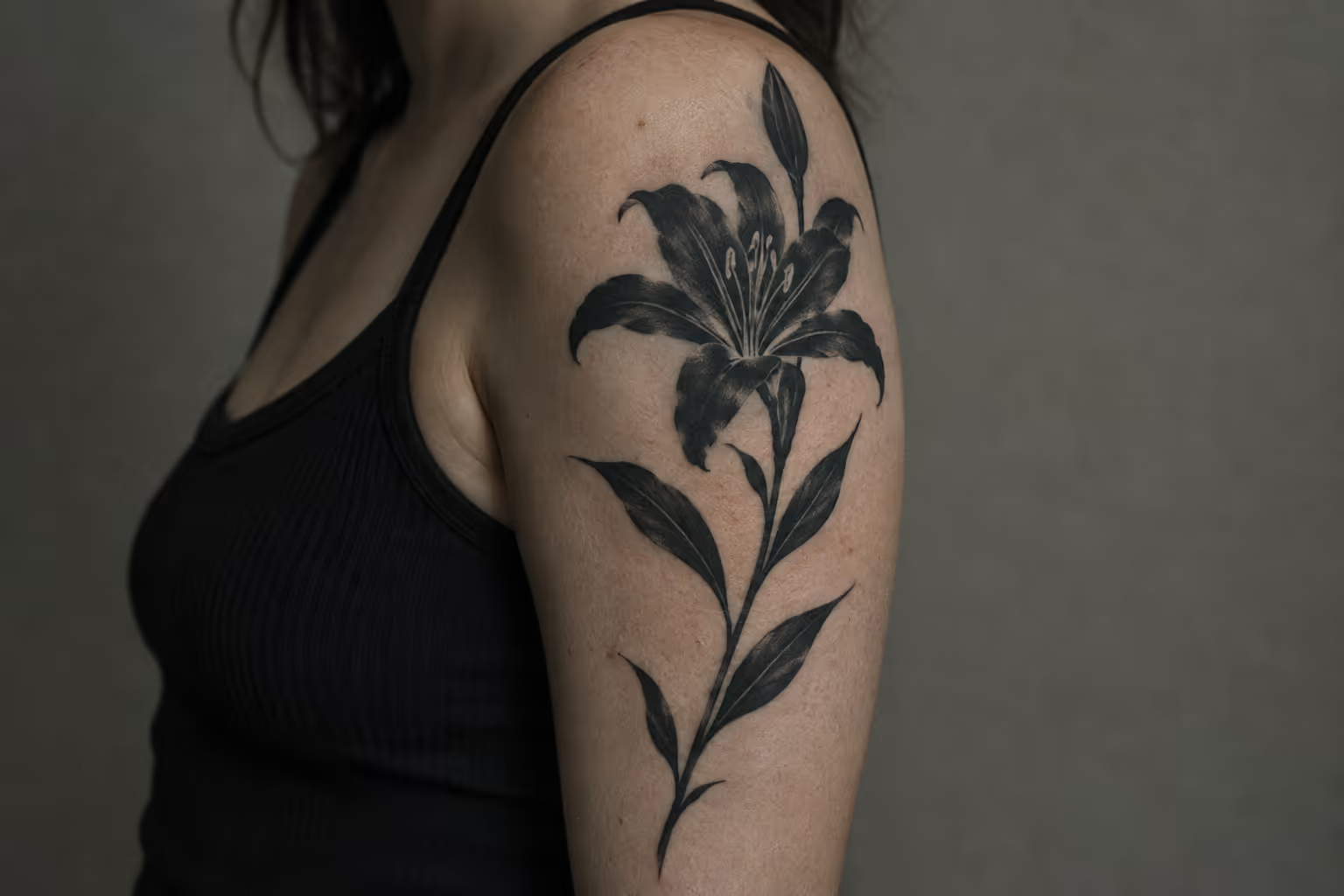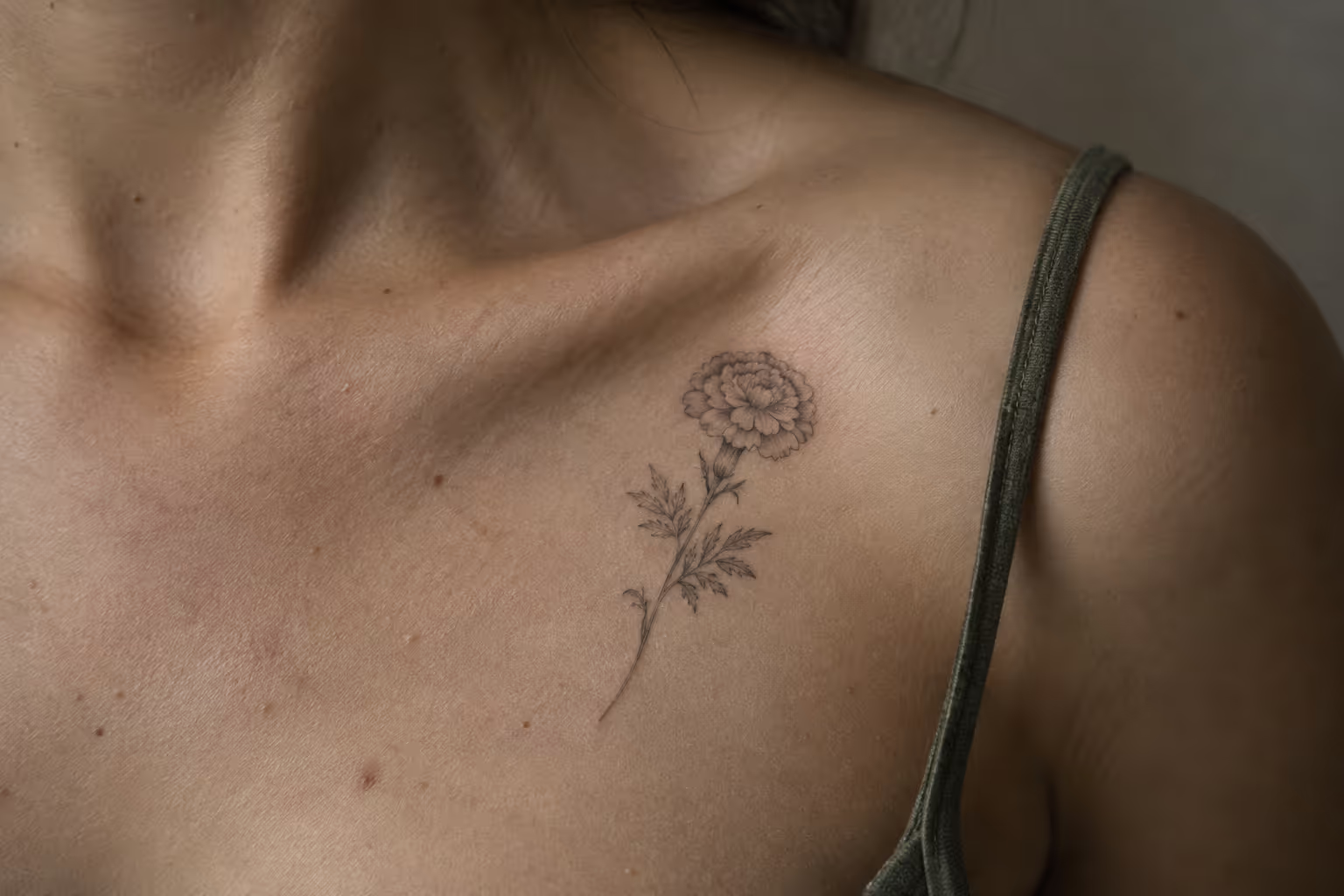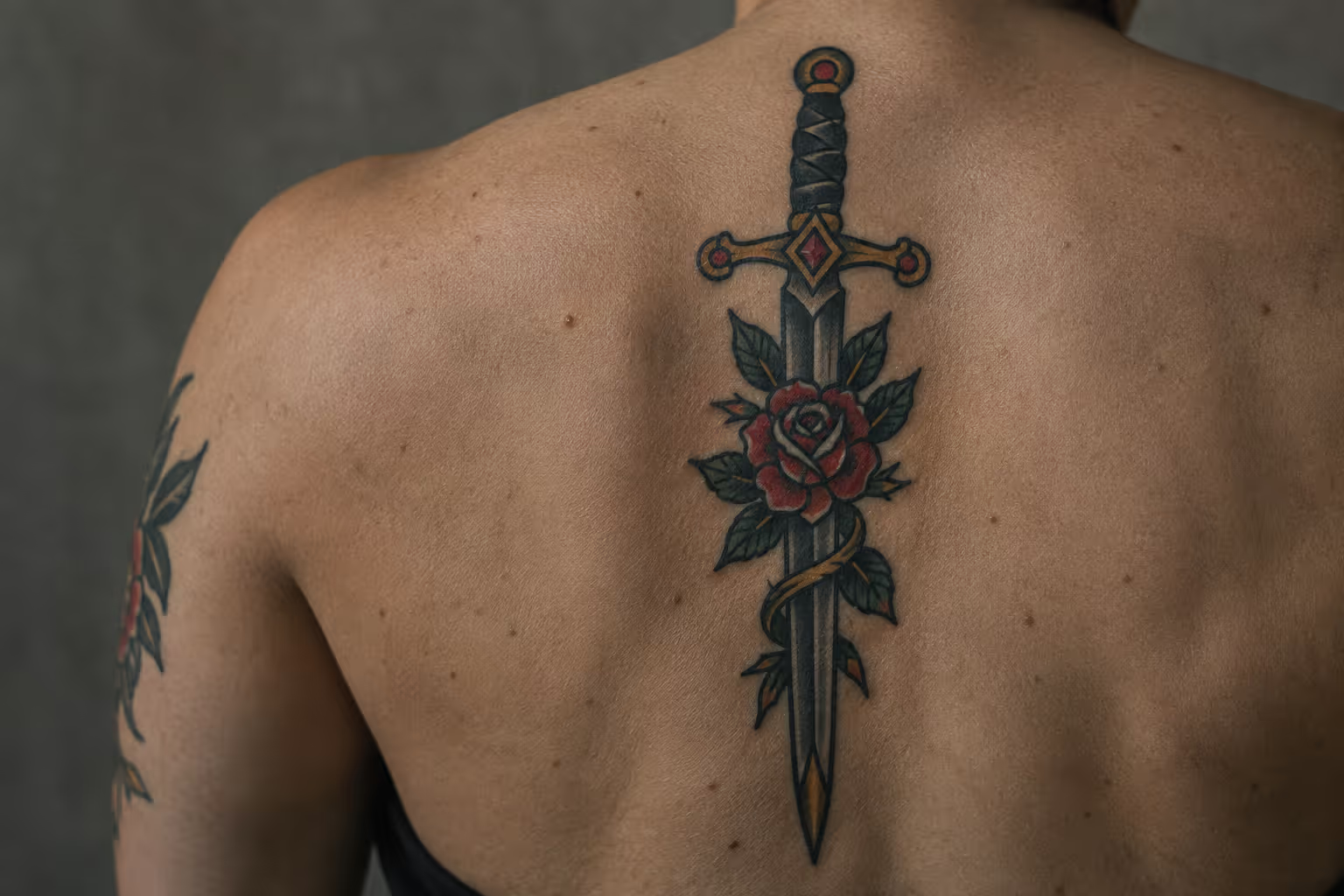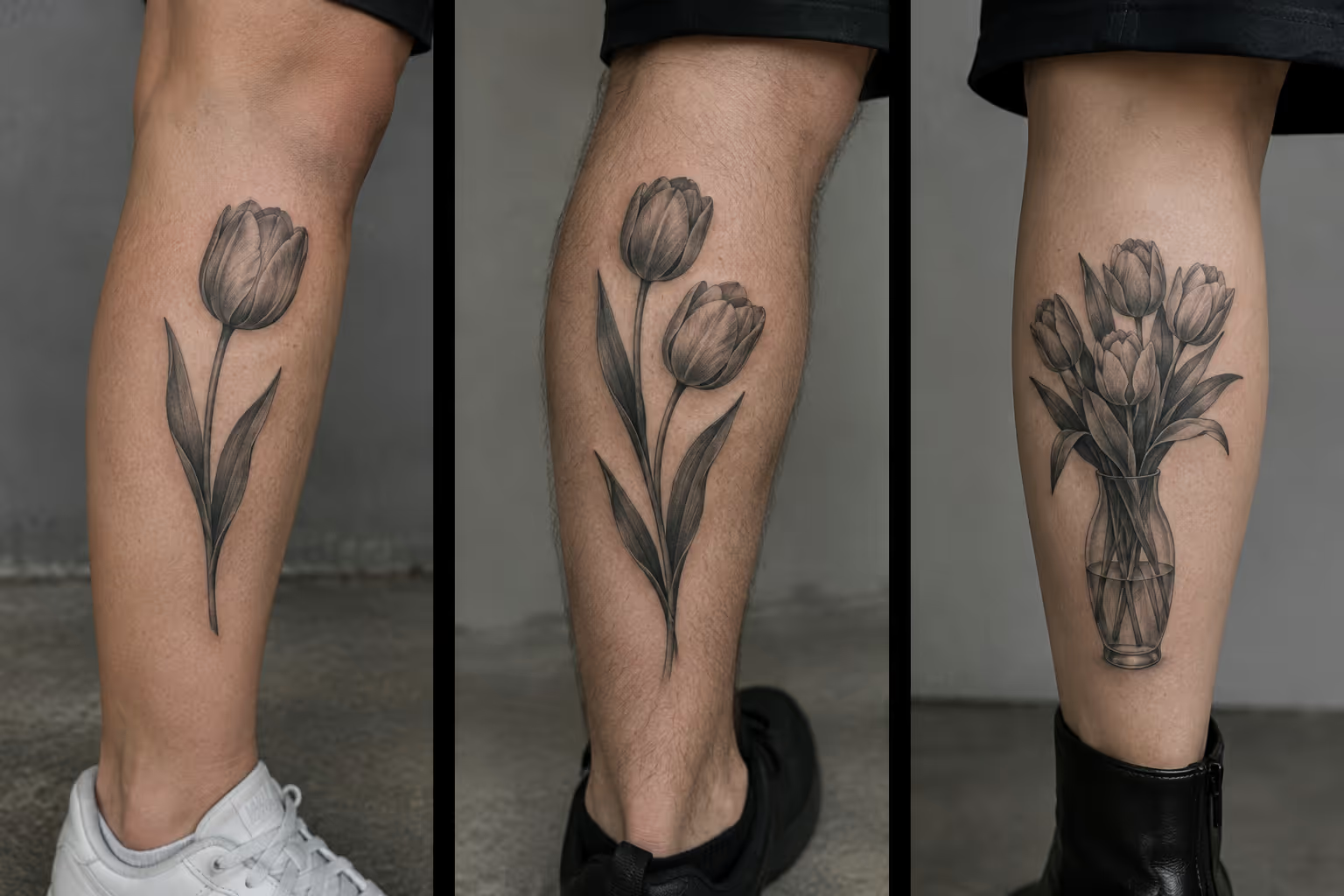
A tulip tattoo can be a thin black outline small enough for the inner wrist, or a full-color bouquet wrapping the forearm. It’s the same flower, but the two are very different commitments in size, detail and healing risk. Below you’ll find what each color is said to mean, which compositions fit which placements, and how to keep a small tulip readable once the fresh-ink sharpness wears off.
✓ Pros
- A recognizable bloom silhouette gives the design a clear read even without elaborate petal detail.
- The motif can carry a personal reference without requiring the viewer to know its symbolism.
✗ Cons
- A composition that looks balanced on a screen may need more skin space when fitted to a curved body area.
- Fine-line detail may need a touch-up sooner than bolder linework.
Tulip Tattoo Meaning: Love, Beauty, and New Beginnings
The usual tulip tattoo meaning is love, beauty and new beginnings, but these are popular interpretive associations, not a fixed rule that every viewer reads the same way (1)(4). Plenty of people pick a tulip for its shape alone: the cupped, turban-like bloom on a straight stem reads clearly even at small sizes.
The cultural background is older and more layered than the Dutch postcard image suggests. Tulips originated in Central Asia and gained popularity in Turkey, and the name derives from the Persian word for turban, after the turban-like shape of the fully open bloom (2). That guide also recounts the love story of Farhad and Shirin, in which a red tulip grows where the grieving Farhad’s blood touches the ground (2). The flower reached Holland in the 16th century, where intensive breeding produced the range of colors you see today; demand grew into a “Tulip Craze” that sent prices soaring before they collapsed in what is considered the first speculative bubble (5).
In tattoo guides, all of that usually comes down to love, beauty and new beginnings (1)(4). That’s fine, as long as you know it’s one reading among several. If the tulip marks something specific to you, such as a garden or a person who grew them, that personal reference carries more weight than any symbolism chart, and one guide notes that a tulip tattoo’s meaning can be deeply personal (4).
Pros of a tulip design:
- Flexible symbolism
- Scales from tiny outline to full bouquet
- Works in color or black-and-gray
Cons:
- Color meanings aren’t universal
- Small sizes risk blurring
- The ink and healing risks of any tattoo apply
Tulip Color Meanings: Red, Yellow, Purple, and White
Each tulip color carries its own convention. One tattoo guide links red to love, yellow to cheerfulness, purple to royalty, and white to forgiveness or purity (2). Treat those as conventions, not a dictionary.
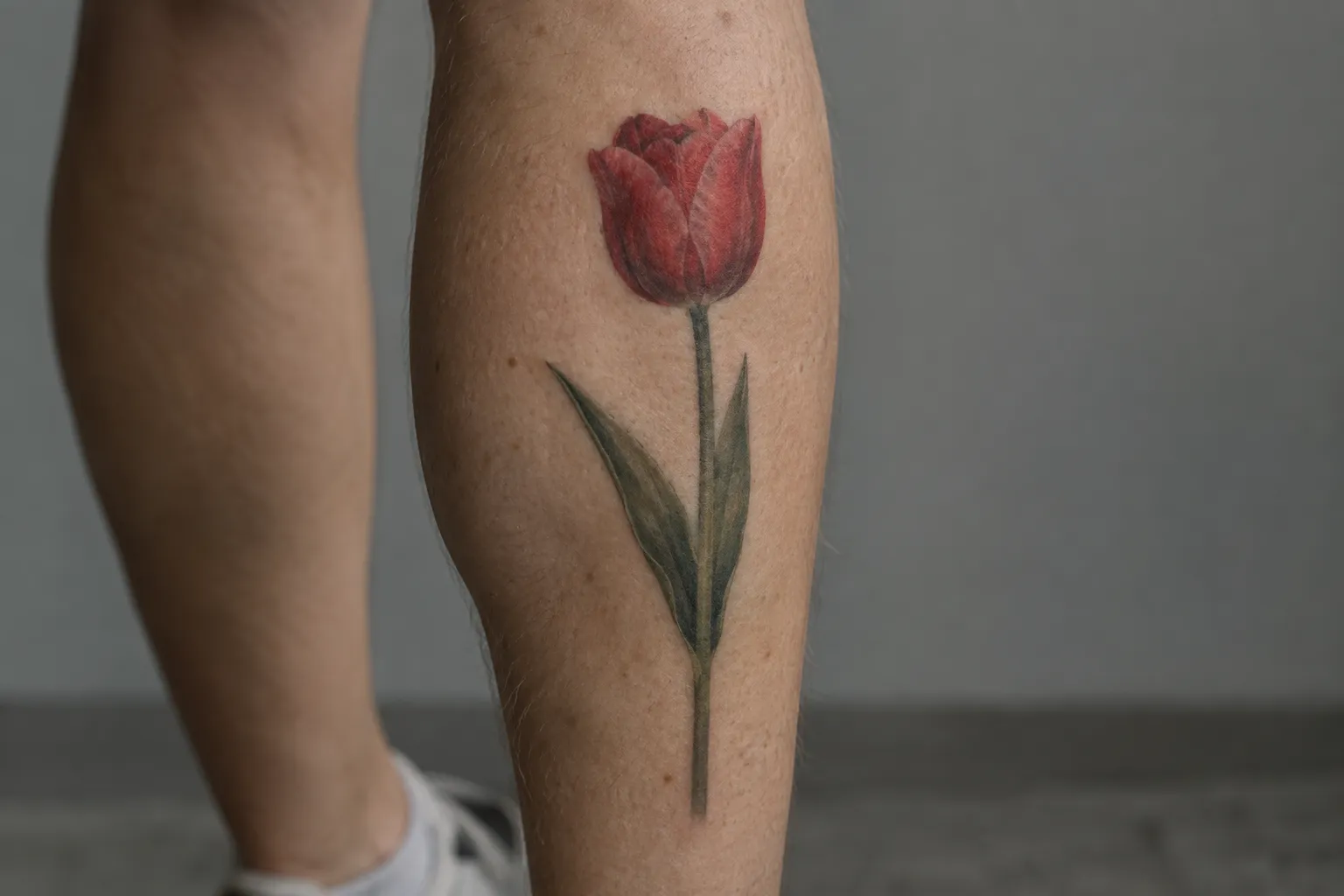
Red is the least controversial choice. In Western culture, red tulips are associated with love, passion and romance (4), and one guide calls the red tulip the most popular flower to send to a loved one after the rose (2).
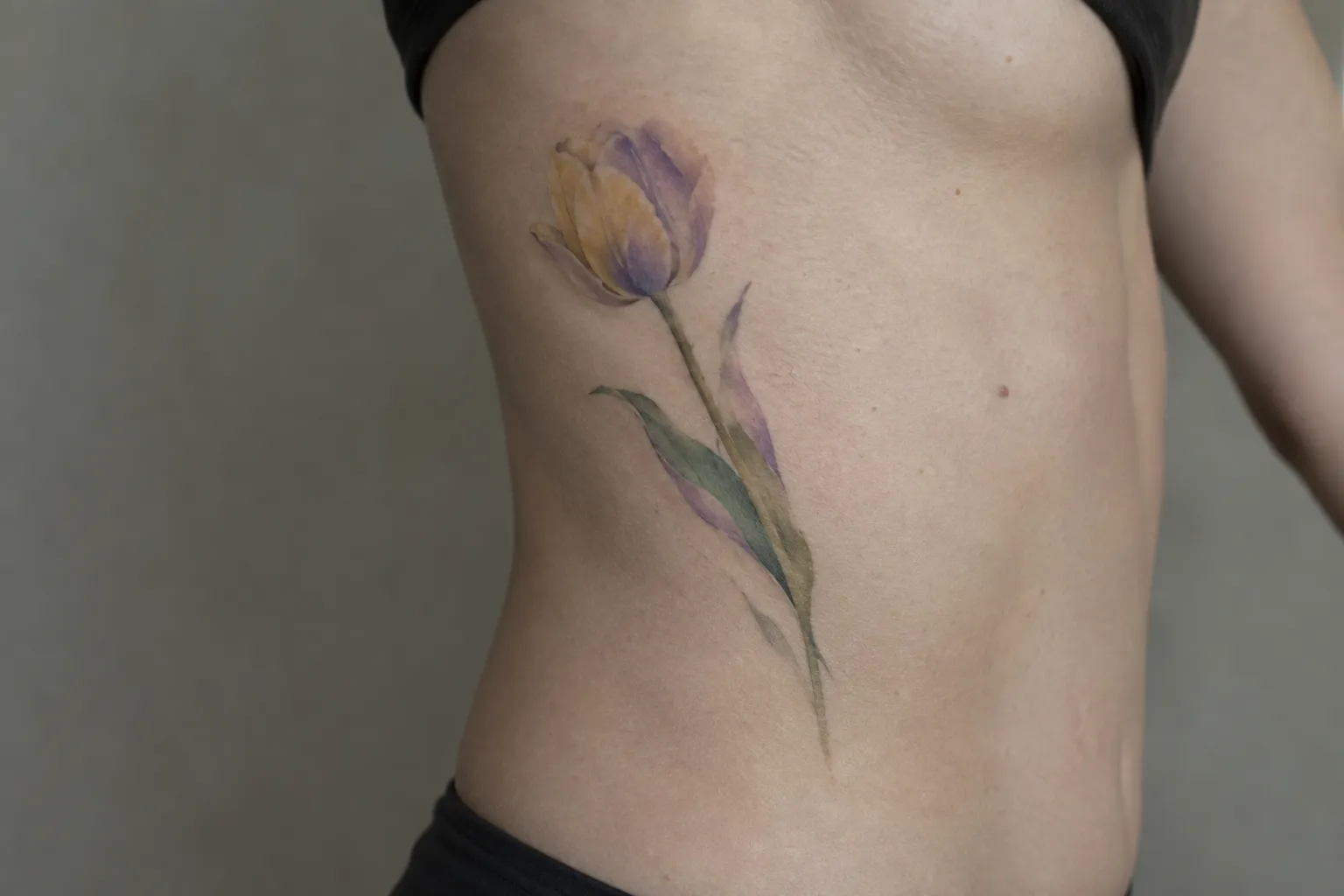
Yellow carries two readings. One guide ties yellow tulips to cheerfulness (2). Another frames them as carrying a historical “hopeless love” association that only later shifted toward sunshine and cheer (5). If someone who knows older flower symbolism might read your yellow tulip as unrequited love, decide in advance whether that bothers you.
Purple is associated with royalty (2). It’s a good pick if you want something less sentimental than red.
White is linked to forgiveness or purity (2). On the skin, a white tulip can be built from black-and-gray shading and negative space rather than white ink.
The practical rule: choose a color for what it means to you, then check whether the common reading clashes with it. A tulip’s meaning also depends on cultural and personal interpretation, so don’t assume every viewer will read yours the same way (4).
Tulip Flower Tattoo Styles: Single Stems, Bouquets, and Vases
A tulip flower tattoo usually falls into one of three compositions: a single stem, a pair or bouquet, or a vase arrangement. One inspiration gallery shows 49 designs across those formats (1). Match the composition to the skin you have available, not just to what looks good on a screen.
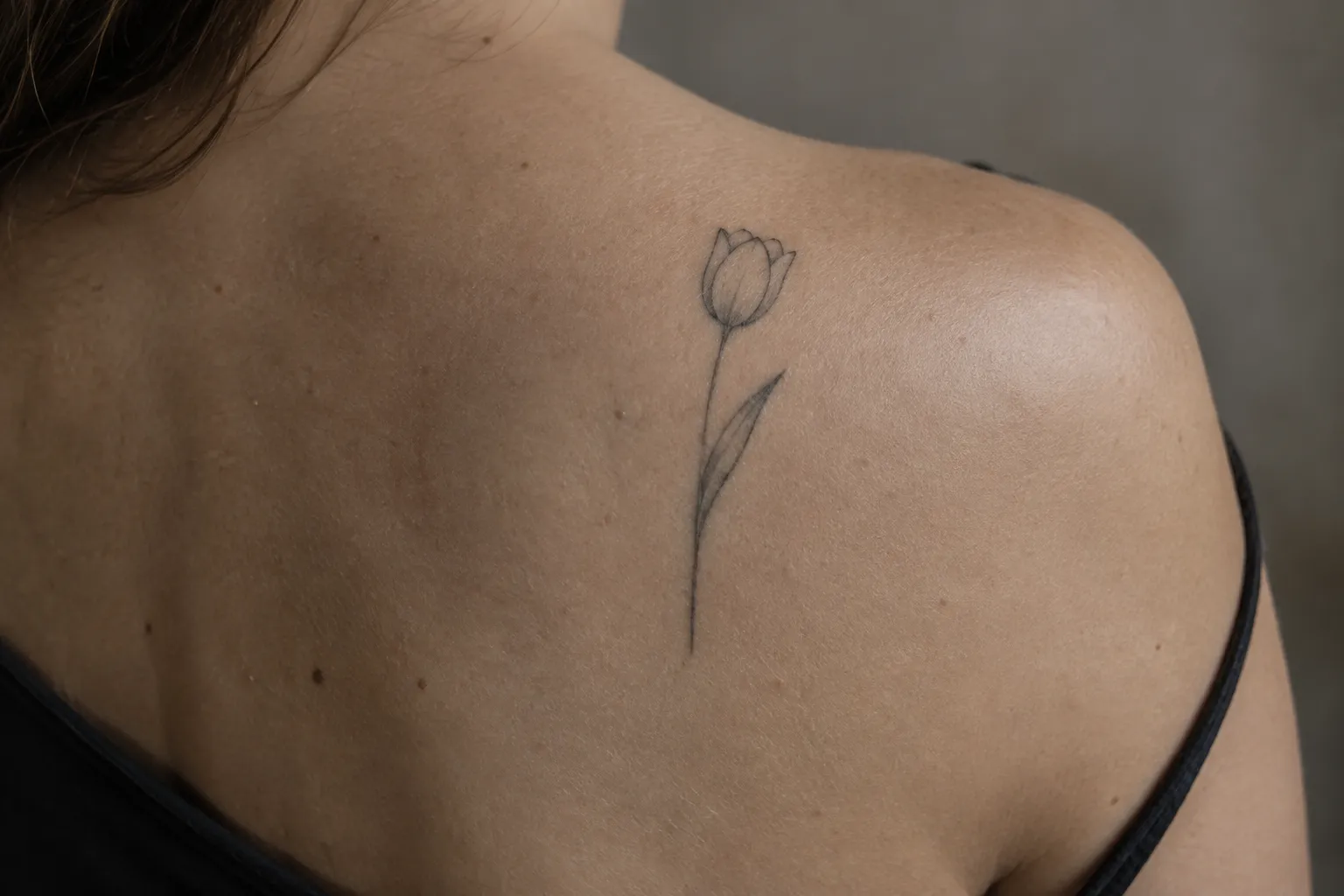
Single stem outlines
A single stem gives the flower a clear, elongated silhouette that can follow the long axis of a forearm or the spine, and the gallery shows lone blooms running along the arm (1). In fine line, the hallmarks are a single needle or tight needle grouping and a pen-drawing look, as opposed to the heavy saturation of bold work (6). This is the most forgiving format for small work. There’s one bloom to read, one stem and maybe a leaf.
Two-flower and bouquet compositions
Paired blooms on the forearm, bouquets wrapped in paper, and colorful multi-bloom pieces all appear in the gallery (1). Each extra flower needs its own outline and breathing room, so a bouquet pushes you toward a palm-sized piece or a full outer forearm.
Vase arrangements and black-and-gray options
A vase adds a hard-edged object under organic shapes, which gives the composition a base and lets it sit squarely on the thigh, upper arm or back. The gallery also shows black line art and black-and-gray shading as alternatives to realistic colored petals (1). Black-and-gray relies on smooth tonal gradients and well-planned negative space for highlights. The common pitfall is shading so dark and uniform that the petals merge into one blob once it’s healed.
How the four compositions compare:
- Single stem: needs the least space and has the lowest complexity. It suits the forearm or ankle and works in either black-and-gray or color.
- Two-flower: needs moderate space. It suits the forearm or shoulder (1).
- Bouquet: needs a large area and carries high complexity. It suits the outer forearm or an arm-wrapping layout, and it’s strongest in color.
- Vase: needs a large area and carries high complexity. It suits the thigh or upper arm, and it’s strong in black-and-gray.
Small Tulip Designs That Hold Up Over Time
A small tulip tattoo lasts longest when the linework is simple, the lines are spaced about 2 mm apart, and there’s visible negative space between petals (6). Cramming detail into a tiny flower is the specific failure that wrecks long-term readability (6).
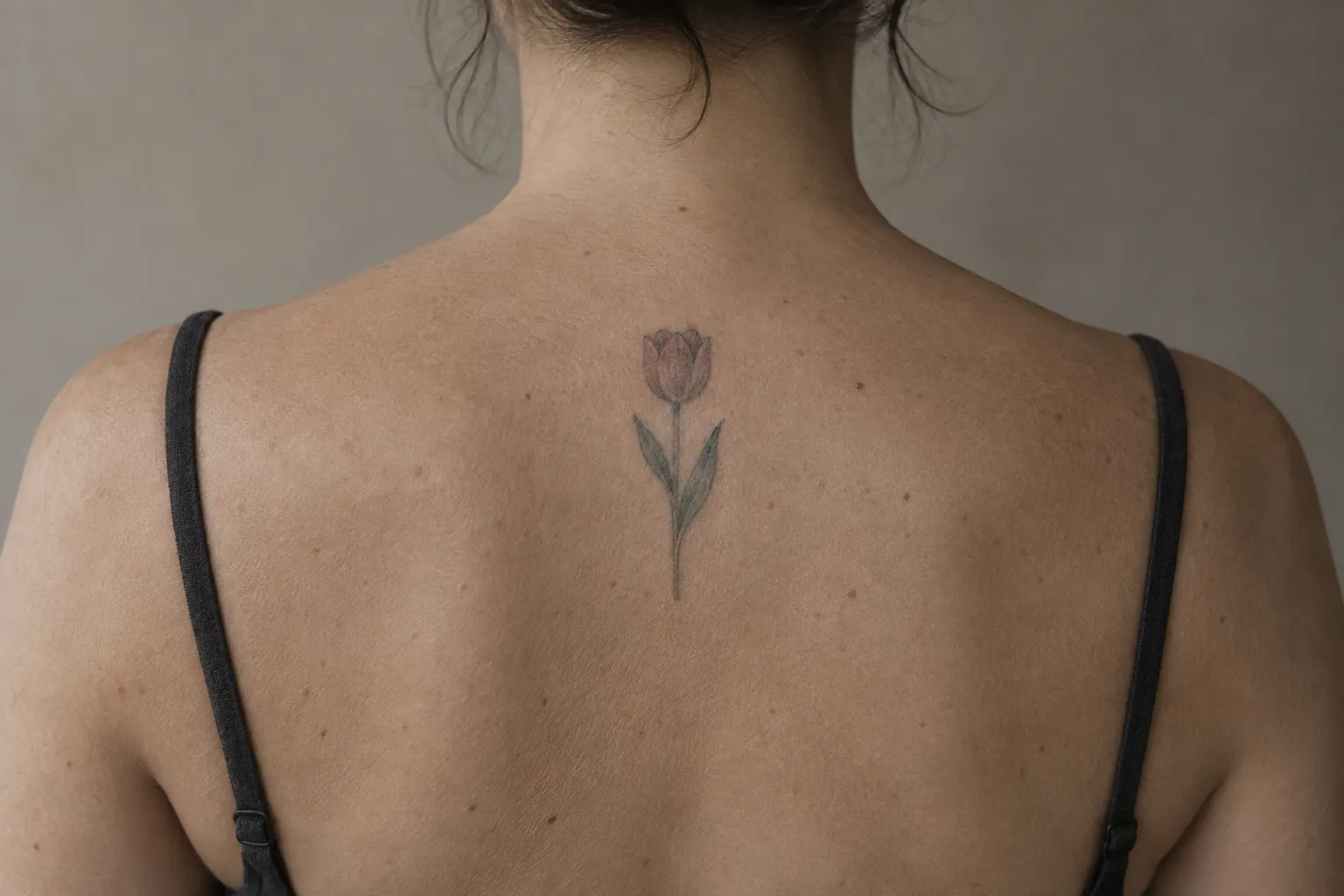
Ink spreads slightly under the skin over the years. Two petal lines drawn too close together will eventually fuse into one thick line, and veining inside a tiny petal turns into a grey smudge. One practitioner source gives roughly 2 mm as a minimum rule of thumb for parallel lines in fine-line work (6). Use it as a conversation starter with your artist, not a guarantee.
For a small tulip tattoo, that means:
- Three petals, not five. Suggest the overlap with one line rather than shading it.
- One leaf at most. Let the stem do the compositional work.
- Open space inside the cup. Leave skin showing rather than filling the bloom solid.
The same source notes that fine line softens faster than bold work. It generally holds its look for 5 to 20 years and often needs touch-ups (6). Protected areas like the inner arm or thigh preserve detail better, while spots exposed to friction or sun fade sooner (6). Hands, fingers and feet see constant friction, so a delicate tulip there fades noticeably faster (6). If you want it on the hand anyway, ask about slightly heavier lines on the stem and main petals, or size the design up a little, which buys longevity (6).
Where to Put a Tulip: Placement and Aging
Tulip designs appear on the forearm, shoulder, knee, torso and spine (1). The right spot depends on the composition’s shape: tall single stems want long, flat areas, and bouquets want width.
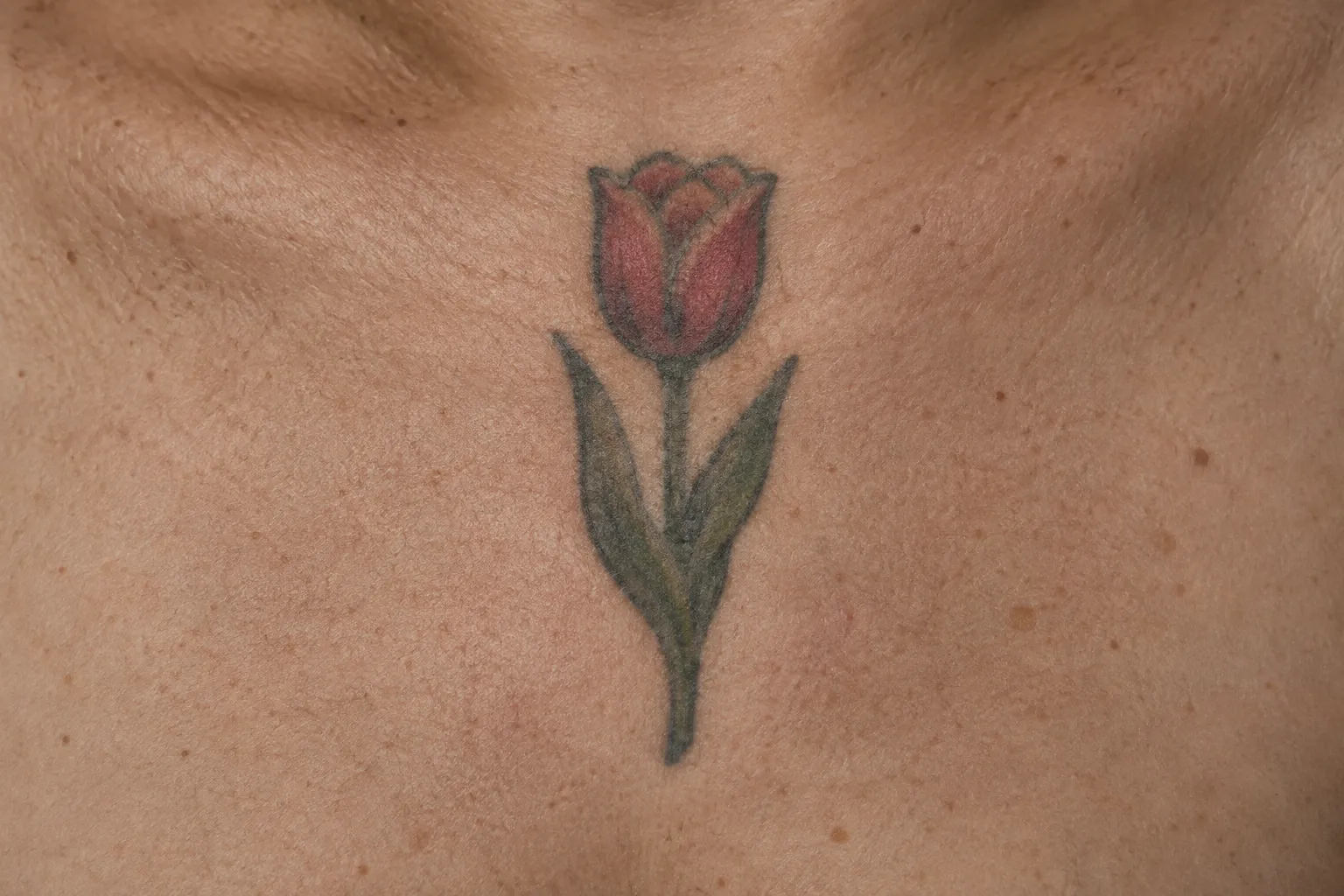
Shoulder and arm
The forearm is the gallery’s most frequent spot for single stems and paired blooms, and arm-wrapping bouquets appear too (1). The inner arm is one of the protected areas where fine line holds detail longer (6). Forearm pain sits at the low end of the scale, though the inner forearm gets sharper toward the wrist, as our tattoo pain guide explains. The shoulder cap suits a rounded bouquet because the curve frames the cluster.
Other spots: torso, spine, knee
A spine placement suits one tall stem. Pain-wise, the spine sits with the ribs among the most painful placements, well above the forearm. Torso pieces give room for a vase arrangement. The knee sits on a joint that bends constantly, and early fading is more common in high-movement areas, so it’s a harder place to keep fine detail crisp (6). Placement changes how a tulip fits and ages; its meaning stays yours to define.
What to agree with your artist before the session
- Bring reference images. Gather a few photos of tulips you like, healed ones if you can find them (6).
- Agree on size and placement together. A consult typically covers reference images, placement and rough sizing before anything touches skin (6).
- Ask to see the stencil on the actual body area. A tulip that looks right flat on paper can twist on a curved shoulder or knee.
- Confirm final placement in the mirror before the first line goes in.
Ink Safety and Healing After the Session
A sealed ink bottle doesn’t guarantee safety. According to the FDA, even unopened, sealed tattoo inks can harbor bacteria and other microorganisms that cause infections (3). Don’t assume “sealed” means “sterile.”
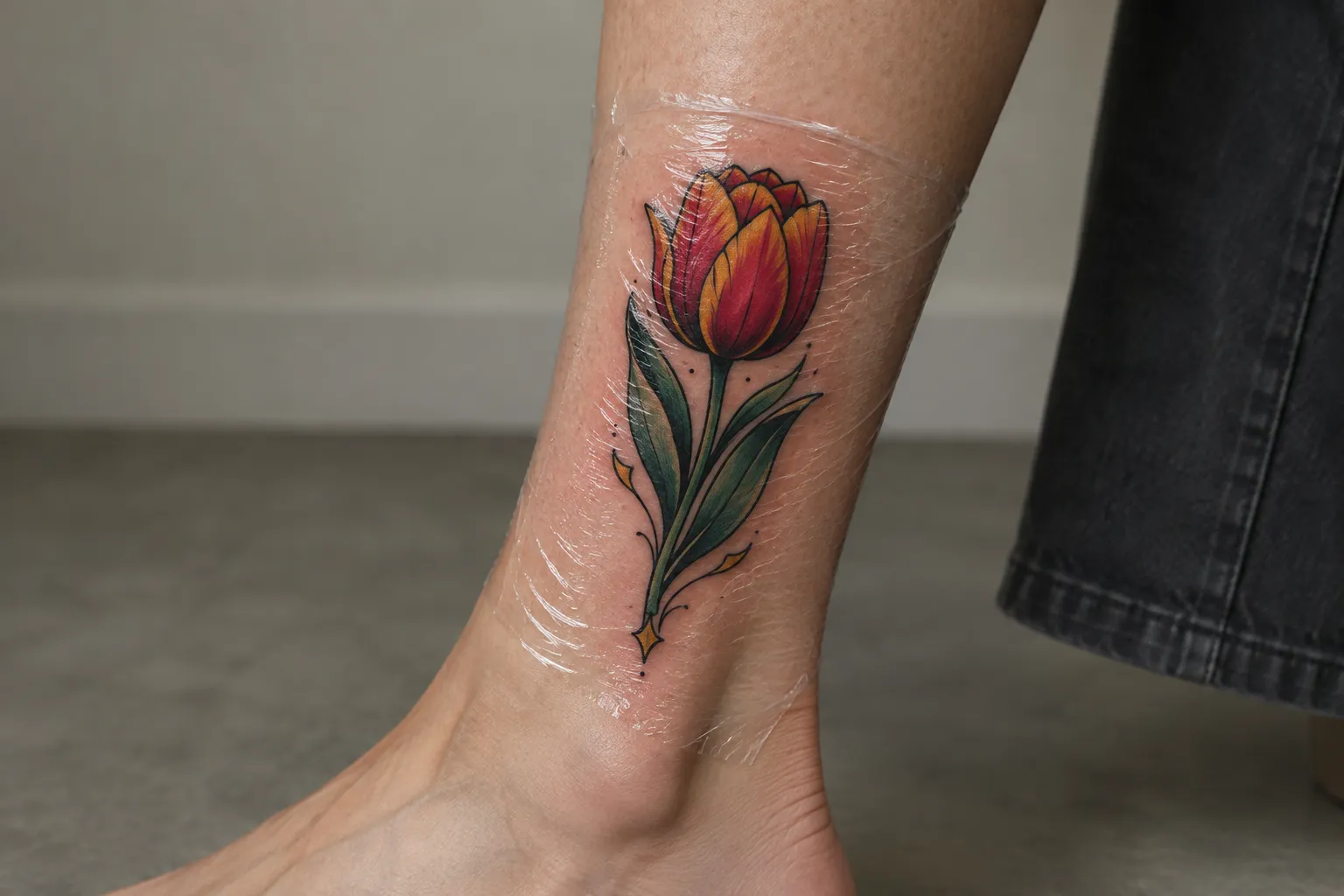
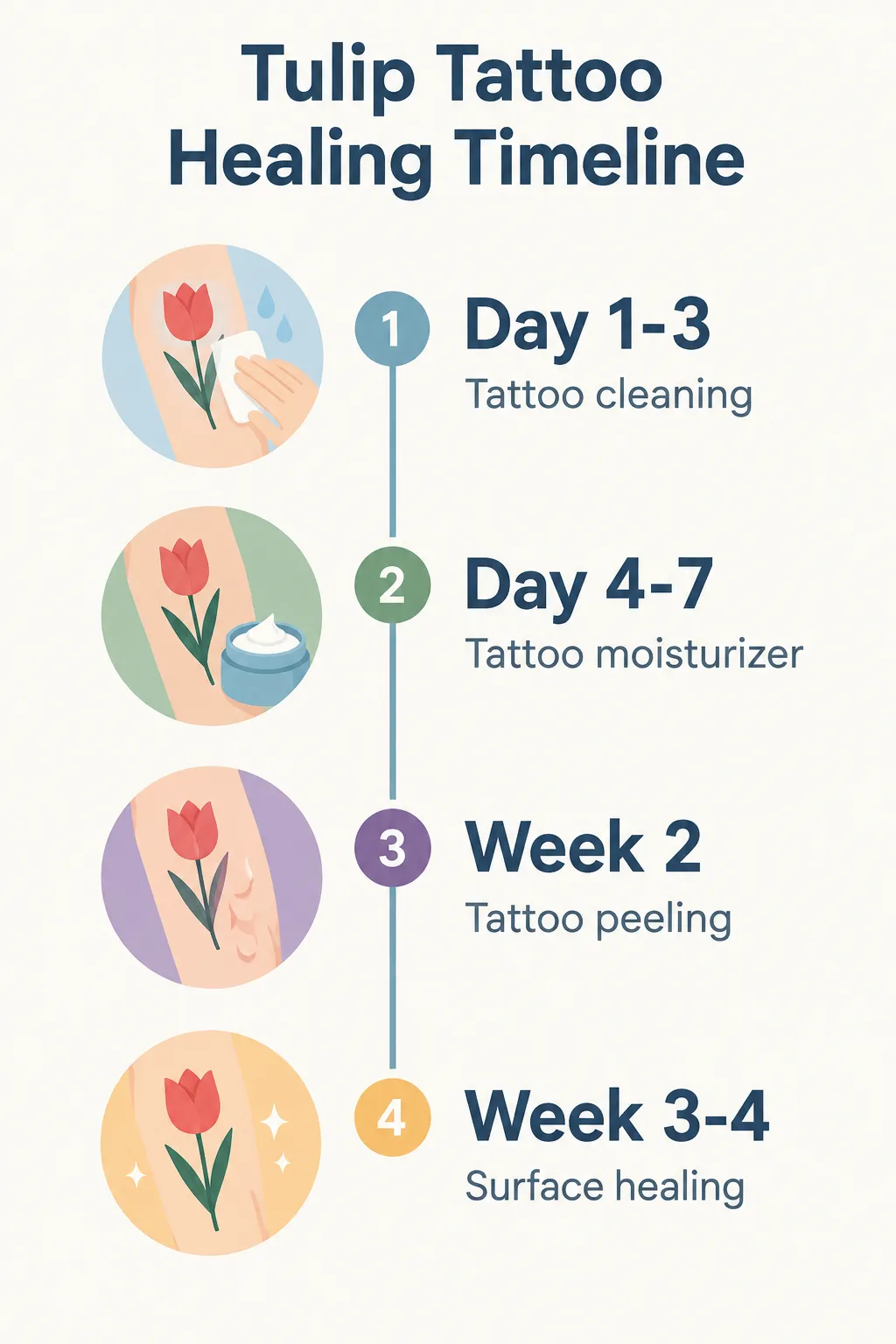 Aftercare timeline: cleaning on Day 1-3, moisturizing on Day 4-7, peeling in Week 2, and surface healing in Week 3-4.
Ink safety basics
Before booking, ask which ink brand and batch your artist uses (6), and ask for care instructions: the FDA says your tattooist should advise you how to care for the new tattoo (3). If you develop an infection or other reaction, the FDA advises asking for the brand, color and any lot or batch number of the ink, to help determine the source of the problem and how to treat it (3).
A basic healing timeline looks like this:
- Day 1-3: Keep the tattoo clean and follow your artist’s wrapping and washing instructions.
- Day 4-7: The skin starts to flake. Once it feels tight or dry, apply a thin layer of hypoallergenic moisturizer, and don’t soak the tattoo in baths or pools until it’s fully healed (6).
- Week 2: Expect peeling and itching, and don’t pick at it.
- Week 3-4: The surface looks healed, while the skin underneath keeps settling until about week 6. Keep the tattoo out of direct sun for the first 4 to 6 weeks.
Once the skin has closed and healed, start daily sun protection (6). Our tattoo aftercare guide walks through each of these stages in detail.
Warning signs that need medical attention
Persistent redness, bumps, a rash, fever, or a tattoo that won’t heal are not routine healing. The FDA advises contacting both your tattooist and a health professional when these appear (3). Have the ink information you saved ready to share.
Frequently Asked Questions
- What does 5 tulips mean?
- Five tulips have no established, universal tattoo meaning; treat the count as personal and explain its significance to your artist.
- What are the prettiest flowers for tattoos?
- There is no objective prettiest flower; compare silhouettes and cultural associations, then choose a bloom that suits your preferred style and placement.
- What is a good caption for a tulip?
- A short phrase or date can pair with a tulip, but check that the lettering remains legible at the size you plan to wear.
- What are the 10 most popular tattoos?
- Popularity rankings change from year to year, so treat any top-ten list as a trend snapshot rather than a design rule.
- What does a tulip tattoo mean?
- A tulip tattoo is often associated with love, beauty or renewal, but its meaning can be personal and varies across cultural contexts.
- Where should I get a tulip tattoo?
- Choose a body area that fits the design's shape and expected detail; have your artist test the stencil there before settling on placement.
- How should I care for a new tattoo?
- Follow your artist's aftercare instructions, avoid picking at peeling skin, and contact a health professional if concerning symptoms develop.
Choosing Your Tulip
The right tulip comes down to two matches. The composition (single stem, bouquet or vase) has to fit the placement’s size, and the color has to fit the meaning you want, knowing that yellow in particular reads two ways. If you’re going small, keep it to a simple outline with about 2 mm between lines (6). Bring your reference images, see the stencil on your body, and ask which ink brand and batch you’re getting before the needle starts. If you’re still weighing the tulip against other blooms, our guide to flower tattoo ideas compares them by size, style and placement.