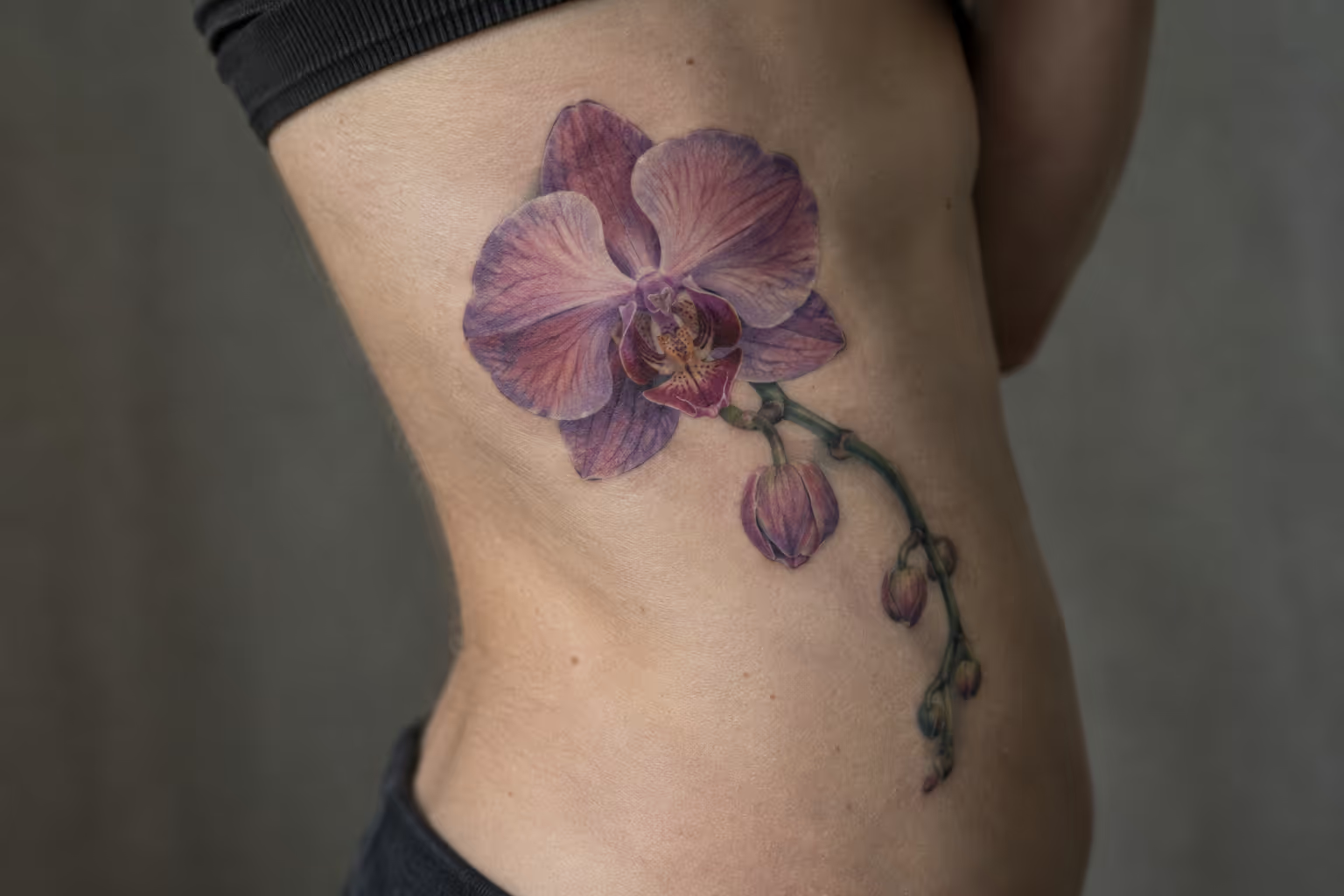
An orchid tattoo depends on line spacing. If the petals and veining sit too close together, the detail blurs over the years. If you keep a gap of 1.5-2 times the line width between neighboring lines, the layered petals stay readable as the ink settles (5). That one number shapes every other choice here: meaning, color, single stem or bouquet, placement and size.
Here is the trade-off before you commit. An orchid gives you a wide range of color associations, several species with distinct shapes, and compositions that fit almost any body area. Against that, the symbolism is not universal. Color fades faster without sun care, and the fine veining and lip detail that make an orchid recognizable are the first things lost if you size it too small.
✓ Pros
- Distinct species silhouettes give the design options beyond changing its color.
- A curved stem can follow the body's shape without needing a dense composition.
✗ Cons
- Choosing a species for its symbolism may conflict with the silhouette you prefer.
- A design that needs close inspection to read can lose its identity as lines soften.
Orchid Tattoo Meaning by Color and Culture
Tattoo guides read the orchid as beauty, refinement, love, strength or fertility, and those readings shift from culture to culture rather than forming one fixed definition (9)(12). Treat every meaning below as a popular association. None of them is a rule your artist or anyone else can hold you to.
The fertility reading goes back to the name. The word “orchid” comes from the Greek orchis, meaning testicle, a reference to the paired tubers at the root of many species (2)(3). The ancient Greeks treated the orchid as a symbol of love, virility and fertility, and Greek parents-to-be were said to eat its tubers to choose the sex of their child (3). Victorian England added a different layer. During the “Orchidelirium” of 19th-century Britain, hunters died on jungle expeditions to bring rare specimens back to London, and a single plant could sell for the modern equivalent of £25,000 (2). Orchids are still widely read as an emblem of luxury and wealth (3)(9).
Chinese classical culture gives a third reading. There the orchid is one of the “Four Gentlemen,” alongside bamboo, plum blossom and chrysanthemum, each standing for a Confucian virtue; the orchid’s is humility and moral integrity (2). Chinese ink painters rendered orchids with minimal brushstrokes and flowing leaves rather than botanical detail (15). If you want that reading, ask for a brush-stroke style orchid with long, sparse leaves rather than a lush realistic bloom.
Tattoo design guides add resilience. The orchid looks delicate but can thrive in harsh environments, so an orchid tattoo can stand for your own resilience and inner strength (12).
Common color meanings: red, orange, yellow, purple, white, pink
Color gives the motif a second layer of meaning. One florist’s guide gives these associations (14):
- White: innocence, reverence and humility
- Pink: charm, grace and femininity
- Purple: admiration and respect
- Yellow: friendship and joy
- Red: passion and desire
Other flower-meaning guides shift these. White also reads as purity and elegance (2)(3), red picks up strength (2), and orange, missing from some lists, stands for pride and enthusiasm (3)(14). Blue and black orchids show up in tattoo design galleries (7)(10). Natural blue orchids are extraordinarily rare, and most blue ones on sale are dyed; one guide reads blue as rarity (2), another as peace and tranquility (14). Near-black orchids are deeply pigmented red or purple flowers (3), and one tattoo guide reads a black orchid as power and authority (9).
Species carries its own readings too. Phalaenopsis is linked to health and prosperity, Dendrobium to wisdom and beauty, Cymbidium to strength and nobility, and Oncidium to love and talent (14). This matters because the species also sets the silhouette. A phalaenopsis is broad and flat-faced, a dendrobium grows in clustered canes, and an oncidium has small, frilled “dancing lady” blooms. You can choose a species for its meaning and get a distinct shape with it.
Why there’s no single universal meaning
Color meanings are subjective (3), and the same bloom can carry several readings. Like most flower tattoos, an orchid carries layered meanings rather than one fixed definition.
So pick the meaning you want, then pick the color and species that match it. Do not start from a chart and accept whatever it says about the flower you like. If someone reads your purple orchid as “admiration,” that is their association. Your reason for getting it can be completely different and still valid. Orchids have no single fixed meaning, and that freedom is useful when you plan the piece.
Single Stems vs. Bouquets: Composition Choices for an Orchid Flower Tattoo
An orchid flower tattoo usually takes one of two forms: a single stem with one or two blooms that keeps the focus on shape, or a multi-flower bouquet that makes room for color and supporting elements (7)(12). The right one depends on what you want the eye to land on first.
Orchids work in both forms because the family is so varied. There are around 26,000 accepted species (2), and design coverage shows everything from a lone bloom to a stem with buds, tight clusters, and large flowing pieces across the back or thigh (7)(12). Choose the composition before you choose colors, because the composition decides how many colors you can fit.
Single stem or minimalist bloom
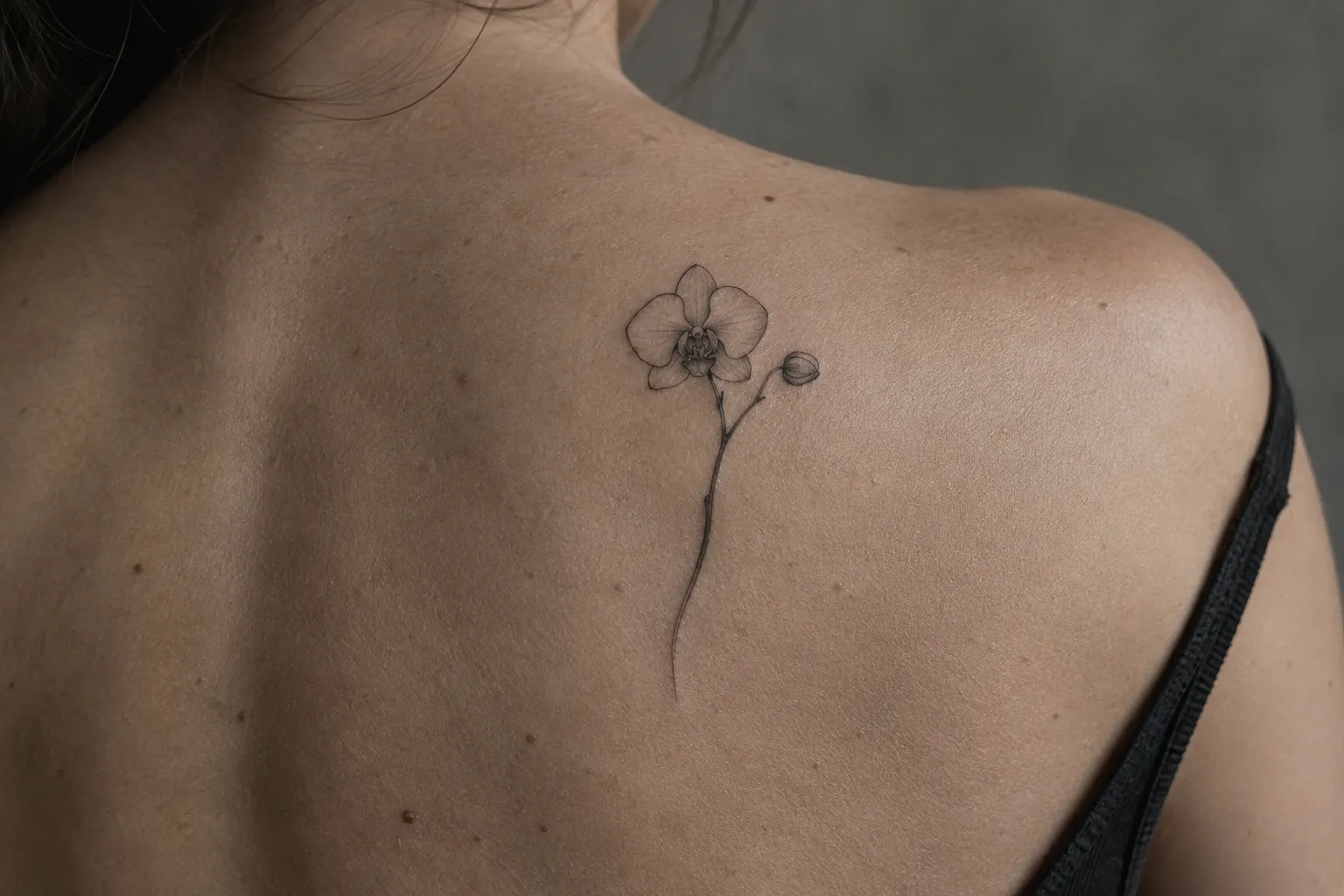
A single stem with one or two flowers is the restrained option (7). All the attention goes to the orchid’s anatomy: the three outer sepals, the two side petals, and the lip in the center that makes an orchid read as an orchid. Petal count and overlap are what make a bloom identifiable. Drawn generically, a flower reads as no flower at all (8). With a single bloom, your artist has the space to get that structure right.
Add buds and a curved stem when you want movement without the density of a bouquet (7). A phalaenopsis stem arches naturally, with open flowers at the base and closed buds tapering toward the tip. That curve can wrap the outer forearm or run down the side of the ribcage. One line, a few blooms, plenty of bare skin around it.
Single stems age best when you keep supporting detail light. One or two leaves at the base help anchor the composition. A full leaf spray around a fine-line stem crowds the outline, and once the lines start to soften, the orchid stops standing out.
Bouquet and multi-flower pieces
A bouquet or multi-flower layout gives you room for several colors, several species, or extras like leaves, geometric shapes and dotwork (7)(12). This is the route if you want one flower per family member, or a pink-and-white pairing that mixes two color meanings.
The risk is density. Each extra bloom adds outlines, veining and overlap, and every place where two petals meet is a place where lines can merge as the ink spreads. Before you approve a bouquet, ask to see the stencil at final size and check the tightest areas. Where two petals overlap or a leaf crosses a stem, the gap should stay at 1.5-2 times the line width (5). If it doesn’t, cut a bloom or make the piece bigger.
Geometric accents need the same care. A thin circle or hexagon behind an orchid looks crisp when fresh. If it touches the petal edges at several points, it reads as one tangle once the lines soften. Ask for the frame to sit clear of the flower, or to break where the petals cross it.
Color, Black-and-Grey, and Linework: Choosing a Style
Choosing color or black-and-grey for an orchid tattoo starts as a symbolism decision. Color carries the associations in the lists above (14), while black-and-grey uses only black and grey ink and gives the orchid a classic look (12). Make that call first. The technical trade-offs come second.
When color carries the symbolism
If the reason for your orchid is “purple for respect” or “pink for my daughter,” color is the design, and you need to plan for saturation. Purples and pinks are the colors that fade first on an orchid, so sun protection matters most for them (11). Pale colors in small pieces fade soonest too (4), so they usually need a darker outline or grey shadow behind them.
For a white orchid, one approach is to leave bare skin as the white of the petal and build the form with grey shading around it. You still get a white orchid, built from skin and shadow.
Ask your artist to adapt the color plan to the size. A small piece works best simple, bold and high contrast, while the medium range has room for simple shading and a limited palette (5).
Black-and-grey, fine line and watercolor looks
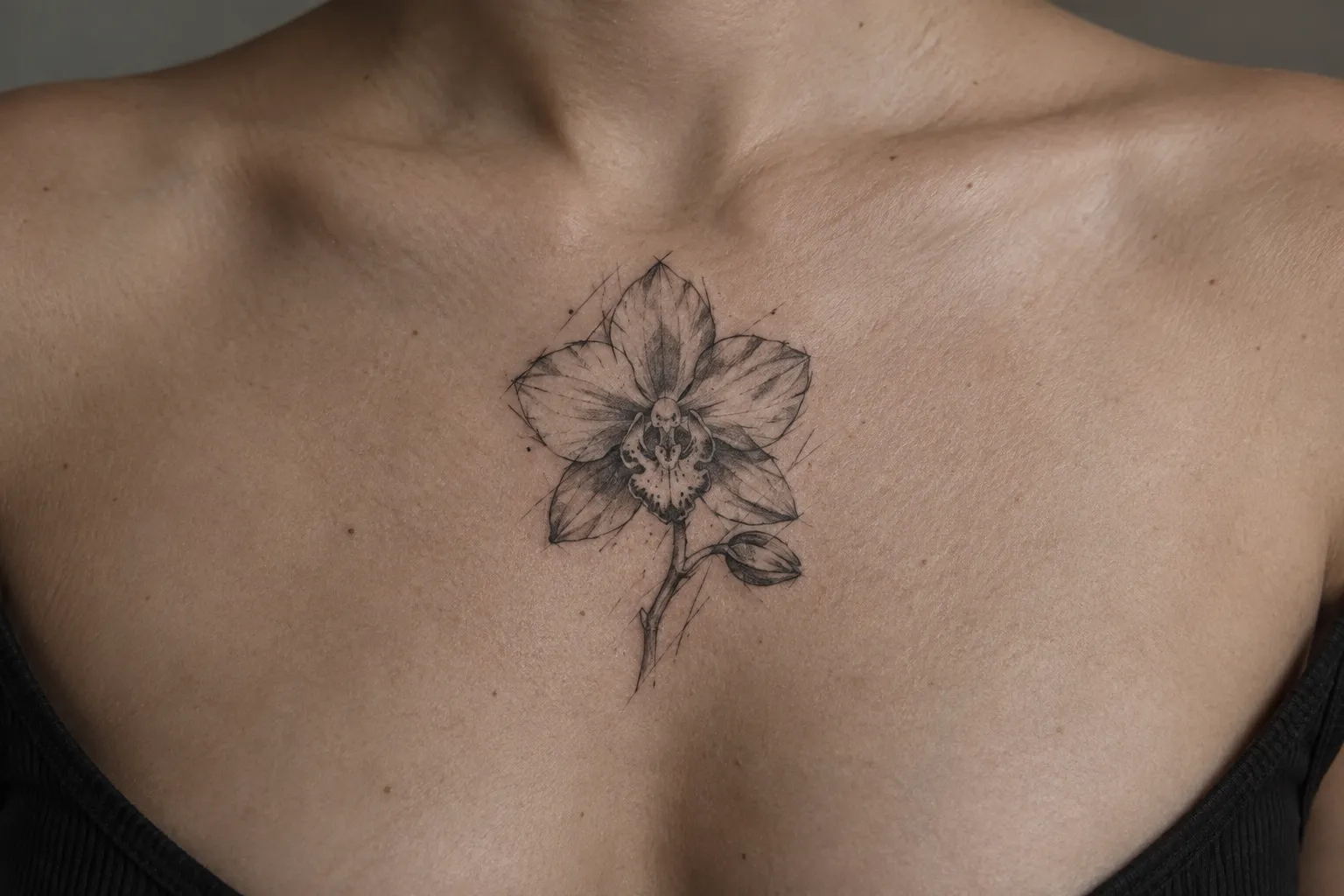
Black-and-grey keeps the color question out of it. Its hallmarks are a firm outline to hold the silhouette and smooth grey shading to model the curve of each petal. Galleries show black orchids on the forearm with thin stems (10), and dramatic black shading is one of the treatments design guides suggest (7). The common mistake is shading that is too even. Without dark lows near the lip and bare skin on the highlights, the petals flatten into a grey blur.
Fine line uses small needle groupings, sometimes a single needle, to produce thin, delicate lines. Botanicals are its signature subject (4). It suits orchids because thin lines can trace the veining on the lip. Fine line also leaves no room for error: there is no bold outline to hide a wobble, and improper needle depth causes blowouts, where ink spreads under the skin and permanently blurs the work (4). Fine lines also soften as they age (4), so a fine-line orchid needs the most generous line spacing of any style. Choose an artist with healed fine-line photos in their portfolio, not just fresh ones.
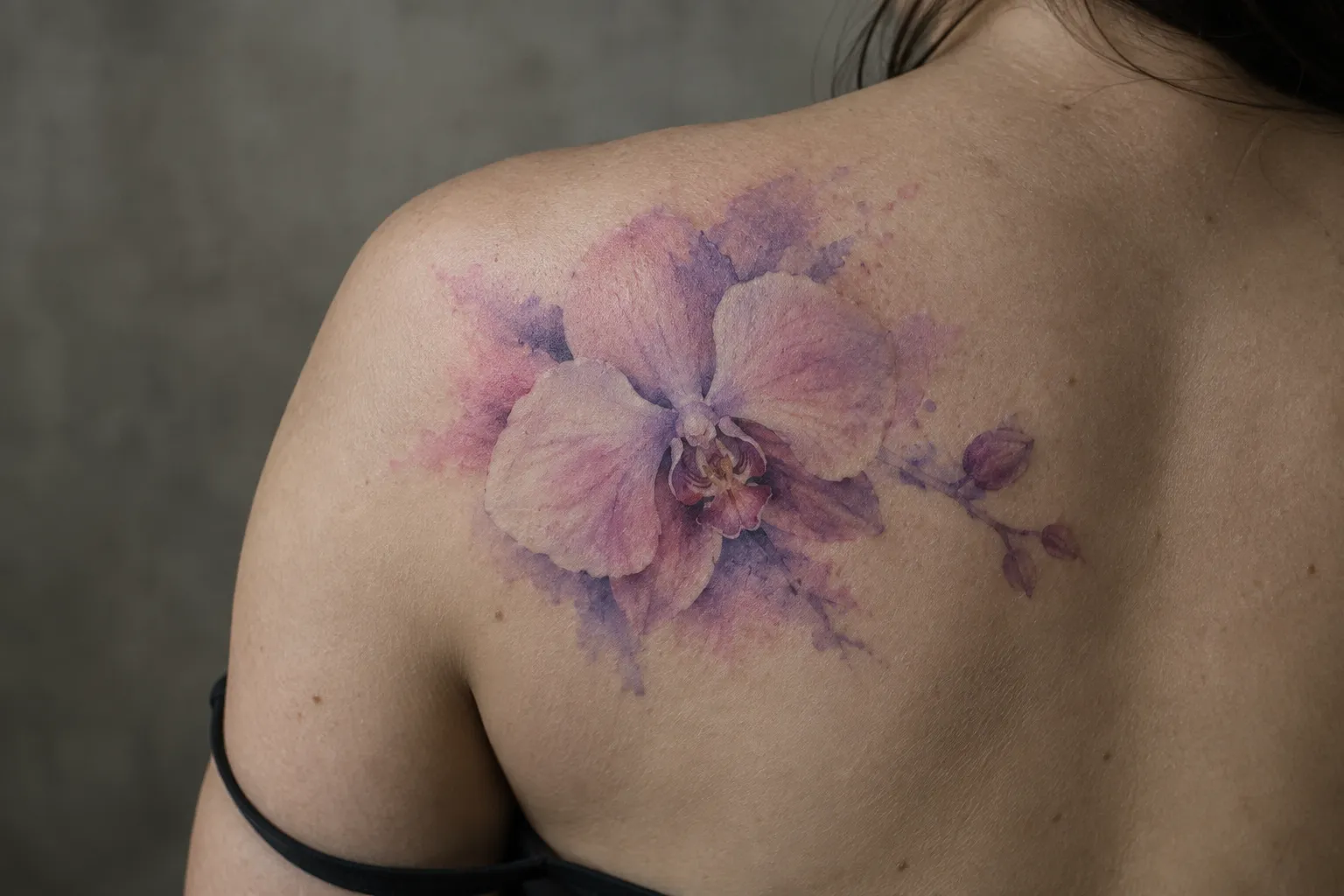
Watercolor orchids use soft washes of color bleeding past the edges of the petals (11)(12). It fits the orchid’s fluid petals well. The mistake is skipping structure entirely: watercolor with no linework or dark anchor points has nothing left to define the shape once the soft edges spread (11). Ask for a fine outline or darker anchors around the flower center and stem to hold the shape (7)(11).
Whichever style you pick, look at the stencil at final size before color goes in. It is far easier to cut a line on paper than on skin.
Placement Ideas and How They Shape the Design
The best placement for an orchid tattoo is the one that fits the design’s shape and how visible you want it to be. Design coverage shows orchids on the shoulder, ankle, wrist, spine and forearm, each suited to a different composition (7)(10)(11)(12).
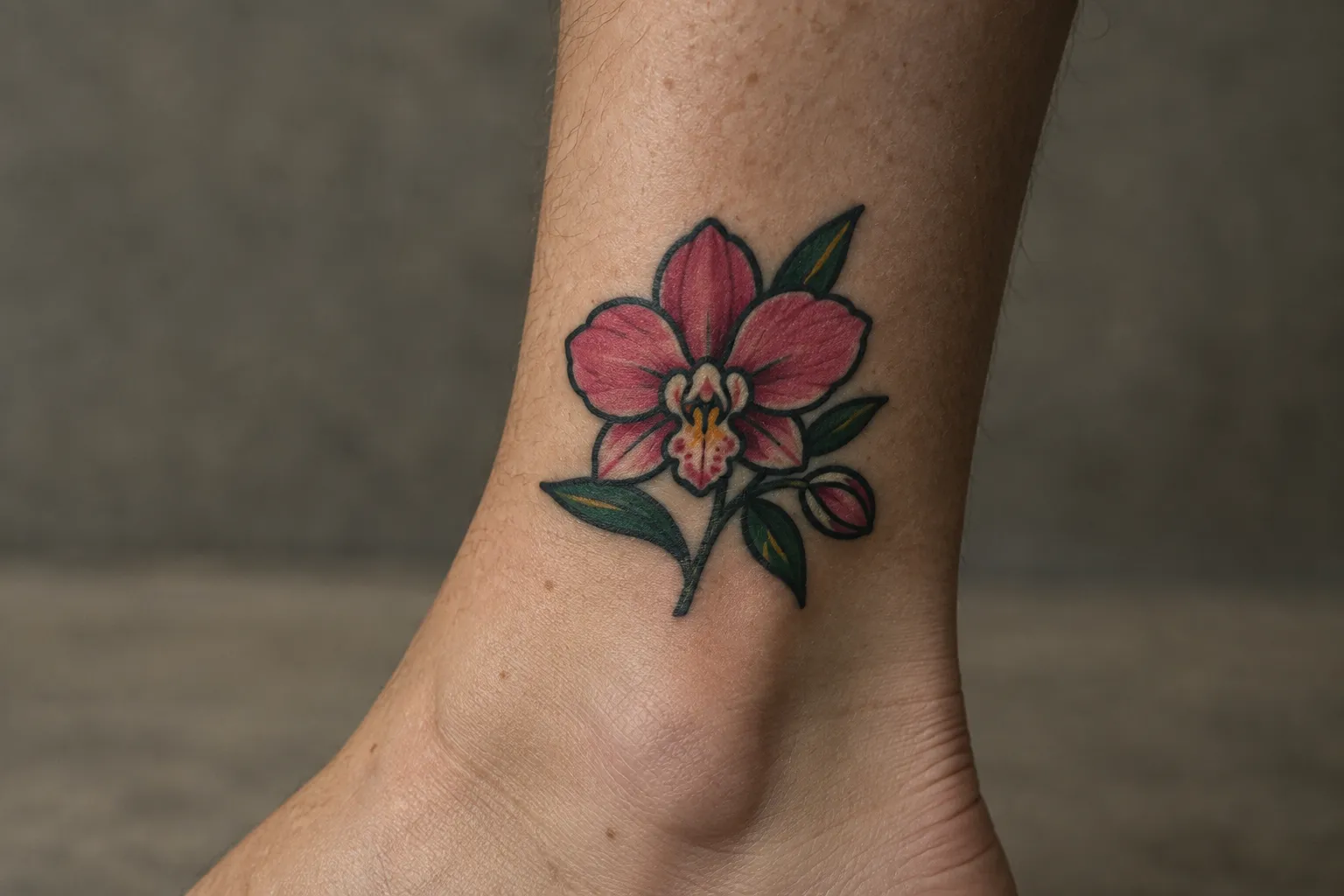
Two questions narrow it down. First, does the composition run long and narrow, wide and round, or small and compact? Second, do you want it in view every day, or covered at work? Pain is a third factor. On the tattoo pain scale, the spine and ribs sit in the high tier, while the outer shoulder and outer forearm sit in the low tier.
Shoulder and spine flow
A shoulder piece suits an orchid branch that curves over the top of the shoulder and down toward the collarbone or shoulder blade. The branch follows the body as it moves (7). It’s easy to cover, reads well in a tank top, and the outer shoulder is one of the gentler places to sit for detailed work.
The spine fits the orchid’s natural shape. A phalaenopsis stem grows in a long, slightly curved vertical line with blooms stacked down its length, so the design doesn’t have to be forced onto the body (11). A tattooer who does a lot of spine work calls it no beginner placement: it hurts, it heals slowly, and it punishes rushed linework more than almost anywhere else (11). Expect more pain than on the forearm, and plan for slower healing, because clothing, chair backs and sleeping position all rub against it (11).
Body curvature affects bouquets most. A cluster that looks balanced flat on paper can stretch on the shoulder blade or compress where the ribs curve in. Have the stencil placed on you and check it from the front and side, with your arm relaxed and raised, and standing rather than lying down, before you approve it (7)(11).
Wrist and ankle minimal placements
The wrist and ankle suit small or minimalist orchids: a single bloom, a short stem, a bud or two (7)(12). Both are easy to show, and an ankle piece hides under socks or trousers.
Both also have limits. Botanical realism does not hold at wrist and ankle scale, while clean, evenly weighted linework with generous spacing does (5). A bolder single bloom with a clean outline and limited interior lines is the safer choice. On the ankle, the needle also works close to the bone, where the vibration is hard to ignore.
If you want something visible but have more room for detail, the outer forearm is a good compromise. It’s flat, it’s in view, and it has enough space for a stem with buds.
Sizing a Compact Orchid Design: Keeping Fine Details Legible
A small orchid tattoo stays legible only if its size leaves room for the details that identify the flower and for clear gaps between lines (4)(5). “Small” describes the design approach, not a fixed measurement.
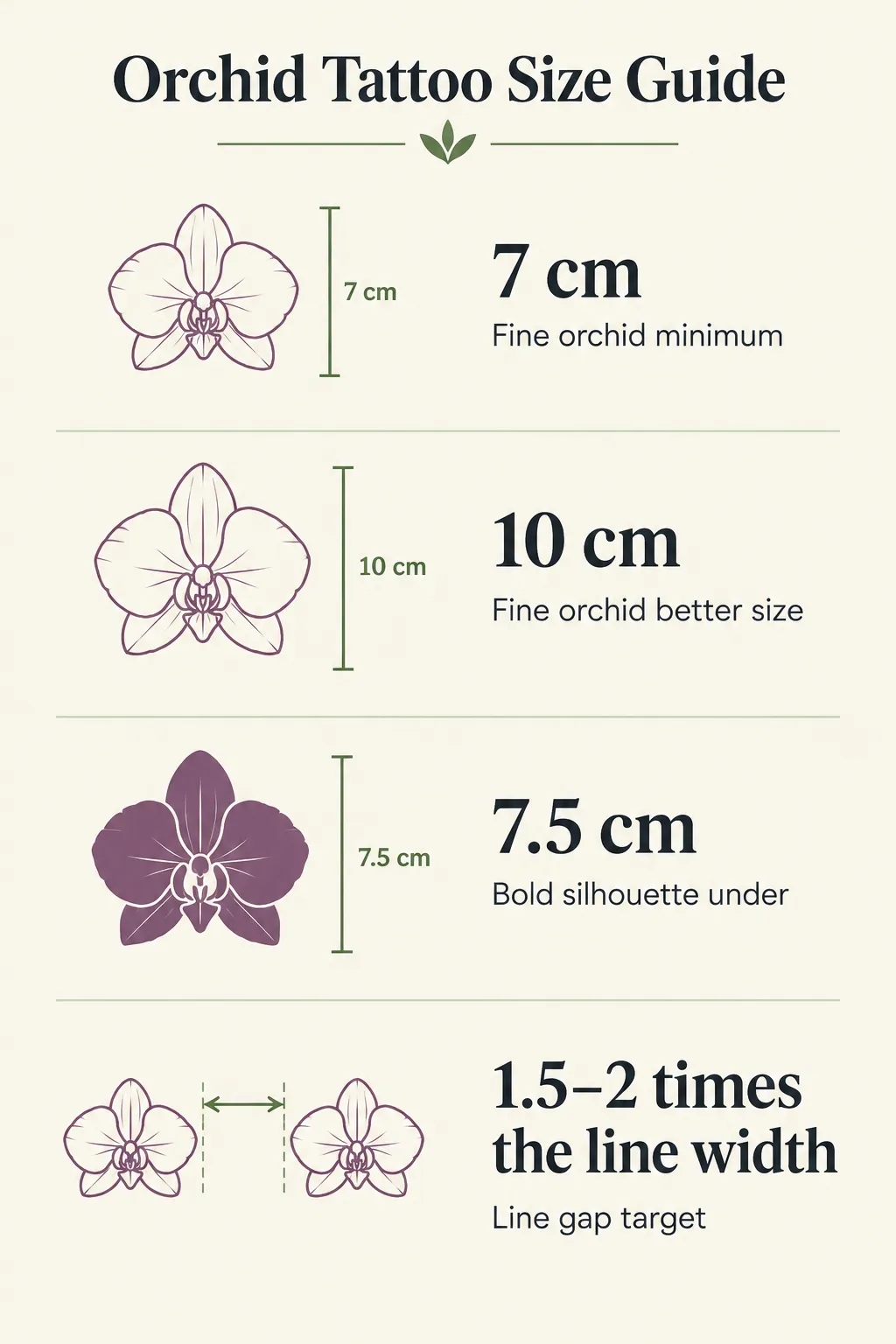 The sizing guide recommends 7 cm as the smallest workable size for a fine botanical orchid, 10 cm as the better choice, under 7.5 cm for a bold silhouette, and line gaps of 1.5-2 times the line width.
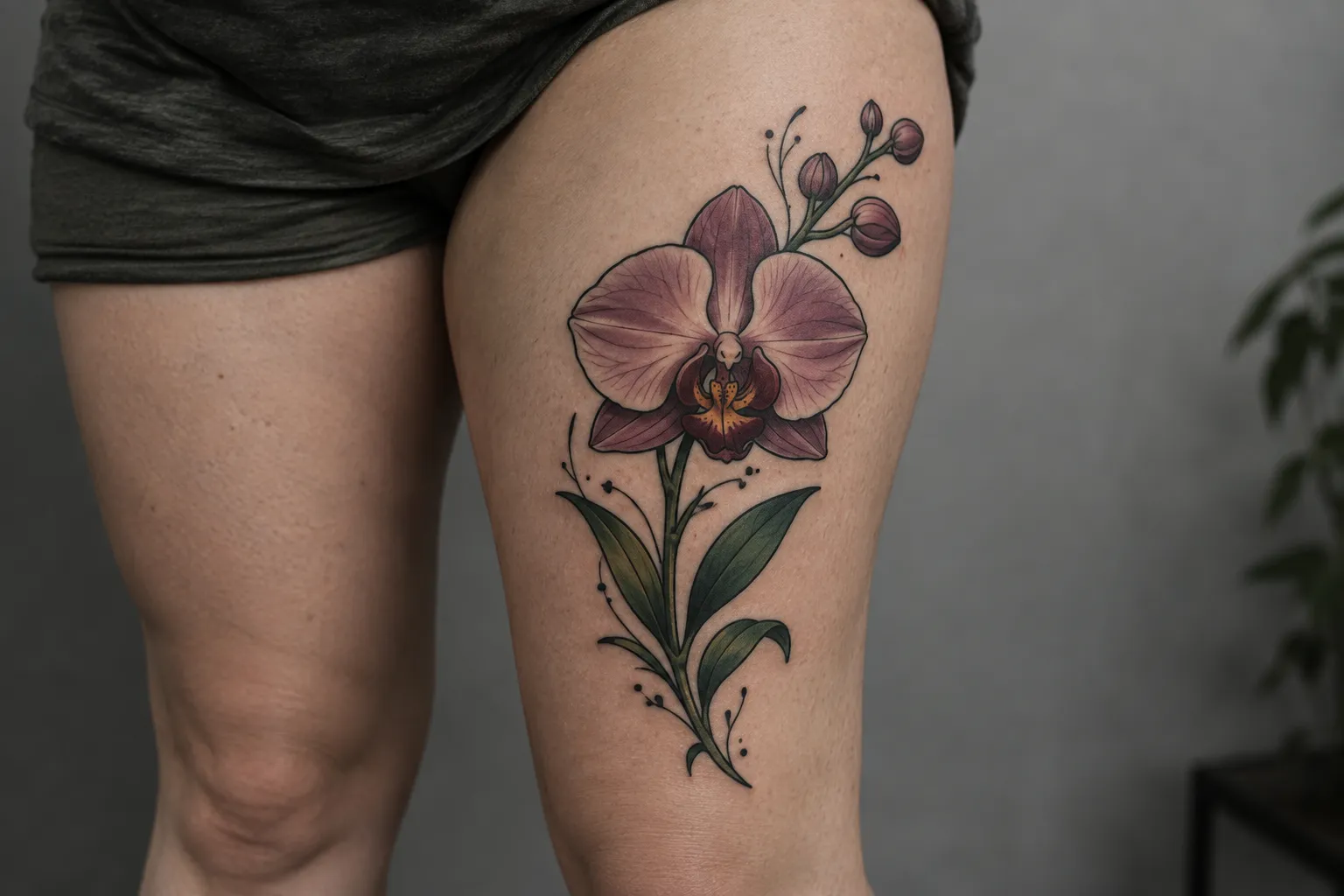
One sizing guide puts the smallest workable size for a fine botanical with veins and stamens at 7 cm on its longest side, with 10 cm (3.9 in) as the better choice (5). The same guide says a bold silhouette built from solid lines works under 7.5 cm (3 in) (5). For an orchid, this sets up a clear trade: below about 7 cm, you either drop the veining and keep a bold outline, or you go bigger (5).
Why the order of decisions matters
Most sizing problems come from deciding things in the wrong order, usually picking a tiny spot first and then trying to fit a detailed reference into it. A flower-tattoo guide recommends deciding species first, because the species shapes style, scale, placement and palette (8). The six-step sequence below walks through that order and ends with the stencil check.
Each step limits the next one. A phalaenopsis bouquet in four colors will not fit behind the ear. A single fine-line dendrobium cane might, if the artist simplifies it.
Keeping lines from crowding as it ages
Ink spreads slightly under the skin over the years. Lines that were crisp at the session thicken and soften. Fine lines in particular soften noticeably over time (4). When two lines sit closer than their own width, they eventually merge. On an orchid, check the lip first: it is where the veining, the column and the petal edge meet.
This is why the spacing rule matters more than the overall size. Keep gaps at least as wide as the lines, ideally 1.5-2 times the line width (5). On a compact piece, that means fewer lines, not thinner ones.
Here is how the common small spots compare (5)(7):
- Behind the ear: room for a single bloom or bud with a bold outline. Drop the veining.
- Inner wrist: a single bloom in bold linework. Fine-line detail blurs here.
- Inner arm: more room, so a short stem with one open flower and one bud can keep some interior detail.
- Outer forearm: enough flat space for a stem with buds and light veining.
Size works in the other direction too. If you’re enlarging a design, line weight and spacing shouldn’t scale up at the same rate. A line that looks delicate at 8 cm can look clumsy at 20 cm (5). Ask the artist to redraw at the new size rather than enlarging a small stencil.
Plan a Compact Orchid Tattoo
Make the design decisions in sequence, then check the smallest gaps on a stencil at the intended size.
- 1
Choose the species or reference
Bring a reference for a specific orchid form, such as phalaenopsis or dendrobium, so the silhouette is clear.
- 2
Decide the meaning
Choose an association you want to use, or set meaning aside rather than treating a color chart as a rule.
- 3
Pick the composition
Choose a single bloom, a stem with buds, or a bouquet before adding supporting details.
- 4
Pick the style and color treatment
Decide whether color, black-and-grey, fine line, or watercolor best fits the design and the details it must retain.
- 5
Choose the placement
Match the composition's shape to the body area and decide how visible you want the tattoo to be.
- 6
Confirm the scale at the stencil stage
Check the tightest spaces at actual size and keep gaps between neighboring lines at 1.5-2 times the line width.
Safety, Healing and Long-Term Care
Orchid tattoo safety runs from booking to years after healing: choose a studio with hygienic practices and sterile equipment (6), then protect healed color with SPF 30 or higher sunscreen (1).
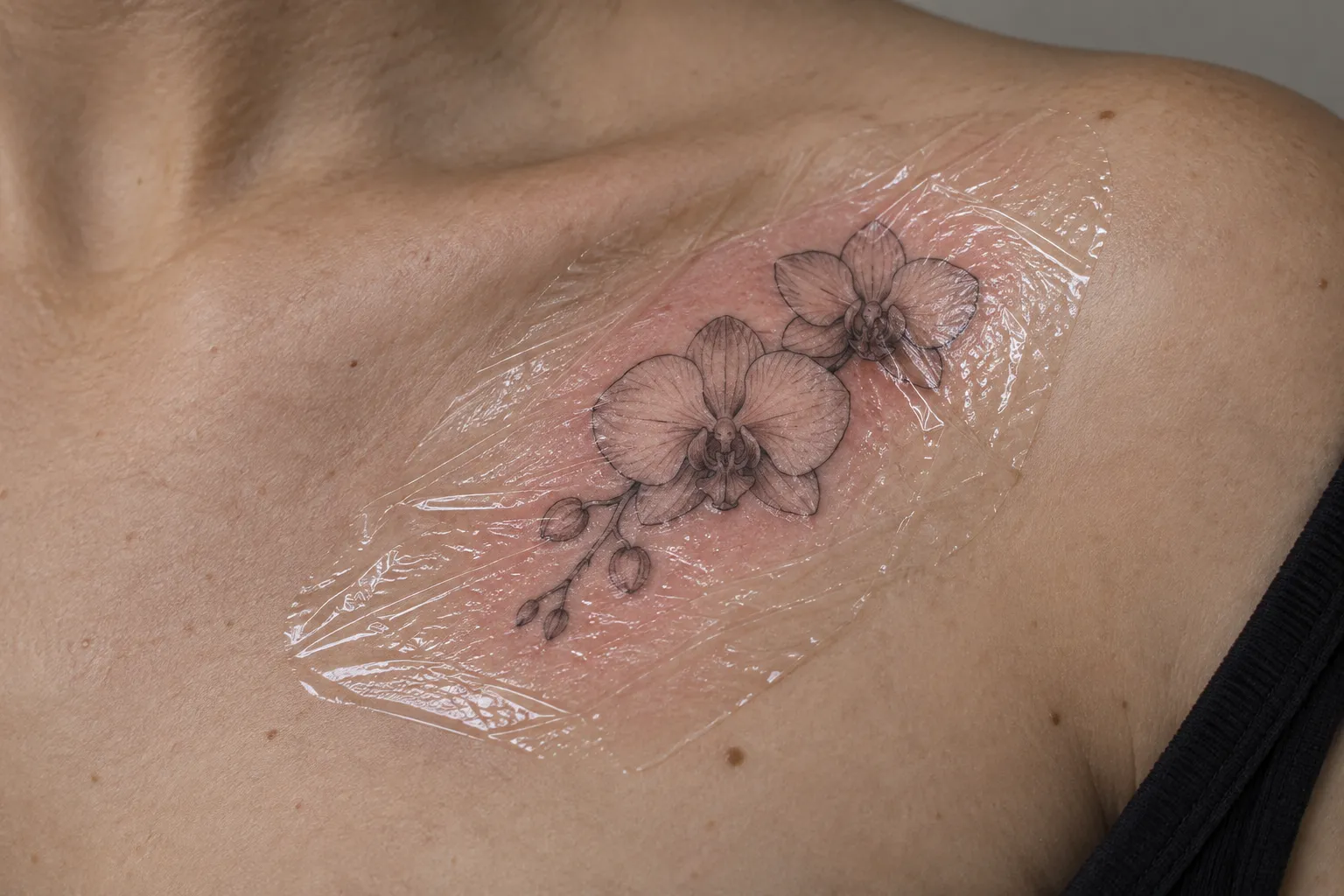
Before you book: studio and ink safety
In the US, state and local authorities oversee the practice of tattooing, and the FDA regulates tattoo inks as cosmetics (6). The FDA has received reports of infections from contaminated tattoo inks and allergic reactions to the inks themselves. FDA scientists have also found that even unopened, sealed inks can carry bacteria and other microorganisms (6). A sealed bottle does not guarantee clean ink.
What to check (16):
- The studio is regulated by your state or local authority.
- Needles and equipment are sterile.
- The studio does not reuse ink.
Choose skin without moles. Tattooing over a mole can make early signs of skin cancer harder to see (1). If a mole sits where you want the orchid, ask the artist to shift the composition or curve a leaf around it rather than over it.
After healing: sun care and skin checks
Healing follows the stages set out in the tattoo aftercare guide:
- Days 1-3: Follow your artist’s wrap instructions. Wash gently with lukewarm water and a fragrance-free soap, pat dry, and apply a thin layer of ointment or fragrance-free lotion. Some redness, swelling and oozing of plasma and ink is normal.
- Days 4-7: The surface dries, feels tight and starts to flake. Don’t pick or scratch. Avoid soaking the tattoo in baths, pools or the sea.
- Week 2: Peeling and itching. Let the flakes come off on their own.
- Weeks 3-4: The surface looks healed, and color can look milky while the deeper skin is still remodeling. Full clarity returns around this point.
- Around week 6: Full integration. Keep the tattoo out of direct sun for the first 4-6 weeks.
Once the skin has fully healed, sunscreen becomes your main tool against fading. Ultraviolet light can fade some tattoo inks. The American Academy of Dermatology recommends a broad-spectrum, water-resistant sunscreen with SPF 30 or higher, applied 15 minutes before sun exposure and reapplied at least every 2 hours (1). Tanning beds and sunlamps can also fade tattoo ink and raise skin cancer risk (1). A shoulder or ankle orchid gets far more sun than a spine piece, so plan sun care around the placement.
Keep an eye on the skin over time. Ink reactions can appear right away or years later. If you have a skin reaction or the tattooed skin changes in any way, see a board-certified dermatologist (1).
Frequently Asked Questions
- What does an orchid mean as a tattoo?
- Tattoo guides read an orchid as beauty, refinement, love, strength or fertility; its color and species add more specific associations, and your own reason for choosing it counts as much as any chart.
- What is the prettiest flower to get tattooed?
- No flower is objectively prettiest; compare healed examples at your intended size to see which silhouette still reads clearly.
- How long does an orchid tattoo session take?
- Ask for a time estimate after the artist has seen the final stencil, since placement, detail and color packing change the workload.
- Can a small orchid tattoo still carry color symbolism?
- Yes; color can carry an intended association even when the design uses a simplified bloom and omits small anatomical details.
- Does orchid tattoo color fade faster in the sun?
- Sun exposure can fade tattoo pigments, so choose clothing that covers the design when sunscreen is unsuitable or the skin is still healing.
Getting the Stencil Right Before the Needle Starts
Meaning, color, composition, placement and size are five separate decisions. They work best when you make them in that order, because each one limits the next. Choose the species and the association first, then single stem or bouquet, then the style, then where it goes. Size comes last, once you know how much detail the design has to carry.
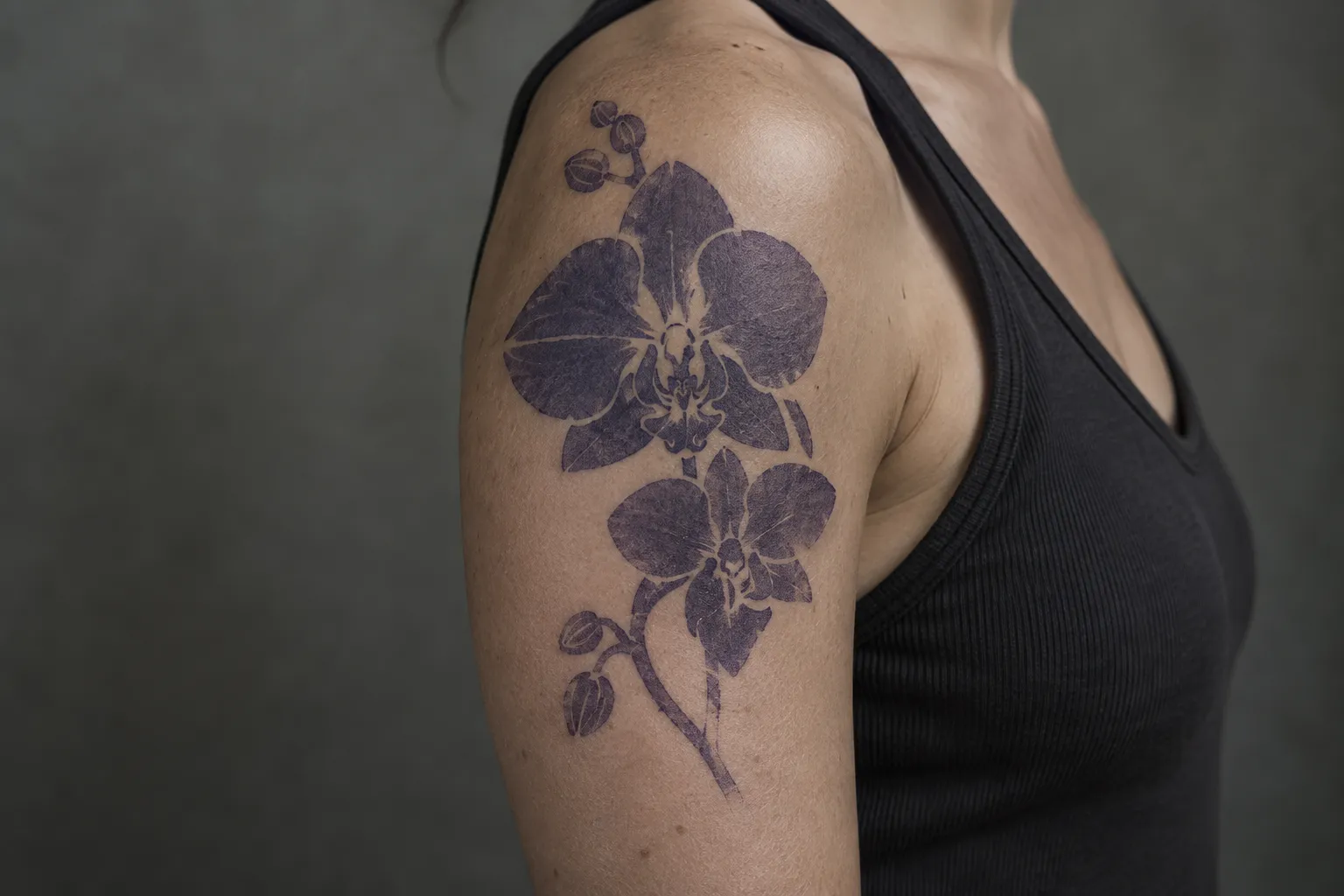
At the consultation, bring a reference photo of the orchid form you want and tell the artist how big you’re willing to go. Then have the stencil placed on the skin at its real size and check the tightest areas, the lip and any overlapping petals, for gaps of 1.5-2 times the line width. If the lines touch on the stencil, they will blur on your skin over time. Once healed, use sunscreen whenever the tattoo is in the sun.