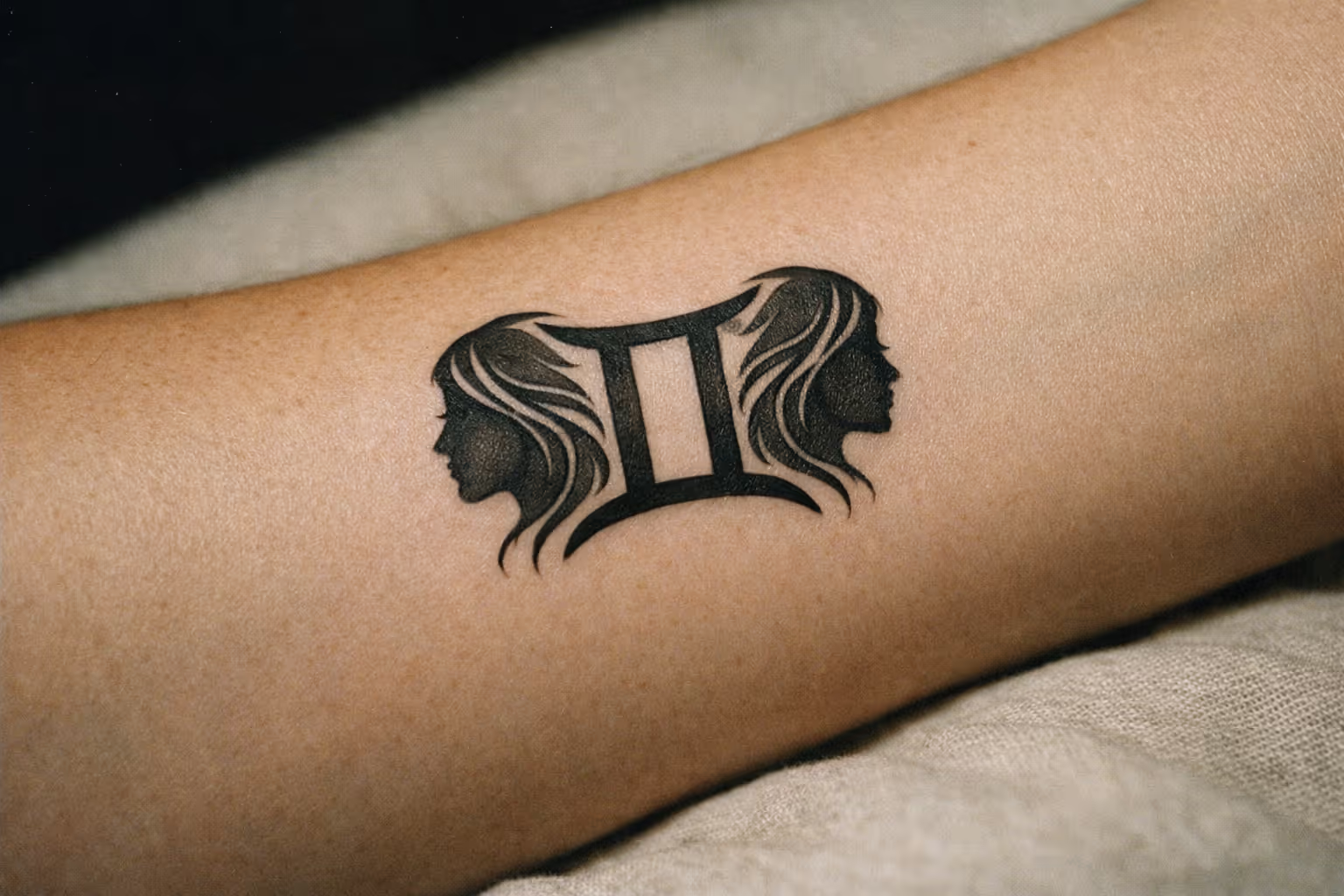
A Gemini tattoo splits into two very different bets on size. The glyph - the little Roman-numeral II - survives clean down to an inch. The twin faces, the other classic Gemini design, need at least three inches or they blur into an indistinct smudge. Choosing between them isn’t about taste; it’s about how small you want to go. Here’s how to pick one anchor design and a stable placement so your Gemini reads for the long haul.
What the Gemini Symbol Actually Means (and Why It’s More Than “Two-Faced”)
A Gemini tattoo often features the Gemini symbol, which consists of two parallel vertical lines connected by short strokes at the top and bottom - resembling the Roman numeral II. According to Zensa Skin Care’s zodiac tattoo guide, those parallel lines represent coexisting personality traits held within one contained shape (1). That’s the key reframe: it’s not two warring sides, it’s two things living together.
Gemini is the third sign of the zodiac, covering roughly May 21 to June 20, and it’s ruled by Mercury - the planet associated with communication and intellect. That Mercury rulership matters more for your design than most people realize. The core traits - duality, adaptability, mental energy, communication - are coexisting qualities, not a split personality. Our Mindful Life points out that “Gemini” is Latin for “twins,” and the sign ties explicitly to the idea of two souls in one body, expressing adaptability and changeability rather than chaos (2).
Mercury opens up the design space well beyond literal twins. If the planet rules communication and movement, you can build a gemini astrology tattoo around speech, writing, mirrors, motion, or split text instead of two faces. I’ve seen clients come in dead-set on twin portraits when what they actually connected with was the Mercury side - the curiosity, the restlessness. A gemini astrology tattoo carries the most weight when it anchors to one of those traits rather than just slapping the zodiac label on your skin. BlackInk AI’s 2026 overview frames the sign through Castor and Pollux to emphasize partnership and shared identity over the old “two-faced” cliché (2). Pick the trait that’s actually yours, then design around it.
The Gemini Constellation - Subtle, Scalable, and Surprisingly Versatile
The Gemini constellation is two roughly parallel chains of stars anchored by the bright stars Castor and Pollux. NASA’s constellation guide describes them as twin figures standing side by side, which is the visual you’re translating onto skin. The International Astronomical Union notes that Pollux is the brightest star in the constellation at magnitude ~1.1, with Castor also prominent - so those two points are the natural focal anchors in any constellation tattoo.
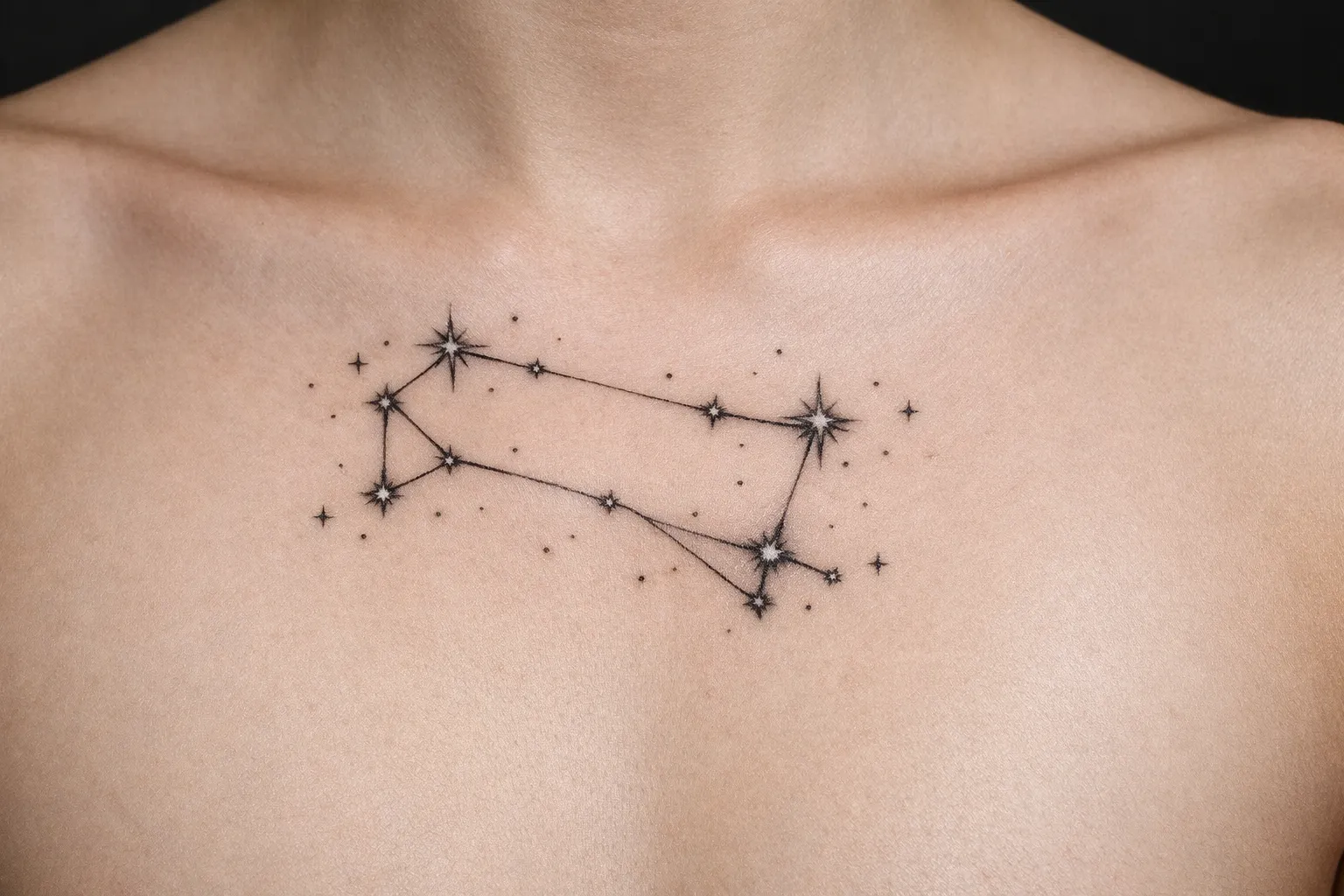
You’ve got three main rendering routes:
- Pure dot-and-line map - the most minimal version, just the star points and connectors
- Dot-and-line with a glyph overlay - adds an explicit zodiac read
- Constellation with moon or star accents - leans into a cosmic look
On size: 2 to 4 inches (5 to 10 cm) is the realistic minimum for readable star detail. According to layout advice from OCD Ink Studio, fine-line constellation work generally needs at least 2 to 3 inches on flatter areas to keep the dots and connector lines distinct over time. Under 1.5 inches, the connectors and dots tend to merge into a smudge as the tattoo softens. I’ve touched up enough constellation work to say this isn’t theoretical - it happens faster than people expect, especially on wrists and ankles.
Placement is where constellations live or die. Zensa recommends the collarbone, shoulder, or upper back, where skin movement is lower and fine dotwork ages more cleanly than on the wrist or ankle (3). The outer forearm and side rib also hold up well. Skip high-friction spots if you want the star detail to last.
One technical ask that pays off long-term: request line-weight hierarchy. Slightly thicker dots for the main stars, thinner connector lines between them. That contrast keeps the design legible years after it heals.
Pairing the Constellation With Other Gemini Elements
- Glyph plus 3 to 5 star dots reads as zodiac-inspired without committing to full twin imagery - the subtle option.
- Constellation plus a crescent moon pushes into the cosmic duality aesthetic.
- Constellation plus birth flowers (lavender, lily of the valley) makes it personal and feminine-leaning without feeling generic. If you want to explore how birth flowers tattoo designs work across all twelve months, there’s a full sizing and placement guide worth reading before you finalize your layout.
Core Gemini Design Options and What Each One Communicates
This is the decision hub. There are four main directions for a gemini tattoo, and each carries a different symbolic weight and visual footprint. Pick one as your anchor.
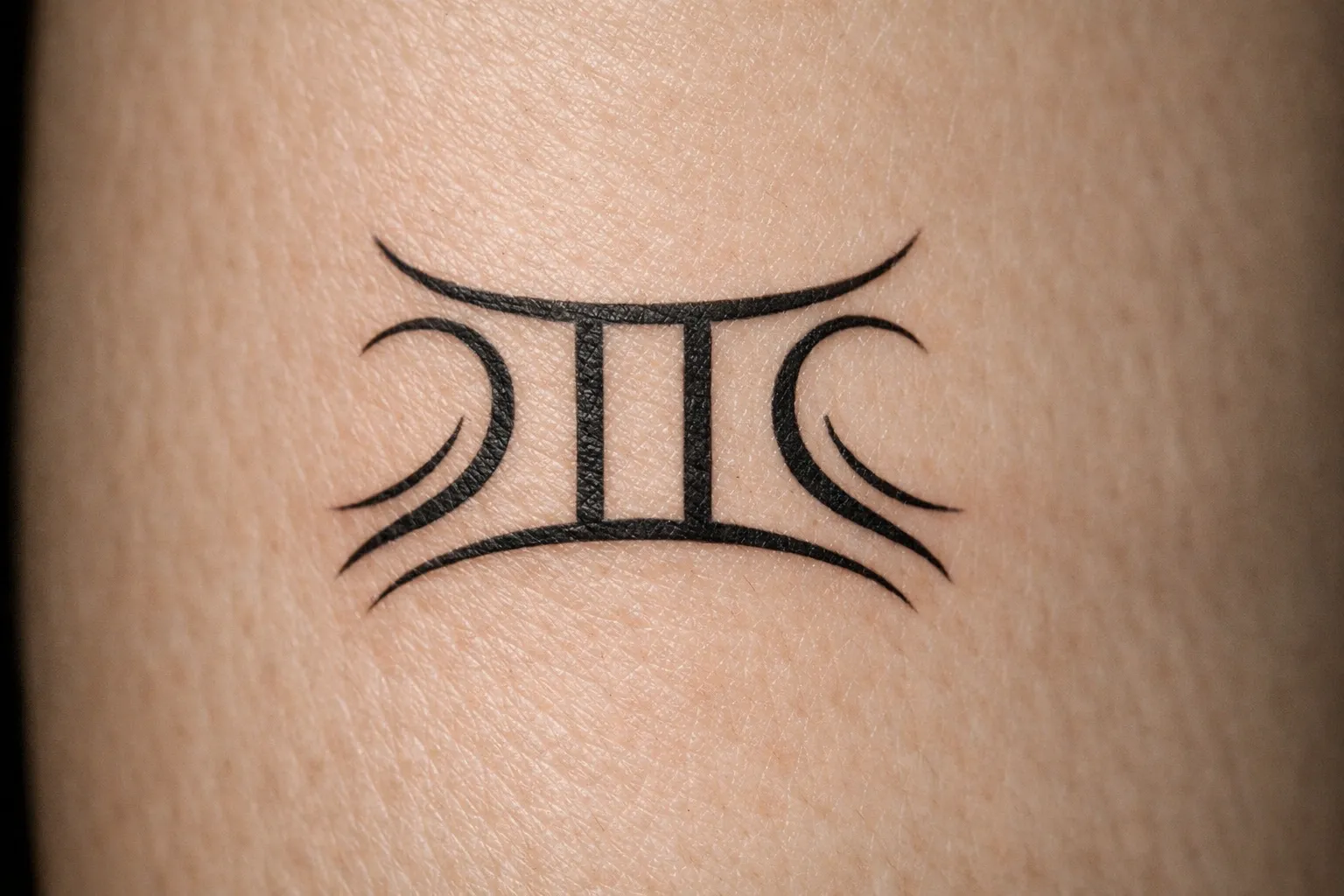
The glyph alone is the fastest, cheapest, most discreet route. It works at 1 to 2 inches on the wrist, ankle, behind the ear, or collarbone, and pairs cleanly with a single star or a birth date. Zensa notes the simple II-shaped symbol stays readable even at 1 inch, unlike detailed twin faces (4). According to OCD Ink Studio’s pricing overview, small minimalist zodiac glyph tattoos in U.S. studios typically start around $80 to $150 for pieces in that range.
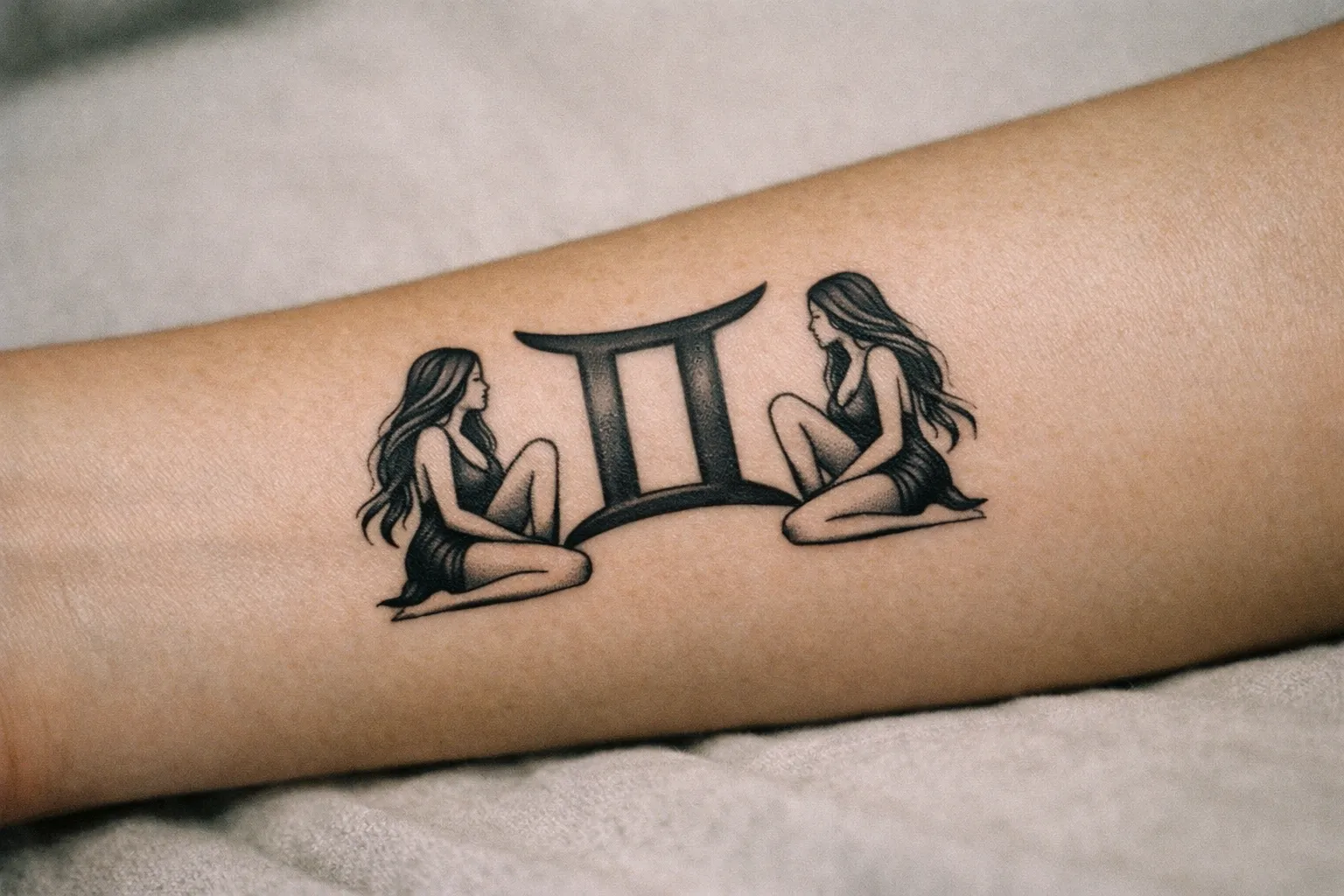
The twin motif is the strongest statement about duality and coexistence: two faces, two figures, two hands, or mirrored silhouettes. The Black Hat Tattoo notes twin pieces are often done as 3 to 6 inch illustrative designs on the forearm, ribs, or upper arm to preserve facial and hand detail (5). Anything under 2 to 3 inches starts losing readability - and I mean that literally, not as a general caution.
The cosmic duality design is the abstract route - sun and moon, day and night, black and negative space. It suits people who want Gemini meaning without literal zodiac imagery on their body.
The Mercury/communication motif works for readers who identify with the curious, talkative side of the sign: speech bubbles, typewriter keys, quotation marks, or text split across two body points.
The mistake to avoid is stacking all four into one tattoo. BlackInk AI’s gallery catalogs over 15,000 Gemini designs as of 2026 (6), and the cluttered ones are almost always the ones that tried to do everything. One dominant idea plus one supporting motif is the stronger approach every time.
Which Design Fits Your Situation
Which Gemini Design Fits Your Situation
| Best for Beginners Glyph | Constellation | Twin Motif | Cosmic Duality | |
|---|---|---|---|---|
| Best For | First-timers, tight budgets | Astrology fans, subtle tattoos | Symbolic statement, duality lovers | Abstract meaning seekers |
| Minimum Readable Size | 1 inch | 2 inches | 3 inches | 3 inches |
| Recommended Placement | Wrist, ankle, behind the ear, collarbone | Collarbone, outer forearm, shoulder | Forearm, upper arm, ribcage | Ribcage, upper arm, back |
| Aging Risk | Low | Moderate (fine lines soften) | Higher at small sizes | Moderate to high |
| Approximate Cost Tier | Low | Mid | High | Mid to high |
| Style Compatibility | Nearly all styles | Fine-line, dotwork | Blackwork, neo-traditional, illustrative | Illustrative, neo-traditional |
Twin Symbolism in Gemini Designs - Castor, Pollux, and the Duality Motif
The twin motif has more depth than “two personalities” once you know the myth. Castor and Pollux come from Greco-Roman tradition as twin brothers - one mortal, one divine. NASA’s constellation background explains their story is embedded directly in the Gemini constellation, and Encyclopedia Britannica notes that Zeus placed the twins in the sky as Gemini, making it one of the earliest recorded twin-symbol myths in Western astronomy. That mortal-and-immortal contrast is why duality here reads as coexistence of opposites, not instability.
The design interpretations break down into a few directions. The Black Hat Tattoo identifies mirror tattoos, two faces, and two hands reaching toward each other as core modern Gemini motifs (7). Zensa adds split or interlocking faces, mirrored siblings, and yin-yang-inspired dual portraits to the list. All of them riff on the same Castor-Pollux narrative.
Now the size reality check. Two detailed faces need 3 to 5 inches (7.5 to 13 cm) minimum. Smaller than that and the facial features blur as the tattoo heals and ages - this is the single most common sizing mistake in Gemini tattoos. When clients push back on sizing up, I show them healed photos of undersized twin work. That usually settles it.
Style pairings that hold up:
- Illustrative blackwork for bold twin portraits with strong contrast
- Fine-line for delicate mirrored silhouettes
- Neo-traditional for bold outlines with a limited palette
On placement, the twin motif wants a flat, relatively stable skin surface: forearm, upper arm, ribcage, or spine. Avoid high-movement zones like the inner elbow or the back of the knee, where the detail distorts faster.
Delicate Directions for Women That Still Carry Meaning
Searches for Gemini For female skew toward delicate linework, florals, crescent moons, script, and small placements. Those are aesthetic preferences, not design limitations - the symbolism stays fully intact either way.
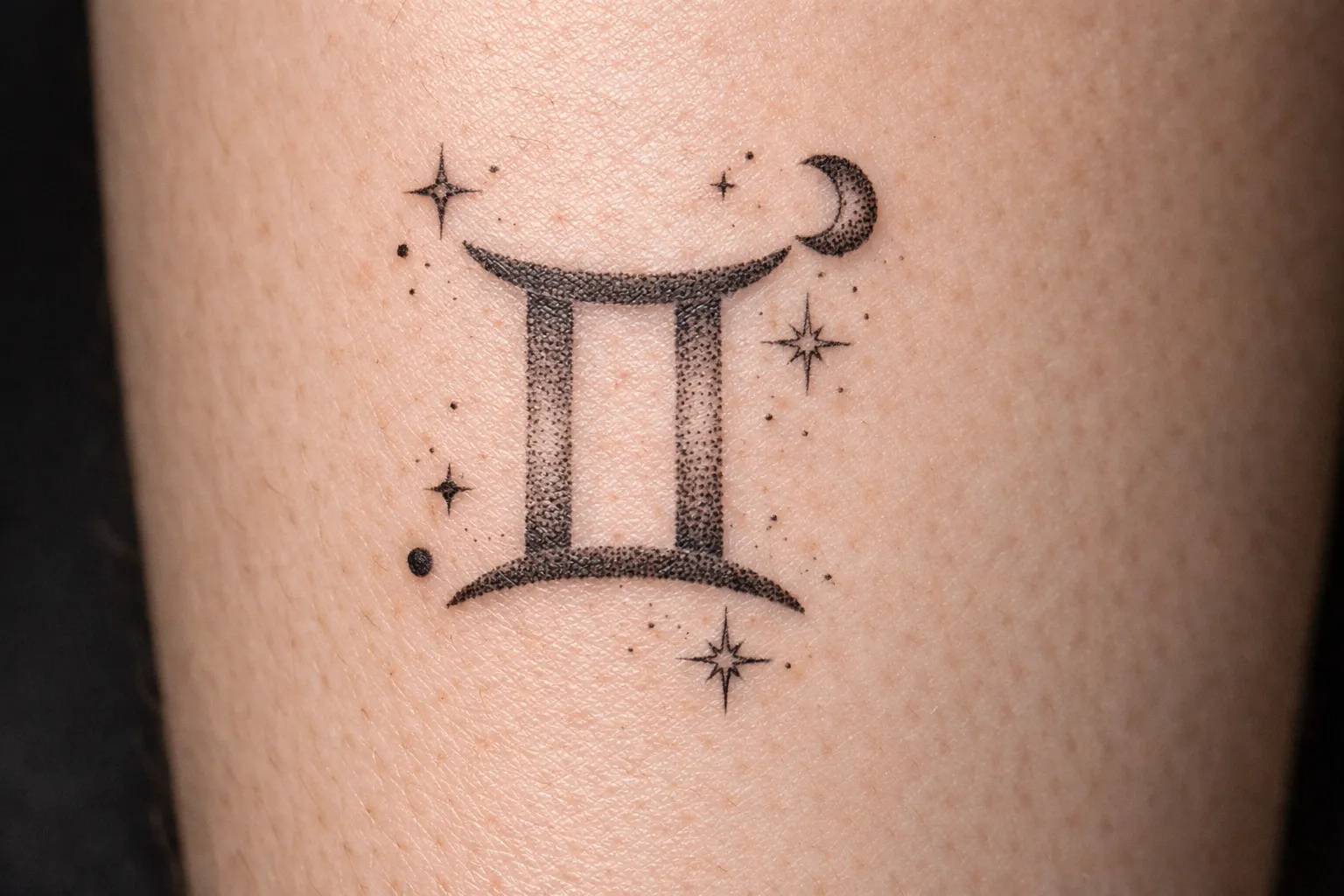
The most versatile direction is a small glyph near a floral element. Zensa reports that lavender and lily of the valley are recognized Gemini flowers, with lavender specifically cited as the birth flower. That gives the florals actual meaning instead of arbitrary decoration. Our Mindful Life adds that lavender’s florets growing in different directions get used symbolically to echo the sign’s multi-directional energy - a nice detail if you want the piece to mean something beyond looking good.
Combinations that work well:
- Fine-line constellation plus a crescent moon on the collarbone, 3 to 4 inches (7.5 to 10 cm)
- Glyph plus a lavender sprig on the inner wrist or ankle, 1.5 to 2.5 inches (4 to 6 cm)
- Mirrored twin silhouettes in delicate linework on the sternum or ribcage
- Script - birth dates or a Mercury-linked quote - split across two wrists or two ankles for a matching-with-yourself effect
A style note on longevity: fine-line and single-needle work suit these aesthetics, but they age faster on high-movement placements. Zensa observes that fine-line zodiac designs on the collarbone and inner wrist are disproportionately favored by women seeking understated symbolic pieces. Of those, the collarbone and upper arm hold detail far better than the wrist or ankle over time.
One caveat: “feminine” doesn’t require flowers. A clean glyph or a minimal constellation reads just as elegantly, and it ages better.
Small Gemini Tattoos for Females - Placement and Size Guide
- Behind the ear: glyph or a 3-star cluster, 0.75 to 1.5 inches (2 to 4 cm). Subtle, with a fast session around 15 to 30 minutes.
- Inner wrist: glyph plus a single star or small constellation, 1 to 2 inches (2.5 to 5 cm). Moderate aging risk on a high-movement spot.
- Collarbone: constellation or glyph plus a floral, 2 to 4 inches (5 to 10 cm). One of the best placements for fine-line longevity.
- Sternum: twin silhouettes or a cosmic duality design, 3 to 5 inches (7.5 to 13 cm). Higher pain than the forearm, but strong visual impact.
Bolder Directions for Men - Designs and Placement Logic
Male-skewing searches favor forearm placements, larger compositions, blackwork, and illustrative styles. The symbolism is identical - the execution just shifts bolder. BlackInk AI’s database shows forearm and upper-arm placements dominate male-tagged Gemini tattoos, often with bold blackwork or illustrative twin portraits between 4 and 6 inches in height.
Strong directions:
- A bold twin portrait in illustrative blackwork on the forearm or upper arm, 4 to 6 inches (10 to 15 cm)
- The Gemini constellation as a sleeve filler or standalone forearm piece, 3 to 5 inches (7.5 to 13 cm)
- Cosmic duality - sun and moon, light and shadow - in neo-traditional style on the upper arm or chest
- The glyph integrated into a larger geometric or abstract composition on the forearm or calf
The Black Hat Tattoo highlights illustrative blackwork twins, abstract air motifs, and cosmic duality pieces on the forearm and chest as particularly popular among male clients. The forearm is the most-searched placement here because it suits both the constellation (running along the arm’s line) and the twin motif (across the width). The inner forearm is easier to cover for professional settings.
Size note: a twin illustration under 2 inches becomes an unreadable blob on male forearm skin. Size up to at least 3 to 4 inches (7.5 to 10 cm) for any face or figure detail. OCD Ink Studio notes that medium-to-large zodiac tattoos with complex detail belong on larger canvases like the chest, back, or sleeve - which lines up with most men’s placement choices.
For matching or mirrored tattoos with a partner or friend, split the design across two forearms or two upper arms. It aligns with the duality theme and works as a quiet nod to the sign rather than a billboard.
Placement, Pain, and How Gemini Designs Age Over Time
This is the practical layer most articles skip, and it’s the layer that decides whether you still like the tattoo in five years.
Placement by design type:
- Glyph alone: wrist, ankle, behind the ear, collarbone. Small footprint, but the wrist and ankle carry higher aging risk for fine lines.
- Constellation: collarbone, outer forearm, back of shoulder, side rib. Flat, stable skin holds dot-and-line work best.
- Twin motif: forearm, upper arm, ribcage, spine. Needs space and a relatively flat surface.
- Cosmic duality and larger compositions: ribcage, upper arm, back, sternum.
Pain, in relative terms: the ribcage and sternum are more intense than the forearm. The Cleveland Clinic’s tattoo pain guidance notes that areas directly over bone - like the ribs and sternum - generally cause more discomfort than fleshier regions such as the outer upper arm. The forearm is moderate and forgiving for longer sessions. The wrist and behind-the-ear spots are more sensitive, but at small sizes the session is short, so the sting ends quickly.
How these designs age:
- A fine-line constellation under 1.5 inches will lose its star detail as the lines soften - size up or use slightly heavier dot weights. The American Academy of Dermatology explains that tattoos on areas with frequent movement and friction blur and fade faster than work on flatter, stable areas.
- Twin faces under 2 inches can become unreadable. A 2018 review in the Journal of Clinical and Aesthetic Dermatology notes that fine-line and small-detail tattoos are more susceptible to line spreading and pigment migration over time, especially on thin or mobile skin. That’s exactly the twin-face problem.
- The glyph is the most aging-resistant option because it’s simple geometry. Even if the lines soften, the II shape still reads.
- High-movement placements (inner elbow, back of knee, fingers) accelerate blowout and fading for any fine-line work.
The AAD also stresses that sun exposure accelerates fading in both black and colored ink, particularly on exposed spots like the forearms and wrists, unless you use broad-spectrum sunscreen consistently after healing.
Session timing: a small glyph runs 15 to 45 minutes. A constellation or fine-line hybrid takes 1 to 2 hours. A detailed twin illustration runs 2 to 4 hours. A large cosmic composition may need two sessions.
What a Gemini Tattoo Costs - Three Budget Tiers
Most articles skip pricing entirely. Here’s the realistic market range.
Tier 1 - Minimal glyph or small symbol (1 to 2 inches / 2.5 to 5 cm): roughly $80 to $150 at most U.S. shops, with a session of 15 to 45 minutes. A 2023 cost survey by TattooSEO reports that small tattoos in this range are largely driven by shop minimums rather than time alone. Best for first-timers and tight budgets.
Tier 2 - Constellation or fine-line hybrid (2 to 4 inches / 5 to 10 cm): roughly $150 to $300 or more depending on artist minimums and city pricing, with a session of 1 to 2 hours. The same TattooSEO data ties this range to fine-line constellations and glyph-plus-floral designs.
Tier 3 - Detailed twin illustration or cosmic composition (4+ inches / 10+ cm): roughly $300 to $800 or more. A 2022 pricing guide from Inked Magazine puts larger detailed pieces in this range, with many artists charging hourly rates between $150 and $250. Exact symmetry or large coverage may require two sessions.
For matching or mirrored tattoos, budget for two placements and potentially two sessions. TattooSEO confirms that matching tattoos effectively double the placement cost, since each person typically pays the studio minimum or per-piece rate even when the designs are related.
The Alliance of Professional Tattooists advises that most custom tattoos start with a 15 to 30 minute consultation, often free or with a small drawing fee credited toward the final session. Bring no more than 3 reference images - more than that confuses the brief and produces a collage instead of a coherent design. These are market-range estimates, not guarantees; artist minimums vary by city and reputation.
How to Brief Your Artist for a Custom Gemini Design
30 minutesA step-by-step guide to preparing a clear and effective tattoo brief for your Gemini design.
- 1
Choose your anchor symbol
Pick one dominant element: glyph, constellation, twins, or cosmic duality.
- 2
Add one supporting motif
Select a star cluster, birth flower, Mercury reference, or mirrored element to complement your anchor.
- 3
Decide on placement and size
Use placement and aging guidance to commit to a minimum size that holds detail.
- 4
Choose your style
Fine-line, blackwork, neo-traditional, or illustrative - this affects which artist you need.
- 5
Build your reference folder
Gather up to 3 images: composition, line weight/texture (preferably healed), and placement context.
- 6
Write a one-sentence brief
Summarize your concept clearly, e.g., 'Fine-line Gemini constellation with a small lavender sprig, 3 inches on the collarbone, blackwork only.'
Aftercare for Fine-Line and Detailed Gemini Tattoos
Fine-line Gemini tattoos are more vulnerable to blowout and premature softening than bold blackwork, so aftercare matters more for these styles. This is a healing timeline for a permanent tattoo, not a temporary one.
- Days 1 to 3: keep the tattoo wrapped or covered as your artist directs. Wash gently with a fragrance-free soap and apply a thin layer of fragrance-free moisturizer 2 to 3 times daily. No soaking, no picking. The American Academy of Dermatology advises exactly this gentle wash-and-moisturize routine for the first few days.
- Week 1: peeling and flaking begin. Mayo Clinic guidance notes this typically starts within the first week. Keep using a fragrance-free lotion and stay out of direct sun on the fresh tattoo.
- Weeks 2 to 4: the outer skin heals. Once your artist clears it, apply a broad-spectrum SPF. Mayo Clinic recommends avoiding swimming and soaking for at least 2 weeks to reduce infection risk and pigment loss - hold off on the pool and heavy gym sessions that stretch the skin.
Long-term, sun exposure is the fastest way to fade a fine-line constellation or glyph. The AAD stresses that healed tattoos on sun-exposed areas should be protected with a broad-spectrum SPF 30 or higher - on exposed placements that’s non-negotiable. A review in Clinical, Cosmetic and Investigational Dermatology found that proper aftercare in the first 2 to 4 weeks significantly reduces complications including premature pigment loss.
One placement-specific note: wrist and ankle tattoos flex constantly, which accelerates line softening in fine-line Gemini work. Moisturize consistently and plan to touch up earlier than you would a forearm piece.
Frequently Asked Questions
- What tattoo is lucky for Gemini?
- The glyph paired with Mercury-linked imagery - especially the constellation with a few star accents - is widely cited as a fortunate design for the sign. Zensa notes the simple glyph is considered the most direct lucky symbol, particularly with stars or communication motifs. If you want one single lucky symbol, the glyph alone is the most direct choice.
- What does the Gemini symbol look like as a tattoo?
- It resembles the Roman numeral II - two vertical lines connected by short horizontal strokes at the top and bottom. As a tattoo it's clean, geometric, and readable down to about 1 to 2 inches. It's the most aging-resistant Gemini design because simple geometry holds its shape far better than fine-line faces or micro constellation dots.
- What's the difference between a glyph tattoo and a constellation tattoo?
- The glyph is the zodiac symbol, the II shape. The constellation is the actual star map of Castor and Pollux rendered as dots and connecting lines. The glyph is faster, cheaper, and more durable at small sizes; the constellation is subtler and more astrology-specific but needs at least 2 inches to stay readable long-term. Plenty of people combine both.
- Do Gemini tattoos work as matching tattoos?
- Yes - the duality theme makes Gemini one of the most natural zodiac signs for matching or mirrored designs. Common approaches: split a constellation across two forearms, mirror the glyph on two wrists, or use the twin motif as a shared design. Budget for two sessions if your artist wants exact symmetry.
- Are Gemini tattoos more painful on some placements than others?
- Yes. The ribcage and sternum are more intense than the forearm, which is moderate and forgiving for longer sessions. The wrist and behind-the-ear spots are more sensitive, but sessions are short at small sizes. Fine-line work on the wrist also ages faster due to constant movement, so weigh pain against longevity.
- Who will Gemini usually marry?
- That's an astrology compatibility question rather than a tattoo one. The American Federation of Astrologers lists Libra, Aquarius, and Aries as traditionally compatible with Gemini in Western astrology. If you're considering a couples tattoo, the duality motif - mirrored glyphs or a split constellation - works regardless of your partner's sign.
What Actually Matters Before You Book Your Gemini Tattoo
Three decisions determine whether this tattoo ages well. First, your anchor symbol - glyph, constellation, or twins. Second, your placement - flat, stable skin holds detail; high-movement zones like the wrist, inner elbow, and fingers don’t. Third, your size - hit the minimum readable dimension for your chosen design, because that’s where most Gemini tattoos fail.
The most useful design principle in this whole guide is also the simplest: one dominant idea plus one supporting motif. Resist the urge to cram the glyph, the twins, the constellation, and a Mercury reference into one piece. The cluttered ones never age well. If you’re weighing one zodiac glyph against another, the Sagittarius tattoo and Aries tattoo guides walk through the same size-versus-detail tradeoffs for other signs.
Decide your anchor symbol first. Then choose a placement that can actually hold the detail level you want. Show up with a clear brief and 3 good references, and the artist can handle the rest.