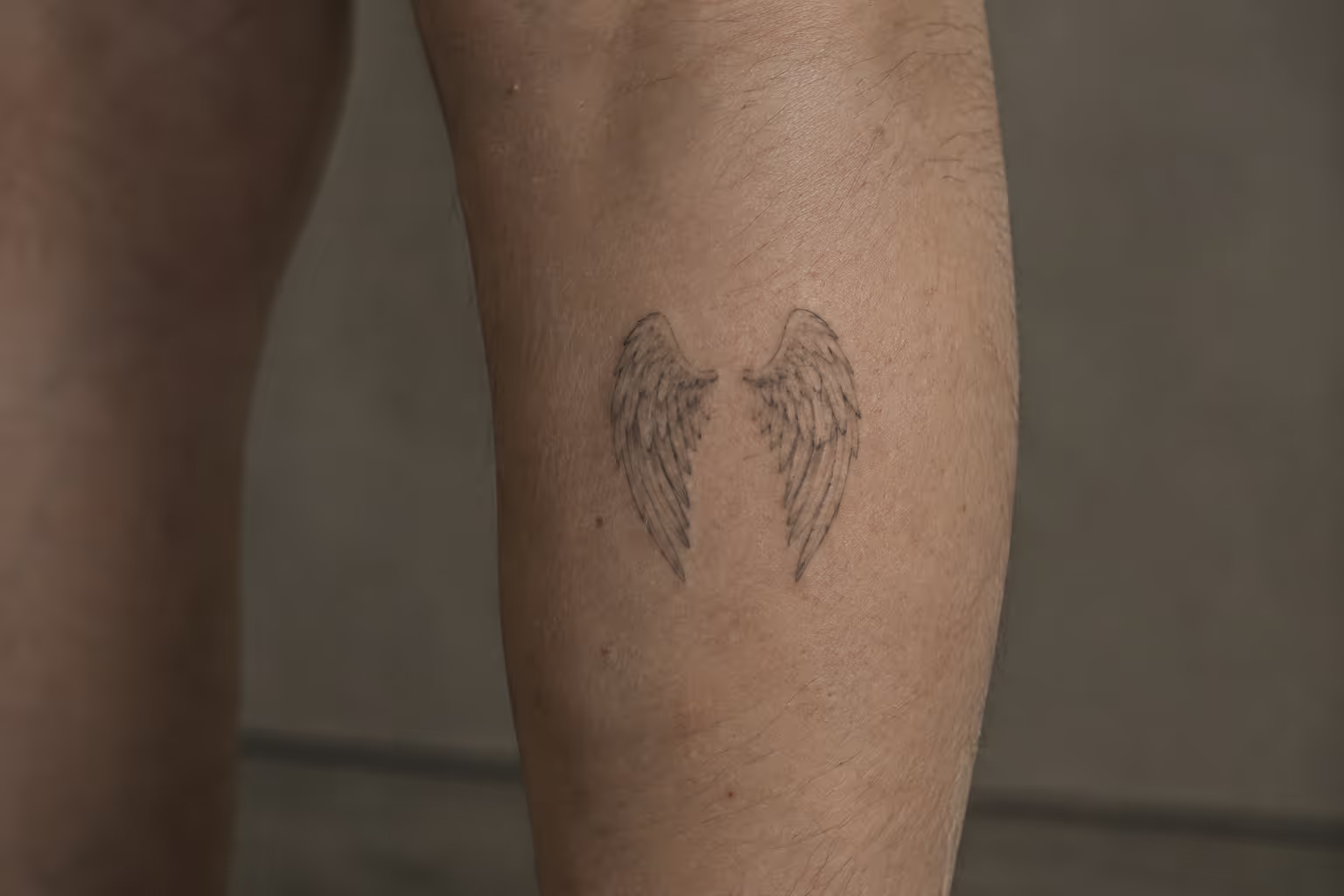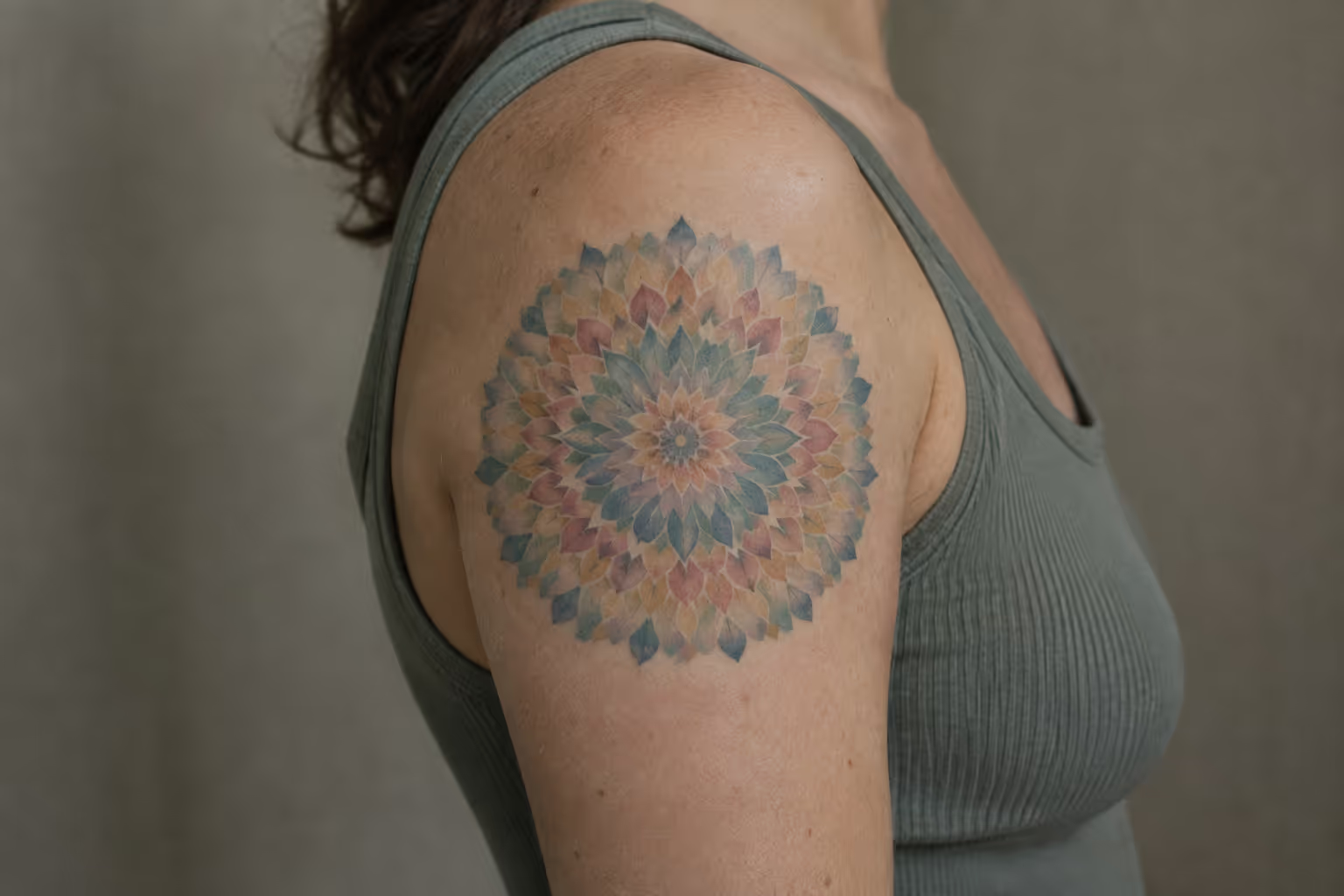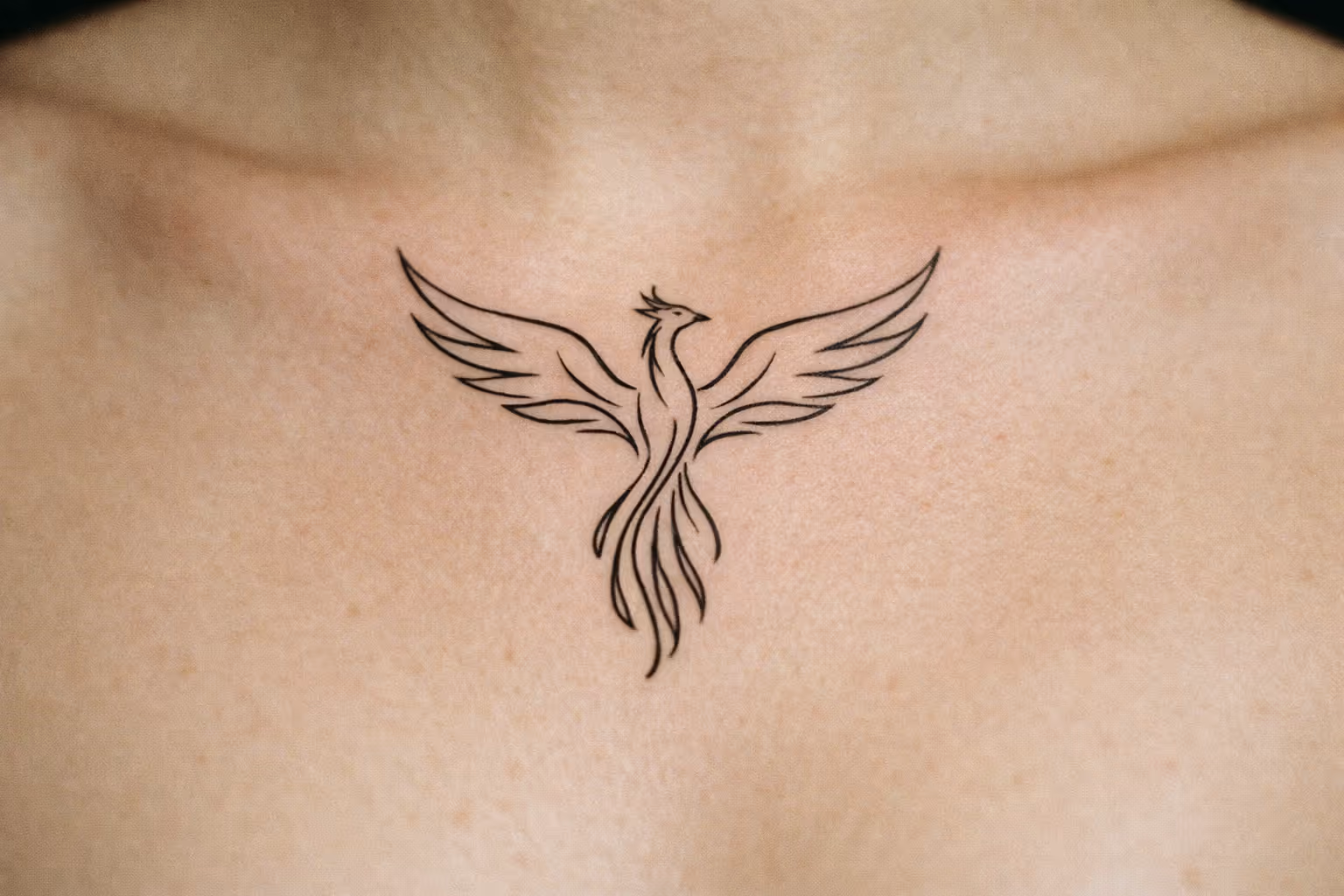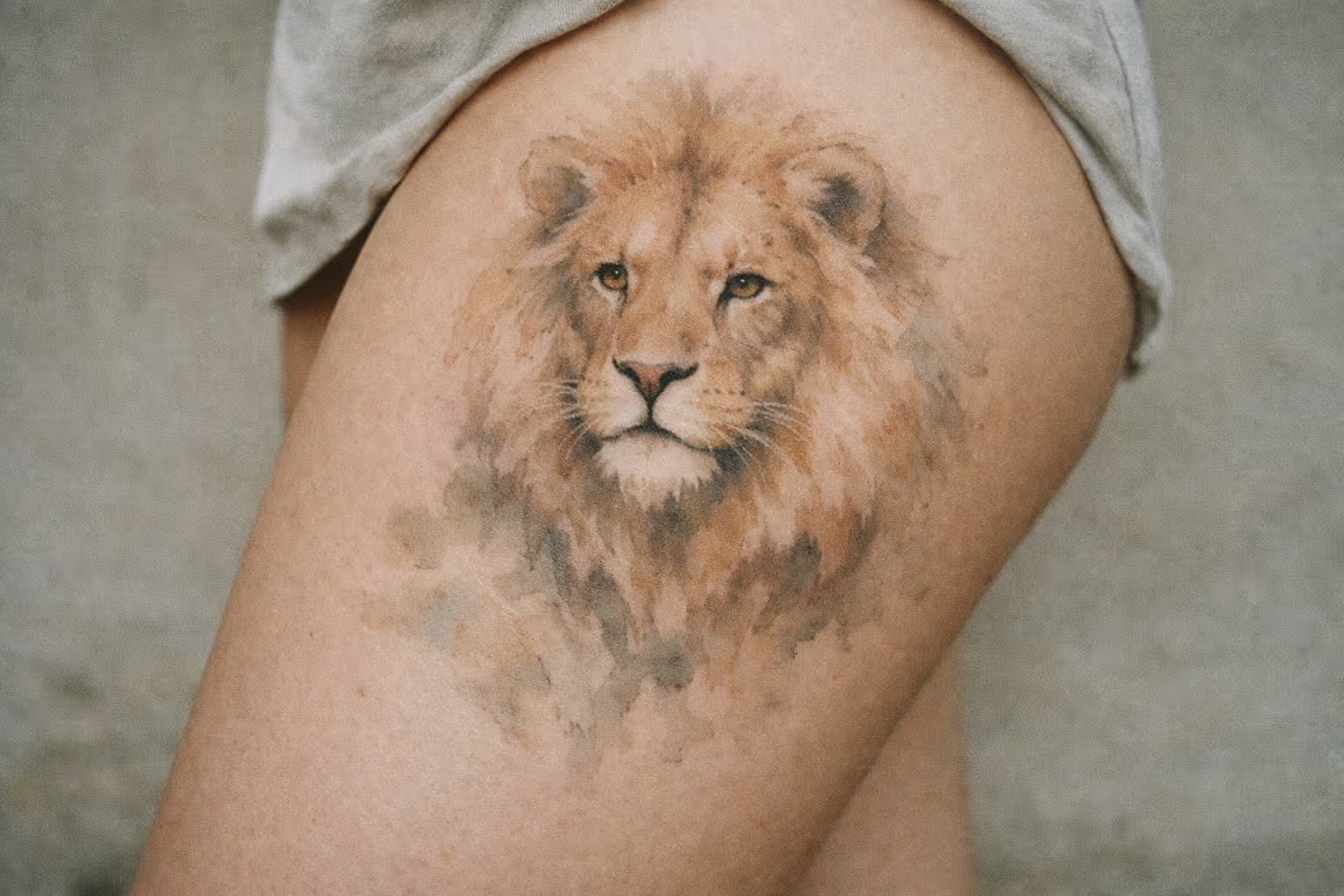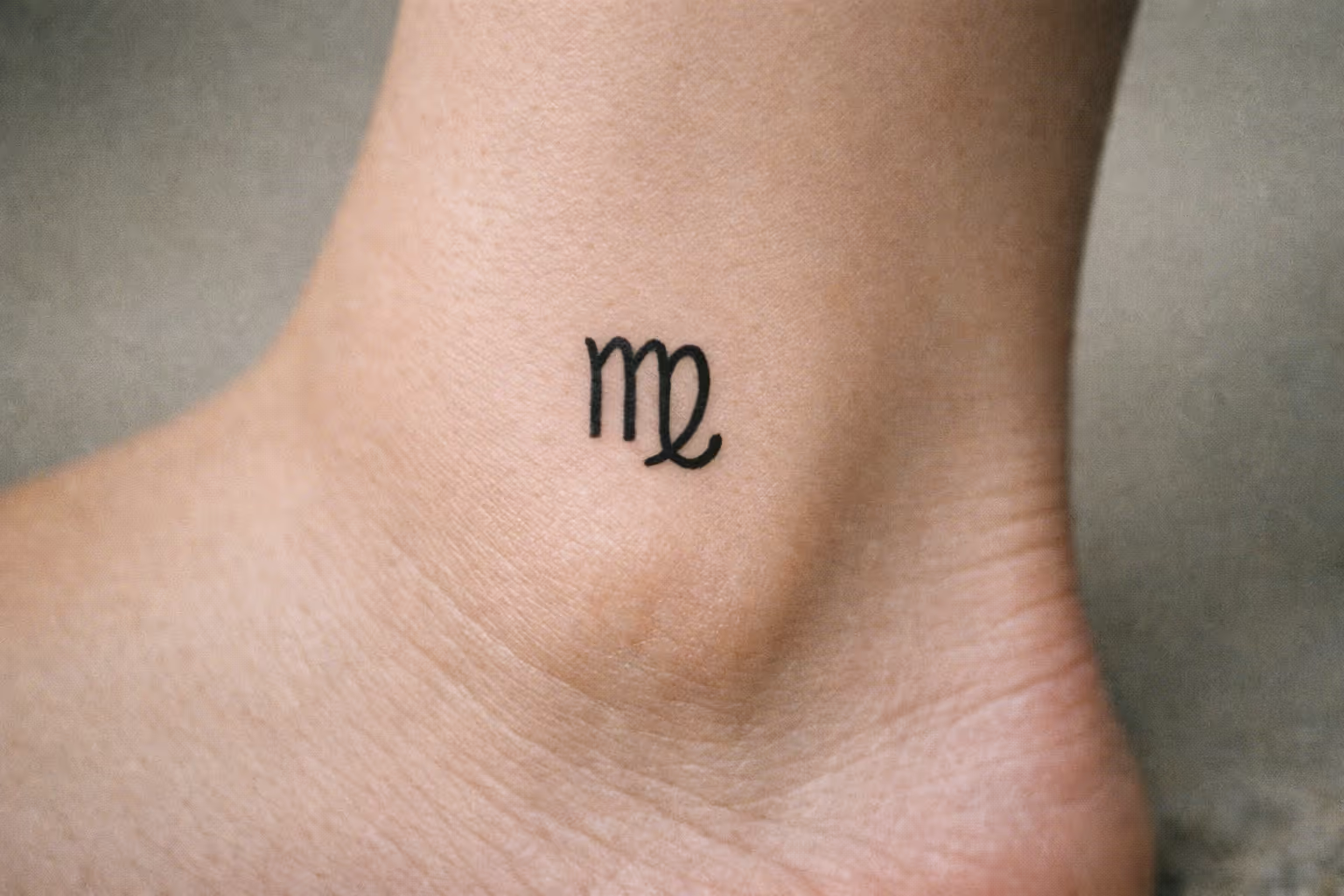
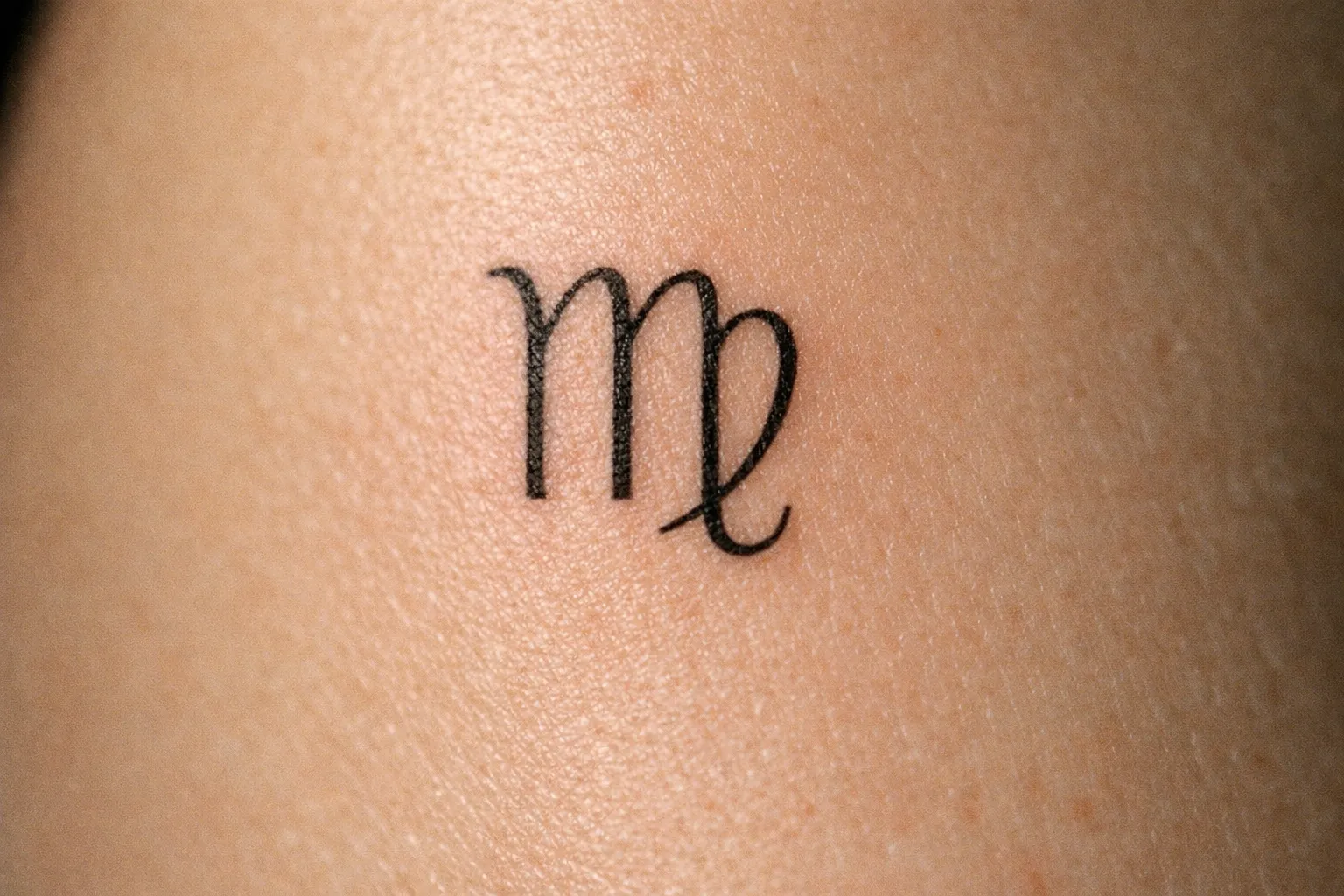
The Virgo glyph is a compact “M” with a curled tail looping back on itself, and it’s one of the more technically demanding zodiac symbols to execute cleanly at small scale. A Virgo tattoo usually draws on one of three core symbols - the maiden, the glyph, or the constellation - each carrying its own meaning and requiring different sizing and placement decisions. Virgo is generally given as August 23 to September 22 (1), though the exact cutoff shifts by a day depending on the year and time zone - if you were born on either boundary date, a precise birth chart will confirm your Sun sign, per BeBeautiful. It’s a mutable earth sign ruled by Mercury, and most people searching for a Virgo tattoo right now want something precise and understated. That happens to match the sign’s personality almost too well.
I’m treating you here as someone who already knows they want this tattoo and needs to choose between the three symbol categories, then place and heal it correctly. Not someone who needs convincing.
✓ Pros
- Three distinct symbol options (maiden, glyph, constellation) suit very different size ranges and placements
- Fine-line and minimalist execution matches current tattooing trends and ages reasonably well on low-movement placements
- Real mythological depth - Ceres, Demeter, Astraea - for anyone who wants more than a bare symbol
- Flexible commitment: a 20-minute glyph or a multi-session goddess portrait, same sign either way
✗ Cons
- Fine-line work is the least forgiving style long-term. Blowout or scabbing on thin lines distorts the precision the whole design depends on
- Maiden and goddess designs need real skin real estate - upper arm, thigh, back - to hold facial detail
- Overcrowding (glyph plus constellation plus wheat plus goddess in one piece) produces visual noise that contradicts Virgo's clean aesthetic
- High-movement placements like fingers and inner wrist degrade fine linework faster than other zodiac tattoos
Virgo Tattoo: Core Symbols, Designs, and Placement for the Virgo Zodiac Tattoo
Virgo is symbolized by three distinct images - the maiden, the glyph, and the constellation - all tied to its identity as a mutable earth sign ruled by Mercury (1). That combination (earth for grounded practicality, mutable for adaptability, Mercury for analytical thinking) is why a virgo zodiac tattoo tends toward clean lines and organized composition more than almost any other sign. Understanding what each symbol actually means will save you from committing to imagery that misses the point.
The Maiden and Her Mythological Roots
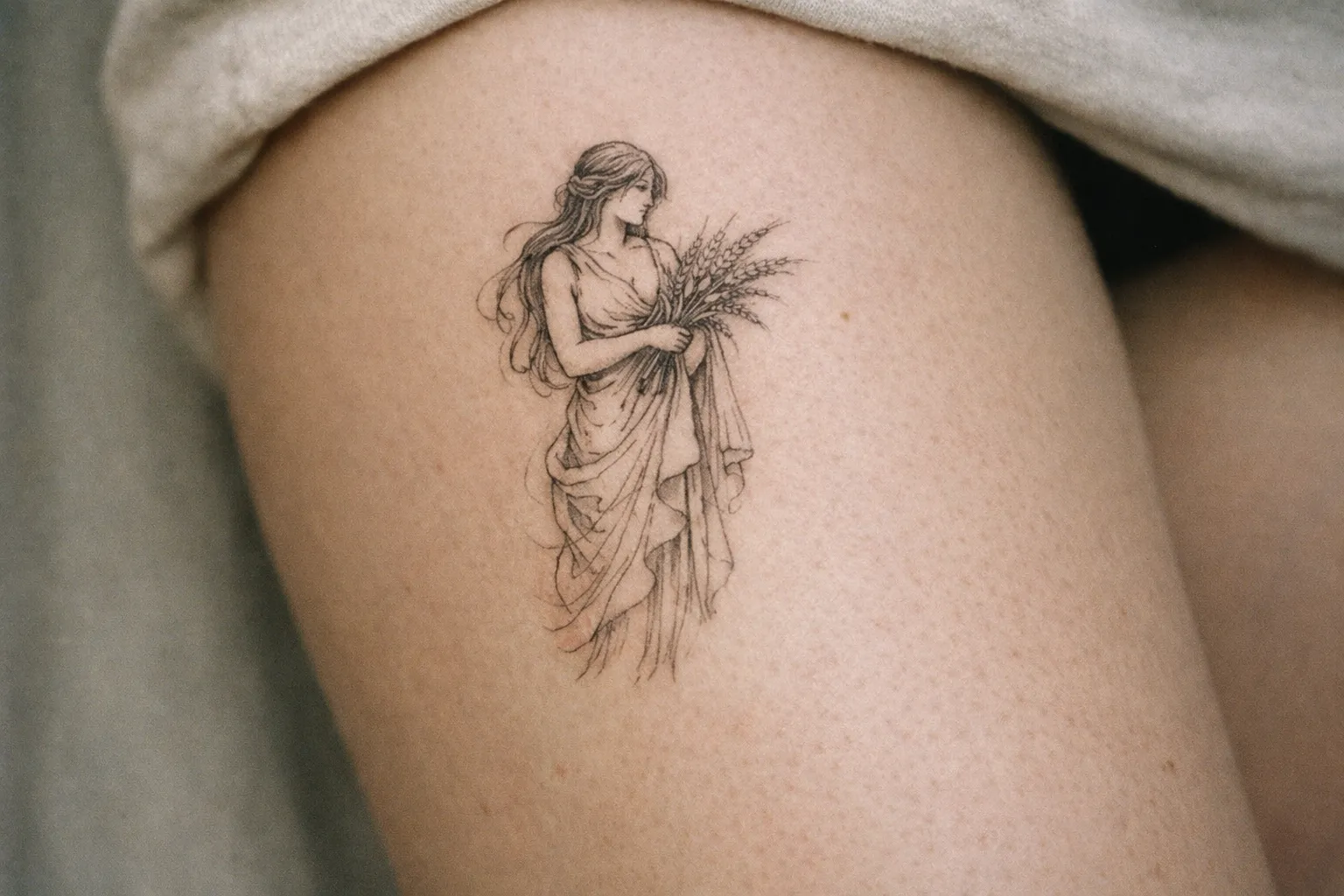
The maiden - often called the virgin - is the oldest Virgo symbol, and it gets routinely misread. It has nothing to do with sexual innocence. The correct frame is discernment, purity of purpose, and service. The figure draws from a cluster of harvest and justice goddesses: Ceres (Roman) and Demeter (Greek), both agricultural deities, and Astraea, the goddess of justice and innocence who, in myth, was the last immortal to leave Earth before ascending to become the constellation Virgo. The wheat the maiden carries in classical imagery comes straight from that harvest lineage.
The Glyph - Compact, Medical, and Misunderstood
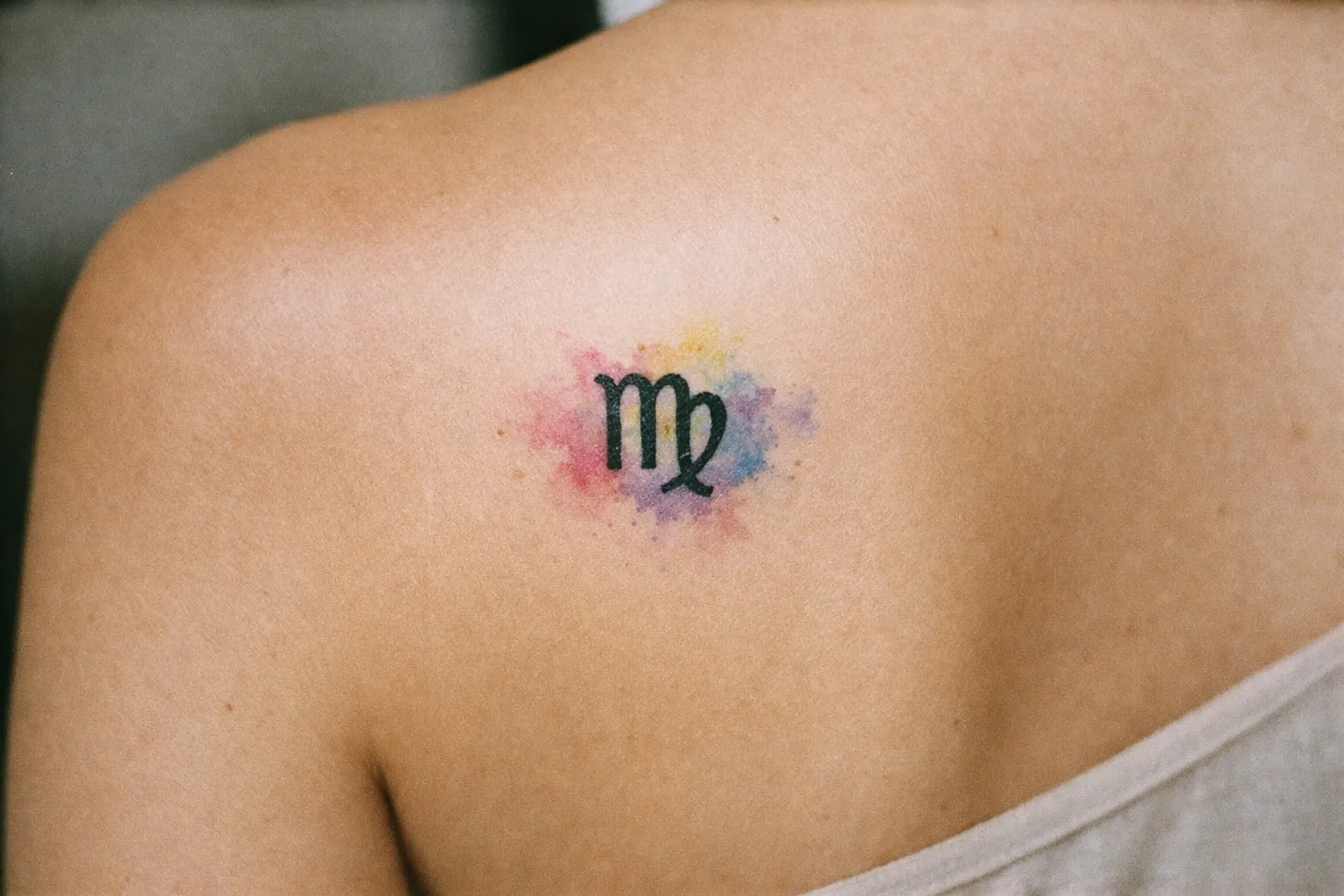
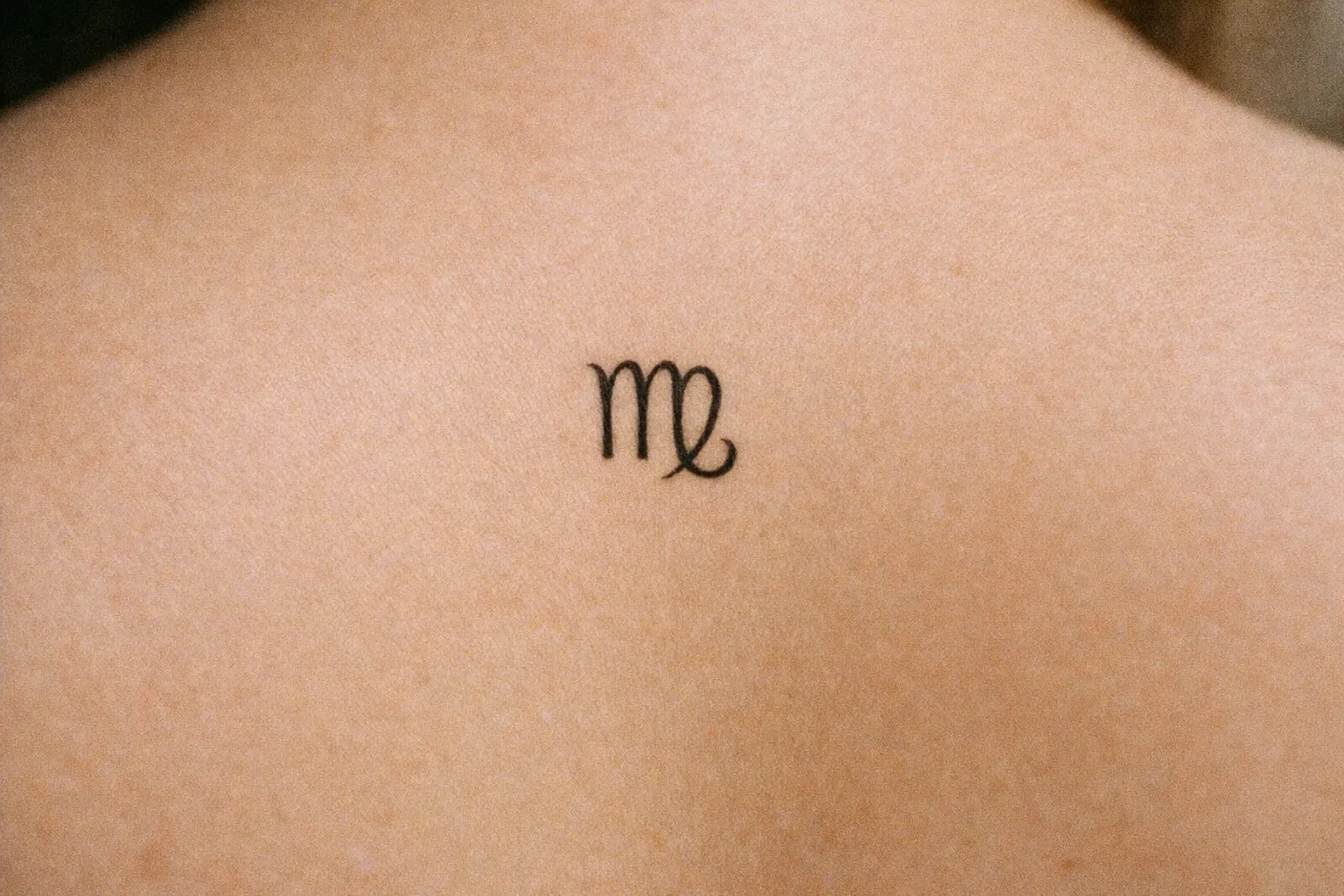
The Virgo glyph is that stylized “M” with a curled tail. Its origins are debated: it may stand for “M” as in Maiden, or it may be a shorthand depiction of a maiden carrying a sheaf of wheat. It also carries a dual association with medicine and healing, which fits the sign’s service orientation. As a virgo symbol tattoo, it’s the most immediately readable option - one small, self-contained mark that anyone astrology-literate recognizes on sight.
The Constellation’s Star Pattern
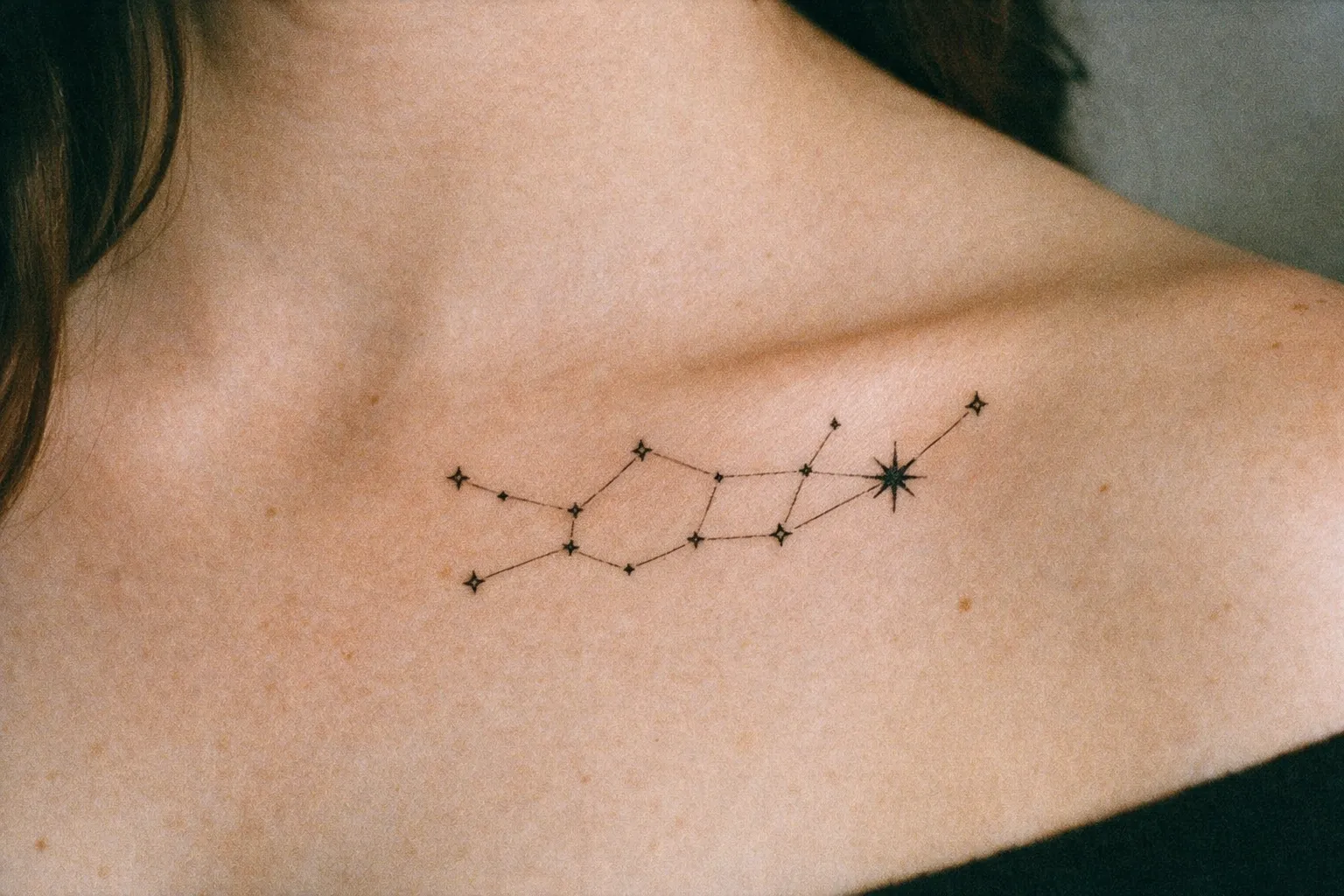
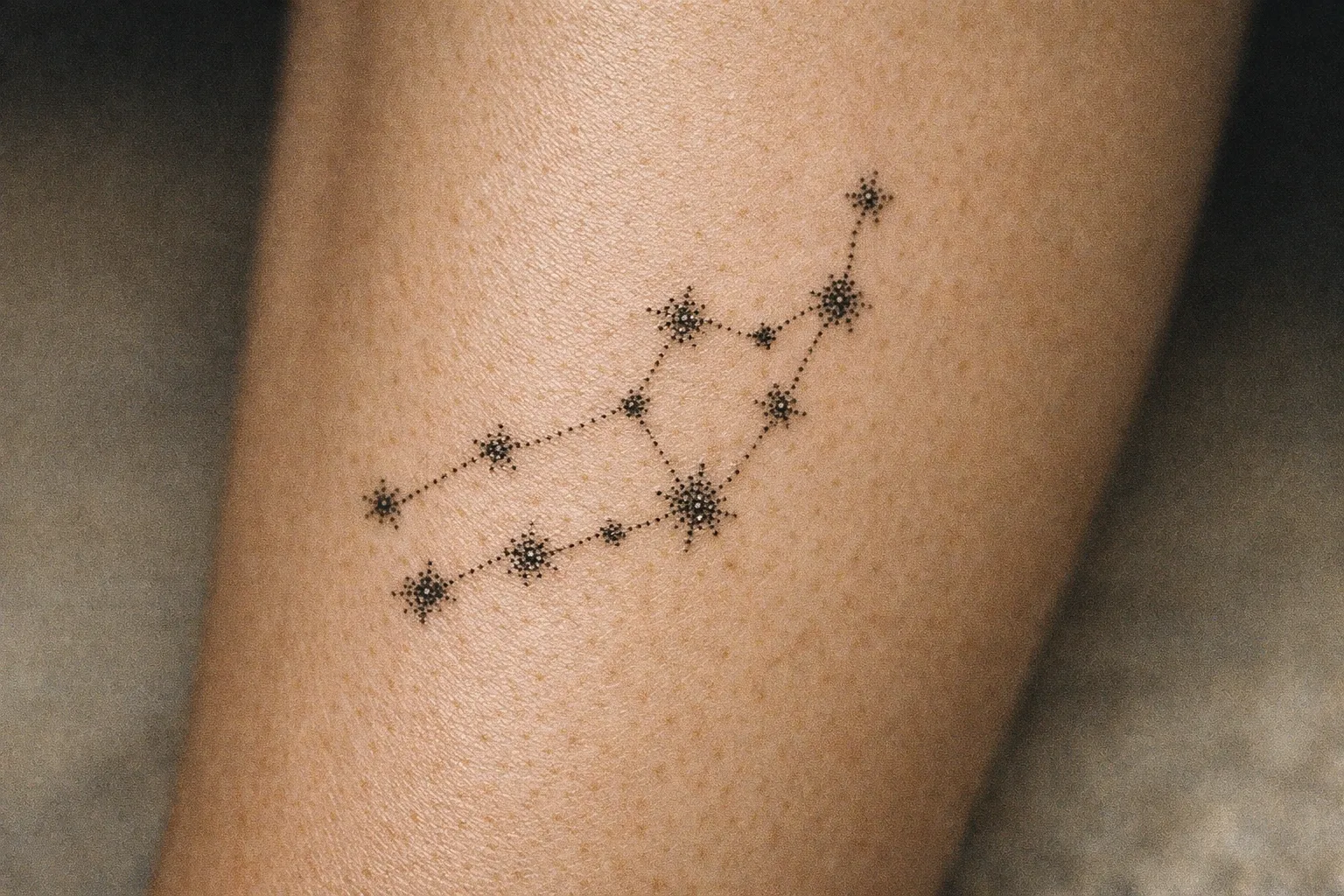
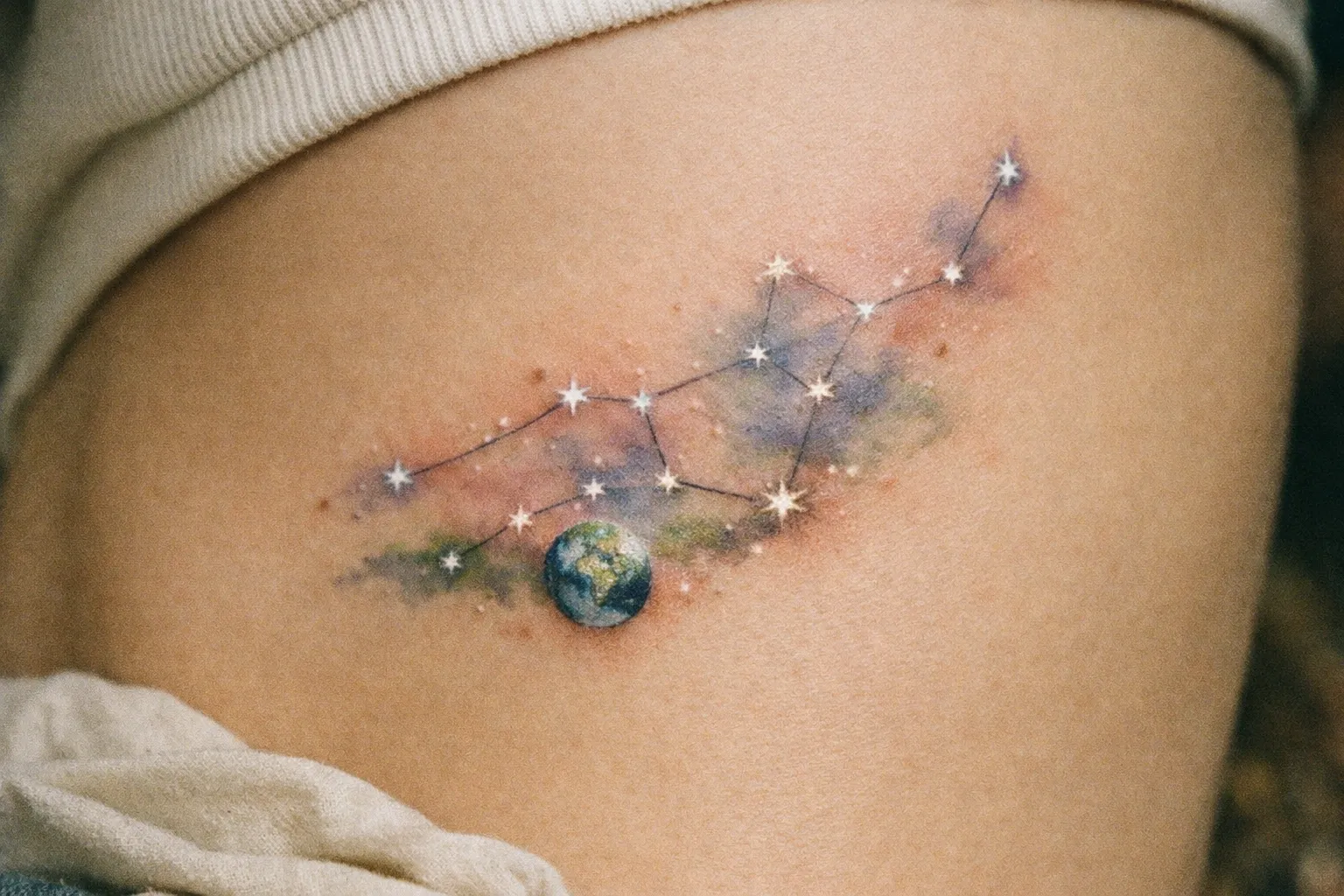
The Virgo constellation uses roughly 6 to 10 stars connected by fine lines, anchored by Spica (Alpha Virginis), the brightest star in the pattern (2). When those stars are connected, the shape loosely suggests the outline of a demurely dressed woman - which is exactly why the constellation reinforces the maiden imagery rather than contradicting it. If you want the celestial version to read as Virgo specifically, Spica’s position is the detail that sells it.
Maiden and Goddess Motifs in Virgo Tattoo Designs
Maiden and goddess pieces are the most visually complex virgo tattoo designs, and they demand the most skin. If you want facial detail, drapery, and wheat to survive years of healing and aging, you cannot cram this into a wrist spot. Plan for size from the start.
Full Goddess Portrait - Sizing and Placement
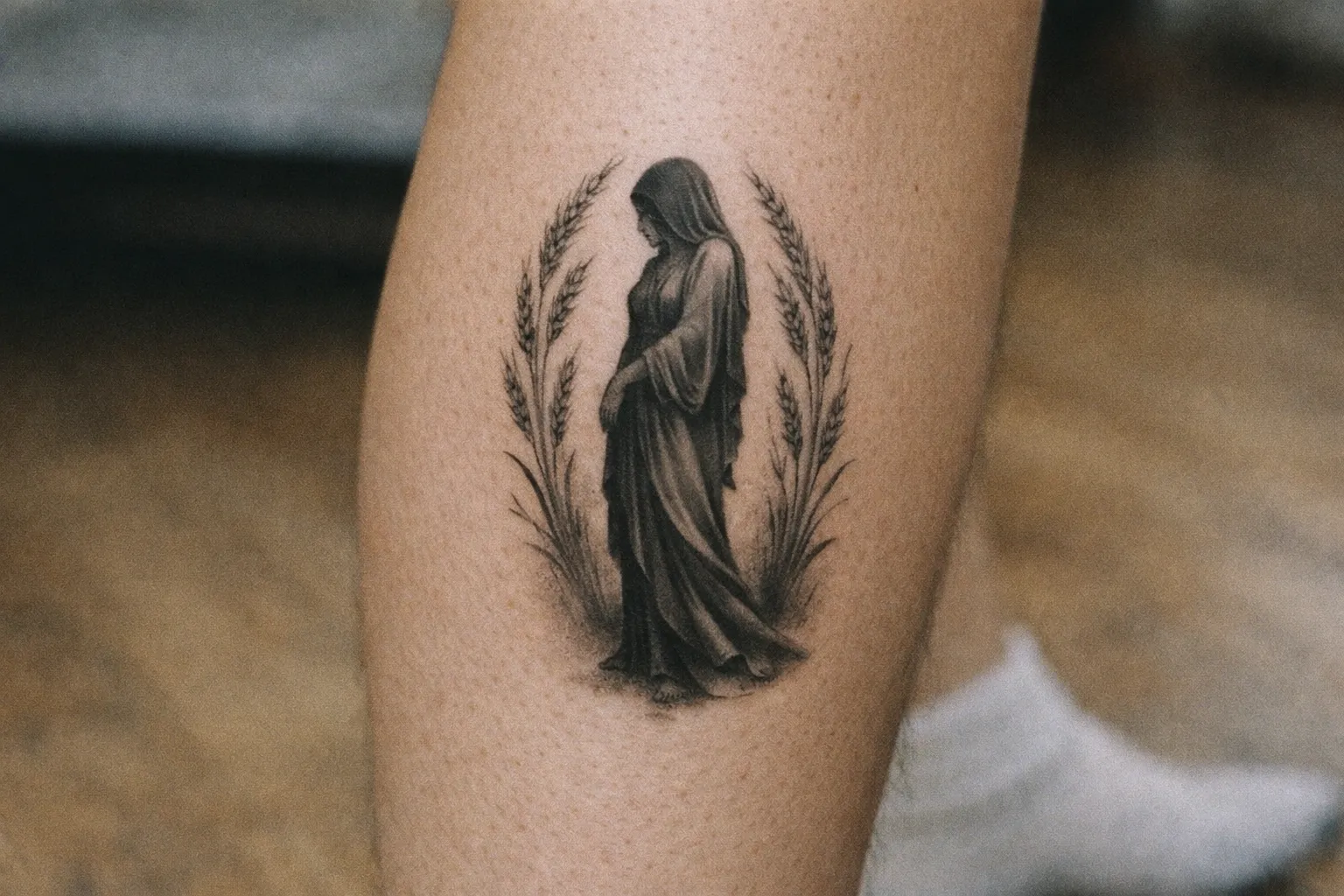
A full-body maiden with wheat sheaves - drapery, wheat stalks, a downcast gaze - is the classic composition. To hold facial features and fabric folds without blurring, plan for 15 to 25 cm in height on the upper arm, thigh, or back. Going smaller than that with this much detail is the single most common way these pieces fail.
A portrait-style goddess pins the design to a specific figure rather than a generic maiden. Ceres or Demeter ties the piece to agriculture and abundance; Astraea ties it to justice and the stars. Either choice gives the tattoo a narrative anchor beyond “I was born in Virgo season,” and both read as more considered than a nameless female figure.
Botanical framing suits these larger pieces well. Wheat wreaths, morning glory (one of several flowers associated with Virgo, alongside chrysanthemum and aster, according to FoliageFriend and Vivify Tribe), oak leaves, and vines work as compositional borders around the figure rather than competing standalone motifs. Keep them supporting the goddess, not fighting her for attention.
Minimalist Maiden Silhouette - Where Fine-Line Works
If you want the maiden read without the surface area, a fine-line silhouette - an outline with no internal shading - works at 8 to 12 cm on the outer forearm or thigh. You lose facial detail at this scale, but the symbolic read survives. This is the version that suits people who want the maiden without a half-day session.
For a virgo tattoo for female placement, editorial coverage consistently points to the ribs, collarbone, and thigh for maiden silhouettes, and the upper arm and back for full goddess portraits. Those are the spots that give the design enough flat, low-movement space to hold up.
One pitfall worth repeating: overcrowding. Adding the glyph plus the constellation plus wheat plus the maiden into one piece produces exactly the visual noise that contradicts Virgo’s clean, organized aesthetic. Pick a lead motif and let the rest support it, or leave it out entirely.
Size, Placement, and Fine-Line Execution for Virgo Constellation Tattoos
A virgo constellation tattoo is the strongest current trend for the sign, and it’s the design where technical execution matters most. The pattern uses 6 to 10 stars connected by fine lines, with Spica (Alpha Virginis) as the brightest and most recognizable anchor point. Get Spica’s placement right and the constellation reads correctly. Get it wrong and anyone astrology-literate will notice.
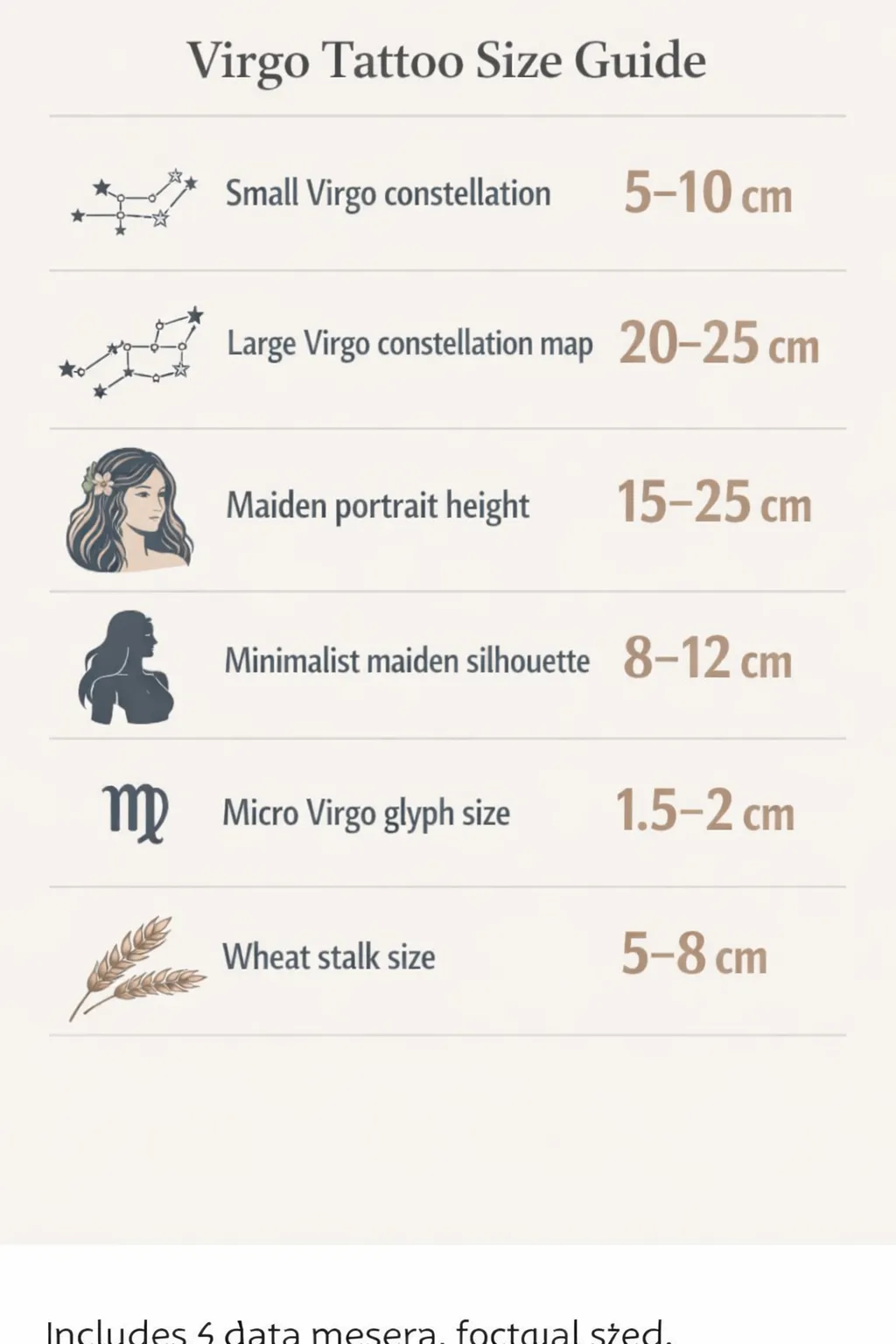 Virgo tattoo sizes span from 1.5-2 cm for micro glyphs to 20-25 cm for celestial maps, with maiden pieces typically 15-25 cm.
Small Constellation Placements (5-10 cm)
At the small end, a 5 to 10 cm constellation suits the wrist, behind the ear, sternum, or ribcage. At this scale, use dotwork stars rather than solid filled circles - dots keep the design from looking crowded and hold their shape better through healing. Solid filled dots at tiny scale tend to spread and merge over time.
I’ve seen a lot of behind-the-ear constellations come back for touch-ups within two years, and the culprit is almost always placement, not the artist. The outer forearm holds fine lines well. Behind the ear and the inner wrist see faster line degradation because of movement and sun exposure. If long-term precision is the whole point (and for a Virgo client it usually is), factor that in before you fall in love with a behind-the-ear spot.
Larger Celestial Map Compositions
Scale up to a celestial map at 20 to 25 cm across the forearm or shoulder span and you get room to label stars, vary line weight on the connecting lines for depth, and integrate wheat or earth motifs at each star point (2). This is where the constellation stops being a quiet marker and becomes a proper composition.
For layered meaning without clutter, anchor constellation points with tiny wheat grains, a small earth element symbol, or micro botanical details. Dotwork reads softer and quieter - a good match for Virgo’s understated energy - while solid linework reads bolder and ages slightly better on lower-movement placements. Neither is wrong; it’s a call about how loud you want it.
Minimalist Virgo Glyph Designs That Hold Up
The glyph is the most popular Virgo choice for first-timers, professionals, and anyone who wants discreet ink. It’s fast, low-commitment, and immediately legible. The catch is that “small and simple” is not the same as “easy to execute” - the curled tail is where cheap work falls apart.
Glyph-Only Designs - Sizing and Fonts
A standalone glyph works at sub-2 cm on the wrist, finger, behind the ear, or collarbone. It’s the fastest session and the most discreet option, which is why it’s popular with professionals who want a subtle identity marker. The practical floor is about 1.5 to 2 cm - go below roughly 1.5 cm and the curled tail and interior negative space tend to blur together once the tattoo heals.
For script - “Virgo,” a birth date, or coordinates - stick with serif or monoline fonts. Clean, precise lettering aligns with Virgo’s association with neat structure. Ornate calligraphy visually contradicts the sign’s organized aesthetic, so skip it.
Combining the Glyph with Botanical or Earth Details
Pairing the glyph with the earth element symbol (a simple circle-cross) adds a layer of meaning - grounded, realistic, practical - while keeping the piece under 3 to 4 cm. A glyph plus a single micro botanical detail, like one wheat grain or a small morning glory or chrysanthemum bud, does the same work, encoding harvest and earth symbolism without bloating the size.
The placement caveat is non-negotiable for this crowd: fingers and inner wrist degrade fine linework faster than the outer forearm or behind the ear. If long-term precision matters to you - and for Virgo clients it almost always does - placement is the decision that protects the design.
Botanical and Earth Element Motifs That Reinforce Virgo’s Sign
Virgo’s earth element is the part most zodiac guides skip, and it’s where some of the strongest design choices live. Greens, browns, and blackwork with stable, grounded compositions reinforce the sign’s agricultural core in a way that purely abstract celestial designs lose.
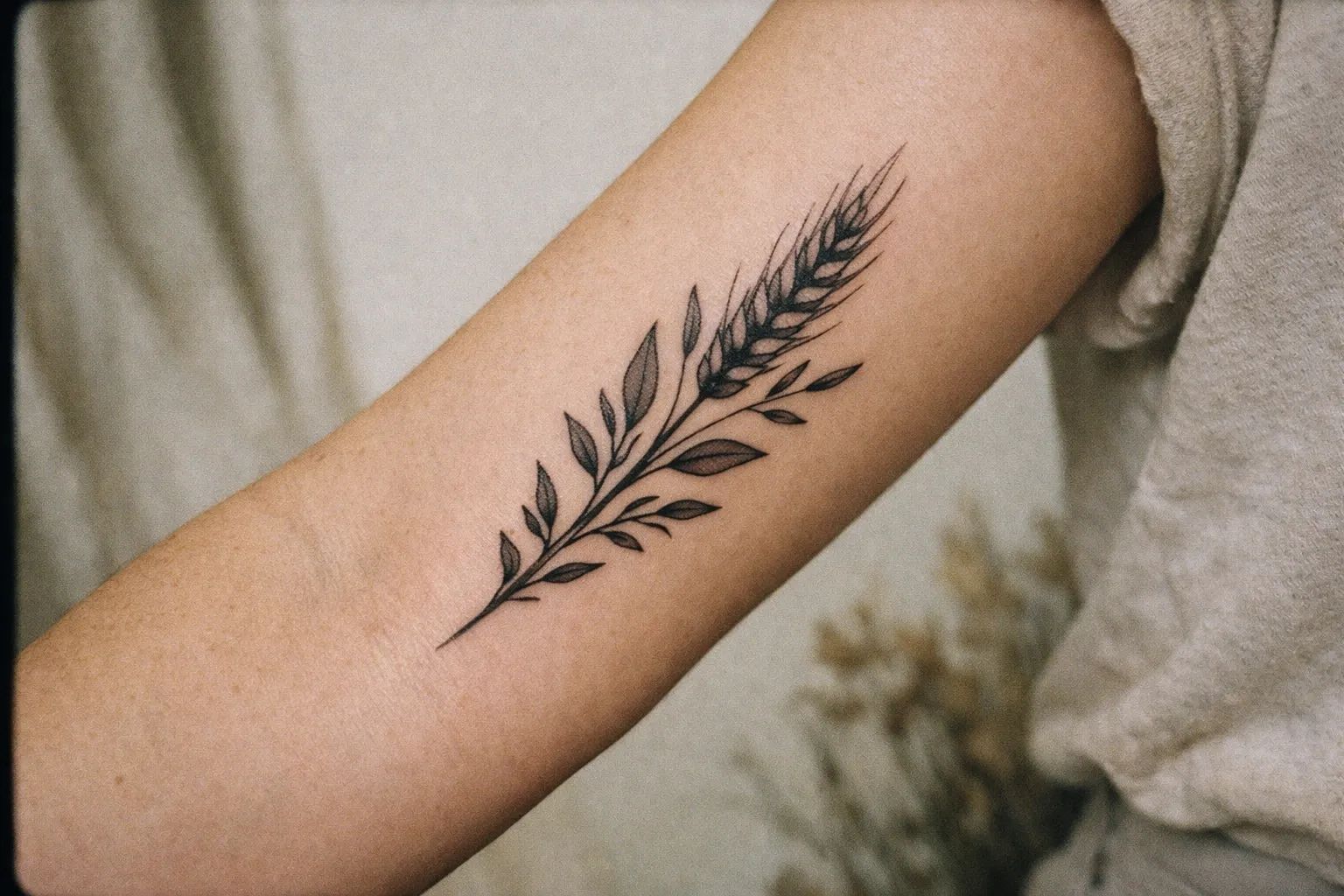
Wheat stalks and sheaves are the most direct Virgo botanical motif, encoding productivity, harvest, and abundance. A single wheat stalk at 5 to 8 cm on the inner forearm or calf is clean, readable, and references Virgo without announcing “zodiac tattoo” to everyone in the room. Wheat works in blackwork or with subtle watercolor accents.
Morning glory is one of the flowers most commonly linked to Virgo - chrysanthemum and aster also appear depending on the source - and it’s a more distinctive choice precisely because it’s less common than wheat. Fine-line morning glory sits well at 4 to 6 cm on the outer forearm or ankle, small enough to stay delicate while keeping petal detail intact.
Oak leaves and vines represent strength, endurance, and adaptability - a nod to Virgo’s mutable modality, the flexible, continuously optimizing side of the sign. They work best as border or framing elements around a larger composition rather than as the main subject.
Progression designs - a flower shown at three stages of bloom, for instance - visually narrate growth and self-development. That suits Virgo’s mutable earth identity, the sign that refines continuously rather than staying fixed.
Soil texture, roots, and stones show up more in recent guides as a way to reinforce Virgo’s grounded, practical nature beyond the standard stars-and-wheat imagery. These read best in blackwork or a fine-line illustrative style.
Whatever combination you land on, keep the earth palette and stable composition. That’s the thread tying the botanical work back to the sign.
Placement Guide - Matching Design Scale to Skin Real Estate
The right placement depends entirely on which symbol you’ve chosen and how big it needs to be to survive. Here’s how the design types map to placement, size, pain relative to the outer forearm, and long-term aging risk.
Virgo Tattoo Placement by Design Type
| Glyph only | Small constellation | Large constellation / celestial map | Maiden silhouette | Full goddess portrait | Botanical (wheat, morning glory) | |
|---|---|---|---|---|---|---|
| Best Placement(s) | Outer wrist, collarbone, behind ear | Sternum, outer wrist, behind ear | Outer forearm, shoulder | Outer forearm, thigh | Upper arm, thigh, back | Inner forearm, calf, ankle |
| Size Range | 1.5-3 cm | 5-10 cm | 15-25 cm | 8-12 cm | 15-25 cm | 5-12 cm |
| Pain vs. Outer Forearm | Similar / slightly higher (behind ear) | Higher (sternum, behind ear) | Similar / lower (outer forearm) | Lower (thigh); similar (forearm) | Lower (thigh, back) | Lower (forearm, calf) |
| Aging Risk | Low-moderate on wrist; higher behind ear | Moderate - dotwork ages better than solid lines | Low on forearm; moderate on shoulder | Low-moderate | Low - larger scale holds detail better | Moderate on ankle; low on forearm |
Small Designs (Under 5 cm)
The wrist, behind the ear, and collarbone suit glyphs and micro constellation clusters. Outer wrist holds fine lines better than inner wrist. Behind the ear is very discreet, but pain runs moderate-to-high over the bone, and lines soften faster there than on the forearm.
Medium Designs (5-15 cm)
The outer forearm is the most technically forgiving placement for fine-line work: lower movement, lower sun exposure than the wrist, and a flatter surface. It suits glyphs, constellations, and botanical motifs at 5 to 15 cm. The sternum and collarbone are popular for fine-line constellations and maiden silhouettes; sternum pain is higher than ribcage pain because of bone proximity, so factor that in if this is your first tattoo.
Large Designs (15+ cm)
Maiden and goddess portraits need the upper arm, thigh, or back at 15 to 25 cm - the most surface area and the most detail capacity. Ribcage suits constellation maps and botanical compositions at 10 to 20 cm, but pain there is notably higher than the forearm. Not ideal for a first session. For men after vintage zodiac imagery, garden scenes, or larger glyph-with-botanical compositions, the chest, shoulders, and biceps give the room those designs need.
Fine-Line Virgo Tattoos - What Ages Well and What Doesn’t
Fine-line is the dominant style for Virgo tattoos, but it’s the least forgiving long-term. Thin lines can blur, spread, or lose definition within 3 to 5 years on high-movement or high-sun placements (2). For a sign built around precision, that’s the exact failure mode you want to design around.
Line weight matters more than most clients realize. A slightly heavier outer outline paired with thinner internal lines creates depth and holds its structure better than uniformly ultra-thin work, especially on small glyphs and constellations. When you’re vetting an artist, ask to see healed examples, not just fresh photos. Fresh work always looks crisp. Healed work tells the truth.
Dotwork ages better than tiny solid circles for constellation stars, because each stippled dot carries less ink density and spreads less. That makes dotwork the smarter choice for behind-the-ear or wrist constellation placements where you’re already fighting movement and sun exposure.
Blackwork and illustrative styles rely on heavier lines and solid fills, so they hold up longer than ultra-fine work. They suit wheat stalks, botanical borders, and larger maiden compositions where multi-year legibility is the priority.
Placement and aging interact directly: outer forearm and upper arm age best for fine-line; fingers, inner wrist, and behind the ear need touch-ups sooner. And in my experience, Virgo clients are especially sensitive to symmetry and line spacing - so invest time in the stencil review before the needle touches skin. That’s not overthinking. For this sign, it’s correct prioritization.
Virgo Tattoo Aftercare - Protecting Fine Detail Through the Heal
Fine-line Virgo tattoos are especially vulnerable during healing, because scabbing over thin lines can pull pigment and distort the precision that’s the whole point of the design. A disciplined heal protects the linework. Here’s the sequence.
Virgo Tattoo Aftercare
1 monthStep-by-step care to protect fine-line Virgo tattoos during healing
- 1
Day 1-3
Keep the second-skin or Saniderm-style bandage on for 24 to 72 hours. Wash with fragrance-free antibacterial soap twice daily and pat dry - never rub.
- 2
Week 1
Switch to a fragrance-free moisturizer and apply it 2 to 3 times daily. Expect tightness and light flaking. Do not pick at scabs forming over the linework.
- 3
Week 2-4
Surface healing is mostly complete by the end of week two. Avoid submersion - pools, ocean, baths - for 2 to 3 weeks, and avoid direct sun for 4 to 6 weeks.
- 4
Month 2 onward
Apply SPF 30 to 50 over the healed tattoo whenever it's exposed to sun. This is non-optional for fine-line work on visible placements like forearm or wrist.
- 5
Touch-up window
Most reputable studios offer one free touch-up within 3 to 6 months. Book it. Fine-line constellation and glyph work almost always benefits from a single corrective pass.
Frequently Asked Questions
Frequently Asked Questions
- What tattoo is lucky for Virgo?
- Wheat and grain motifs connect to Virgo's harvest mythology and abundance. Morning glory and the Virgo constellation with Spica as focal point are also symbolically strong.
- What symbolizes a Virgo?
- The maiden, glyph, and constellation define Virgo. Supporting motifs include wheat, morning glory, oak leaves, and earth element imagery tied to Virgo's mutable earth sign identity.
- What is Virgo the goddess of?
- Virgo links to goddesses Ceres, Demeter (harvest/agriculture), and Astraea (justice/innocence). The 'virgin' means self-sufficiency and discernment, not sexual innocence.
- Who is Virgo's #1 soulmate?
- Taurus and Capricorn are the most cited compatible earth signs; Scorpio and Cancer also appear. Taurus-Virgo tattoo pairings are a documented couples' tattoo concept.
- How small can a Virgo glyph tattoo go?
- Sub-2 cm is possible on low-movement spots like collarbone or outer wrist, but under 1.5 cm risks losing the curled tail detail after healing.
- Does a Virgo constellation tattoo need to be astronomically accurate?
- It should be close enough for astrology-literate viewers to recognize, especially Spica's position. Inaccurate patterns are noticeable; use an accurate star chart.
- What's the difference between a fine-line and blackwork Virgo tattoo?
- Fine-line is delicate but less durable long-term; blackwork uses heavier lines and solid fills, better for larger botanical or maiden pieces.
Three Decisions Before You Book
Before you sit down, settle three things. First, which symbol category fits the size and placement you actually have in mind - a sub-2 cm glyph and a 25 cm goddess portrait are not interchangeable choices. Second, whether fine-line or blackwork suits your appetite for long-term maintenance, because fine-line will ask for touch-ups that heavier work won’t. Third, whether you’ve seen healed examples from the artist you’re considering, not just fresh photos.
Virgo is one of the few signs where the design philosophy and the tattooing philosophy genuinely line up. A clean, well-placed, properly healed Virgo tattoo is exactly what the sign would approve of - so give it the precision it’s asking for.