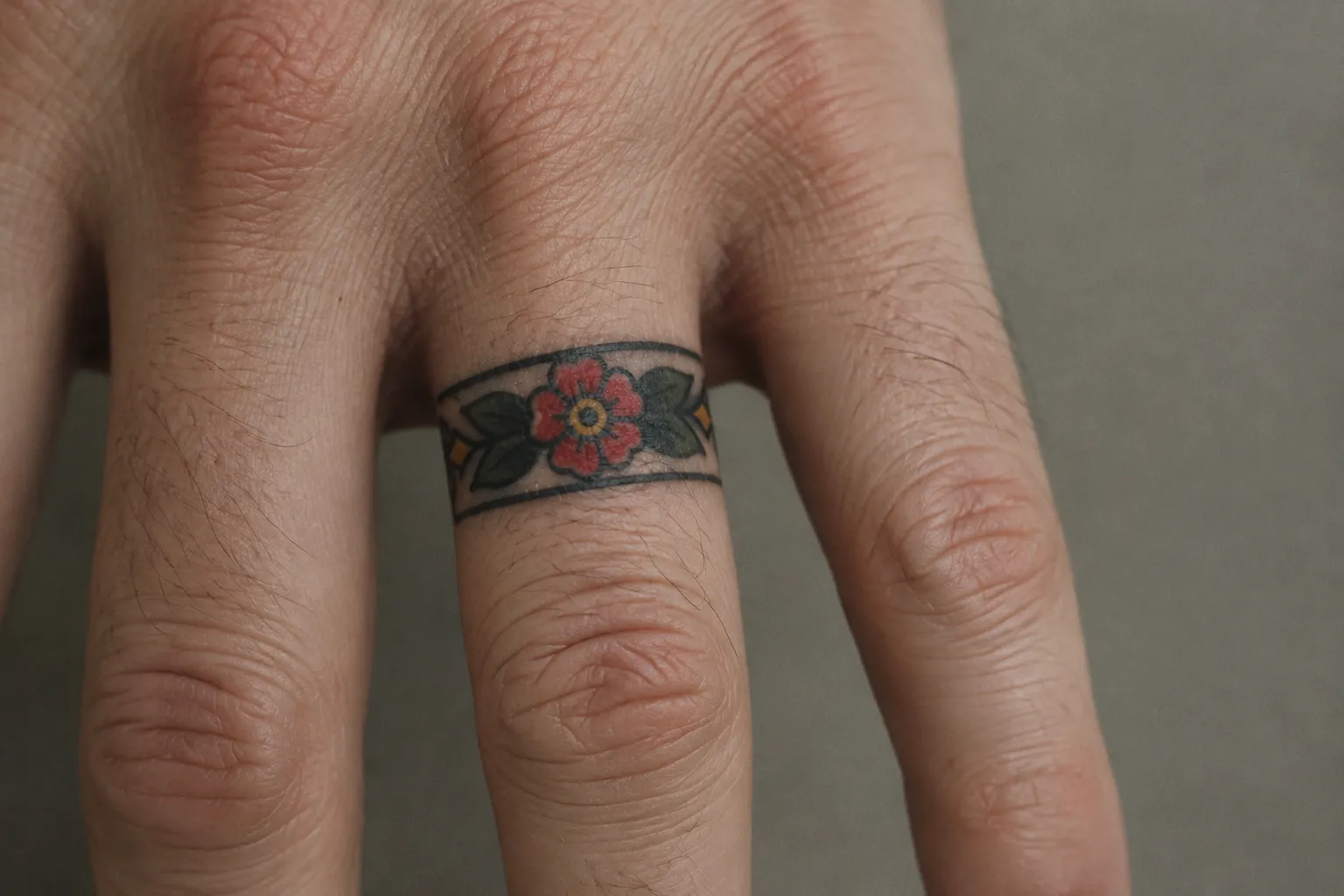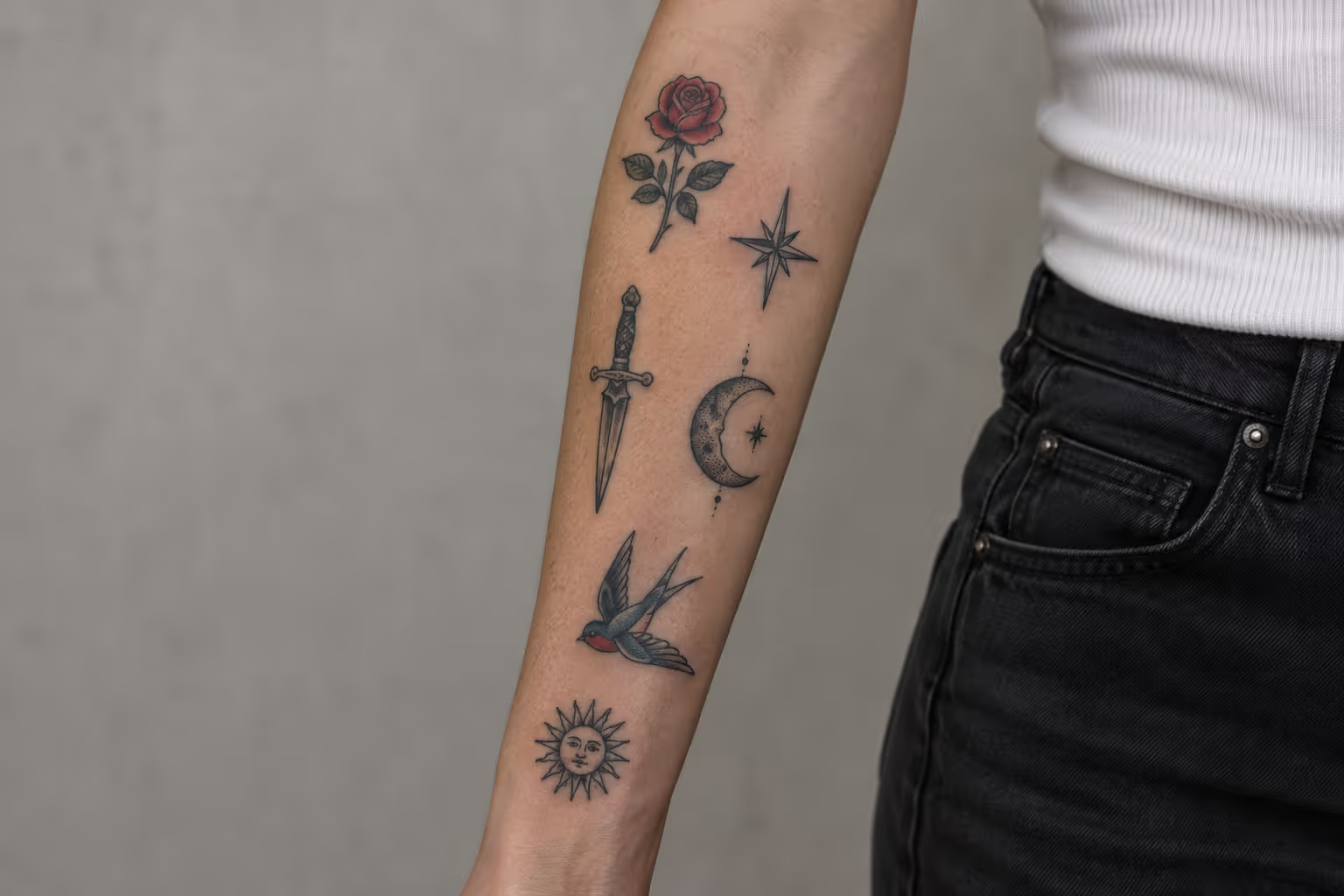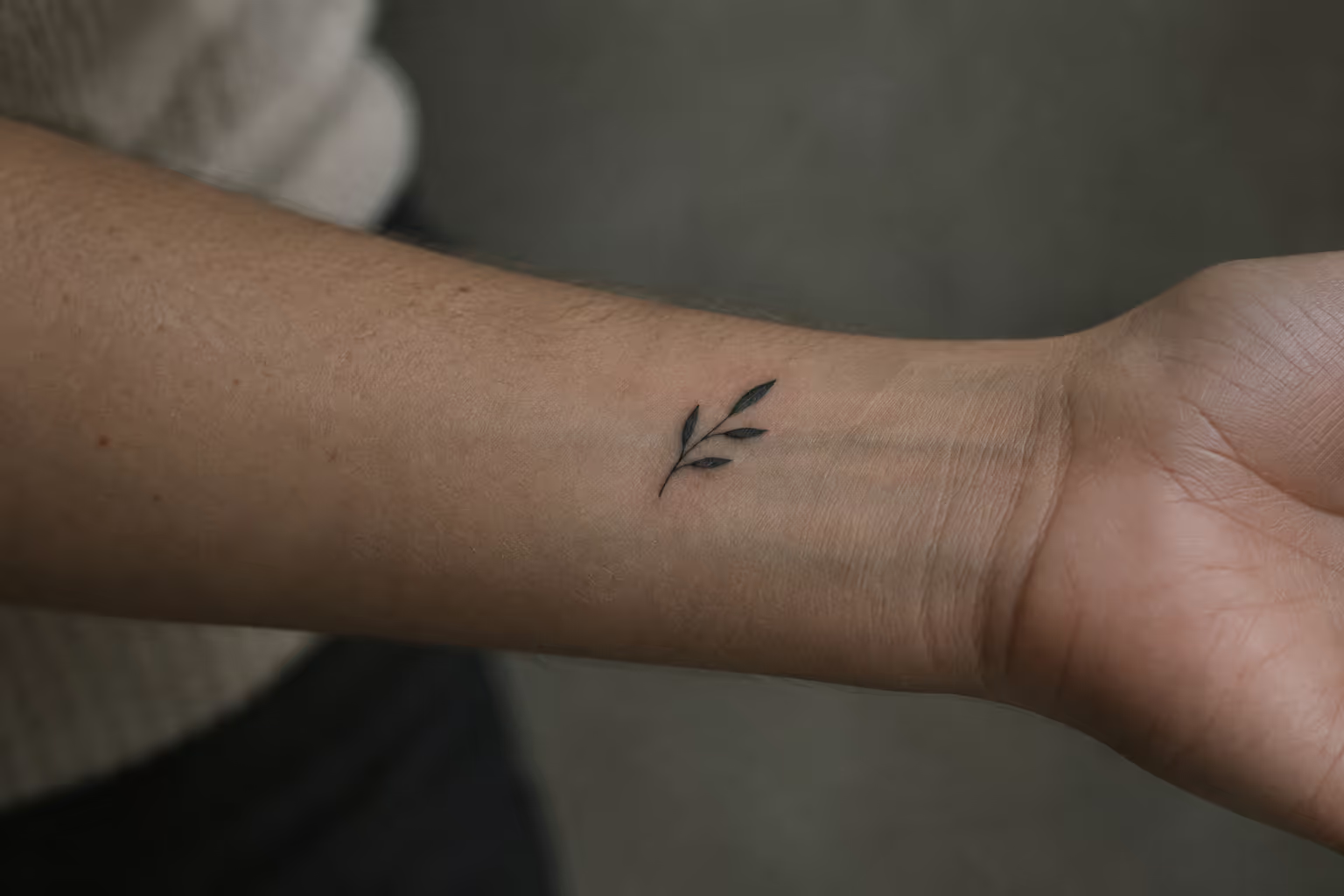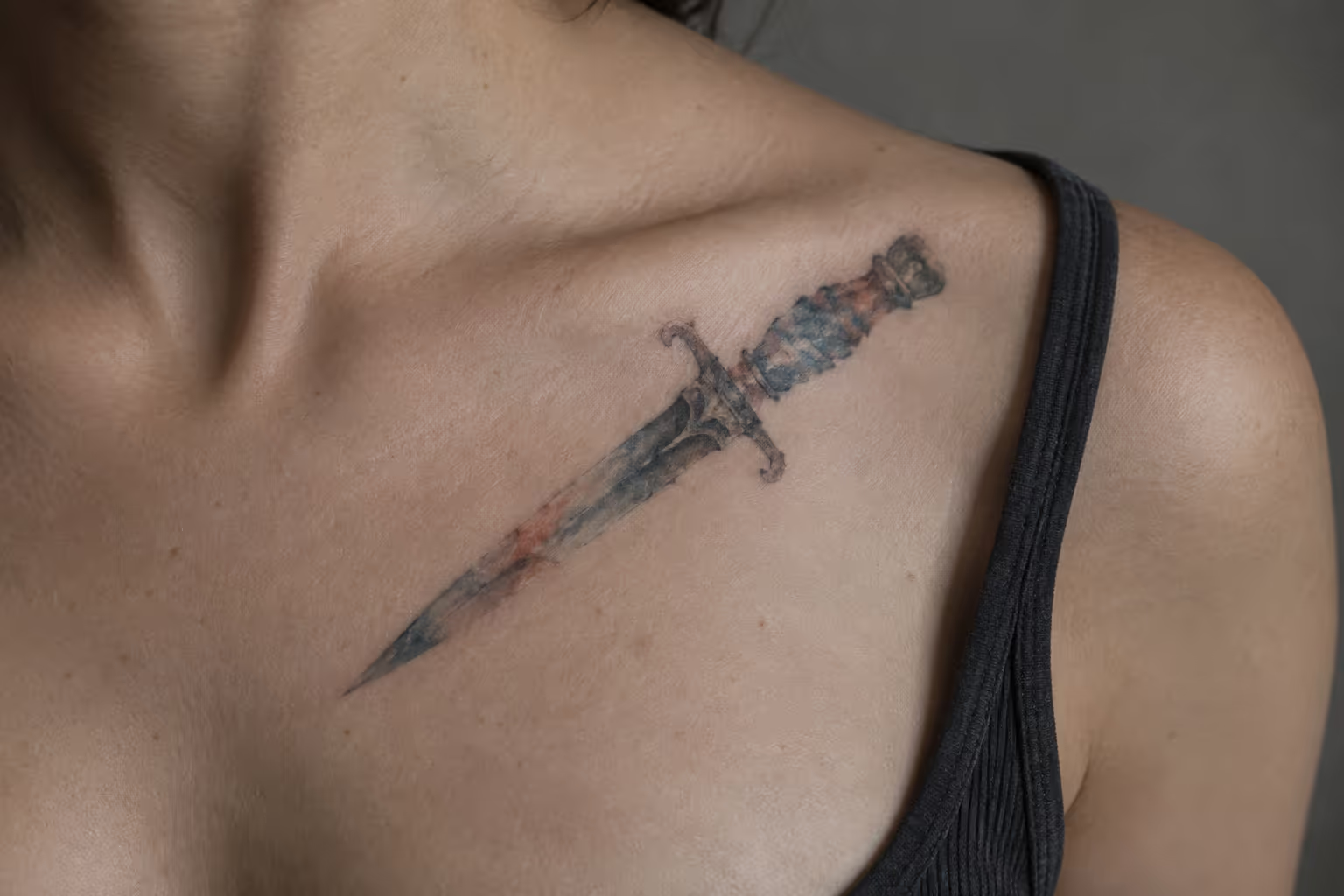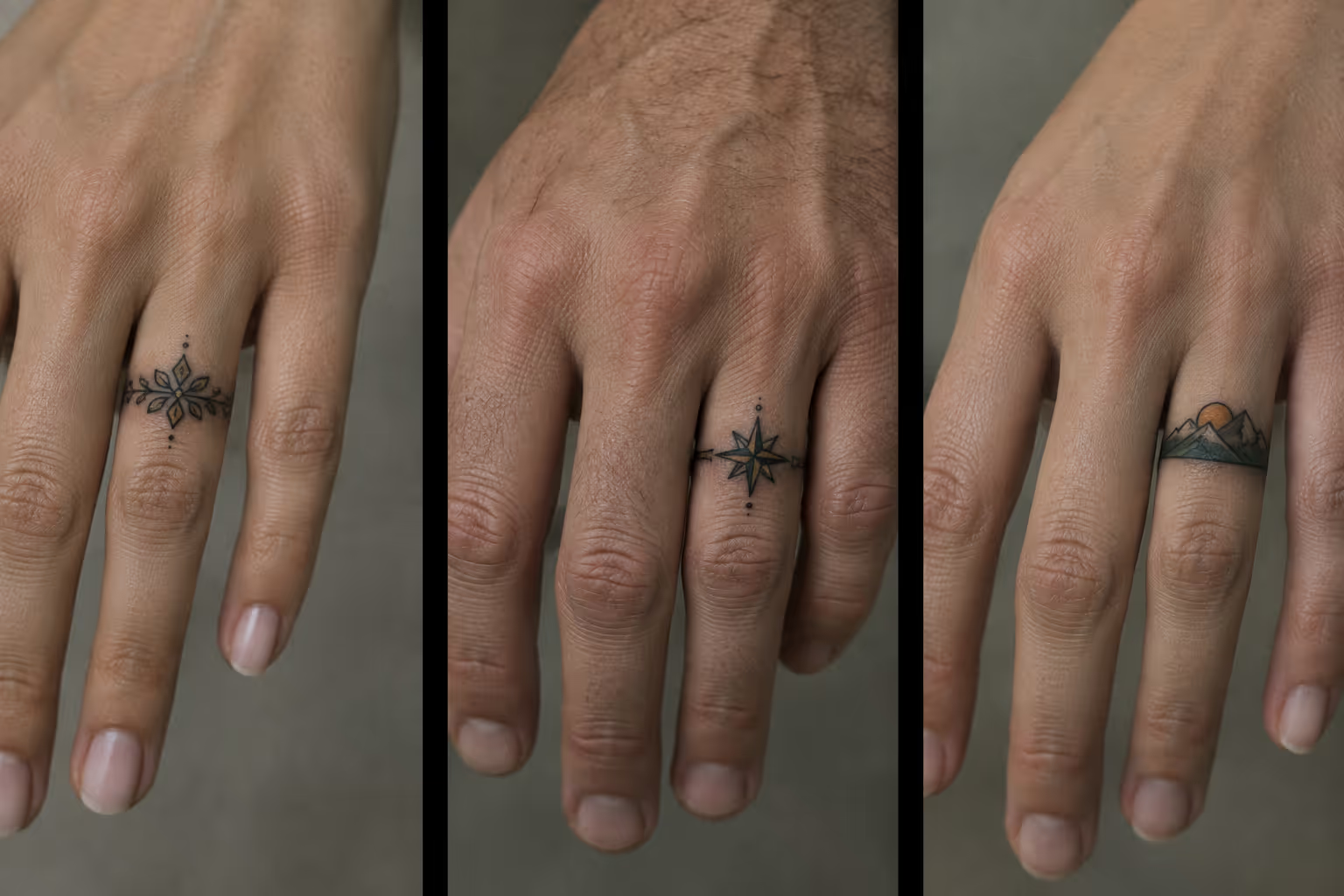
A wedding ring tattoo doesn’t have to circle the whole finger. Where it sits matters more than how it looks the day it’s fresh. The flat top of the finger holds ink well, while the creases and joints that fold every time you grip a steering wheel are more prone to patchiness and fading (6). Get the placement right and book weeks ahead of the ceremony, and a simple band or symbol holds up. Get it wrong and you’ll be back in the chair for touch-ups.
✓ Pros
- A design can stay in place when workplace rules or hands-on tasks make jewelry impractical.
- A small motif can carry the couple's commitment without needing a full wraparound band.
✗ Cons
- Finger skin is a high-friction surface, so a crisp result requires accepting that the design may change unevenly.
- A permanent mark can conflict with future jewelry preferences or personal circumstances.
The advantages are straightforward. You can’t lose a tattoo, you can wear it through any job or workout, and it usually costs less than a precious-metal band (2). It also suits people who can’t wear metal at work or whose skin reacts to certain metals. The disadvantages are just as real. Ink near a crease fades unevenly. The window for clean touch-ups on a finger is narrow. The design shows on days you’d rather not wear jewelry. And if your circumstances change, you can’t slide it off.
What a marriage ring tattoo symbolizes
A marriage ring tattoo carries the same meaning as a metal band: commitment to one person. It adds one thing a ring can’t offer, which is that you can’t take it off, misplace it, or leave it by a sink. Many couples choose ink for that reason. One design gallery describes the tattoo as a more permanent replacement for the gold or silver band (7).
The choice of the fourth finger comes from Western ring custom. It is often traced to the Roman-era idea of a vena amoris, a “vein of love” running from that finger to the heart. Anatomically, that vein doesn’t exist. The custom persisted anyway, and a ring finger tattoo inherits it. Some European countries wear the wedding band on the right hand, so check the tradition you’re following before you pick a hand.
Religious motifs bring their own meanings, and each comes from a specific tradition. Published galleries include a cross, a Star of David, and Om (7). The cross is Christian. The Star of David is a Jewish symbol. Om is a sacred syllable in Hindu, Buddhist and Jain practice. One caveat: many observant Jewish communities discourage tattooing, so a Star of David in ink can draw mixed reactions within the faith it represents.
Two popular secular motifs have shifted meaning in modern Western tattooing. Celtic knotwork comes from early medieval Insular art. The common reading of it as “eternal love” is a modern revival interpretation, not a documented original meaning. The infinity sign began as a mathematical symbol and now reads as “forever” in Western tattoo culture.
Practical reasons count too. A tattoo stays on during manual work, sport, or anything where a ring could snag or get damaged (2).
Wedding ring tattoo ideas: minimalist, personalized, and complementary designs
Wedding ring tattoo designs in published galleries fall into three practical groups (2)(7):
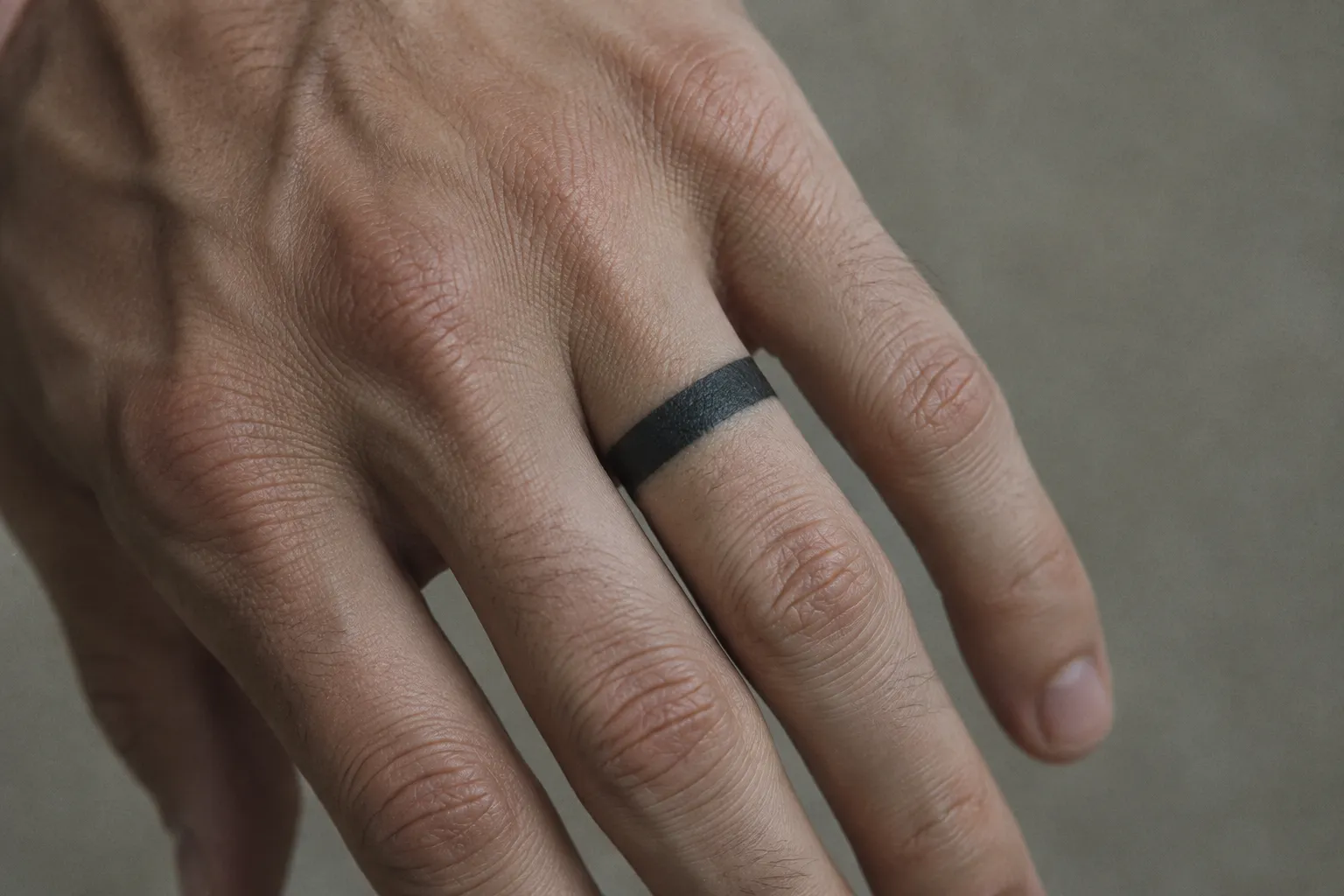
- Minimalist: a narrow band, a line, or a small symbol.
- Personalized: initials, dates, or religious motifs.
- Complementary: two related but non-identical designs, one for each partner.
Choose the group first. The specific motif is easier to settle once you have.
Minimalist bands and symbols
A minimalist wedding band tattoo is a solid line, a thin double line, or a ring of small dots. Keep a solid band slightly bolder than a fine line. Too thin and the line can break up as the finger heals and flexes. Dotwork bands forgive more, because a dot that fades slightly still reads as part of the pattern.
Fine line and finger skin don’t pair well. A hairline single-needle band looks crisp in fresh photos, but on a finger it can spread or drop out in patches within the first heal. When artists do fine-line ring tattoos badly, they skip line weight entirely. Ask for a line a little heavier than you think you want.
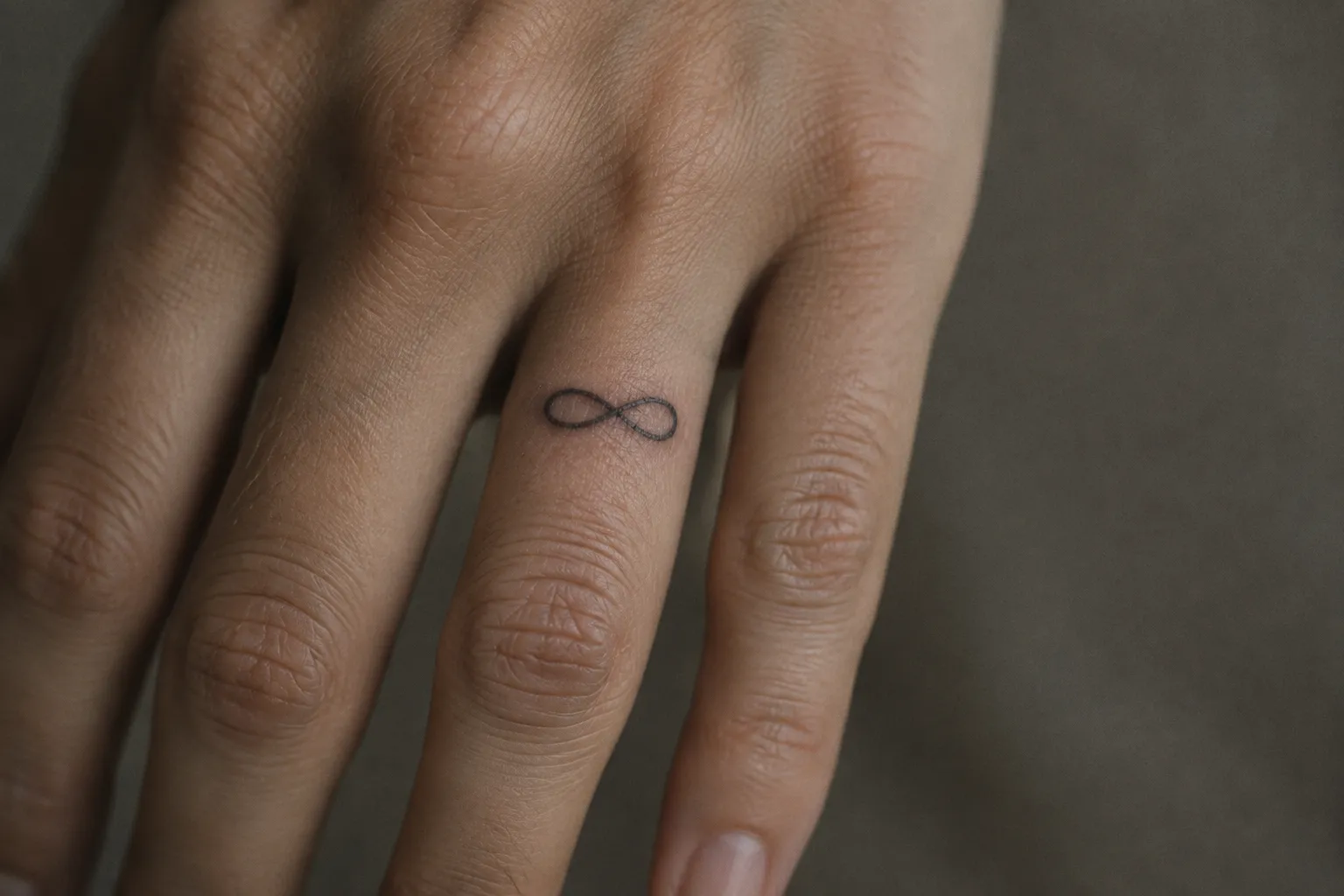
A full circle isn’t required. A compact symbol on top of the finger, such as an infinity sign, a heart, a crown, or a tiny knot, kept small enough to sit on top of the finger, stands in for a ring without wrapping into the inner finger. Many artists avoid the inner finger because ink there smudges and heals poorly.
Personalized initials, dates, and motifs
Initials and dates mean something specific to the two of you, but lettering needs room. Block letters and numerals need a letter height of at least 6 mm (1/4 in). Standard script needs at least 12 mm (1/2 in), and fine or ornate script about 25 mm (1 in). The top of a finger rarely gives you enough flat space for legible script. For a ring finger tattoo, stick with block initials or a date in Roman numerals. A single block initial at 6 mm (1/4 in) or taller reads better than a full date crammed in below that height.
Religious motifs belong in this group as well: published galleries show a small cross, Star of David or Om (7), and each sits well on top of the finger at symbol size. Simplify the outline. A Star of David with interior detail closes up as the lines settle.
Complementary couple designs
Complementary designs work together without being identical. Galleries show pairings such as a lock on one partner and a key on the other, read as each holding the key to the other’s heart (7). Other pairings use two halves of one shape, sun and moon, or matching bands with a different symbol set into each.
Matching beats complementary when you want instant recognition. Complementary beats matching when you want each partner’s half to look finished on its own.
Comparing the three groups:
- Minimalist designs are the least complex and the smallest: a band, a line or a compact symbol. Even near a crease, they lose the least visual information as they fade. They fit couples who want something clean, low-maintenance and easy to touch up.
- Personalized designs are moderately complex and need at least 6 mm letter height for block letters or numerals. Fading near a crease is serious here, because a broken letter stops reading as a letter. They fit couples with a date or initial that matters more to them than the band shape.
- Complementary designs vary in complexity and size. Fading near a crease is moderate, and worse for detailed pairs like lock and key. They fit couples who want a shared concept without identical tattoos.
Finger placement and why it affects fading
Ring finger tattoo placement decides how long the design stays crisp. A design kept entirely on the flat top of the finger holds up better than one that crosses a crease or joint, because creases and joints are more prone to patchiness and fading (6).
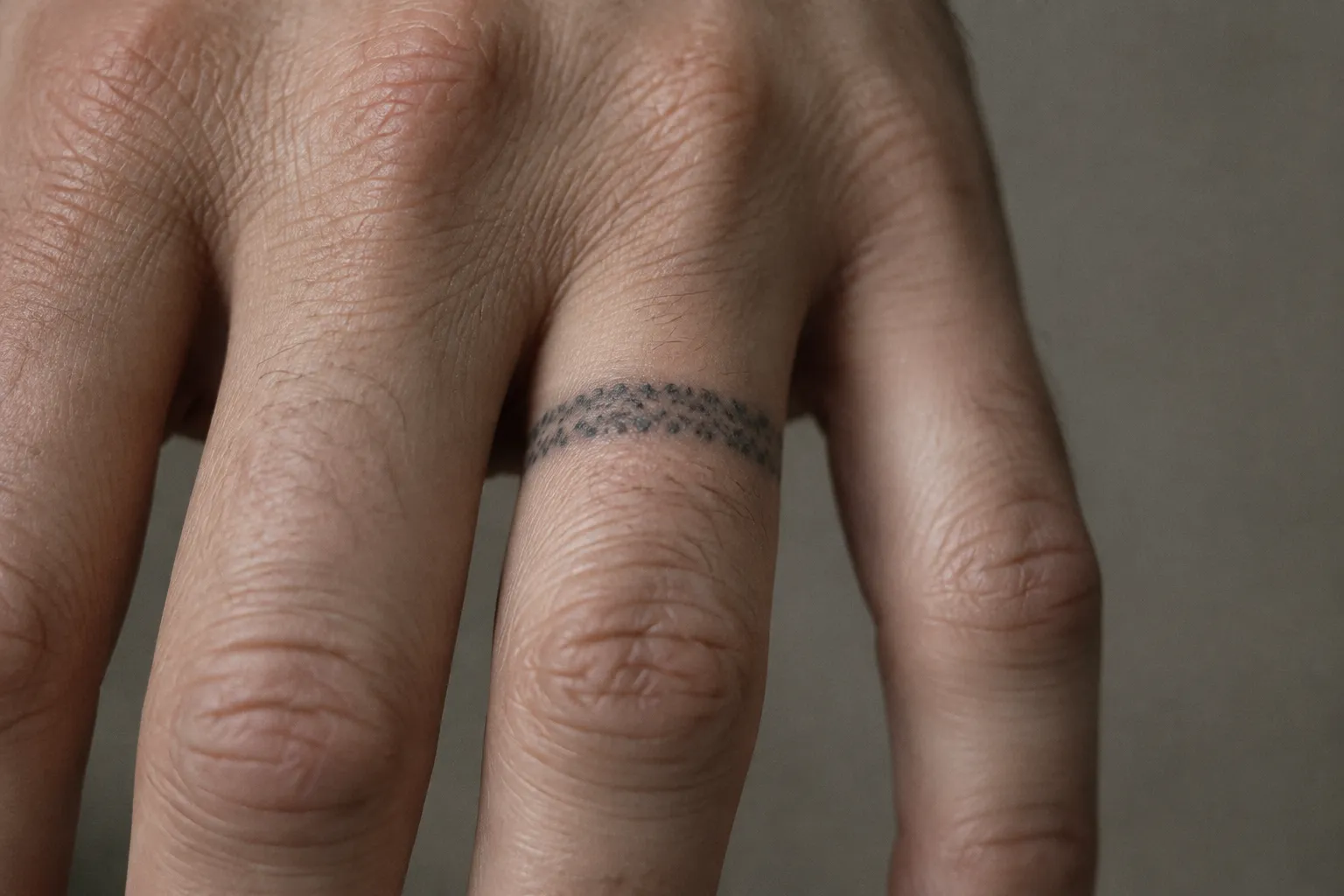
Hands get more daily wear and tear than almost any other placement and are almost always exposed to the elements, so finger tattoos placed on the sides or between the fingers can fade much quicker over the years than one on a bicep or thigh (6). Don’t expect a finger band to keep the crisp, even line of a tattoo on a less-used area.
Top of the finger vs. creases and joints
The decision rule is simple. Keep the whole design on the top of the finger, between the knuckle and the middle joint. That flat patch is short, but it’s enough for a band segment, a symbol or two block initials.
A band that wraps around the finger hits trouble in three places:
- The inner finger. Palm-side skin is thick, sheds fast, and is in contact with everything you hold. Ink there blurs or drops out, which is why many artists refuse it.
- The sides. Edges get some protection but still rub against neighbouring fingers. A wrap-around band often heals thinner on the sides.
- The crease line itself. Placing the band where the finger folds means the skin flexes through the line all day. Expect patchiness here first (6).
Your options: a top-only design that suggests a ring without closing the circle, or a full band placed squarely on the segment with an agreement up front that the underside will need more maintenance. Talk this through with your artist before anything is stenciled.
How long does a wedding ring tattoo last? The ink is permanent. The sharpness isn’t. Plan on a touch-up after the first heal, when any dropped-out spots show. After that, expect occasional refreshes over the years. How often depends on how much you use your hands and how well you protect them from sun.
Pain and finger sensitivity: what to expect
A wedding ring tattoo hurts more than a forearm tattoo, because finger skin is thin and sits close to bone with little fat or muscle as padding. Forearm work tends to hurt less, while the ribcage and the fingers hurt for the same reason: little body fat, right over bone (2).
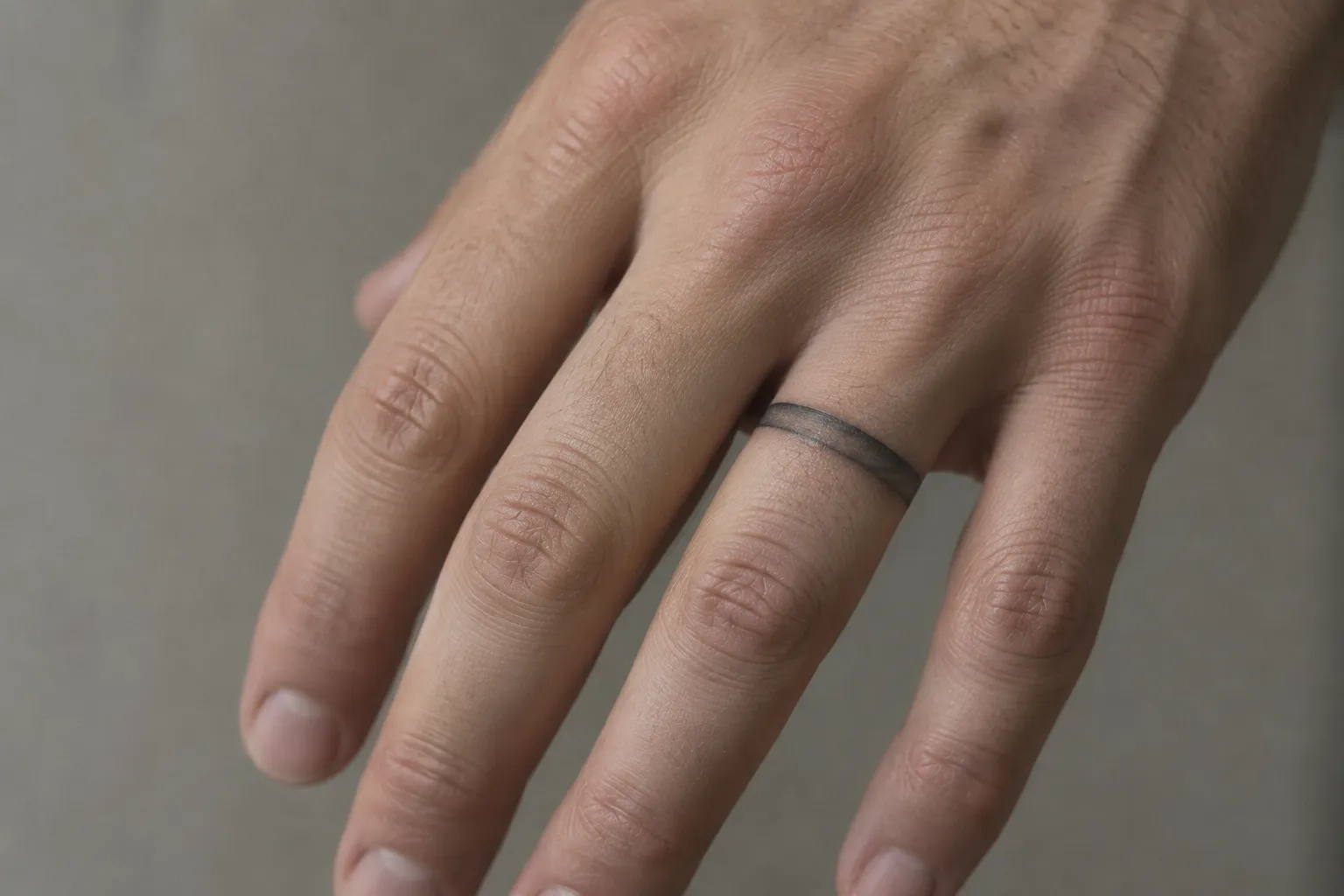
Finger pain feels different from fleshy placements. It’s sharp, it buzzes into the bone, and the knuckles are the worst spots. The thin skin over the top of the finger is more sensitive than the side of a calf or the outer shoulder, where there’s padding to absorb the needle’s vibration. Expect the bony area near a joint to feel noticeably sharper than the middle of the segment.
The saving grace is time. A minimalist band or small symbol is quick work: depending on the design, a ring tattoo often takes about an hour or less in the chair (2), nothing like the hours a sleeve or back piece takes. A detailed complementary design or lettering takes longer and stings more, mostly because the artist passes over the same small area repeatedly.
A few things make the session easier. Eat beforehand and arrive rested. Skip alcohol the night before (2). Tell your artist about any medications you take, especially blood thinners, and don’t stop a prescribed medication without asking your doctor. Don’t plan to grip anything hard with that hand for the rest of the day.
Wedding day tattoo timing: how far ahead to book
Wedding ring tattoo timing comes down to two windows: one week before the ceremony as the bare minimum, and three to four weeks for a healed look. One wedding planner’s guide suggests booking about a month before the big day (2). The longer window gives a healed look in close-up photos and lets you wear a ring over it comfortably.
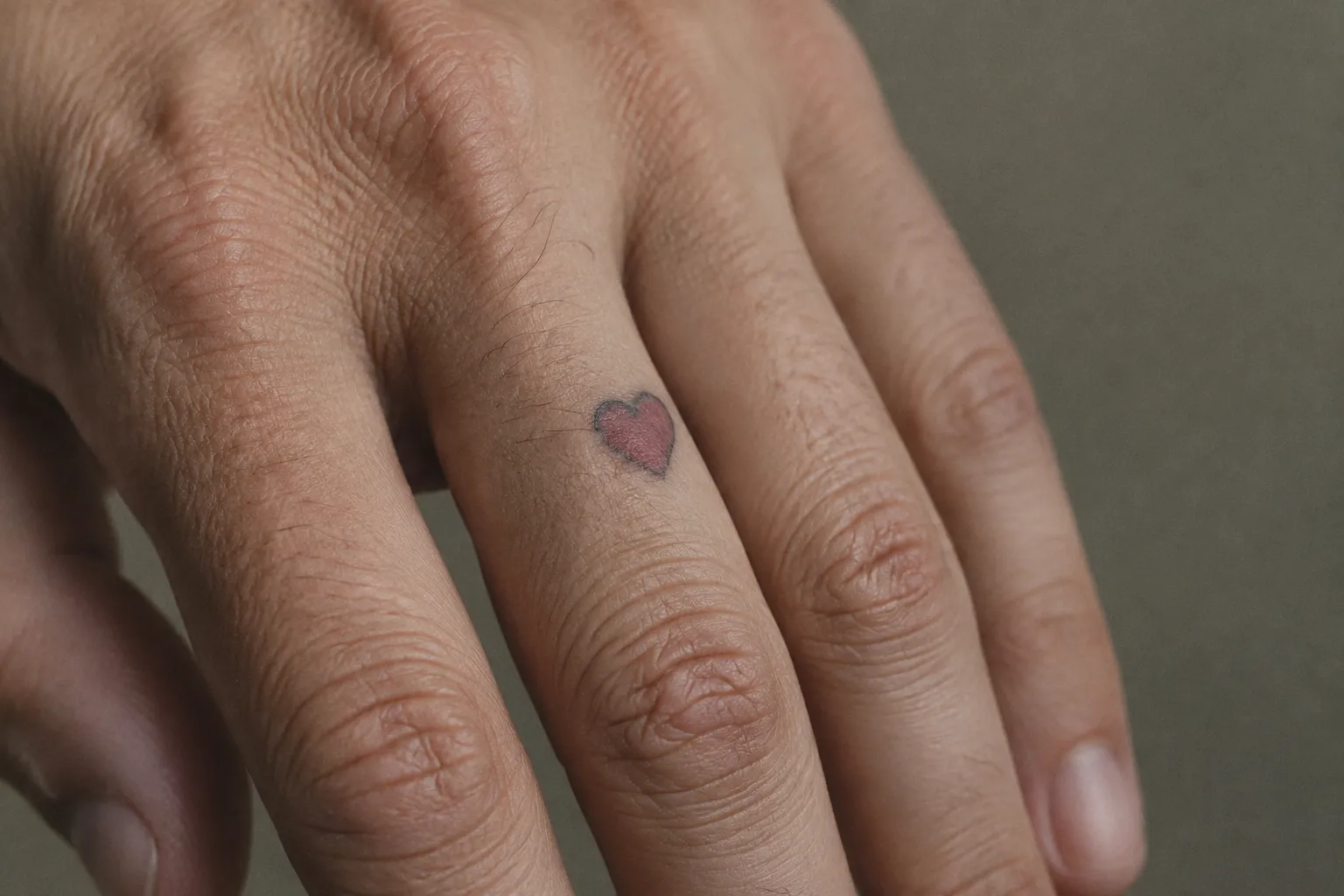
One week minimum vs. three to four weeks
The one-week minimum reflects the bare reality: a fresh tattoo is an open wound. It can stay red and sensitive for at least a few days. At one week, a finger tattoo has usually stopped weeping, but it may be flaking, shiny and slightly raised. That shows in ring-exchange photos, and a band slid over it on the day will rub.
The three-to-four-week window covers the surface healing, which usually finishes around weeks 3-4. The skin has usually settled, the ink looks close to its healed tone, and you can wear a ring over it with less friction. If you have the choice, take the longer window.
To leave room for a touch-up before the wedding, book further out still. The first heal has to finish before your artist can judge what needs filling in, and the touch-up then needs its own heal.
If the timing doesn’t work, you have two clean options:
- Get tattooed after the wedding. You wear your regular ring or a placeholder for the ceremony and book the tattoo once the honeymoon is over. You won’t spend the trip nursing a healing finger in pools and sunshine.
- Use an interim stand-in. A temporary tattoo lets you test placement and size, and a silicone ring covers the ceremony itself. A temporary tattoo doesn’t heal: it simply wears off, faster on hands because of washing.
Healing timeline and aftercare for a finger tattoo
A finger tattoo heals in the same stages as any tattoo: soreness, clear fluid, itching, flaking and some scabbing are all normal (4). Spreading redness, worsening pain, pus, fever or chills are warning signs that need a doctor (4). How well the design holds up still depends on whether it sits on a crease or joint or on the flat top of the finger (6). Hands make it harder, because you wash and touch them constantly. Wash gently with mild, fragrance-free soap and moisturize twice daily (5). Never pick at flakes or scabs: picking can cause infection (5) and compromise the crispness of the lines (6).
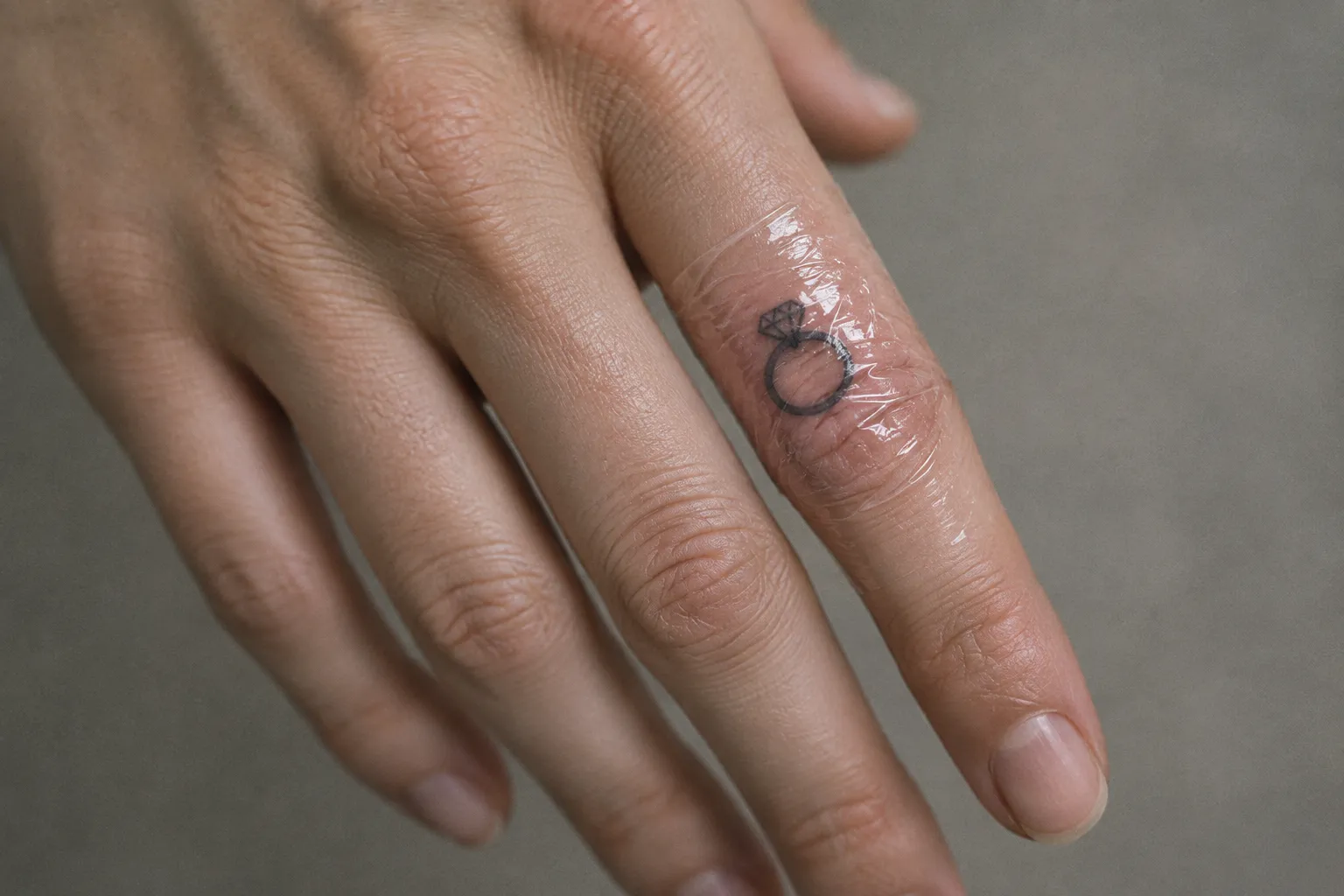
Normal healing: the first six weeks
Follow your artist’s instructions first. As a baseline:
- Days 1-3: The tattoo is sore, a little swollen and may ooze clear fluid (4). Wash gently with mild, fragrance-free soap, pat dry with a clean paper towel, and apply a thin layer of fragrance-free moisturizer (5)(6). Avoid soaking: no baths, pools, or long dishwashing sessions. Wear gloves for cleaning chores.
- Week 1: Itching and flaking start (4). Keep the routine at twice daily (5) and don’t over-moisturize. A thick, greasy layer on a finger traps moisture and can soften the ink. Let flakes and scabs fall off on their own (5). Keep rings off that finger.
- Weeks 2-6: Peeling and itching peak in week 2. By weeks 3-4 the surface looks healed, but the skin underneath keeps settling until around week 6; book your touch-up check after that. Keep the finger out of direct sun for the first 4 to 6 weeks, then use a broad-spectrum sunscreen of SPF 30 or higher (4) or sun-protective gloves when outdoors for long periods. UV fades fine lines on hands quickly.
Hand-specific habits matter more than any product. Wash with lukewarm water rather than hot. Rinse off hand sanitizer splashes quickly. Avoid gripping rough tools with the tattooed finger during the first week.
Warning signs that need medical attention
The American Academy of Dermatology lists signs that point to infection rather than normal healing (4):
- Redness that gets darker or spreads instead of fading
- Pain that continues or worsens instead of easing
- A rash of itchy, red, painful bumps inside the tattoo
- Pus or open sores in the tattoo
- Fever, chills or shivering
If you notice any of these, see a doctor or a board-certified dermatologist right away. The earlier treatment starts, the less damage to your health and to the tattoo (4). Don’t treat worsening symptoms as “just how fingers heal.”
Finding the right artist and booking logistics
Choose an artist who tattoos fingers regularly and can show healed finger work, not only fresh photos. Not every artist accepts this placement, and some won’t take on an unfamiliar original design.
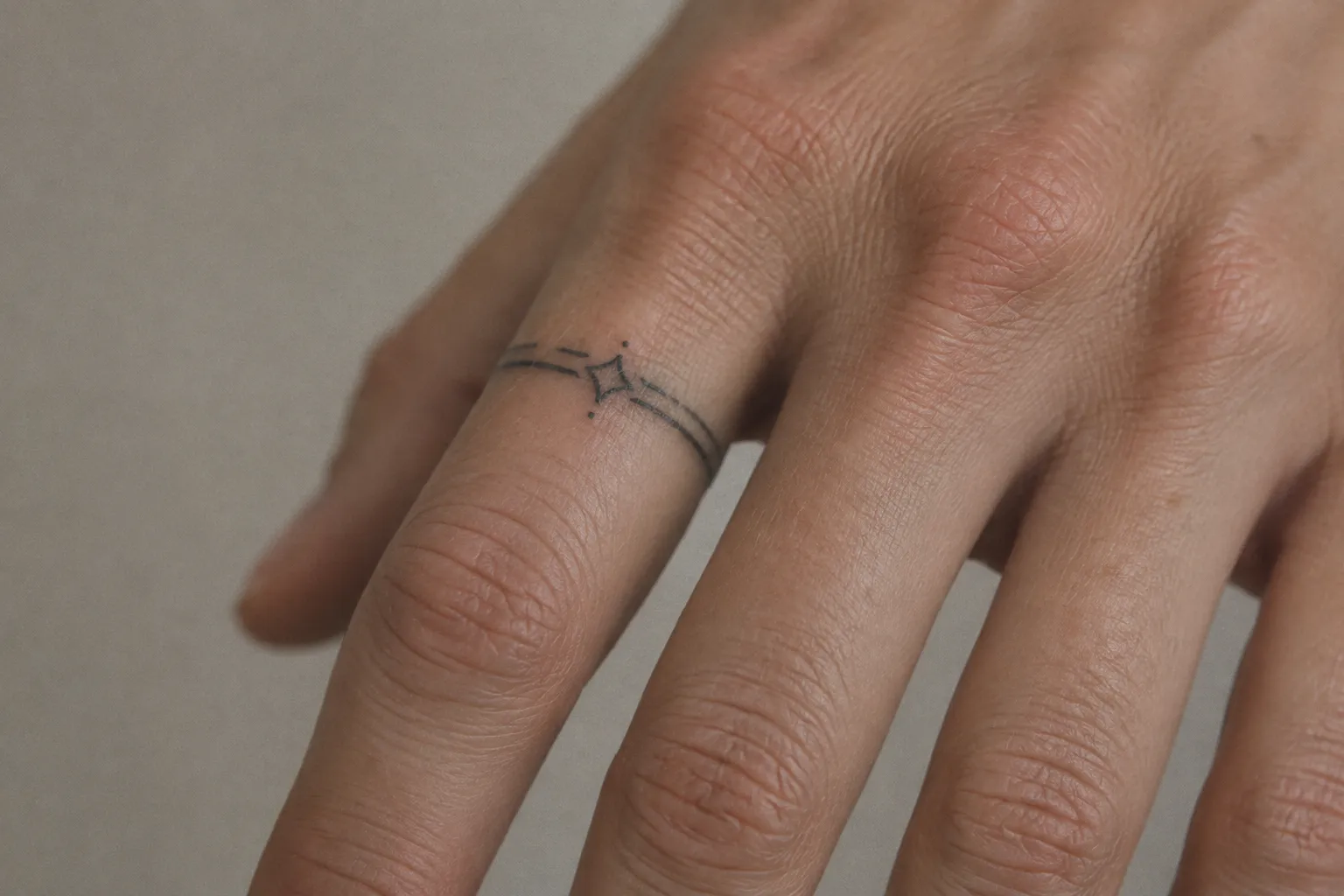
Fresh finger tattoos all look sharp. The test is how they look months later. Ask for healed photos of bands and small symbols specifically. A portfolio full of large color pieces tells you little about how someone handles a thin line on a knuckle.
Questions to ask before booking
- Do you tattoo fingers, and can I see healed examples?
- Will this design fit on the top of my finger, or does it need to cross a crease?
- What line weight do you recommend so it doesn’t blur or drop out?
- Do you tattoo the inner finger, and if not, how would you adapt the design?
- How do you handle aftercare for hands, given how often they’re washed?
- What’s your touch-up policy for finger work?
Bring your design idea and let the artist assess the actual finger surface and scale before you commit. A good finger specialist will often suggest simplifying. That’s usually advice worth taking.
Booking lead time
Popular artists can be booked weeks or months in advance. Start inquiries a few months before the wedding. Count backwards: the wait for an appointment, then three to four weeks of healing, then possibly a touch-up and its own heal. If the date is already close, book after the ceremony instead of squeezing a session into wedding week.
Replacing a traditional ring with tattooed ink
A wedding ring tattoo can replace a physical ring long term, or sit alongside one: you can still wear a ring over it on special occasions or whenever you like (2).
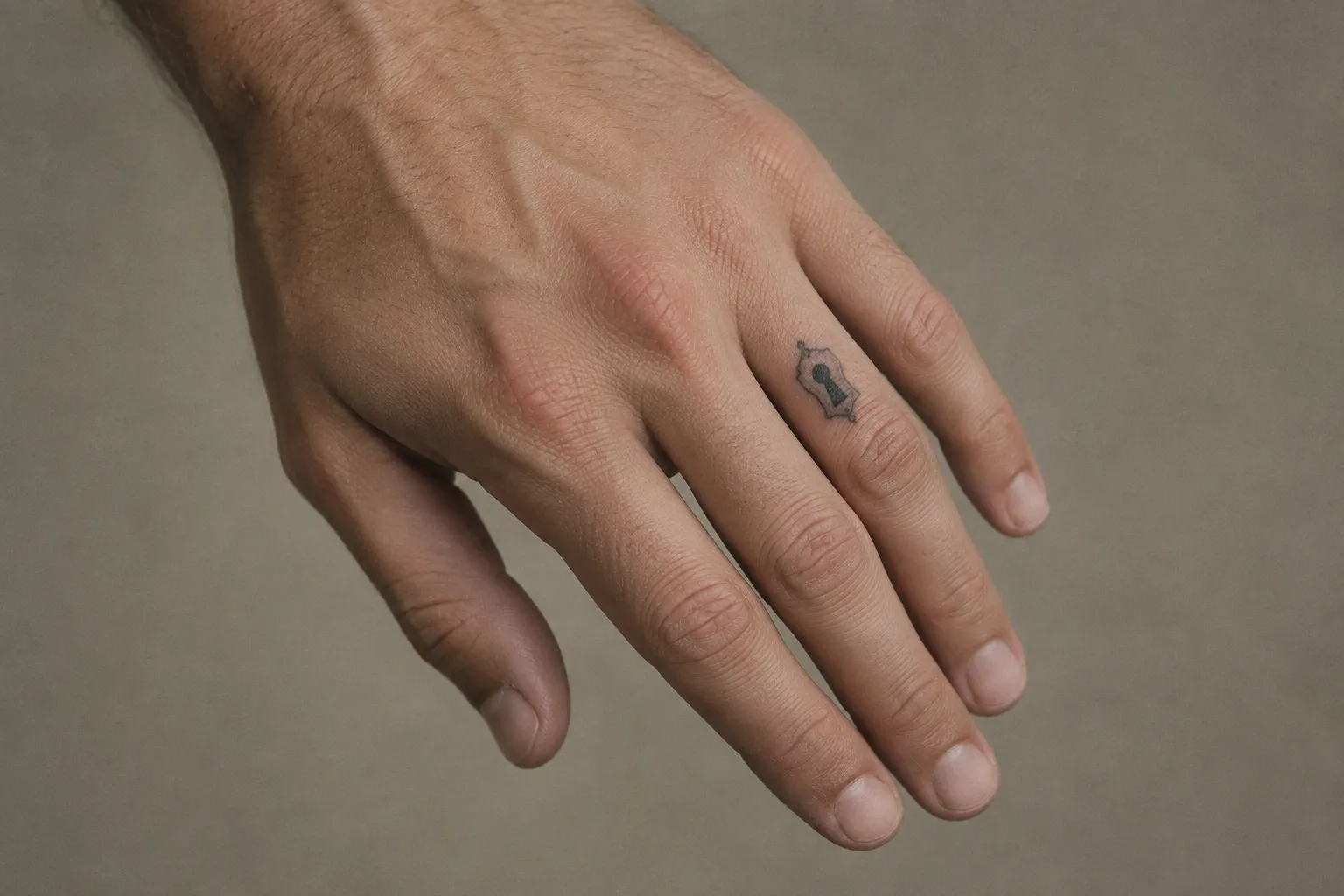
As a full replacement, the tattoo solves the practical problems: you can’t lose it and never have to take it off for work (2), and there’s no metal to snag or irritate the skin. The trade-off is maintenance. You’re swapping occasional ring resizing for occasional touch-ups.
As a pairing, wait until the tattoo has fully healed before wearing a ring over it. Decide whether you want the ring to cover the ink or sit beside it. A band worn on top hides the tattoo most of the time and adds friction to the area that already fades fastest. Placing the tattoo slightly above or below where the ring sits keeps both visible.
On reversibility: laser removal is possible, but it is painful, expensive and can take months (5). Don’t treat it as an easy undo. A minimalist band is the easiest to cover or rework into a larger hand design later, and it won’t stop you from wearing a ring over it in future.
Frequently Asked Questions
- Are wedding ring tattoos a good idea for everyone?
- Wedding ring tattoos suit people comfortable with visible, permanent hand art and ongoing maintenance; they are a poor match for anyone expecting jewelry-like consistency.
- How long do wedding ring tattoos last?
- The pigment remains in the skin, but the design's clarity changes; ask your artist how the specific line weight and placement may age on your hand.
- What does a wedding ring tattoo symbolize?
- It can mark commitment, but motifs carry distinct origins: Celtic knotwork's eternal-love reading is a modern Western interpretation, not one fixed historical meaning.
- Is a wedding ring tattoo painful?
- Finger tattoos are usually sharper than forearm tattoos because the skin sits right over bone with little fat, as on the ribcage; knuckles tend to feel sharper than the flat segment.
- How much do wedding ring tattoos cost?
- Ask the studio for its minimum and whether a follow-up is included; a tiny design may still be billed at the shop's minimum rate.
- Can you wear rings over a finger tattoo?
- Yes, after the skin has fully healed; for less day-to-day rubbing, position the tattoo outside the band's contact line rather than underneath it.
- What should I tell my artist before booking a finger tattoo?
- Bring your ceremony date, reference designs, and any history of skin reactions or medication use so the artist can assess timing and a workable scale.
Getting the placement and timing right
Two decisions shape how a wedding ring tattoo looks years from now. First, keep it on the top of the finger, between the knuckle and the middle joint, and avoid the crease and inner finger. Second, book three to four weeks before the ceremony, never less than one, or wait until after the wedding. Keep line weight solid enough to survive finger healing. Moisturize twice daily with a fragrance-free product during healing, and don’t pick at flakes. Before you commit to a band you can’t take off, sit down with an artist who can show you healed finger work and ask them how your design will look once it fades a little.