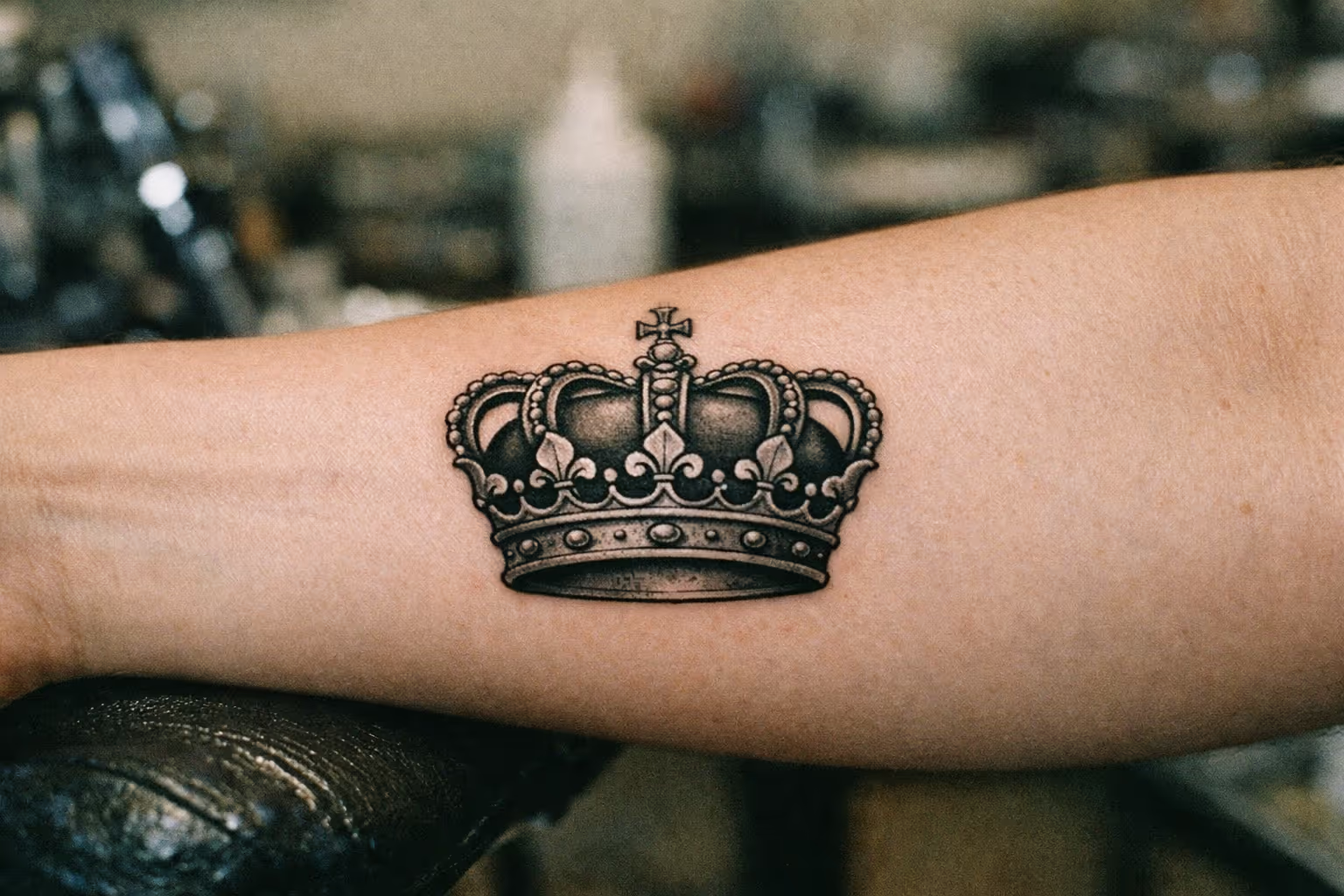
A crown tattoo carries a couple of associations most people - and plenty of artists - never mention. A five-point crown can read as Latin Kings gang iconography, and a crown paired with a name is flagged by anti-trafficking groups as branding. Neither is what you’re reaching for with a symbol of confidence, but both are easy to walk into blind. Here’s what a crown means, the design choices that stay clear of trouble, and the ones worth avoiding.
Crown Tattoo Meaning: What the Symbol Actually Says
A crown tattoo carries more weight than most people realize when they first walk into a shop with a Pinterest screenshot. Yes, it reads as royalty, leadership, self-rule - the obvious stuff. But the same shape can also signal gang affiliation, trafficking branding, religious devotion, or a couple’s bond, depending on points, placement, and what’s sitting alongside it. Before you commit to something that’s going to be on your skin for the next forty years, it’s worth knowing what each variation actually says.
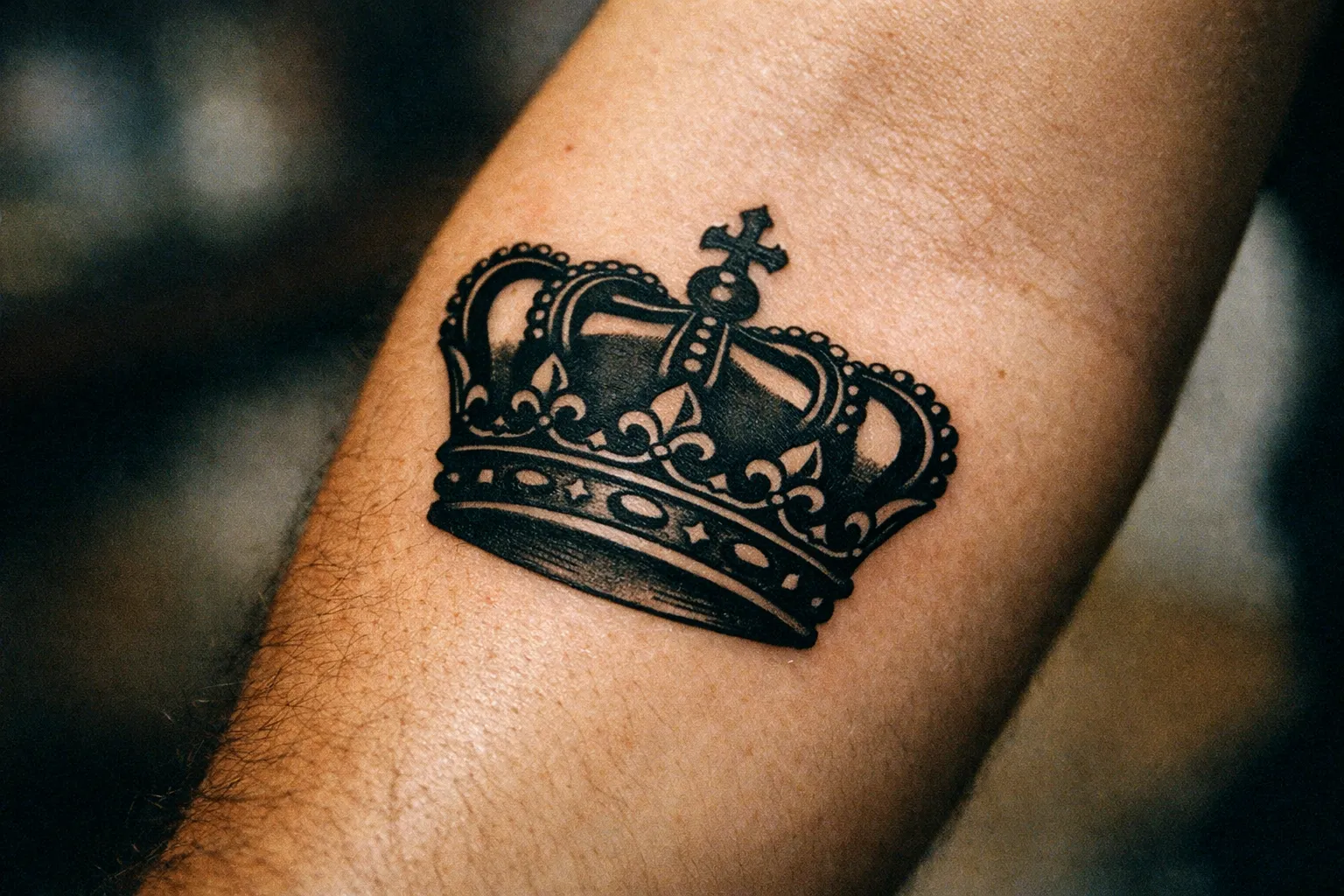
This guide covers the design styles people actually request - small crown Tattoo work, the king and queen crown Tattoo pairing, the laurel crown Tattoo, the crown of thorns Tattoo - plus the crown tattoo meaning across cultures, the contexts that should make you pause, placement that ages well, and what to expect on cost and healing.
Strip away the Instagram gloss and crowns carry a few core meanings that have held up across centuries:
- Power and leadership. The oldest reading. Monarchs wore them; tattoos borrow the visual shorthand.
- Self-rule and self-worth. The modern reframing - “be king or queen of your own life.” Most people getting a crown today mean this, not literal nobility(4).
- Achievement. Tied to laurel and victory crowns, which we’ll get to.
- Faith and sacrifice. The crown of thorns, specifically.
- Bond. Paired crowns between partners or close family.
The catch: the same five points that look regal can also read as a Latin Kings symbol depending on style and context (1). Meaning lives in the details - number of points, lettering, placement, what surrounds it.
✓ Pros
- Rich symbolism spanning power, faith, achievement, and personal bonds
- Works well in small sizes with simple linework
- Multiple placement options that age well with proper care
✗ Cons
- Risk of unintended gang or trafficking associations depending on design and placement
- Small detailed crowns can blur or fade quickly on high-friction skin
- Matching couple crowns can be challenging to cover up if relationships end
What does a crown tattoo mean in jail?
In US prisons, a five-point crown is most often associated with the Almighty Latin Kings Nation (ALKN), one of the largest Hispanic gangs in the country, per Corrections1’s prison-tattoo reference (1). It usually appears alongside the letters ALKN or “Latin Kings,” sometimes with specific point ornamentation. Not every five-point crown is gang-affiliated - but if you’re designing one, ask your artist whether your version reads too close to it for your region.
A crown in a jail context can also mark hierarchy within a gang, or simply status earned inside. It’s almost never the lighthearted “self-love” meaning you’ll see on a wellness blog.
What does a crown tattoo on a woman mean?
For most women getting inked today, a crown reads as self-worth, queen identity, or empowerment - often paired with phrases like “self-made” or placed somewhere only they regularly see (4). It’s also common in couples sets where she gets the queen and her partner gets the king.
There’s a harder context worth naming. Anti-trafficking organizations, including NAPNAP Partners, flag that crowns combined with a name or initials, placed on the neck, arm, or above the groin, are sometimes used by traffickers as ownership branding (2). Same crown shape with a man’s name underneath, placed where a collar would sit, reads very differently than a small crown on a woman’s inner wrist with her own initial. Context, placement, and what’s written next to the crown change the meaning entirely.
King and Queen Crowns in Tattoos
The king and queen crown tattoo is the most-requested couples piece in this category. Standard formula: one partner gets a slightly heavier, squared “king” crown; the other gets a taller, more pointed “queen” crown. Often paired with the K/Q playing card letters, initials, an anniversary date, or Roman numerals.
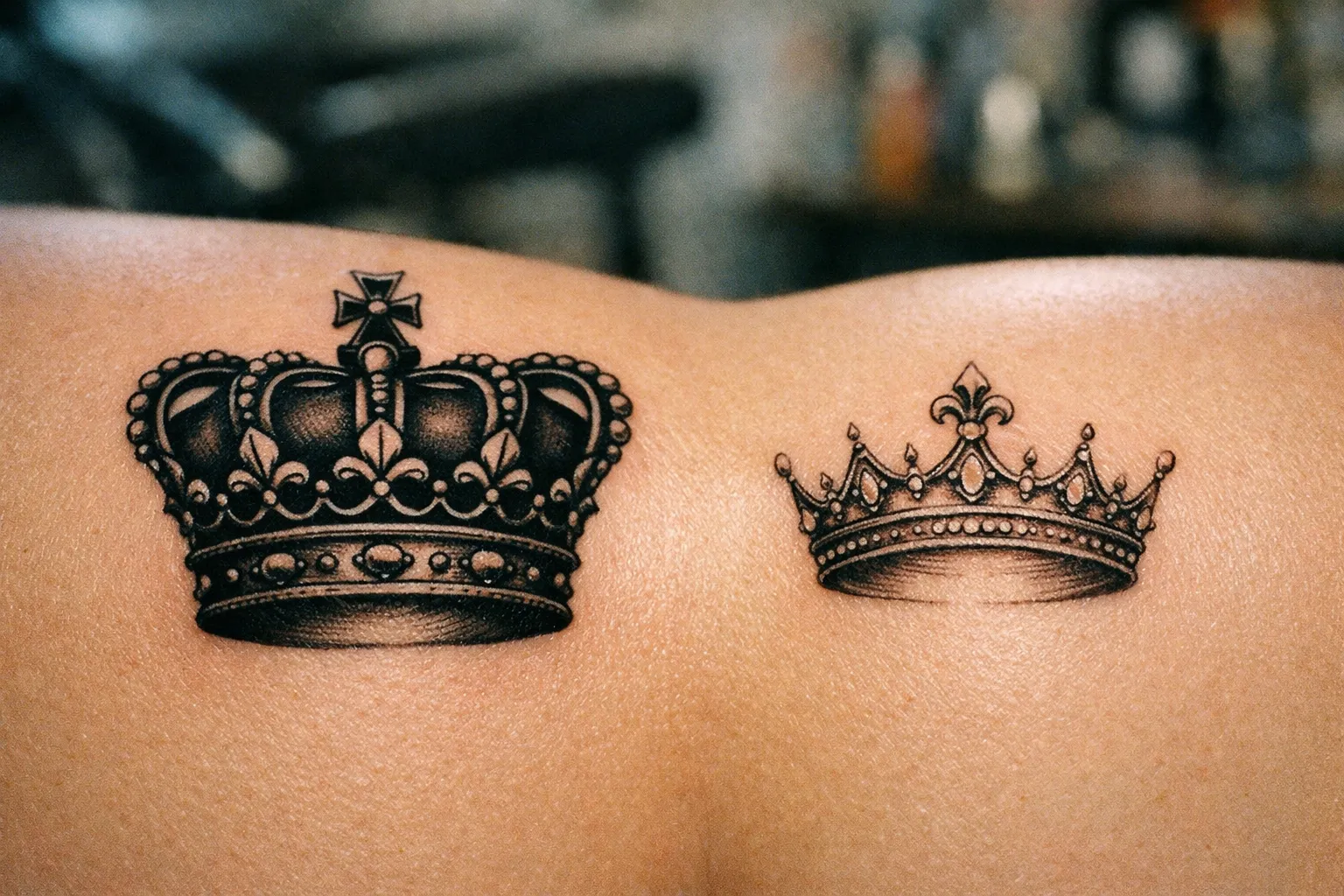
Placement that works:
- Inner forearm, 2-3 in tall - visible when you want, easy to cover for work.
- Ring finger, 0.5 in - symbolic, but expect touch-ups every 1-3 years because finger ink fades fast on high-friction skin.
- Back of upper arm, 3-4 in - ages well, room for shading.
One idea I’ve seen work really well is the split crown. One person gets the left half of a single crown, the other gets the right. Aligns when you stand shoulder to shoulder. Looks intentional even apart, but only feels complete together. It’s a cleaner concept than matching identical crowns, and it photographs well without looking like you coordinated your outfits.
The honest caveat: if the relationship ends, coverups for matching crowns usually need to go larger and darker than the original. Plan the design with that math in mind. A small, simple linework crown is far easier to cover or rework than a heavily shaded color piece with a name attached. I’ve done enough coverup consultations to say - keep the name out of it if you can.
How Small Can a Crown Actually Be?
A small crown Tattoo is one of the most common first tattoos because the shape reads even when shrunk down. But there’s a floor, and people underestimate it.
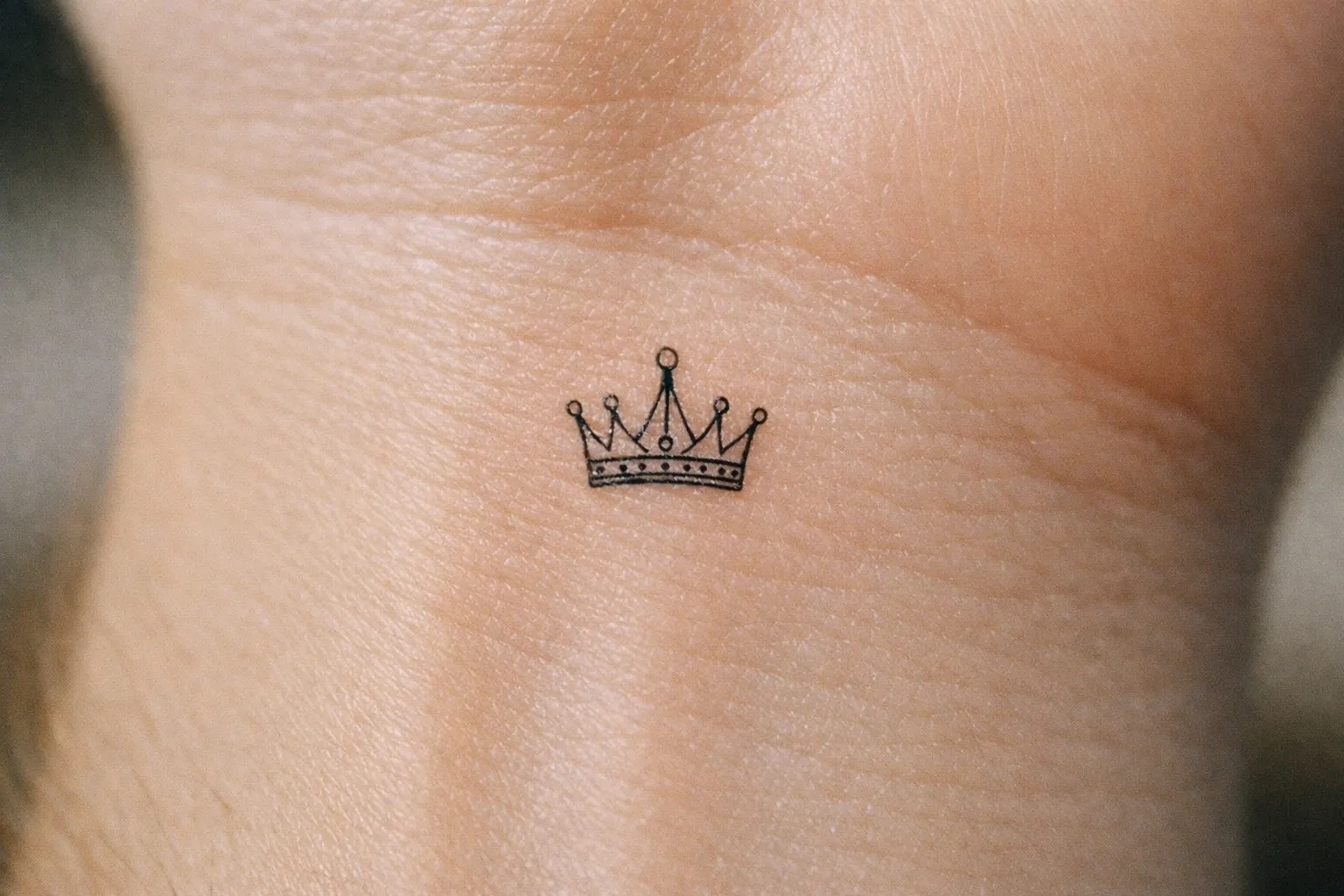
Sizing reality:
- Single-line crown, no shading: can work as small as 0.5 in (1.3 cm) wide.
- Crown with jewels, small text, or fine cross-hatching: stay above 1.5-2 in (4-5 cm) or the detail will blur within 5 years.
- Crown with a name underneath: add another 0.5 in for the text to stay legible after healing.
Placement that holds up small:
- Inner wrist - heals clean, ages reasonably.
- Behind the ear, 1-1.5 in - discreet, good for workplace concerns.
- Back of neck at the hairline - covered by most haircuts.
- Outer forearm - less exciting visually, best longevity.
Placement to avoid for small crowns: finger joints, side of the hand, the inner foot. High-friction or constantly stretching skin, and small detailed work blows out or fades fast. Plan on touch-ups every 18-36 months if you ink there anyway.
Pain-wise, behind the ear and inner wrist are mild compared to ribs or sternum. Finger ink stings sharply but it’s over fast - most small crowns take 30-45 minutes.
The Crown of Thorns Tattoo
The crown of thorns Tattoo is the heaviest crown in this category, both visually and symbolically. It references Christ’s crucifixion - suffering, sacrifice, forgiveness, redemption - and reads as overtly religious in a way other crowns don’t. When clients come in asking for this one, they usually have a clear reason. It’s not casual ink.
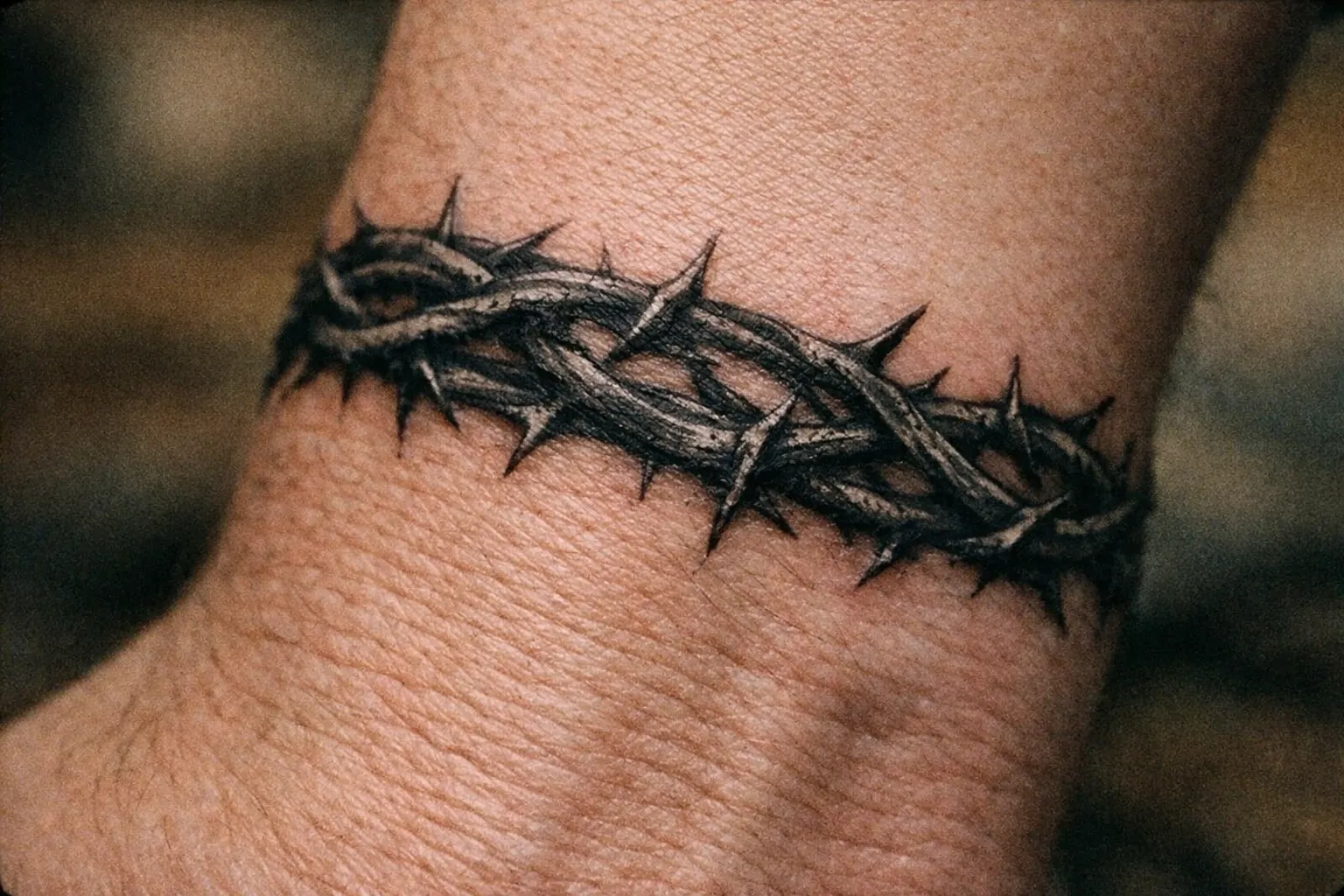
Two design approaches:
- Anatomical realism. Detailed thorn vines with texture, sometimes blood drops, often in fine black-and-gray. Heavy, intense, unmistakably Christian.
- Stylized linework. A thinner, more decorative band with stylized thorns. Less aggressive, more wearable for people who want the meaning without the gore.
Placement options:
- Forearm band, wrapping fully, 1.5-2.5 in tall - the most common request.
- Upper bicep band - easier to hide, more dramatic when revealed.
- Around the heart on the chest - for a more layered religious composition, often combined with a sacred heart or a portrait.
- Around the wrist as a thinner band - smaller commitment, still reads clearly.
Time and cost: a detailed forearm-wrap crown of thorns runs 3-5 hours and typically $400-$700 in most US cities. A simpler linework wrist band can be done in 1-1.5 hours for $150-$250.
One thing I always tell clients on this design: look at healed photos in the artist’s portfolio, not fresh ones. Fresh tattoos always look sharper than they’ll actually heal. Artists who can’t do clean black-and-gray gradient work make the thorns look flat and the shadows muddy. That’s the most common pitfall on this piece - it’s technically demanding and a lot of artists overestimate their black-and-gray skills.
The Laurel Crown Tattoo and Its Origins
The laurel crown Tattoo pulls from ancient Greece and Rome, where laurel wreaths marked victors at the Pythian Games, military triumphs, and academic honor. The modern read: victory, achievement, a specific win you don’t want to forget.
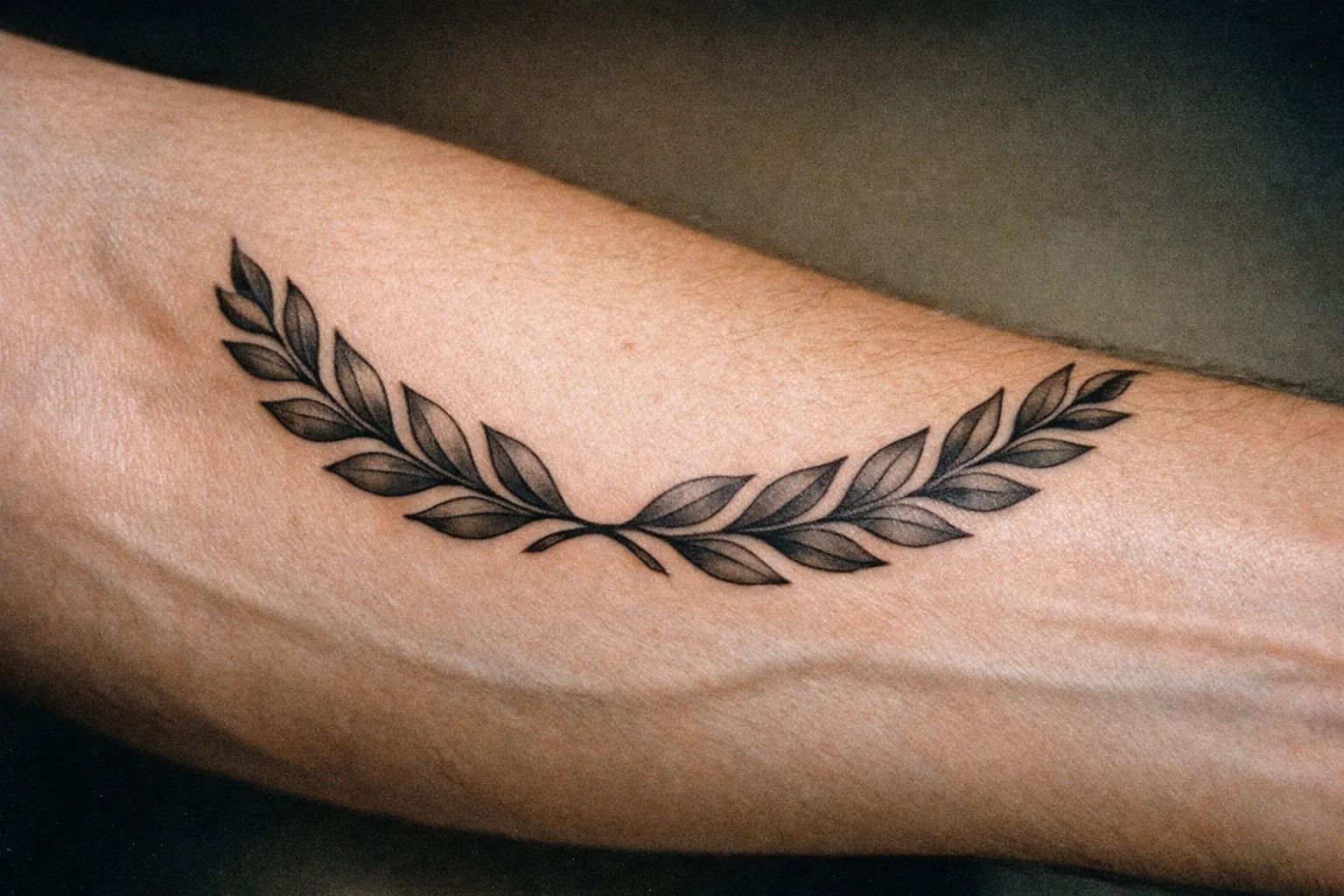
Who actually gets this: people marking a marathon, a degree, sobriety milestones, a championship, surviving something. Often with a date or distance inside the wreath. When the design has a specific number inside it - a race time, a year, a distance - it stops reading as generic almost immediately.
Design variants:
- Full circle wreath - the classical version. Works as a frame around a date, initial, or small portrait.
- Open horseshoe wreath - two laurel branches meeting at the bottom but open at the top, often used to frame text.
- Single sprig - half the wreath, usually on the side of the forearm or along the collarbone.
Placement and sizing:
- Ankle band, 1-1.5 in tall - popular for runners and athletes.
- Inner bicep, 2-3 in - easy to cover, room for a date inside.
- Sternum or chest center, 3-5 in - symmetrical, dramatic, but ribcage is significantly more painful than forearm by a wide margin.
- Behind the ear as a small sprig, under 1 in.
Single-color black linework laurels with minimal overlapping leaves are one of the easier crown-category designs to execute well and age cleanly. Good entry point if you’re newer to getting tattooed.
Placement Tips That Age Well
Where you put a crown matters as much as how it’s drawn. I’ve seen beautifully designed pieces turn into blurry blobs within a decade because the placement was wrong for the detail level.
Best longevity:
- Outer forearm, outer upper arm, outer calf. Low friction, moderate sun exposure if you wear sleeves, plenty of room.
- Upper back and shoulder blade. Skin doesn’t stretch much, ages slowly.
- Inner bicep. Hidden from sun, holds linework well - though it stretches if you gain or lose significant weight.
Looks great, ages harder:
- Fingers and hands. Constant washing, friction, sun. Plan for touch-ups every 18-36 months.
- Inner wrist. Holds reasonably, but watch for sun fading.
- Ribs and sternum. Beautiful placement, pain is significant (ribcage hurts considerably more than forearm), and the skin shifts over time.
- Feet. Shoe friction destroys detail.
Workplace-discreet options:
- Behind the ear (1-1.5 in).
- Under the bra line or under-boob.
- High hip.
- Back of neck under hairline.
If you might build a sleeve later, place your crown where it can anchor a larger composition - outer forearm or upper arm - and keep at least 1-2 in of clear skin around it for future linking pieces. A crown jammed into a corner of an existing piece is a nightmare to work around.
8 Creative Crown Ideas Worth Considering
If you want to avoid the “basic crown” trap, here are eight directions that actually personalize the motif.
- Single-line crown on the finger side, under 1 cm - a discreet self-worth marker only you see when you write.
- Laurel ankle band with a race time or date inside - earned, specific, hard to read as generic.
- Half thorns, half laurel forearm band - suffering on one side, victory on the other. Reads as a story arc without being heavy-handed about it.
- Split king/queen crown between partners - only completes when you stand together.
- Crown with broken points to mark recovery - each broken point a milestone (years sober, surgeries survived).
- Floating crown above an animal - lion, wolf, fox - ties the meaning to a specific personality trait rather than abstract royalty.
- Pixelated 8-bit crown for gamers - references in-game king/queen status, sidesteps the generic Pinterest look.
- Crown with a constellation worked into the band - Leo, Virgo, your kid’s birth sign - gives the design a personal anchor point.
What these have in common: each one adds specificity. A generic five-point crown reads as filler. A crown with a date, a constellation, a broken point, or an animal underneath reads as yours.
Basic Tattoos to Avoid When Considering Crowns
This question comes up constantly, and crowns sit squarely in the discussion. A few categories get flagged as “basic” or overdone:
- Generic five-point crowns with no surrounding context.
- Infinity symbols.
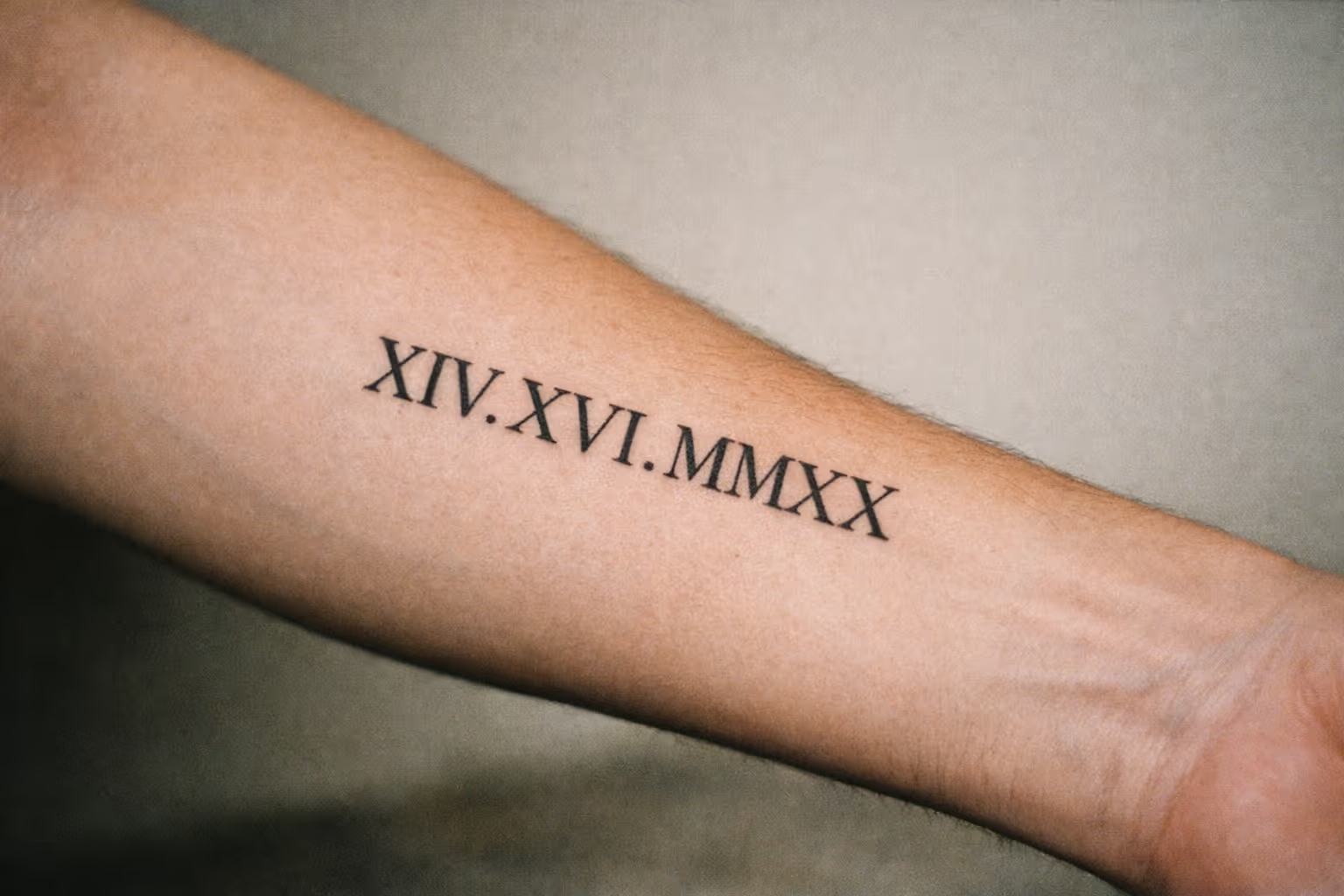
- Roman numerals as a standalone tattoo.
- Single feathers.
- Anchors with no nautical connection.
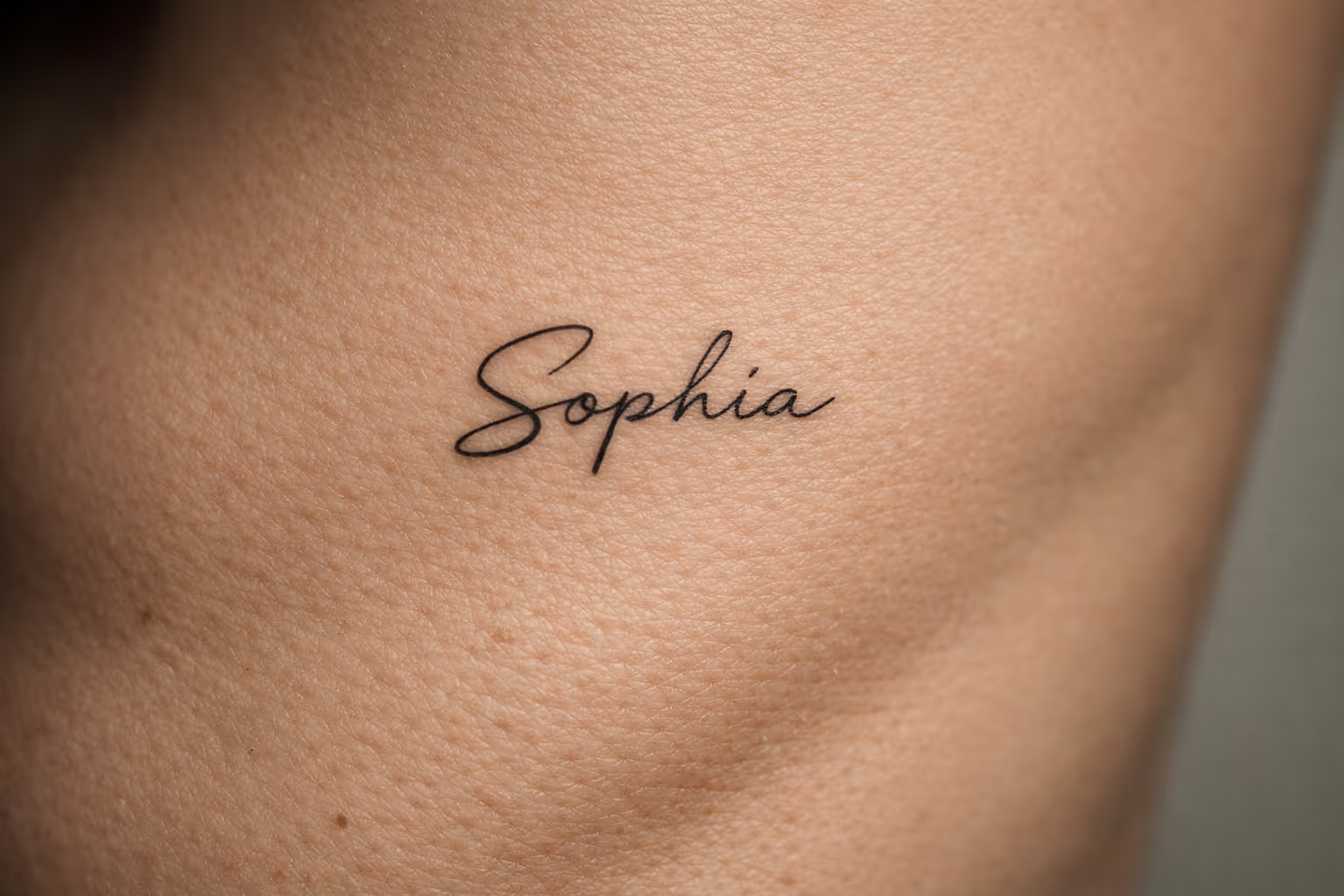
- Generic script quotes in fancy fonts.
The reason they’re called basic isn’t that they’re ugly - it’s that they’re tattooed so identically and so often, without personalization, that they stop carrying meaning. A crown with your daughter’s initial woven into the band isn’t basic. A crown that’s the exact stock image from the first page of search results, placed on the standard inner wrist, is.
The fix isn’t to abandon the crown. It’s to make it specific. Add the date. Add the constellation. Change the number of points to match something personal (three kids, four years sober). Talk to your artist about a custom version rather than picking off a flash sheet.
When to Be Careful About Contextual Risks
Most people getting a crown tattoo are fine. But there are three contexts where the same shape carries unintended weight, and a good artist will flag them before you book.
Latin Kings symbolism. A five-point crown - especially with specific point styling and ALKN-adjacent lettering - is widely recognized as the Almighty Latin Kings Nation symbol per Corrections1’s prison-gang reference (1). If you live in a region with active Latin Kings presence, ask your artist whether your design reads too close. Often a small change - different point count, different proportions, different surrounding elements - solves it without compromising the design.
Trafficking branding. NAPNAP Partners’ anti-trafficking education materials specifically flag crowns combined with a name or initials, placed on the neck, arm, or above the groin, as patterns sometimes used by traffickers to mark ownership of victims (2). Survivor-support nonprofits warn about it because the imagery can be retraumatizing for survivors who encounter it, and because it can prompt misreads by social workers and law enforcement. If you’re getting a crown with a partner’s name on your neck, your artist should at least mention this. If they don’t, bring it up yourself.
Prison aesthetic adjacency. Designs that mimic single-needle prison styling - stark black, no shading, certain lettering conventions - can affect how the tattoo reads in professional and legal contexts. Not a reason to avoid the style if you want it, just something to know going in.
If you’re a survivor of trafficking or abuse looking at coverups, organizations like Survivor’s Ink specialize in transforming branded tattoos into something the wearer chose.
Cost and Time: What to Budget
Pricing varies by city and artist reputation, but the general US ranges hold fairly consistently:
- Small linework crown (under 2 in, single color, no shading): $80-$200. About 30-60 minutes.
- Medium crown with some shading (2-4 in): $200-$400. About 1.5-3 hours.
- Crown of thorns forearm wrap, laurel band with date, king/queen matched set: $400-$800+ per person. 3-6 hours, sometimes split across two sessions.
- High-end realism (gem-encrusted color crowns, intricate filigree): top-tier artists charge $150-$250/hour in major cities.
Most studios have a shop minimum of $80-$150 regardless of size. A 20-minute finger crown still costs the minimum because it covers setup, sterilization, and the artist’s time. That’s not negotiable and it shouldn’t be.
Touch-ups after healing are usually free to $100 depending on shop policy - ask before you book, not after.
Aftercare Timeline for Crown Tattoos
Crown tattoos heal like any other linework piece. Surface healing takes about 2-3 weeks; full internal healing about 6-8 weeks. For a detailed breakdown of what to expect at each stage, the week-by-week healing rules cover everything from the initial wound through full integration.
Day 1-3: Keep the second-skin bandage on as long as your artist instructed (usually 24 hours to 5 days depending on which type they used). When you remove it, wash gently with fragrance-free antibacterial soap, pat dry, apply a thin layer of fragrance-free moisturizer or a healing balm. Expect plasma and some ink to weep - that’s normal.
Week 1: Wash 2-3 times a day, moisturize after each wash with a thin layer. The tattoo will start to scab or flake. Do not pick. Picking pulls ink out and leaves patchy spots that need touch-ups.
Week 2-4: Itching peaks around here. Slap, don’t scratch. Continue moisturizing. The tattoo will look slightly dull as the top layer of skin replaces itself - this is the “milky stage” and it’s normal. Color and crispness return by week 4.
Long-term: Once fully healed, apply SPF 30-50 sunscreen on the tattoo any time it’s exposed. UV is the single biggest cause of fading for fine-line crown work. Sun-protective clothing helps more than sunscreen if you’re outdoors for hours - the SPF in most clothing is more consistent than what people actually apply.
Frequently Asked Questions
- What does the crown tattoo mean?
- Generally, it symbolizes power, leadership, self-rule, or self-worth, but variants like the crown of thorns or laurel crown carry specific meanings tied to faith or achievement. Placement and design details heavily influence interpretation.
- What does a crown tattoo mean in jail?
- In prison, a five-point crown often signals affiliation with the Almighty Latin Kings Nation, especially when paired with specific lettering. Outside that context, it usually doesn't carry gang meaning.
- What does a crown tattoo on a woman mean?
- Typically it represents self-worth, empowerment, or partnership. However, crowns combined with names or initials on certain body parts can be trafficker ownership marks, so context is critical.
- What are basic tattoos to avoid?
- Overdone generic crowns, infinity symbols, standalone Roman numerals, and common script quotes lack personalization and meaning. Adding specific elements like dates or constellations makes a tattoo unique.
- How long does a small crown tattoo take to heal?
- Surface healing takes 2-3 weeks, with full internal healing around 6-8 weeks. Avoid swimming, hot tubs, and direct sun exposure during early healing.
- Will a finger crown tattoo last?
- Finger tattoos fade faster due to friction and washing. Expect touch-ups every 18-36 months to maintain crispness, or accept natural fading.
- Can a crown tattoo be mistaken for gang affiliation?
- Yes, especially five-point crowns with specific styling linked to the Latin Kings. Regional knowledge and artist consultation can help avoid unintended associations.
- What aftercare products are best for crown tattoos?
- Use fragrance-free antibacterial soap initially, followed by fragrance-free moisturizer or healing balm. Long-term, apply SPF 30-50 sunscreen or wear sun-protective clothing to prevent fading.