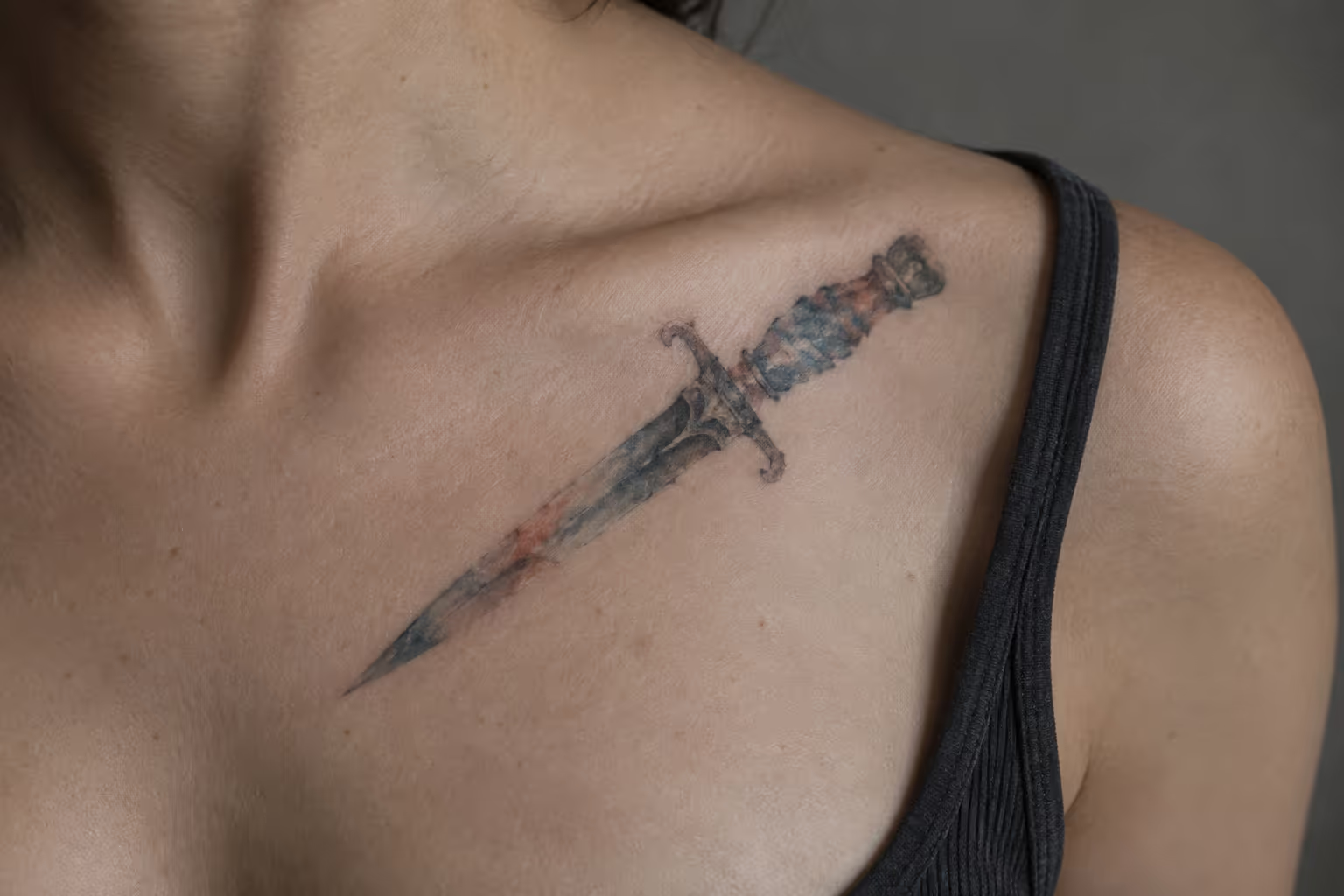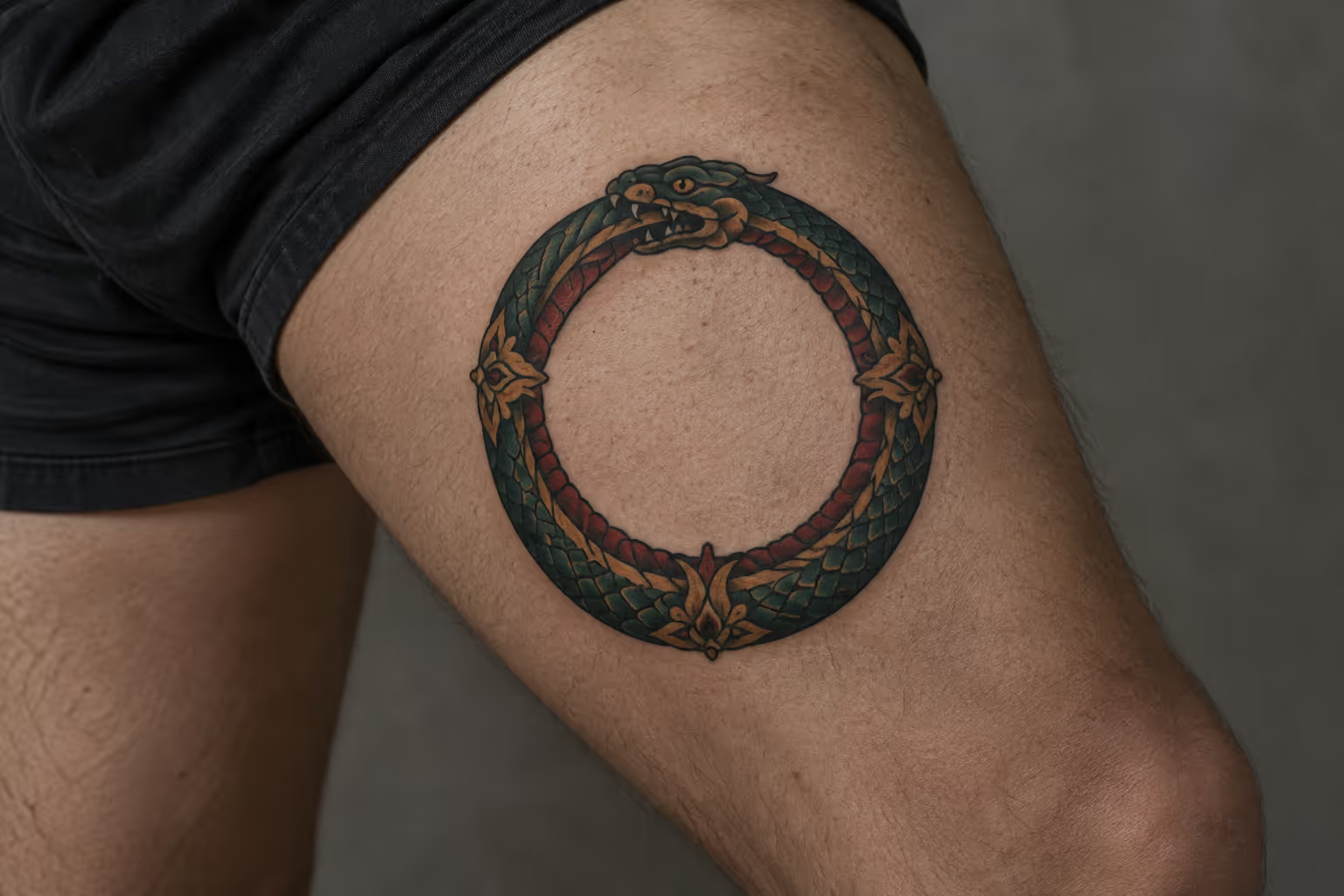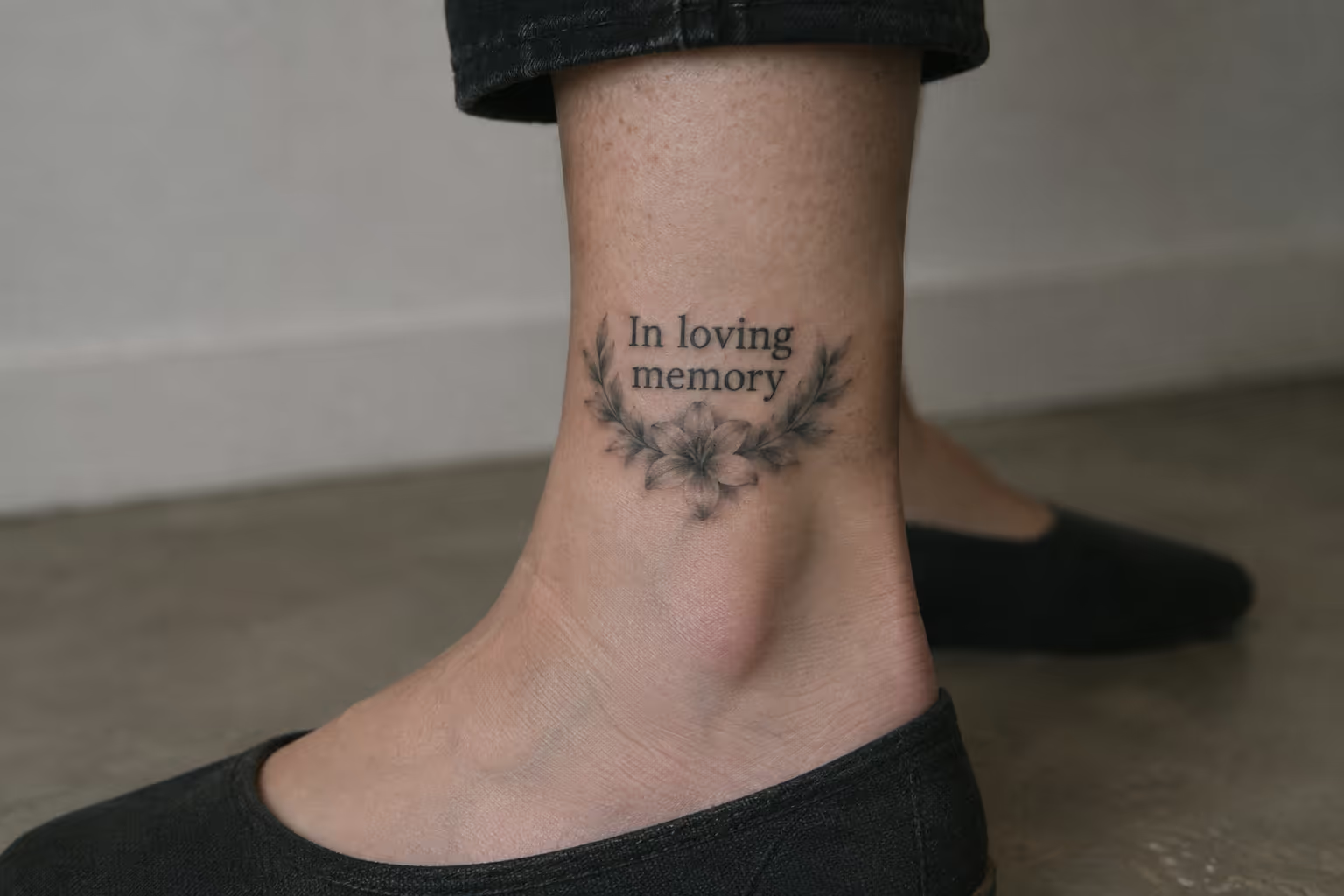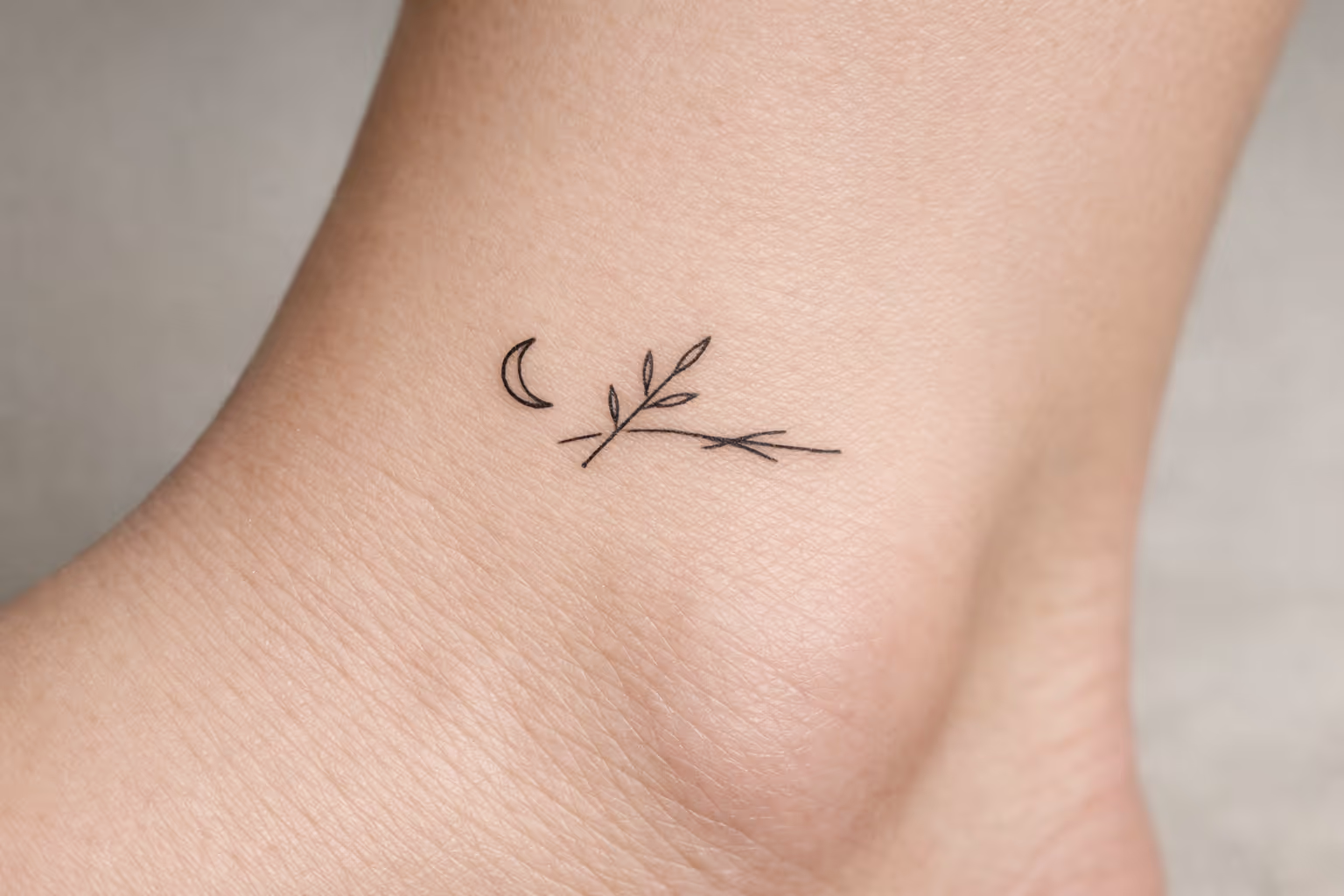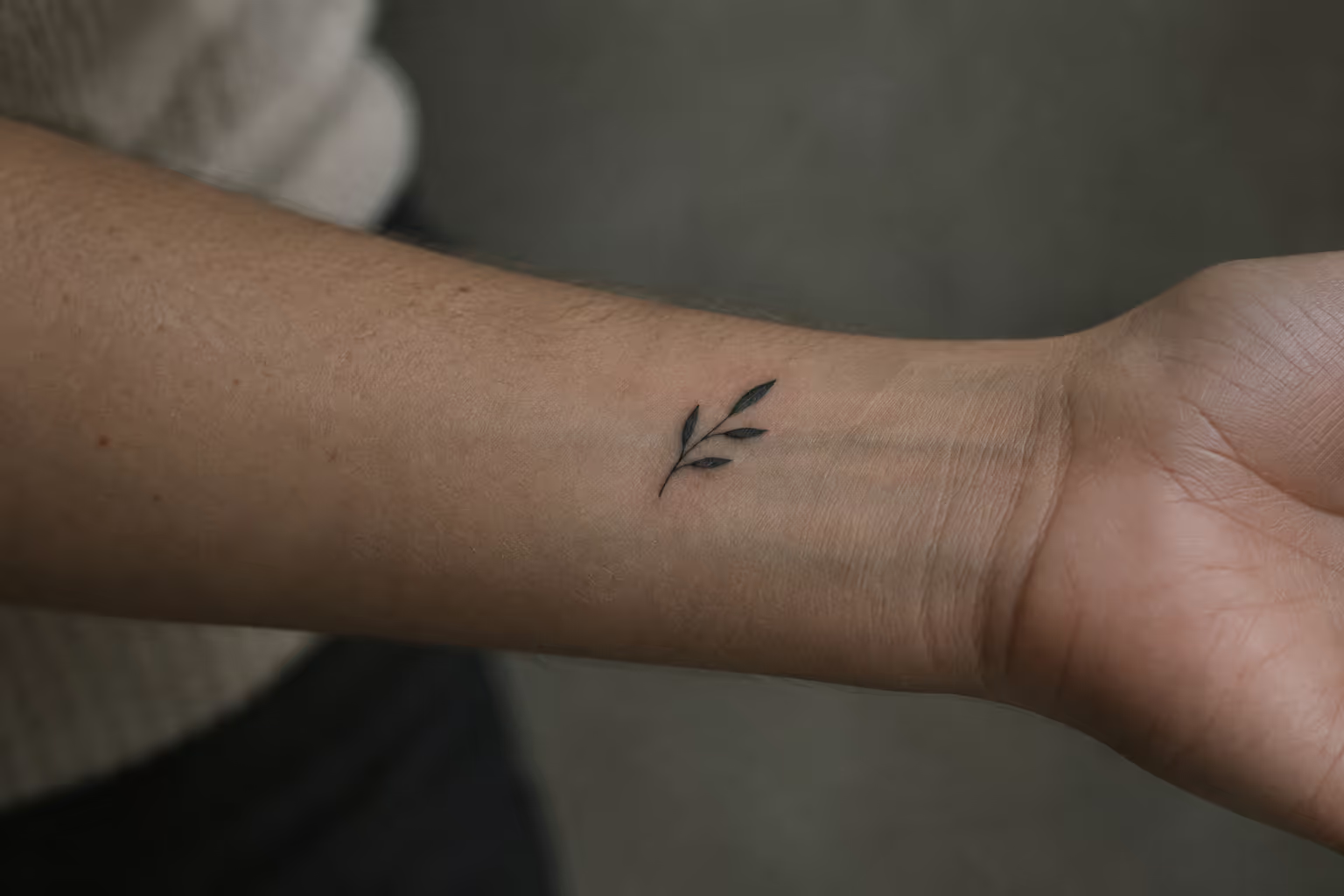
A quarter-inch line looks crisp on the stencil sheet, but the same linework can soften into a gray smudge a decade after it heals. Small tattoos for men live or die on detail size and placement, not on the idea alone. This guide covers the size floor that keeps a design readable, the minimalist and simple styles that hold up, meaningful motifs worth researching first, and which placements stay hidden and which never will.
Small Tattoos for Men: What Size and Detail Look Like on Skin
Small tattoos for men stay readable longest when the whole design measures at least 1 inch (2.5 cm) across and no detail element is under ¼ inch (6 mm) (13). That figure comes from one current small-tattoo guide, so treat it as that publisher’s rule of thumb and not a clinical standard. It does match how ink behaves in skin over the years, which is why it makes a useful starting floor.
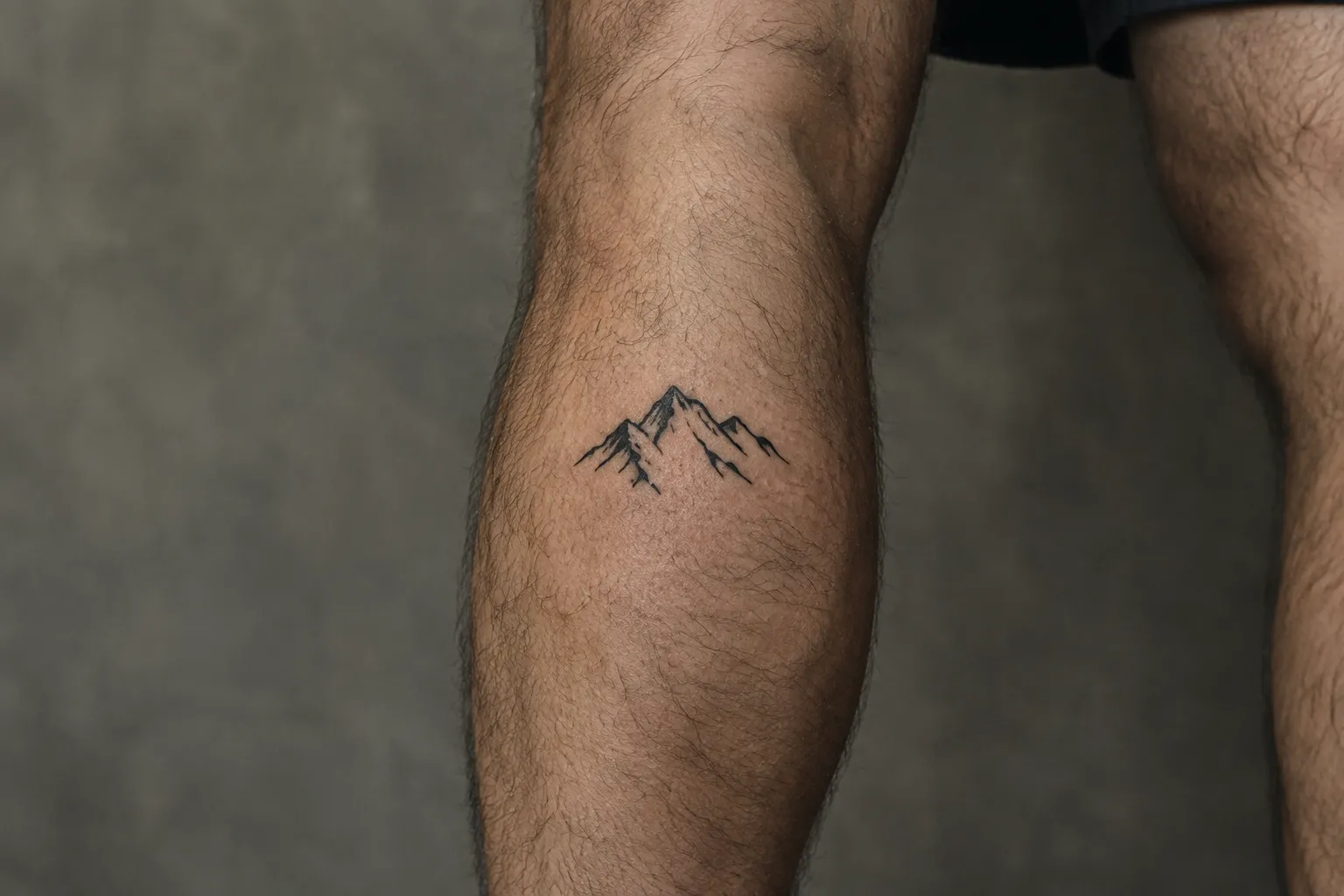
For scale, most artists treat anything up to roughly 3 inches (7.5 cm) on its longest edge as small, and anything at or under 1 inch (2.5 cm) as micro (15). Inside that range, the size of the smallest detail matters more than the overall dimensions.
This is where a simple outline and dense fine line part ways. A three-peak mountain outline at 2 inches (5 cm) wide has maybe six lines and wide open gaps between them. A fine-line pine forest at the same size might pack twenty trees, each with branches a millimeter apart. Both look clean fresh. Only one of them still reads as a forest in ten years.
Why detail under a quarter inch tends to blur
Tattoo ink sits in the dermis, and it doesn’t stay perfectly still. Over years, pigment spreads slightly and lines thicken and soften at the edges. On a large piece that spread is invisible. On a small one, two lines drawn 3 mm apart can close the gap between them, and the negative space that defined the design fills in. That’s the merge the ¼ inch (6 mm) warning is about (13).
The usual casualties:
- Tight parallel lines, like hatching, wood grain or feather barbs
- Enclosed spaces in lettering, the inside of an “e”, “a” or “o”
- Tiny dotwork, which drifts into a gray patch
- Faces and eyes on micro-realism animals and portraits
Lettering has its own floors, measured as letter height (the height of the whole letter). Standard script needs at least 12 mm (1/2 in), fine or ornate script about 25 mm (1 in), and block, serif, typewriter lettering and numerals at least 6 mm (1/4 in). Anything smaller closes up as it ages.
Checking the stencil at actual size with your artist
A design zoomed on a phone screen tells you almost nothing about how it will read on your forearm. One men’s guide sets the bar at whether the design still reads cleanly when the skin moves and when someone sees it from four feet away (15). The consultation is where you can test that before any ink goes in:
- Ask the artist to print the stencil at the exact planned size, not “roughly” that size.
- Have it applied to the actual placement. Paper is flat, and a forearm twists when you rotate your hand.
- Look at it from arm’s length and from about four feet (1.2 m) away. If a stranger would have to ask what it is, it’s already too detailed.
- Ask directly: “Which lines here will close up first?” A good artist will point to them and suggest thickening a line or dropping an element.
Weighing the category as a whole, small tattoos earn their popularity. They’re subtle, sessions are shorter, they’re usually cheaper overall (shop minimums still apply), they’re easy to conceal in most spots, and they make a low-stakes first tattoo. The costs are real too: detail loss as the ink ages, less visual impact from a distance, and very little room for complex color blending or shading. For larger formats like sleeves and back pieces, see our guide to tattoo designs for men.
✓ Pros
- A compact design can fit a personal reference without making it the first thing people notice.
- A focused motif leaves more room to keep line spacing readable.
- Shorter sessions can make it easier to test how you feel about getting tattooed.
✗ Cons
- Small dimensions leave little room to simplify a design after the stencil is on skin.
- Fine details have less margin for the natural softening of ink over time.
- A tiny tattoo may be hard to read from a normal conversational distance.
Minimalist and Simple Tattoo Styles for Men
Minimalist tattoos for men rely on thin single-needle linework and open negative space, while simple tattoos for men get their look from bold outlines and solid black fill. Both are small-scale approaches, but they age differently and suit different placements, so pick the look before you pick the size. If you want a small piece to read as deliberate rather than delicate, one artist quoted in a men’s guide narrows it to three levers: sizing, line thickness and the image itself, with heavy blackwork, sharp angles and bold fonts as the toolkit (5).
Fine-line minimalist motifs
Two technical hallmarks define fine-line minimalist work. First, thin, even linework, usually pulled with a single needle or a tight 3-round liner, in black or diluted gray. Second, deliberate negative space: the untouched skin does half the design work. Think a single continuous-line profile, a small triangle with one line through it, a crescent moon, a circle broken at one point, or an arrow.
A limited palette is standard. Most minimalist pieces are black only; some add one accent color, like a small red dot or a single colored petal. If you add an accent, keep it a saturated color. Pale yellows and whites lose contrast fastest against skin.
Best sizing is 1.5 to 3 inches (4 to 7.5 cm) on the inner forearm, outer upper arm or back of the shoulder, where skin is flat and moves less.
The common pitfall is lines placed too close together or pushed too deep. Too close, and they merge (see the ¼ inch rule above). Too deep, and you get a blowout: ink spreads under the skin into a blurry blue halo along the line. Fine line is unforgiving because there’s no bold outline or shading to hide an uneven pass.
Bold simple shapes that hold up over time
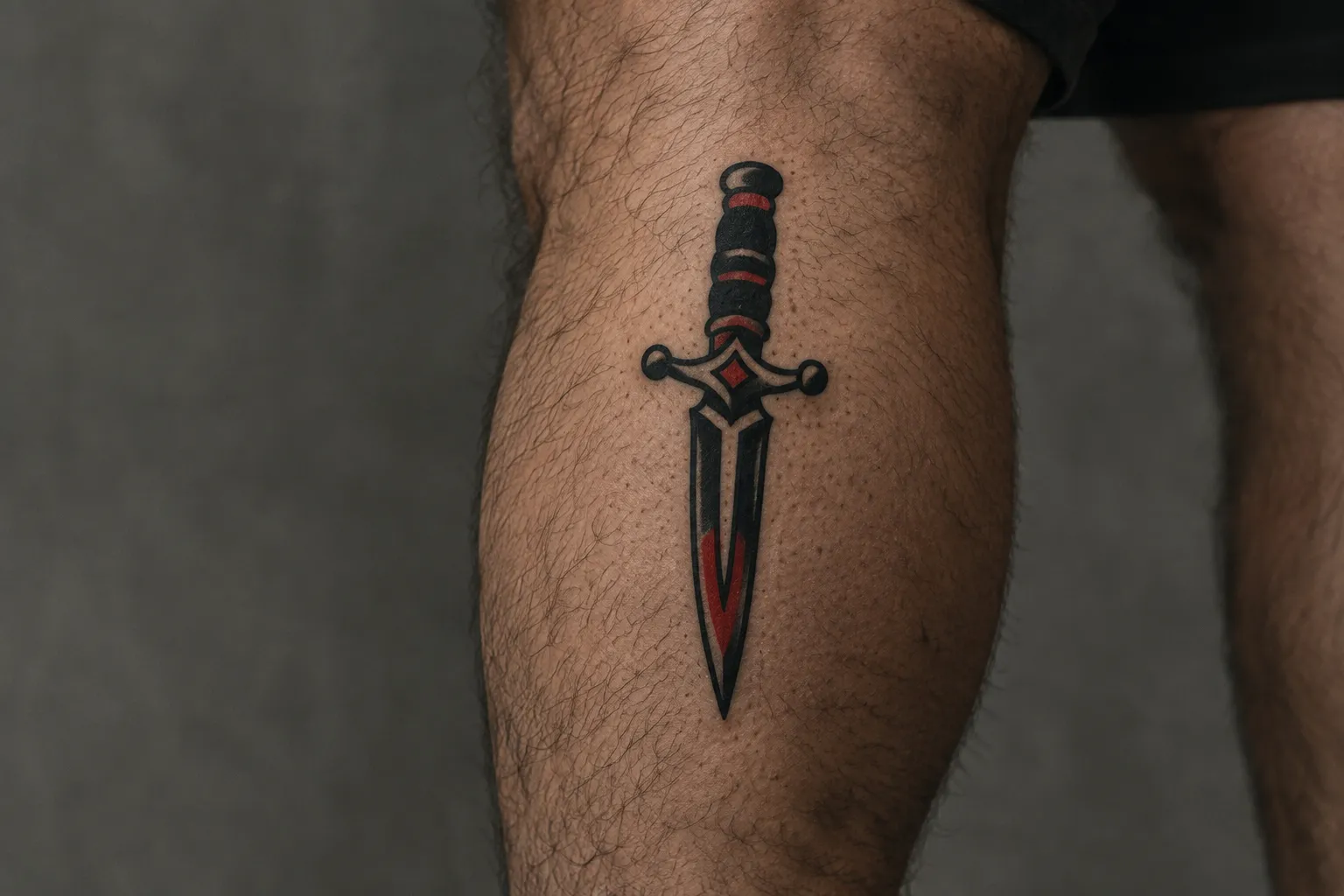
Simple tattoos for men borrow from American traditional and blackwork. The two hallmarks: thick black outlines, often pulled with a 7- to 9-round liner, and a limited palette with solid saturation (black, red, green, yellow, packed fully so no skin shows through). Blackwork versions drop the color entirely and use filled shapes: a solid black band, a filled diamond, a bold dagger silhouette.
Classic small flash works well here: a dagger, swallow, anchor, rose, snake or single star at 2 to 3 inches (5 to 7.5 cm). The thick outline gives the ink room to spread without losing the shape, which is why these pieces still read clearly decades later.
The pitfall is shrinking a full-size flash design without editing it. A traditional panther head drawn for 5 inches (12.5 cm) has whisker lines, tooth highlights and shading that turn into mud at 2 inches (5 cm). A good traditional artist redraws for the size and removes details.
The practical split: minimalist designs read as delicate and suit spots with low friction and low sun. Bold simple shapes tolerate rougher placements (outer forearm, calf) and read from farther away. Neither makes a hand tattoo last, as the placement section explains.
Before your session, finalize the design in this order:
- Pick the motif and the style together. A compass in fine line and a compass in American traditional are two different tattoos.
- Print and test the stencil at true size, at the planned dimensions.
- Confirm the placement on your body, not on paper. Check it with the limb relaxed and flexed.
- Check detail spacing with the artist. Ask which gaps fall under ¼ inch (6 mm) and whether to open them up.
- Approve the final version before the session starts, so you aren’t making design decisions with the machine running.
How to Finalize a Small Tattoo Design
Use the motif, true-size stencil and actual placement to check that the design will read clearly before the session begins.
- 1
Choose the motif and style
Decide what the design depicts and whether it suits fine-line minimalist work or a bolder style; the same motif can read very differently in each.
- 2
Test the stencil at true size
Have the artist print the design at its planned dimensions rather than judging it from a magnified screen image.
- 3
Try the placement on your body
Apply the stencil to the intended spot and check how it looks with the limb relaxed and flexed.
- 4
Review line spacing with the artist
Ask which gaps may close as the ink softens and whether opening the spacing or removing details would help.
- 5
Approve the final version
Confirm the design, size and placement before the tattoo session starts.
Small Tattoo Ideas With Meaning: Symbols, Family, and Personal Stories
Small meaningful tattoos for men work best as one clear symbol, such as a compass, a star or family initials, with any cultural meaning checked before you book. Men’s tattoo guides keep returning to the same compact concepts: stars, compass motifs, geometric shapes, lettering and personal or family symbols (11)(14). What a symbol means is personal, but if it comes from a specific culture or religion, research what it means in the culture it came from first (15).
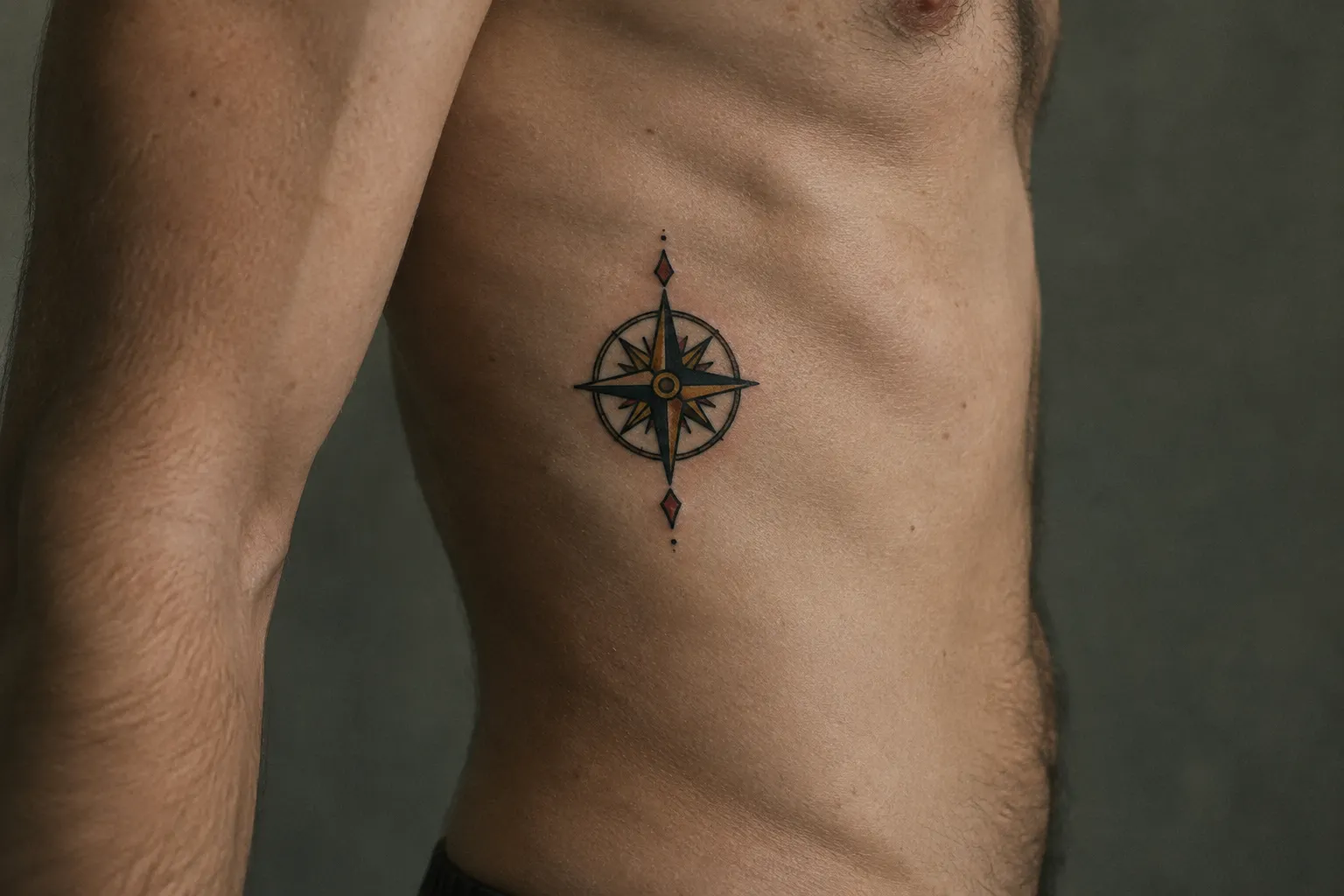
The compass and the nautical star come out of sailor tattooing, and both became staples of American traditional flash. For sailors they were tied to navigation and getting home. In modern Western tattoo culture the meaning has broadened to direction, travel or staying grounded. For a small version, keep a compass rose to 4 or 8 points at 2 to 3 inches (5 to 7.5 cm). A 16-point rose with degree markings at 1 inch (2.5 cm) is a guaranteed blur.
Symbols with cultural roots worth researching first
Several popular small tattoo ideas for men carry histories that differ from the meaning printed on a Pinterest pin.
Celtic knots come from the interlace patterns of early medieval Insular art, the decorated manuscripts and carved stone crosses of Ireland and Britain. The specific meanings now attached to them (“eternity,” “unbreakable love,” a particular knot for brotherhood) are largely modern interpretations from later revivals. Historical sources don’t pin one fixed meaning to each knot, so be wary of any site that claims one. For size, interlace needs space: keep a knot at 2 inches (5 cm) or larger so the over-under crossings stay visible.
Japanese motifs such as the koi, the wave or cherry blossoms come from irezumi, where they were built into large compositions with background water and wind. The koi swimming upstream is tied to perseverance through a legend of Chinese origin, and cherry blossoms to impermanence. A single small koi on the forearm is a Western adaptation of that vocabulary, which is fine, but know that it’s a fragment of a larger system. Kanji need extra care: get the characters checked by a fluent reader before the stencil goes on, because mistranslated kanji are a known problem.
Polynesian patterns (Samoan tatau, Māori tā moko and related traditions) are tied to genealogy, rank and place, and many designs are specific to a family or island. Māori moko in particular is personal to its wearer. Western “tribal” tattoos of the 1990s borrowed the look while stripping out the meaning. One men’s guide is clear about the alternative: work with a recognised cultural practitioner or an artist trained and permitted within that community (14). If this is the direction you want, find that artist rather than copying a pattern from an image search.
Personal and family-tied designs
The most personal small tattoos are often plain: a child’s initials, a birth date, a parent’s signature, the coordinates of a hometown. These live or die on the lettering floors.
- Initials and numerals in block or serif type: letter height at least 6 mm (1/4 in). A set of three initials sits comfortably at 1 to 1.5 inches (2.5 to 4 cm) wide on the inner forearm or chest.
- A name in standard script: letter height at least 12 mm (1/2 in), which puts most first names at 2 to 3 inches (5 to 7.5 cm) long.
- A signature or ornate script: letter height about 25 mm (1 in). Handwriting has uneven, thin strokes, so it needs more height than you’d expect.
- Dates in Roman numerals get long fast. A full date can stretch past 3 inches (7.5 cm), which suits the inner forearm better than the wrist.
On the wrist, only bold script or block lettering holds. Delicate script there closes up faster than almost anywhere else on the arm.
The semicolon deserves a mention as a design choice. It’s widely recognized as a mental-health awareness symbol, read as “the sentence continues,” and it works well small because it’s two solid shapes. Give it at least ½ inch (12 mm) of height with a solid dot rather than an outlined one, and place it on the wrist or inner forearm where you’ll see it every day.
Placement Guide: Best Spots From Forearm to Behind the Ear
The forearm is one of the most versatile placements for small arm tattoos for men: easy to show off and easy to cover (14). Every placement sits somewhere on a visibility scale, from always on display to seen by almost nobody. The upper arm, shoulder and calf are easier to conceal than hands or neck (5). The mistake is assuming that small automatically means easy to conceal. It doesn’t. Placement decides concealment, and the right spot depends on how often you need the tattoo hidden, not just on the design (14).
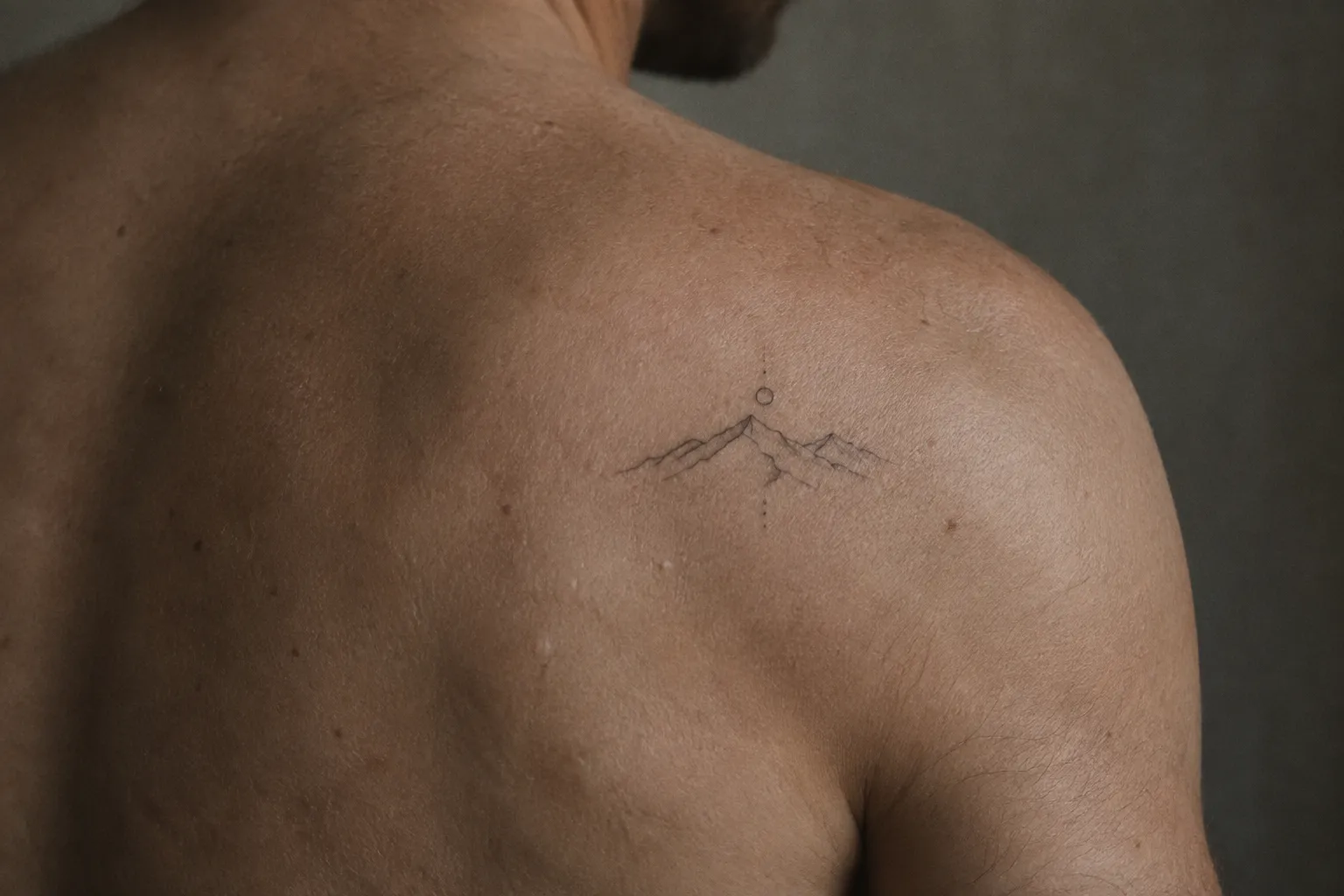
Forearm and wrist: visible but coverable
Men’s guides rank the forearm as a top first placement, a flat canvas that a long sleeve covers when needed (5)(14). The inner forearm gives you a flat, low-hair surface for fine line, lettering and minimalist work at 1.5 to 3 inches (4 to 7.5 cm). The outer forearm handles bold simple shapes and gets more sun, so it needs more sunscreen discipline. Pain is low on both: the outer forearm is one of the easiest spots on the body, and the inner forearm stings a little more near the elbow crease and the wrist.
The wrist is harder than it looks. The skin is thin, it flexes constantly, it rubs against watch straps and cuffs, and it gets washed and sun-exposed all day. Keep wrist pieces to about 1 to 1.5 inches (2.5 to 4 cm), favor bold lines, and remember that only bold script or block lettering holds there. A delicate fine-line wrist design ages badly: one men’s guide expects a fine-line wrist piece to need a touch-up inside a decade (15). Plan on it softening faster than the same design on the inner forearm.
For work, a forearm tattoo can be covered with a dress shirt. A wrist tattoo can peek out at the cuff when you reach for something, so if you need full concealment, move it 2 inches (5 cm) up the arm.
Upper arm, shoulder, and chest: discreet under clothing
The outer upper arm and back of the shoulder hide under a standard T-shirt sleeve, which makes them the easy answer for men who need a tattoo concealed at work most of the time (14)(15). The skin is flat, stable and gets less sun than the forearm, so fine line ages well here. Size range: 2 to 4 inches (5 to 10 cm). Pain is low on the outer arm and noticeably higher on the inner bicep (inner bicep > outer upper arm).
The chest is fully covered by nearly any shirt. A small chest tattoo over the pec at 2 to 4 inches (5 to 10 cm) sits well; the sternum suits a vertical design 2 to 4 inches (5 to 10 cm) tall, like a dagger, a line of numerals or a narrow geometric piece. Two practical notes. Pain runs sternum > pec > outer arm, because the sternum sits right on bone (15). And chest hair matters: the area gets shaved for the session, and regrowth partly veils fine line afterward. Bolder linework reads better through hair.
Behind the ear and upper thigh: fully hidden options
One men’s guide lists the inner wrist, ankle, behind the ear and upper thigh as the spots for something discreet (14). Of those, behind the ear and the upper thigh are the most reliably hidden.
Behind the ear fits a tiny design, 0.75 to 1.5 inches (2 to 4 cm): a star, a small symbol, a single initial in block type. Longer hair hides it completely; a short fade exposes it, so match the placement to your haircut. It sits over thin skin and bone, so it stings more than the inner wrist (5), but sessions for pieces this size are short.
The upper thigh is the most concealable spot on this list. It’s covered by shorts, it has a wide flat area for 2 to 4 inches (5 to 10 cm) of design, and it sees little sun or friction beyond clothing. Outer thigh pain is low; it climbs toward the inner thigh (inner thigh > outer thigh).
The ankle hides under socks and trousers but takes friction from shoes, so keep designs bold there.
Neck and hand tattoos: why ‘small’ doesn’t mean hidden
Hands, fingers and necks are the placements where small feels safe and turns out not to be. A 1-inch (2.5 cm) design on the side of the neck or the back of the hand is visible in any clothing short of gloves and a turtleneck. These are highly visible placements, and a men’s tattoo guide describes hand tattoos as prone to fading (14).
Another men’s guide spells out why: the skin on the back of the hand regenerates constantly, and on the fingers constant washing, handling, friction and fast skin turnover mean even a clean piece fades significantly inside two years (15). Pain runs high too (hand and fingers > outer forearm) because there’s little padding over bone.
Necks carry the same visibility problem, plus daily sun exposure and constant movement. If you need long-term concealment, skip hands and necks even for the smallest designs; the first guide calls the neck not exactly subtle and asks you to check that your workplace is on board (14). If you want them anyway, go bold: solid shapes and block lettering with generous spacing, and accept that you’ll maintain them.
The table below lines up all eight placements side by side, from the forearm to the always-visible neck and hand, so you can weigh visibility against work concealment, aging and suitable design types in one pass.
Small Tattoo Placements Compared
| Forearm | Wrist | Upper arm / shoulder | Chest | Behind the ear | Upper thigh | Neck | Hand | |
|---|---|---|---|---|---|---|---|---|
| Visibility | Visible in short sleeves | Visible | Usually covered by a T-shirt sleeve | Hidden under a shirt | Hidden by longer hair; exposed with a short fade | Hidden under shorts | Highly visible | Highly visible |
| Work concealment | Covered by long sleeves | Partly covered by cuffs | Easy to conceal under a T-shirt | Easy to conceal under most shirts | Concealment depends on haircut | Easy to conceal under clothing | Difficult to conceal | Difficult to conceal |
| Fade and legibility | Inner forearm holds well; outer forearm gets more sun | Fades and softens faster with flexing and friction | Flat, stable skin with less sun exposure | Generally ages well; chest hair can soften fine line | Ages well when protected from sun | One of the better spots for aging, with little sun or friction | Daily sun and movement affect legibility | Fade-prone from washing, friction and sun |
| Suitable design types | Fine line, lettering and bold flash | Bold script or block lettering | Fine line and minimalist work | Bold shapes or vertical sternum designs | Tiny symbols or a single initial | Any small style | Bold designs with generous spacing | Bold solid designs |
Keeping a Small Tattoo Legible for Decades: Placement, Sun Care, and Linework
Once a small tattoo heals, broad-spectrum, water-resistant SPF 30 or higher sunscreen, applied 15 minutes before going outdoors, protects its linework from fading (7). Legibility over decades comes from two habits working together: keep fine detail above the ¼ inch (6 mm) threshold that a small-tattoo guide warns tends to merge (13), and keep UV off the ink once it has healed (7).
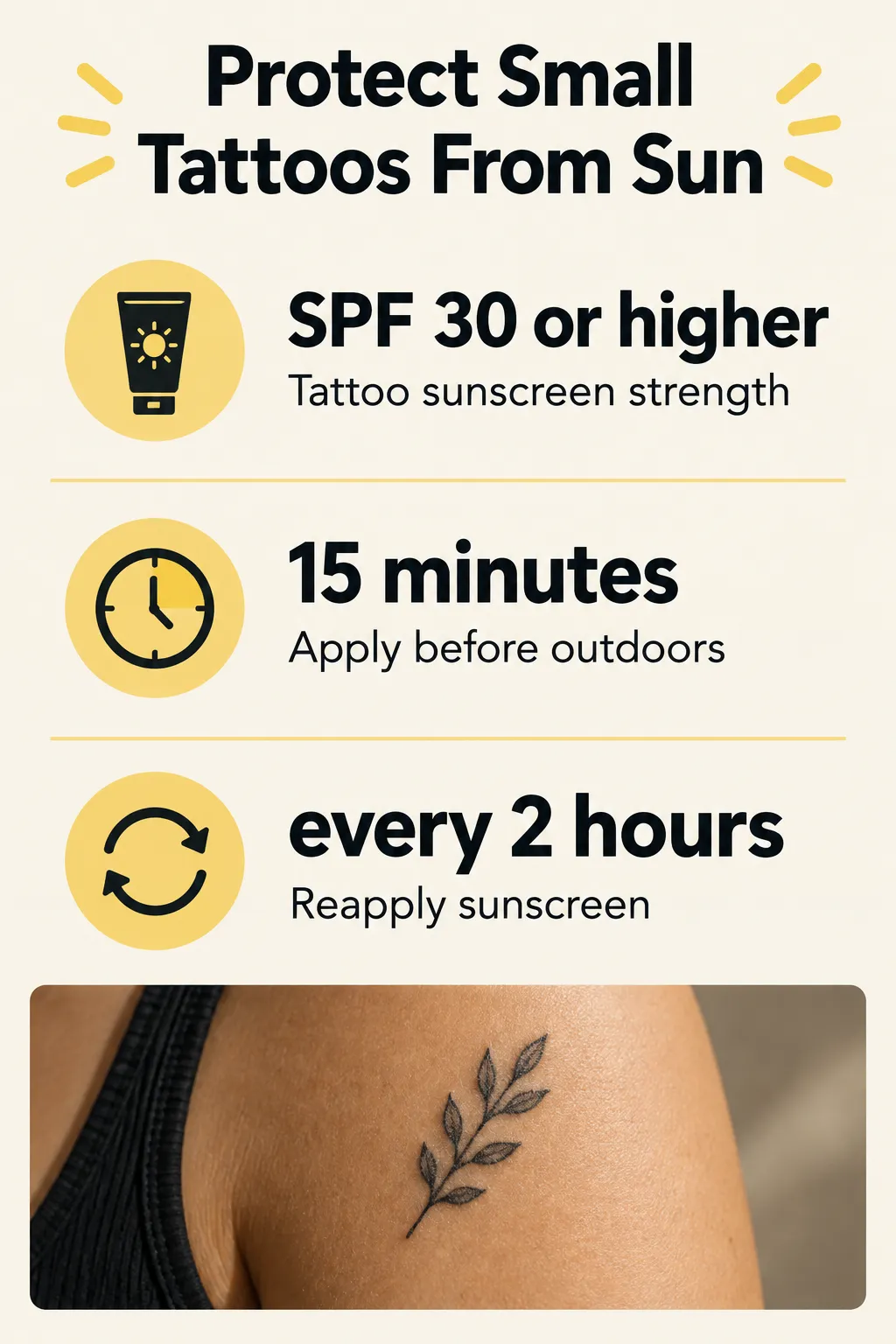 For healed, sun-exposed tattoos, the American Academy of Dermatology recommends SPF 30 or higher, applied 15 minutes before going outdoors and reapplied at least every 2 hours.
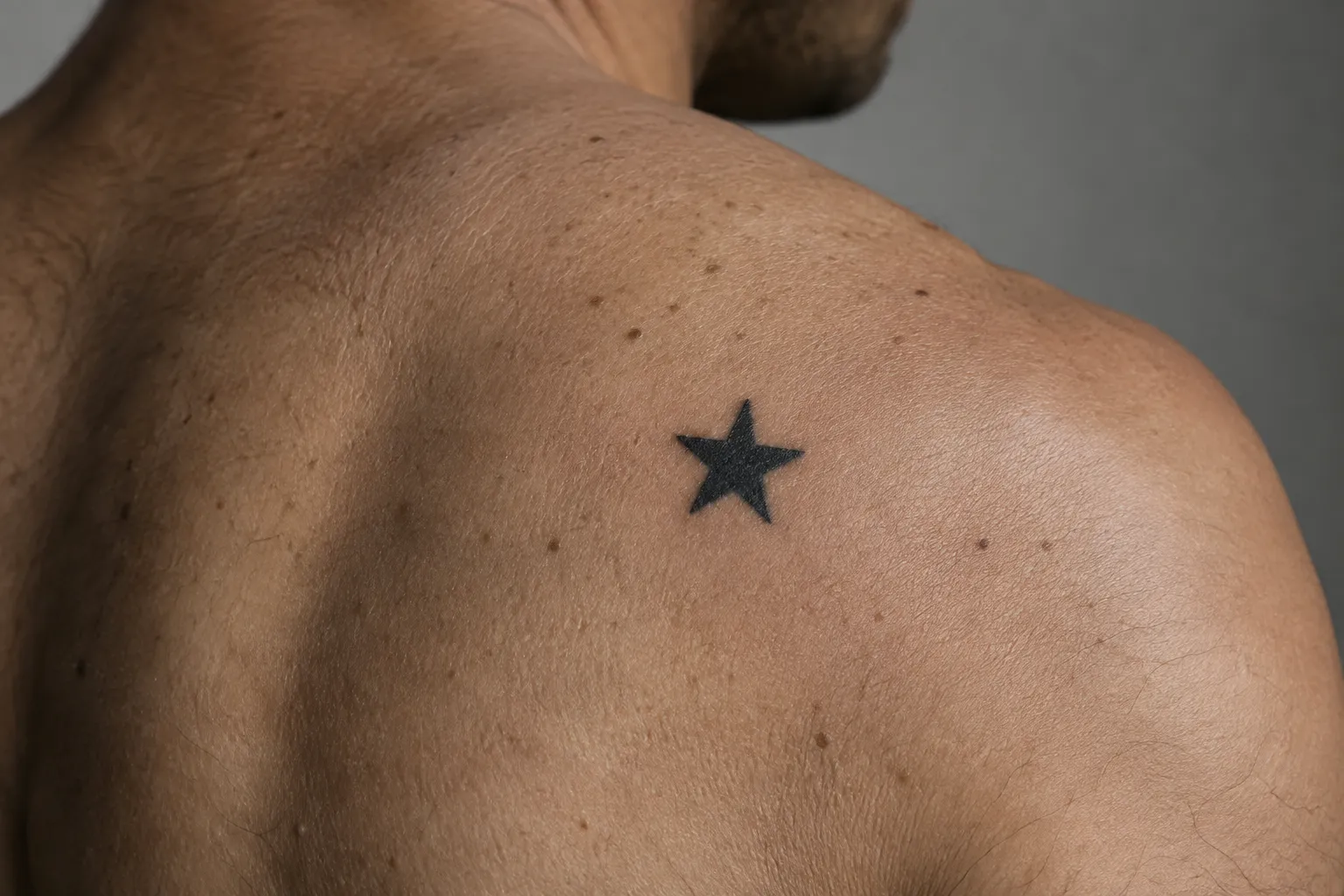
Sun protection once healing is done
Ultraviolet light can fade some tattoo inks, according to the American Academy of Dermatology (7). Its routine for sun-exposed tattoos is specific:
- Sunscreen type: broad-spectrum, water-resistant, SPF 30 or higher (7)
- Timing: apply 15 minutes before going outdoors (7)
- Reapplication: at least every 2 hours while you’re out (7)
- Tanning beds and sunlamps: avoid them; they can fade tattoo ink too (7)
Don’t put sunscreen on a fresh tattoo. For the first 4 to 6 weeks, keep it out of direct sun under loose sun-protective clothing instead, and switch to sunscreen once the skin has fully closed and stopped flaking. A small forearm tattoo is easy to forget, so keep a stick sunscreen in your bag and treat it like your face: if the skin is out, the SPF goes on.
Placement choices that age better
If a design needs to stay legible for decades, pick a spot that lives under clothing, like the upper thigh or the shoulder, over the hands or neck. One men’s guide notes the shoulder cap rarely sees sun under a T-shirt, and that the ankle and calf age slower than the hand or forearm because they spend most of the year under pants (15). The hands are flagged as fade-prone (14), and both hands and neck take sun and friction every day. The upper thigh and the back of the shoulder get less of both, so they’re the placements where fine line has the best odds.
Revisit the ¼ inch (6 mm) floor with aging in mind. On a sheltered placement, a design that sits right at that floor can hold. On an exposed one like the outer forearm or wrist, give yourself a margin: open the gaps a little beyond that floor, and thicken lines one needle size. Combine a generous detail size with a sheltered placement and daily SPF, and a small tattoo still reads cleanly long after a crammed wrist piece has gone soft.
Tattoo Safety, Studio Vetting, and Aftercare Basics
A small tattoo carries the same FDA-listed risks as a large one, including infection, allergic reaction, granulomas, keloids and scarring (1). The FDA’s full list also includes increased sunburn risk, swelling, burning, MRI complications and problems with removal (1), and it notes that some adverse effects can be irreversible (1). The FDA notes an increased risk of infection any time the skin barrier is broken, and that contaminated ink can cause infections (16). Neither depends on how much skin the design covers, so a 1-inch (2.5 cm) piece deserves the same studio scrutiny as a full sleeve.
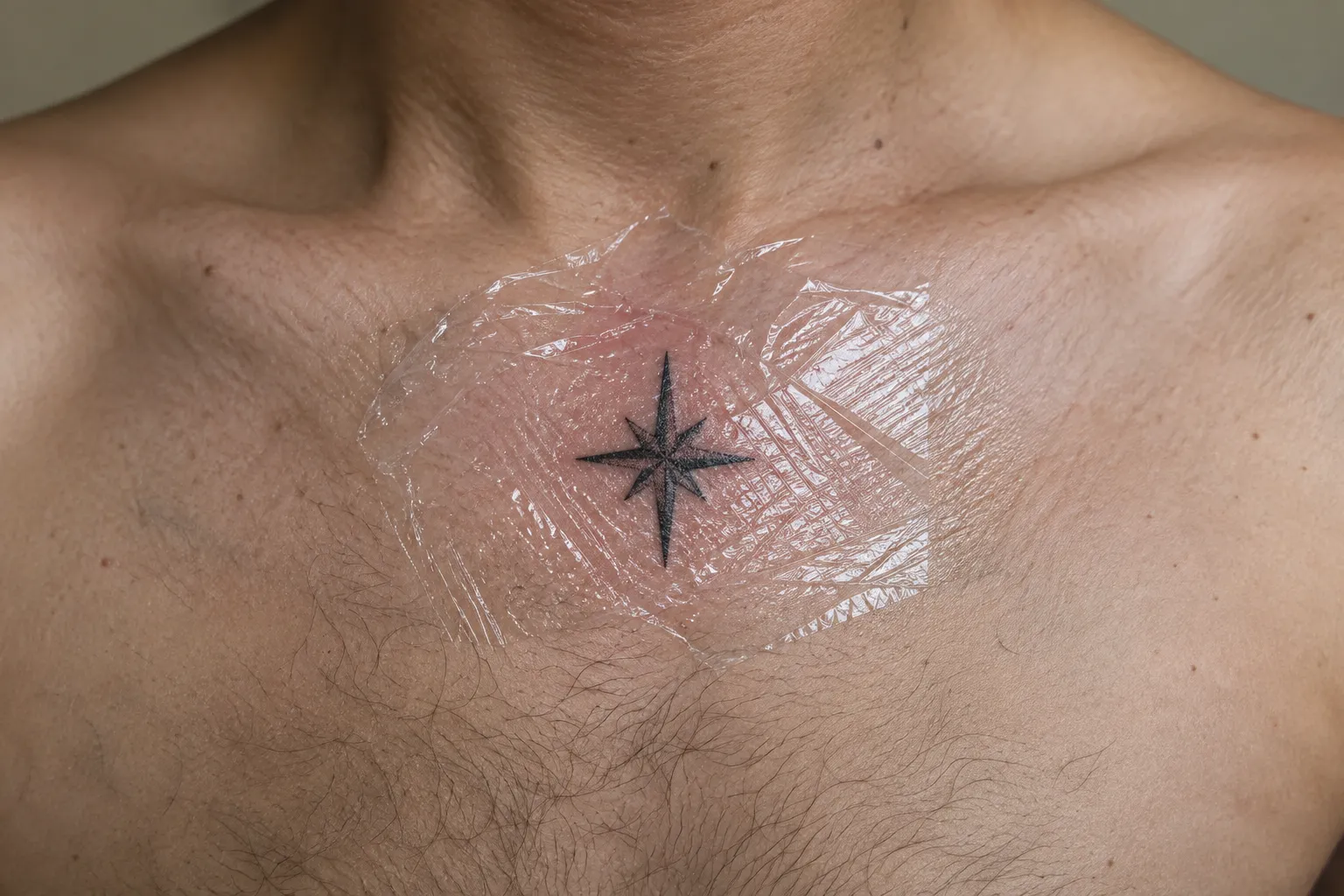
Vetting a studio’s hygiene and ink practices
In the US, the practice of tattooing, including parlor practices and safety, is generally regulated by local jurisdictions, not by a single national license (1). Check what your city or county requires and confirm the studio meets it.
Ink deserves questions too. The FDA reports that more than 50 pigments and shades are in use, and none of the color additives are approved for injection into skin (1). Ink injected into the skin could introduce harmful pathogens, and the FDA notes that manufacturer testing of finished inks for microorganisms helps protect consumers (1). FDA scientists have also found that even unopened, sealed inks can harbor bacteria (3).
Ask the studio:
- Do you hold the local license or permit, and can I see it?
- Are needles and cartridges single-use and opened in front of me?
- Is ink poured into disposable caps for each client and never returned to the bottle?
- What ink brands do you use, and do you keep them sealed and within date?
- How do you sterilize reusable equipment?
Also tell your artist about any medications you take, and avoid blood thinners (including over-the-counter pain relievers that thin blood) before a session unless a doctor tells you otherwise. An artist who gets defensive about any of these questions has answered them.
Daily aftercare and when to see a doctor
Cleveland Clinic’s dermatologist-backed routine is short: wash your hands before removing the bandage, wash the tattoo gently twice daily, moisturize twice daily, don’t pick or scratch, and stay out of pools, baths and hot tubs while it heals (4). Let scabs fall off on their own, since picking irritates the skin and raises infection risk (4).
The timeline for a small tattoo:
- Day 1-3: Remove the wrap when your artist says to, with clean hands. Wash gently with lukewarm water and a fragrance-free mild soap, pat dry with a clean paper towel, then apply a thin layer of fragrance-free moisturizer. Some soreness, redness and clear fluid are normal (2).
- Day 4-7: Keep washing and moisturizing twice daily (4). The surface tightens and starts to flake, and small soft scabs can form. Don’t scratch; tap the skin instead. No soaking, and keep the area out of direct sun with sun-protective clothing.
- Week 2: Peeling and itching peak, and the tattoo can look cloudy or dull. That’s the new skin layer, not fading. Keep moisturizing and leave flakes and scabs alone.
- Week 3-4: The surface looks healed, but the deeper skin is still settling, with full integration around week 6. Keep direct sun off it for the first 4 to 6 weeks, then start sunscreen whenever it’s exposed.
The AAD notes that soreness, clear fluid, itching, flaking and scabbing can all be part of normal healing (2). Get medical care for signs of infection: fever, hot skin, significant drainage or pain that increases instead of easing (4). Redness that darkens or spreads, pus, chills or open sores are also reasons to see a doctor or board-certified dermatologist right away (2). The FDA advises contacting a health professional if a tattoo isn’t healing or a rash develops, especially alongside fever (3).
Frequently Asked Questions
- Are small hand tattoos a good idea?
- A small hand tattoo suits someone comfortable with constant visibility and possible maintenance; choose a bold shape that remains readable when skin and ink change.
- What's the best small tattoo placement for work?
- The best work placement is one your actual dress code covers in every position, including when you reach, sit, or remove a jacket.
- How small can a tattoo be before details blur?
- Judge the smallest gap and line, not just the tattoo's overall width; an open, simplified design can read better than a larger crowded one.
- Do small tattoos fade faster than large ones?
- Small tattoos do not automatically fade faster, but limited spacing makes modest line spread more noticeable; sun, friction and placement also affect how they age.
- What are good minimalist small tattoo ideas?
- A good minimalist idea uses one clear shape and enough untouched skin around it; test the stencil on the intended body spot before approving it.
- Can a small tattoo still carry deep meaning?
- A small tattoo can carry personal meaning through a single symbol or reference; research cultural origins rather than assuming one universal interpretation.
- Is a neck tattoo a good placement for a small design?
- A neck tattoo is a poor choice if you need concealment, because ordinary clothing rarely hides it and the placement receives regular sun exposure.
- How do you protect a small tattoo from fading in the sun?
- After healing, use broad-spectrum SPF 30 or higher on exposed tattooed skin; while it heals, cover the area with loose sun-protective clothing.
Before You Book: Test the Stencil, Then Choose the Spot
Pick the style and the meaning first: fine-line minimalist or bold simple shapes, one symbol whose origin you’ve checked. Then let placement and detail size decide how visible the tattoo is and how long it stays legible. Keep the whole design around 1 inch (2.5 cm) or larger with no detail under ¼ inch (6 mm), match lettering to its letter-height floor, and choose a placement based on how often you need it hidden. The upper arm, chest, upper thigh and behind the ear conceal best; the forearm flexes both ways; hands and necks never hide.
Book a consultation before the session, ask the artist to print the stencil at true size, put it on your skin and look at it from about four feet away. If it reads there, it has a good chance of reading in fifteen years, provided you wash and moisturize it twice daily while it heals and keep sunscreen on it after.