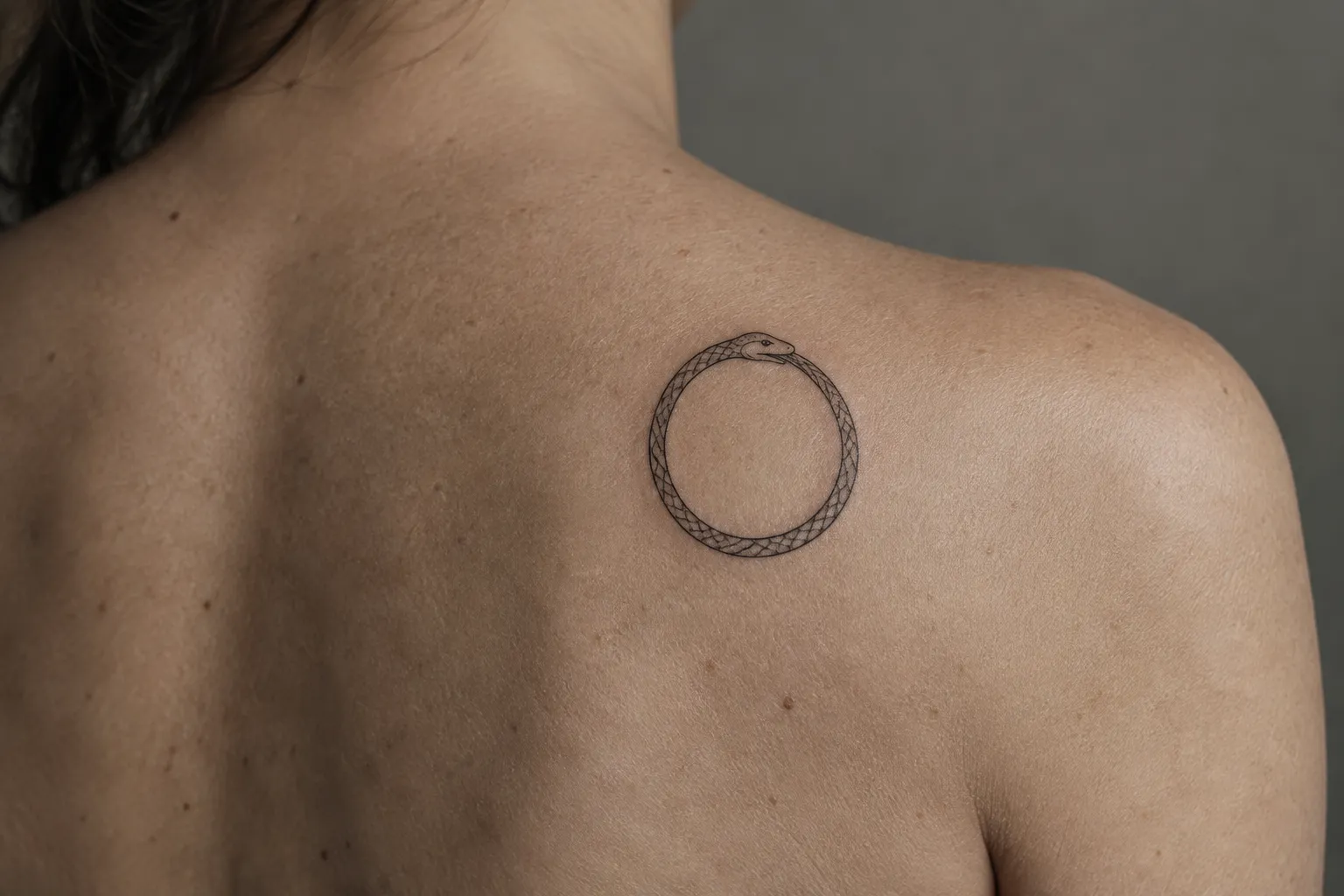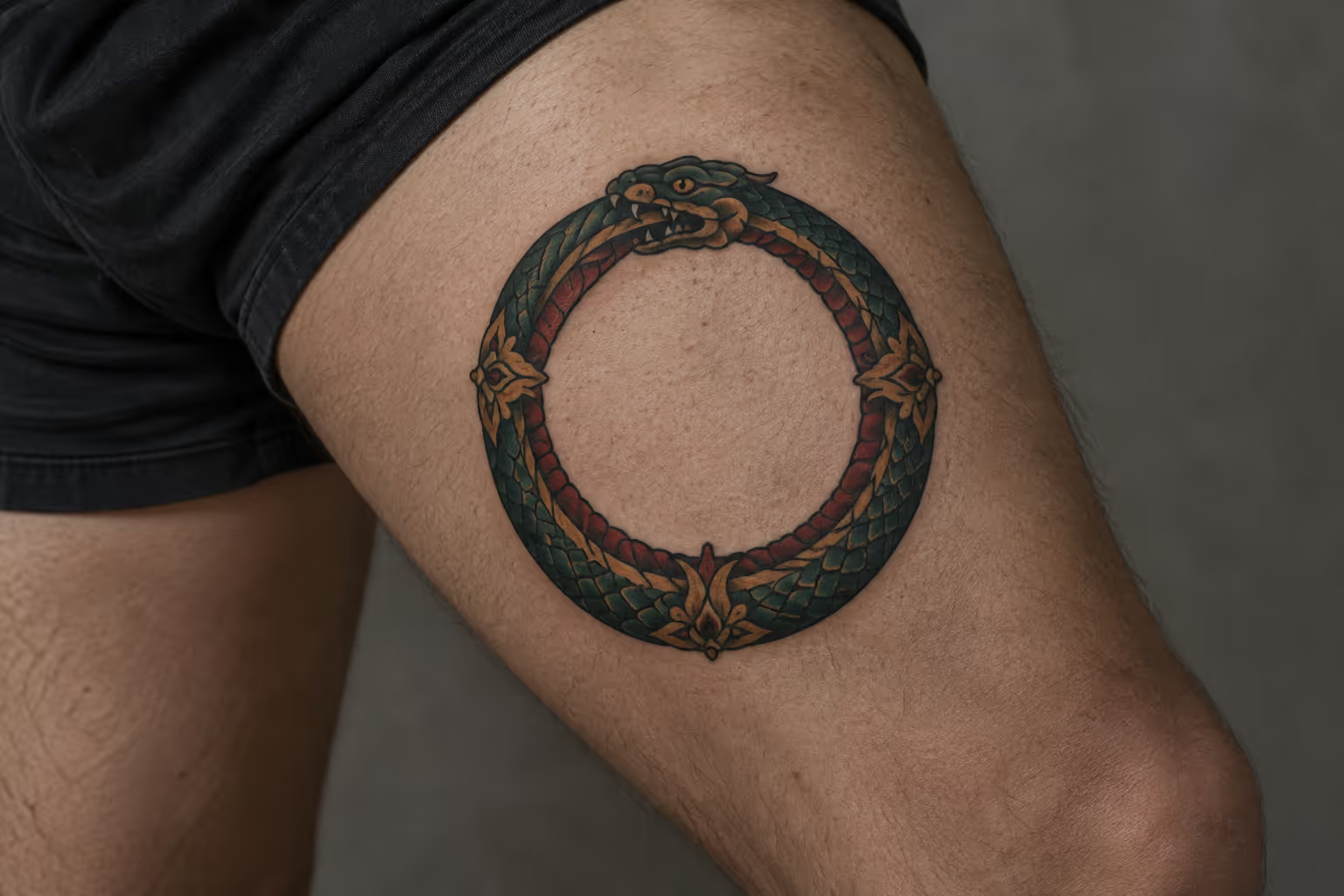
An ouroboros tattoo shows a snake, or less often a dragon, biting its own tail to form a closed ring (2). The image is Egyptian first: the oldest known example sits in Tutankhamun’s tomb, and Greek-speaking alchemists took the figure up more than a thousand years later (5). Whichever animal you choose, the core meaning (wholeness, eternity, renewal) doesn’t change, so snake versus dragon is really a choice about detail, size and time in the chair. Below: what the symbol means, where it comes from, how the two versions differ, which placements suit which scale, and how to heal it.
✓ Pros
- The circular silhouette can be adjusted without losing the basic read of the motif.
- A simplified outline and a fully worked dragon offer different levels of detail.
- The loop gives the artist a clear shape to fit around a specific body area.
✗ Cons
- The jaw-to-tail connection needs enough separation to stay legible as the tattoo ages.
- A compact, highly detailed version can turn into a dense patch of linework.
- Viewers may bring different cultural associations to snake imagery.
What the Ouroboros Symbol Represents
The ouroboros symbol stands for wholeness, eternity, and death and rebirth. Reference sources treat these as overlapping readings, not one required meaning (3). If someone tells you there’s a single “correct” ouroboros tattoo meaning, they’re flattening several traditions into one.
Eternity and cyclical time
The reading with the deepest roots is cyclical time. In its original Egyptian context, the ouroboros stood for repetition, renewal and the eternal cycle of time (5). The closed circle does the work visually: no start, no finish.
Alchemy and Gnosticism
In Gnosticism, a serpent biting its tail symbolised eternity and the soul of the world (9). Gnostic readers also took its two ends as the divine and the earthly in a person, held together despite their opposition (5). Alchemists used it to illustrate the “All is One” idea at the core of their practice (3), and the early Chrysopoeia of Cleopatra drawing encloses the Greek words for “the all is one” inside the ring (9). This is where the symbol picked up its esoteric, manuscript-illustration look, which some clients want to echo in the linework.
Personal transformation tattoos
Many people pick the ouroboros to mark something that happened: a recovery, the end of one phase of life, a loss followed by a rebuild. The death-and-rebirth reading is documented (3), and so is renewal (5), so a personal interpretation built on them stands on solid ground. You don’t need a mystical backstory. “I came out the other side of something” is enough.
As a design motif, the ouroboros symbol is also practical. A circle is one of the easiest shapes to place on a body, and it frames negative space well.
Ancient Egyptian Roots and the Greek Name
The ouroboros image comes from ancient Egypt, with the oldest known example dating to the 14th century BCE (3). The word “ouroboros” is a later Greek label. These are two separate facts, and they’re often merged.
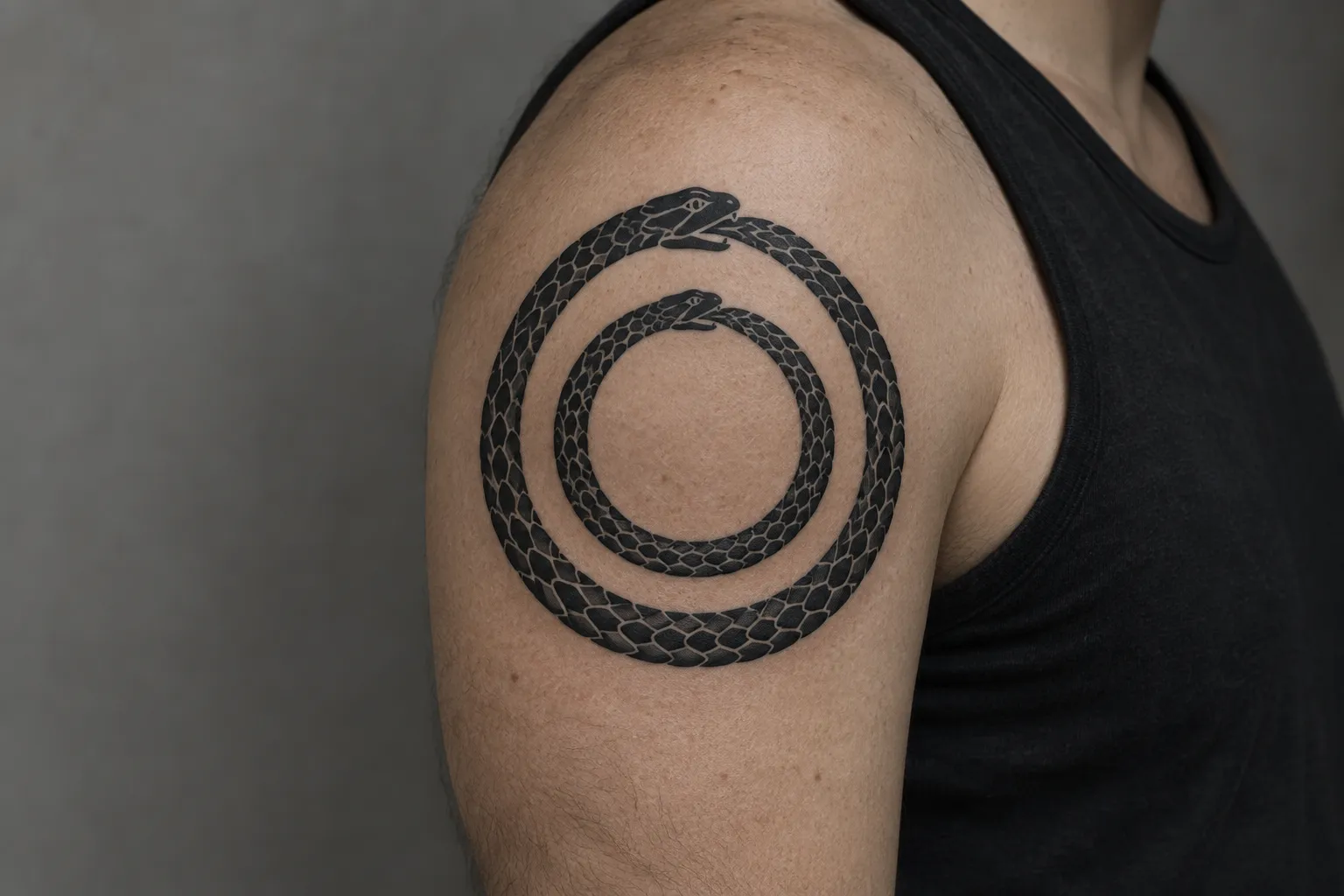
The best-known early example is in Tutankhamun’s tomb (3), known as KV62. There, in the funerary text called the Enigmatic Book of the Netherworld, two serpents holding their tails in their mouths encircle a large figure: one around the head and upper chest, one around the feet (9). That’s a useful reference if you want a double ouroboros design, such as two rings stacked or nested rather than one.
The name arrived much later. Greek ouroboros means “tail-devourer.” It combines oura (“tail”) and -boros (“devouring”) (4)(5). So when a design page says “the ancient Egyptian ouroboros,” it’s using a Greek word for an Egyptian image. That’s harmless as shorthand, but it isn’t the same claim as saying the Egyptians called it that.
The shape stayed stable across both traditions: an animal consuming its own tail to form a circle (2)(3). That consistency is why the design reads the same whether you go Egyptian-inspired, alchemical, or modern blackwork.
Snake or Dragon: Two Ways to Tattoo the Design
Choosing between an ouroboros snake tattoo and an ouroboros dragon tattoo comes down to detail and session time, not symbolism. Reference definitions describe the symbol as a snake or, less commonly, a dragon swallowing its tail (2), and give it the same meanings whichever animal forms the ring (3).
Snake Ouroboros: Clean Outline, Faster Session
An ouroboros snake tattoo is one continuous body, a head and a tail tip. That makes it the cleaner, faster option. It suits several styles:
- American traditional, with a thick black outline and a limited palette. This holds up well over decades.
- Blackwork, with solid fill.
- Fine line, which looks crisp fresh but softens as it heals and ages.
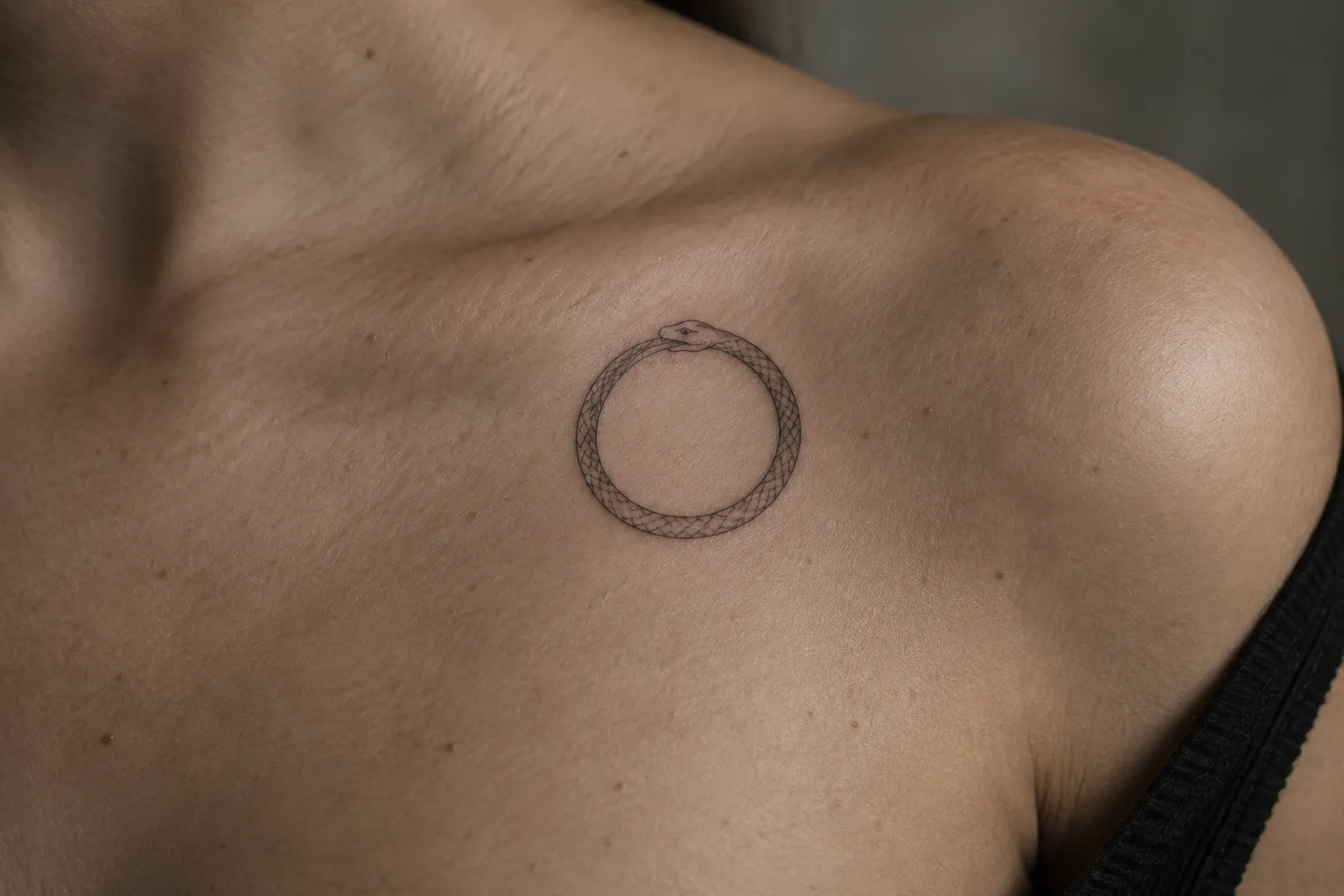
The pitfall I see most is a fine-line snake ring done too small. Single-needle lines spread slightly over the years. On a tight circle, the gap between jaw and tail fills in until you’re wearing a plain ring.
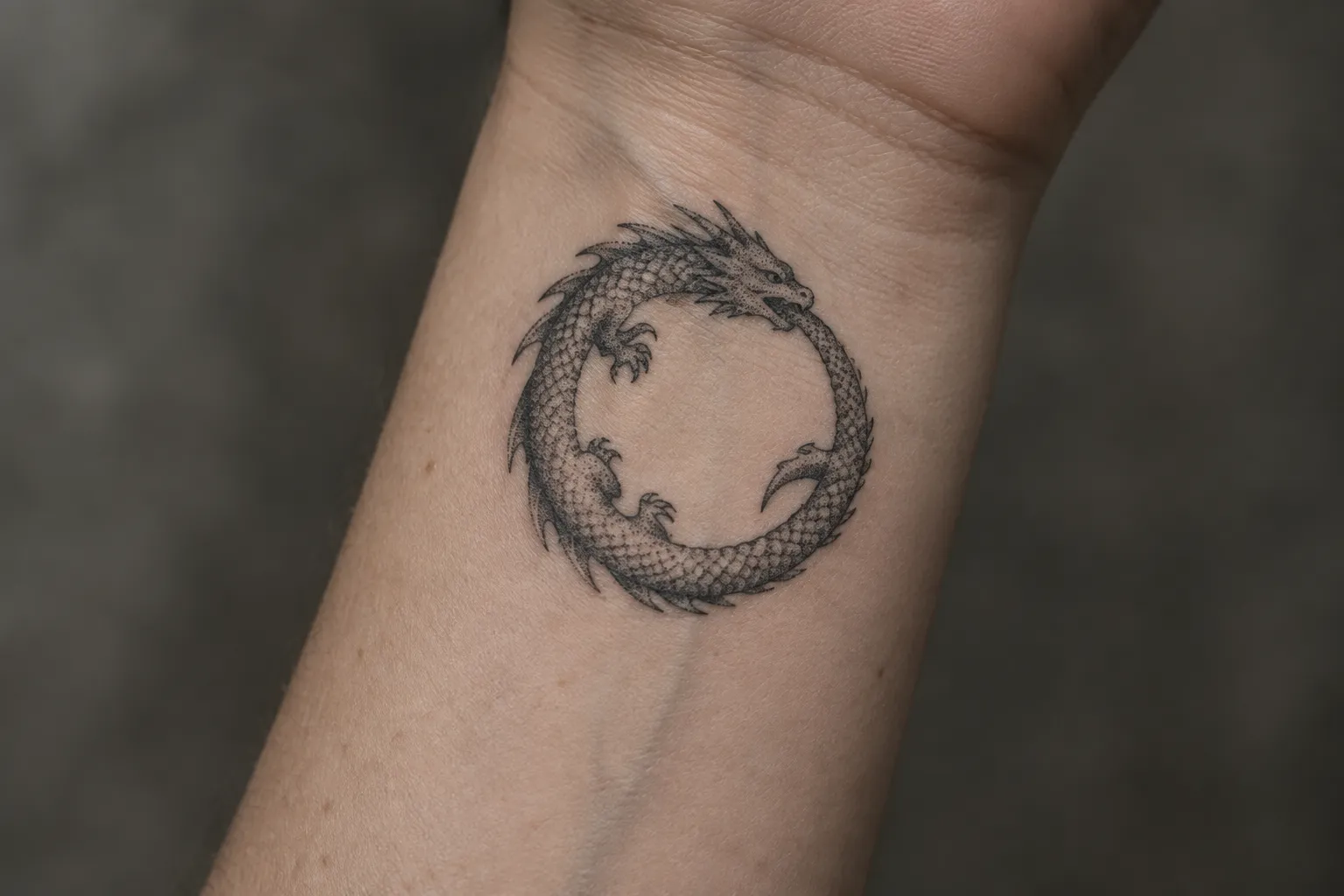
Pick the design to match the placement: a simplified snake outline suits a compact wrist tattoo, while a more elaborate dragon with scales and shading needs the larger canvas of a forearm piece. Whichever scale you choose, confirm with your artist beforehand that the head-to-tail bite will still read clearly, since that closed loop is what makes the symbol recognizable.
Dragon Ouroboros: Scales, Shading, More Detail
An ouroboros dragon tattoo adds limbs, claws and horns to the ring, plus scale work and shading. The scales are where the hours go: whether they’re drawn individually or only suggested is the difference between a two-hour piece and a five-hour one (10). With a traditional Japanese influence, you’re looking at graded black shading and layered scales that need room to breathe. A dragon realistically needs the forearm or larger. Plan on more session time, and possibly more than one sitting.
The common failure is the reverse of the snake problem: a detailed dragon crammed into a wrist-sized circle. The scales turn to texture noise and the limbs blur into the body.
Small Ouroboros Tattoo Ideas: Placement and Scale
A small ouroboros tattoo works best as a simplified snake outline kept tight on the wrist, small enough to read as a bracelet rather than a patch. For scale, one design guide puts a typical ouroboros at roughly 8 to 15 cm (about 3 to 6 inches) across, and notes that the outside of a forearm or a wrist works for smaller versions (10). Move up to the forearm and you’ve got real room to add scales or shift to a dragon.
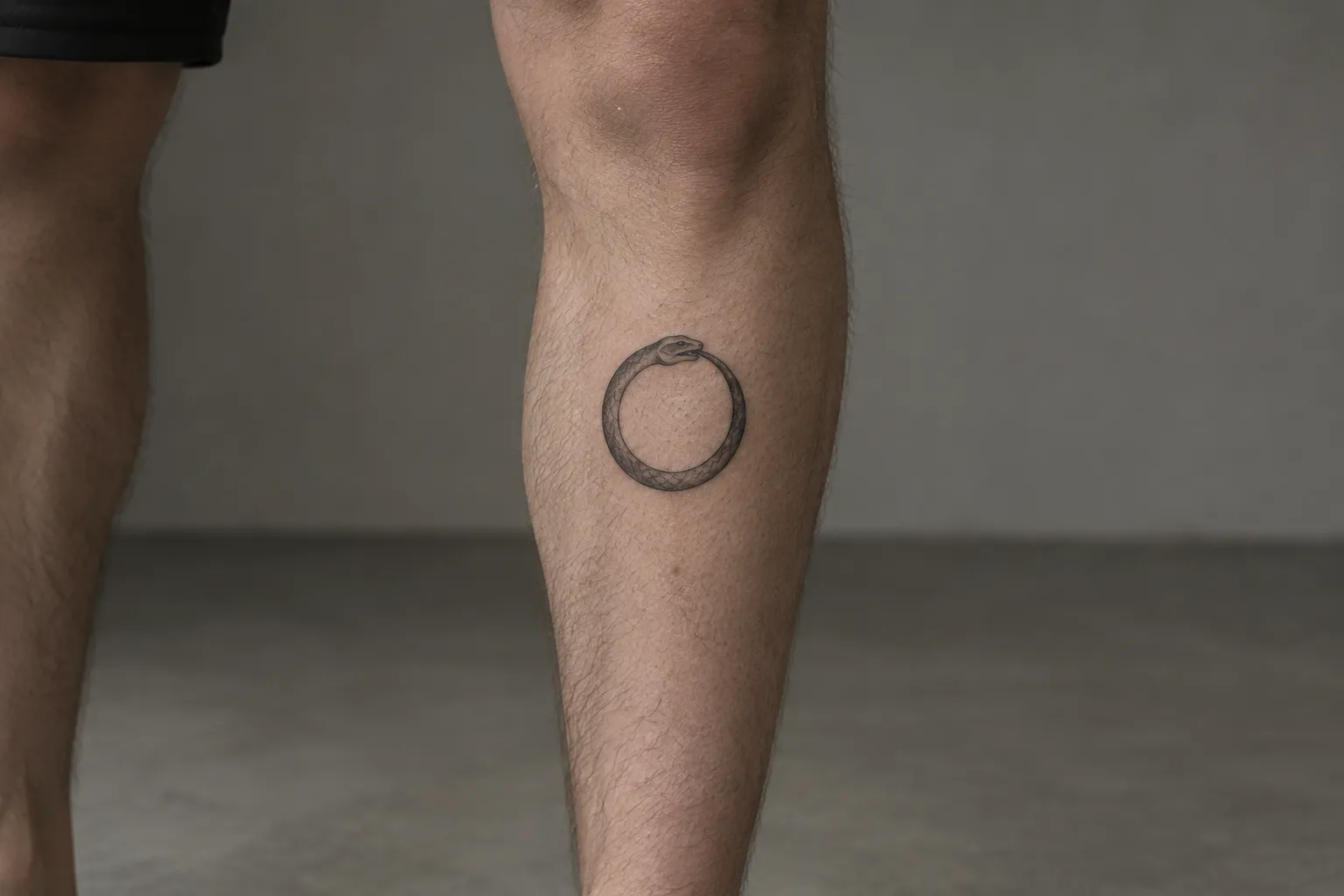
At any size, the head-to-tail bite is the symbol. Before booking, ask your artist how much space the bite will get at the final size (10), and whether the details will stay readable over time (7). If the jaw and tail tip can’t be told apart from arm’s length, the design needs to go bigger or simpler.
Wrist and Other Small Placements
The inner wrist suits a minimal snake ring with bold, simple linework and minimal interior detail. Be honest with yourself about ageing here. Wrist skin flexes constantly and gets heavy sun and friction, so delicate fine-line circles blur faster than on the forearm. Discuss simplification with your tattooist: if the design has to shrink, shrink the body and protect the mouth (10). Behind the ear or on the ankle, stay at the small end with the same bold-outline approach.
Forearm: A Visible Ring
The forearm is flat, easy to heal, and less painful than the ribcage or the wrist (7). It’s also highly visible, so it stands out in short sleeves. This is the placement that fits a dragon, scale texture, or a double ouroboros. The shoulder sits close behind it on both counts: comparable discomfort around the shoulder blade (7), and easy to cover with a T-shirt when you want the option to hide it.
Ribcage and Spine: Easy to Hide
The same design on the ribcage stays easily hidden. That’s the real decision point: how public you want the tattoo to be, not which design you picked. The ribcage offers enough flat space for a fuller ring with real detail, and upper-spine placements work well as a single ring centered between the shoulder blades. Both areas sit at the harder end of the pain scale for this motif, well above what you’d feel on the wrist or forearm (7); the table below sums up visibility and relative pain by placement.
Ouroboros Tattoo Placement Comparison
| Wrist | Forearm | Shoulder blade | Ribcage | Upper spine | |
|---|---|---|---|---|---|
| Visibility | Highly visible | Highly visible | Easy to cover with a T-shirt | Easily hidden | Easily hidden |
| Relative pain | More than forearm and shoulder blade; less than ribcage and spine | Less than ribcage and wrist | Similar to forearm | More than wrist, forearm, and shoulder blade | More than wrist, forearm, and shoulder blade |
Why the Snake Symbol Isn’t Inherently Negative
An ouroboros tattoo is not inherently negative, even though it shows a snake. Reference sources describe multiple established readings, wholeness, eternity, and death-and-rebirth, rather than one fixed meaning (3), so concerns about the symbol being “problematic” usually reflect a narrow, single-meaning misreading rather than the symbol’s actual range of interpretations.
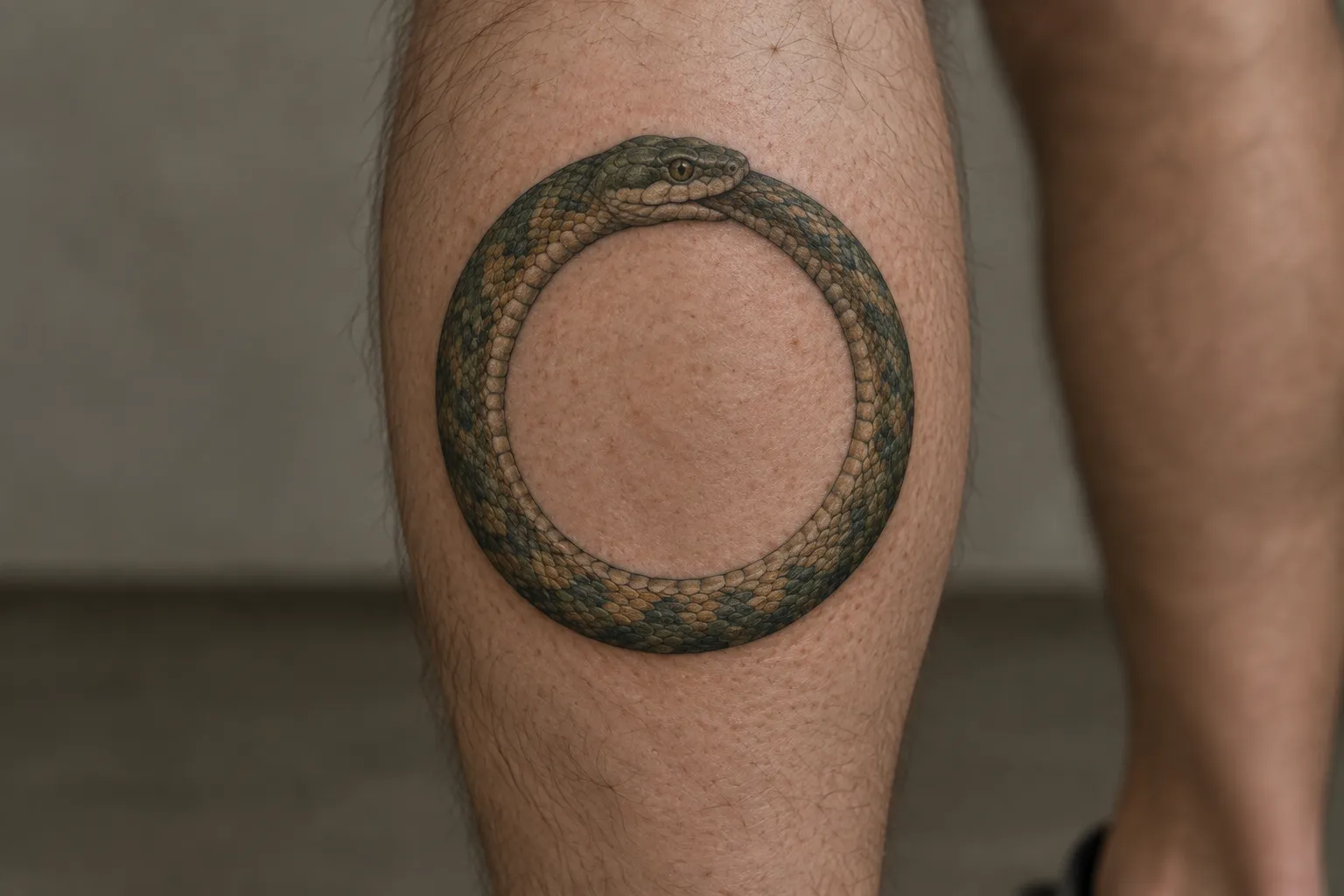
Snake symbolism changes a lot depending on where you look. The ouroboros alone carried different meanings in ancient Egypt, Hindu mythology, and Renaissance alchemy: renewal and the cycle of time in Egypt, eternity and the unity of time’s beginning and end for the early alchemists (5).
The biblical question is a separate one. The ouroboros is not a biblical symbol. The serpent in the Garden of Eden belongs to a different tradition, with a different image and role: a tempter, not a self-renewing circle. If someone reads your tattoo through that lens, they’re conflating two unrelated serpents. That’s worth knowing if family or church context matters to you, but it doesn’t change what the ouroboros itself represents.
So which ouroboros tattoo should you avoid? The symbol itself isn’t the risk. The image does carry a bleak reading, self-consumption, next to the hopeful one of eternal return, and most people wear the hopeful one (10). The designs worth avoiding are technical: a fine-line ring so small that the jaw and tail merge, and a detailed dragon squeezed into a wrist-sized circle.
Healing Timeline and Aftercare for Your New Ink
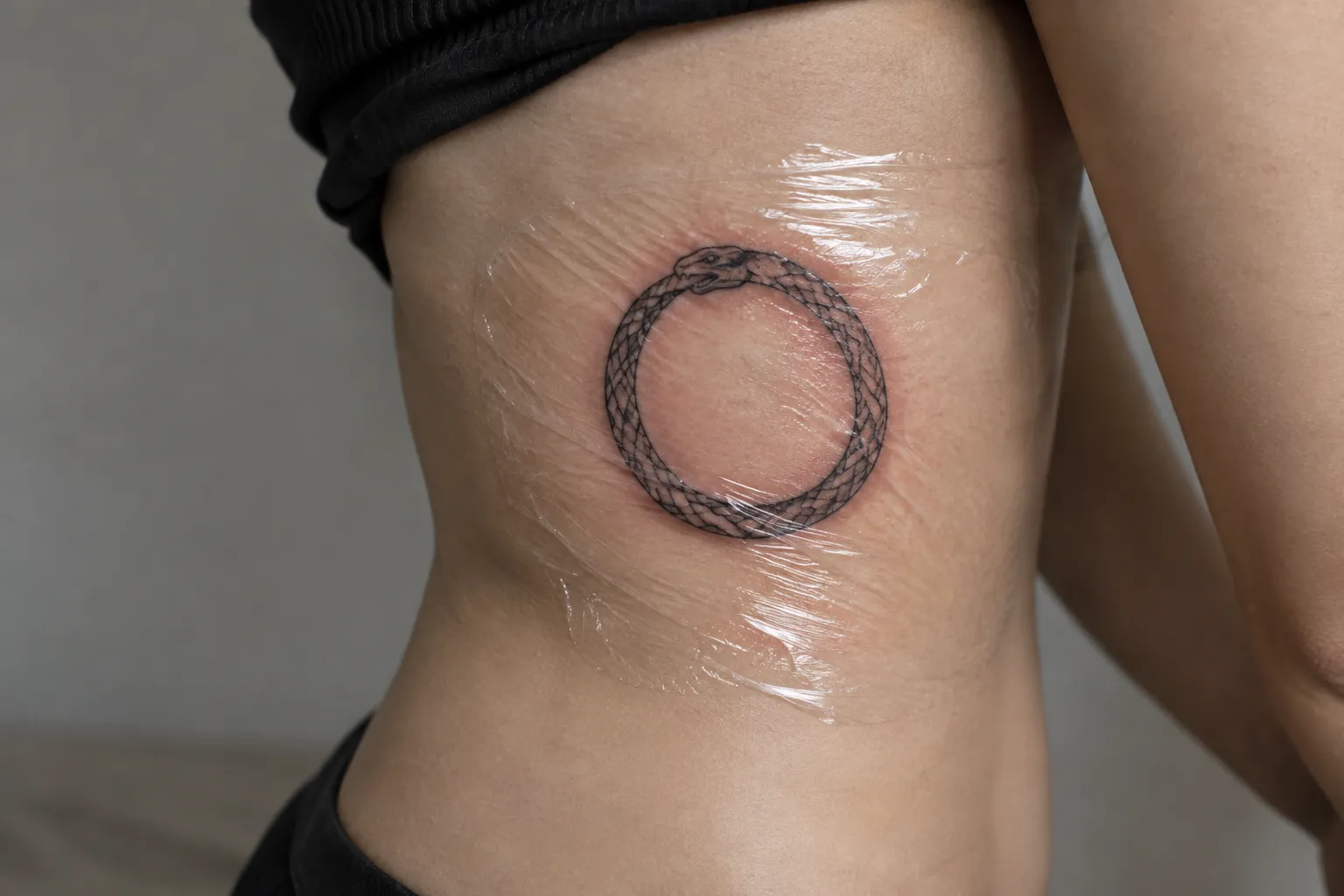
A new tattoo usually looks healed on the surface around weeks 3-4 and settles fully around week 6; our tattoo aftercare guide covers the routine day by day. Your studio’s own instructions take priority where they differ. An NHS leaflet on medical tattooing adds a useful basic: don’t touch the tattooed area until it has completely healed (8).
Days 1-3
Slight swelling, redness and discomfort are normal. The NHS leaflet expects these to improve within one to seven days (8). It also advises keeping the dressing on for 24 hours, then washing and patting the area dry with a clean towel rather than rubbing (8). Keep your hands off it.
Days 4-7
The surface tightens and starts to flake, with light scabbing where the ink went in heaviest. Apply a thin layer of fragrance-free moisturizer, and don’t pick. On a ring design, a pulled scab can leave a gap in the circle. Stay out of chemically treated swimming pools until any scabs have fallen off (8).
Week 2
This is the peeling and itching stage. Let the flakes come off on their own in the shower, and don’t scratch.
Weeks 3-6
The surface looks healed around weeks 3-4, though the skin underneath is still settling, and the linework may look cloudy or dull until it clears. Full integration comes around week 6. Keep the tattoo out of direct sun for the first 4-6 weeks, and cover it with sun-protective clothing when you’re outdoors.
At any stage, contact a doctor if the area becomes inflamed, moist, red or hot. These can be signs of infection (8). Don’t try to diagnose it yourself.
How to Care for a New Tattoo During Healing
Surface healed around weeks 3-4; fully settled around week 6Follow the studio's aftercare instructions through the healing stages and seek medical advice if infection signs appear.
- 1
Days 1-3
Keep the dressing on for the period your studio recommends. Wash gently as directed, pat dry with a clean towel, and avoid touching the tattoo with unwashed hands.
- 2
Days 4-7
As flaking or light scabbing begins, apply a thin layer of fragrance-free moisturizer and leave scabs alone. Avoid swimming in chemically treated pools while scabs remain.
- 3
Week 2
Expect peeling and itching. Let flakes fall off on their own and don't scratch.
- 4
Weeks 3-6
Let the surface finish closing without picking at cloudy or dull-looking linework. Keep the tattoo out of direct sun for the first 4-6 weeks and use sun-protective clothing outdoors.
- 5
Contact a doctor if warning signs appear
Get medical advice if the tattoo becomes inflamed, moist, red, or hot; do not try to diagnose a possible infection yourself.
Frequently Asked Questions
- What can an ouroboros tattoo mean to the person wearing it?
- An ouroboros can mark a personal cycle of change without requiring a religious or mystical belief; the wearer can define what that cycle refers to.
- Could someone mistake an ouroboros for another snake symbol?
- Yes; a clear tail-in-mouth connection distinguishes the ouroboros from a free-standing serpent, especially when the design is shown without its context.
- What should I ask my artist before choosing a small design?
- Ask to see the head-to-tail join at the intended size and discuss whether the line spacing will remain clear as the tattoo settles and ages.
- How long might a dragon version take compared with a snake outline?
- A dragon usually takes longer than a simple snake outline because scales, limbs, and shading add linework; request an estimate after fixing the size and detail.
- Can an ouroboros be designed around an animal other than a snake or dragon?
- Yes; a long-bodied animal can form the loop, but the tail-in-mouth connection must remain recognizable for the design to read as an ouroboros.
- How should I choose between a visible placement and a hidden one?
- Choose by how often you want the tattoo seen in everyday clothing; a forearm is exposed in short sleeves, while a ribcage design is easier to cover.
- Where should I look for references before a consultation?
- Compare historical imagery with healed work by the artist you may book, then bring several references so the consultation can focus on design choices rather than copying one image.
Before You Book the Session
The ouroboros carries several valid meanings, so pick the reading that fits you and don’t worry about a “correct” one. Snake versus dragon is a question of detail and session time. Wrist versus forearm versus ribcage is a question of scale and how visible you want it. Before booking, have your artist show you the head-to-tail join at your chosen size, especially on a small wrist ring. After the session, give it about six weeks to settle, keep it out of direct sun for that stretch, keep your hands off it, and get any heat, moisture or spreading redness checked by a doctor.