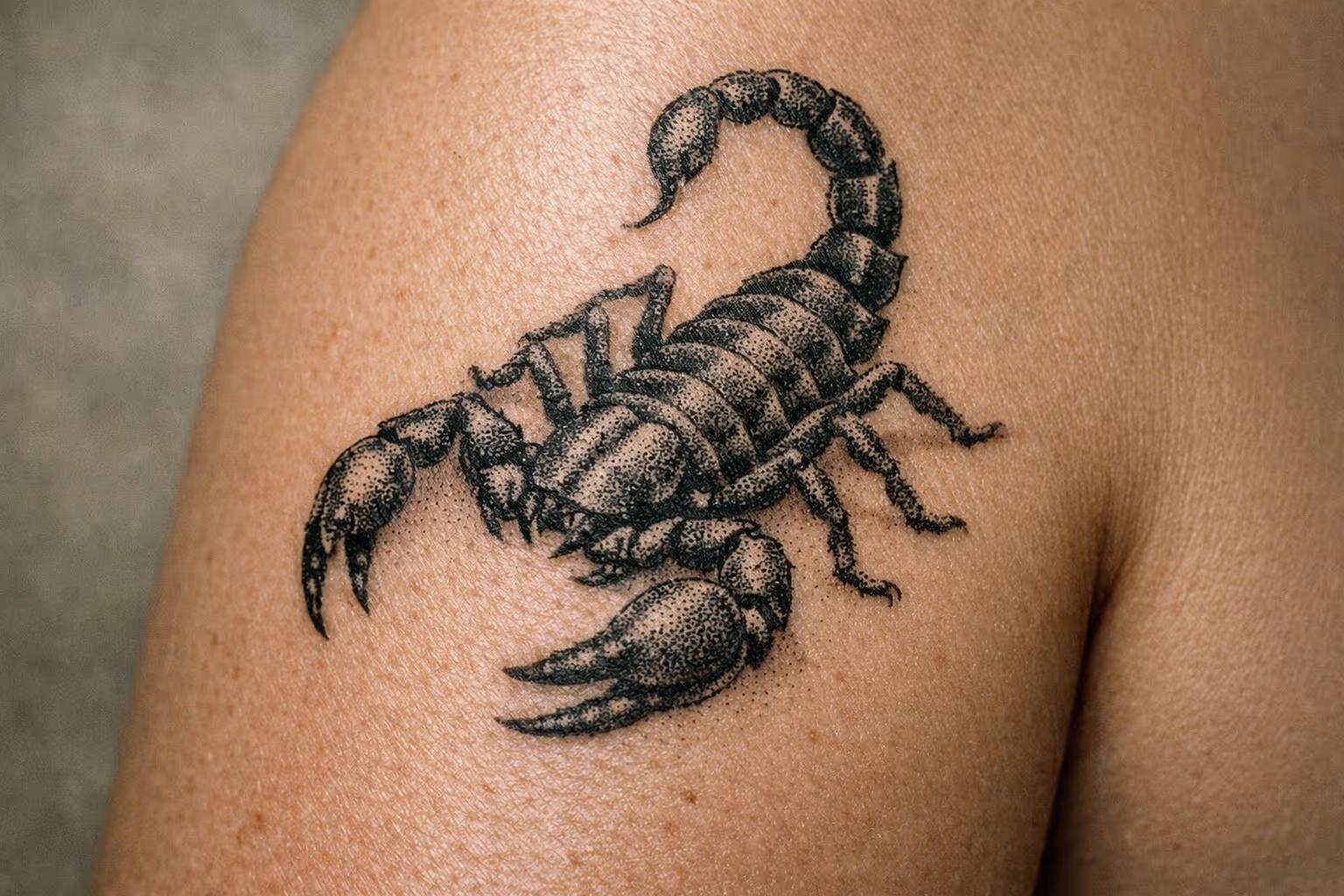
The raised tail, the armored body plates, the two forward-facing claws locked and ready. A scorpion tattoo built around the animal itself reads as protection, danger, survival, and transformation before anyone knows a thing about you. This guide is about the arachnid, not the star sign. If you came for Scorpio dates, personality traits, or the constellation, that’s a separate article. Here we deal with the creature that outlasted the dinosaurs, warns before it strikes, and wears its skeleton on the outside as living armor. Pose, style, and placement each change what your scorpion communicates - so let’s walk through every choice that actually matters.
✓ Pros
- Strong standalone motif that reads clearly without explanation
- Works across realistic, traditional, tribal, and fine-line styles
- Scales from a small silhouette to a full back piece
- Symbolism holds up whether or not anyone knows your reason for getting it
✗ Cons
- Can read as aggressive in conservative or professional settings
- Fine-line versions fade fast on high-movement skin
- Pose can be misread if not thought through
- Micro sizes lose anatomy and blur into a dark blob
What a Scorpion Tattoo Actually Symbolizes
A scorpion tattoo most often signals protection, danger, resilience, and transformation - drawn directly from how the animal behaves and survives (5). Those four meanings aren’t interchangeable, and the one your tattoo projects depends heavily on pose and style.
Protection and defense is the meaning cited most often. The raised stinger is a boundary marker, not an invitation to fight. It says “respect the line,” and that reading comes straight from the animal’s actual behavior: a scorpion warns before it strikes.
Survival and resilience comes from habitat. Scorpions live in deserts, under rocks, in conditions that kill most creatures - which makes the exoskeleton a natural metaphor for enduring something that could have ended you (3). I’ve had clients come in specifically for this one, usually after a medical diagnosis or a period they barely got through. They’re not looking for something decorative.
Danger and duality leans into the fact that the same animal that protects can also poison. Designs that emphasize the venom and the strike read as a warning to others rather than a personal talisman.
Transformation ties to shedding and regeneration. Just as the animal sheds its exoskeleton to grow, the scorpion becomes a symbol of painful but necessary change, of leaving an old version of yourself behind (6).
The cultural roots run deep. In ancient Egypt, the scorpion was linked to Serket (also spelled Serqet), a protective goddess associated with healing venomous stings (3). In many Native American traditions, it represents survival, adaptability, and resilience (2). In Chinese and Japanese beliefs, the scorpion protects against evil spirits and bad luck (3). Different traditions, overlapping theme: protection. Worth noting that in modern Western tattoo culture, these meanings have largely merged into a general “don’t mess with me” shorthand - which isn’t wrong, just flatter than the source material.
If you’re here for the zodiac sign, its dates, traits, or the Scorpius constellation, that’s a separate article about the astrological Scorpio.
What a scorpion tattoo means in the military
In military tattoo lore, the scorpion is tied to combat experience. The best-known code comes from Russian military and prison tattoo traditions, where a scorpion with its claws open usually marks a Special Forces soldier who has seen combat (2). The raised-stinger “do not underestimate me” message maps cleanly onto that reading: lethal, controlled, ready.
What a scorpion tattoo means in LGBT contexts
Within the gay community, the scorpion has been used as a marker of HIV status. A 2020 Philadelphia Gay News feature on tattooing, gender, and sexuality names “the biohazard symbol, or scorpion symbol” as a recognizable way of denoting that the bearer is HIV positive - worn openly, as a statement, rather than hidden (14). The reading isn’t widely known outside that context (2), so the meaning here is personal and contextual, not something to assume from the tattoo alone.
How Pose Changes the Message
Most guides skip this entirely, which is a mistake. Before you settle on a style, settle on a pose - because the pose locks in the emotional message, and style just delivers it.
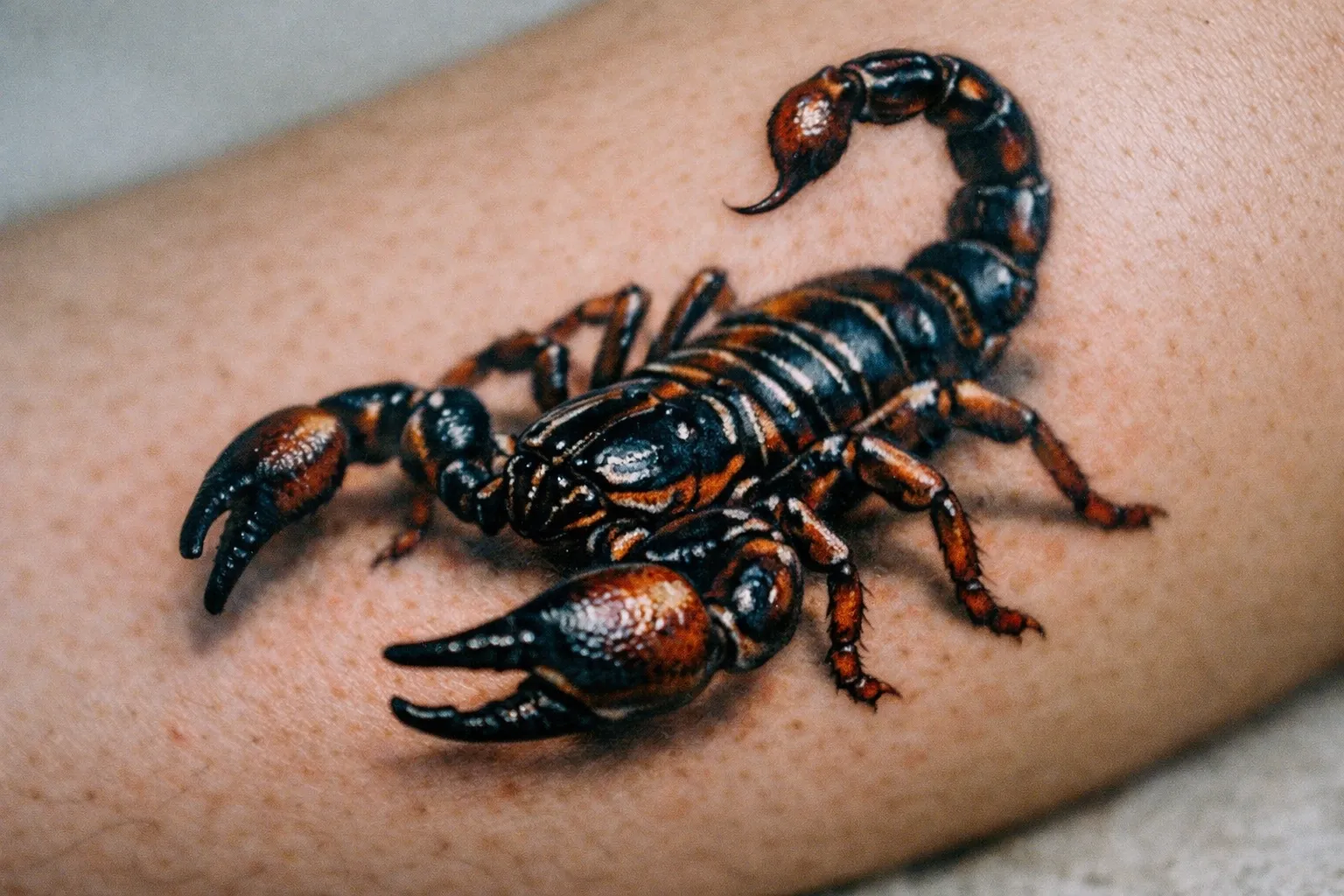
Striking pose (tail raised, claws forward) is the clearest visual cue for boundary-setting: the arched tail works as a warning to respect personal boundaries (6). It works best on the forearm or shoulder, where it faces outward and reads to other people.
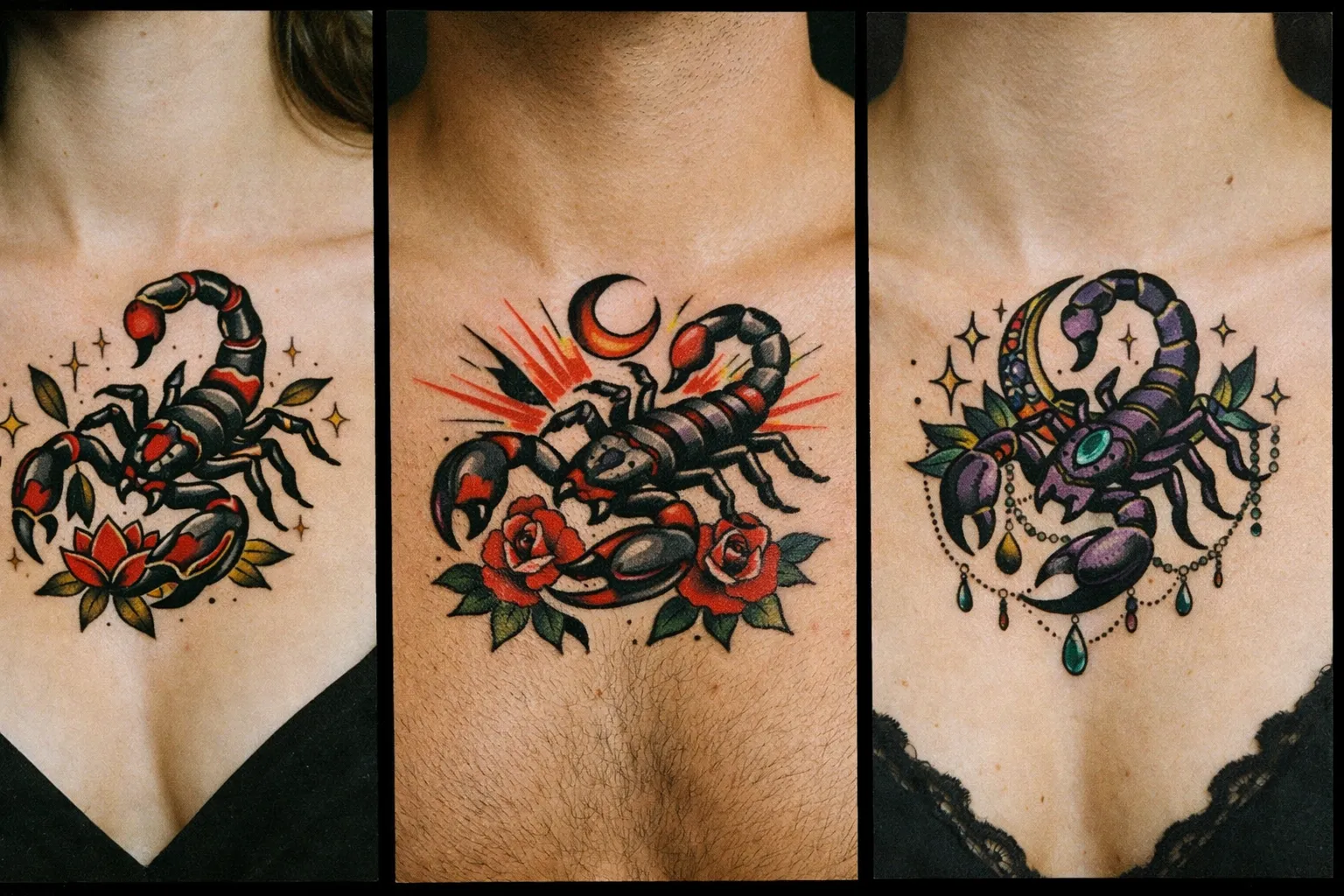
Defensive curl (tail arched protectively over the body) reads as guarded strength rather than outright aggression. It says “I protect what matters,” and it suits chest or upper back placements where it faces inward toward the wearer.
Walking or neutral pose is about movement, survival, leaving the past behind. Less confrontational, more personal - which is why it flows well along a calf, side, or thigh.
Two practical notes. First, choosing a pose purely because it looks cool can clash with what you actually mean, so talk posture through with your artist before the stencil is finalized. Second, orientation matters even within a pose: a raised stinger reads as readiness to strike and protect, while a downward-facing stinger can imply a sense of guilt (5). A stinger pointing up hits differently than one curling down.
Scorpion Tattoo Designs - Four Styles Worth Knowing
Style isn’t just an aesthetic call. It’s a longevity and legibility decision. The right style determines how your scorpion reads in ten years, not just on the day you leave the studio.
Realistic Scorpion Tattoo
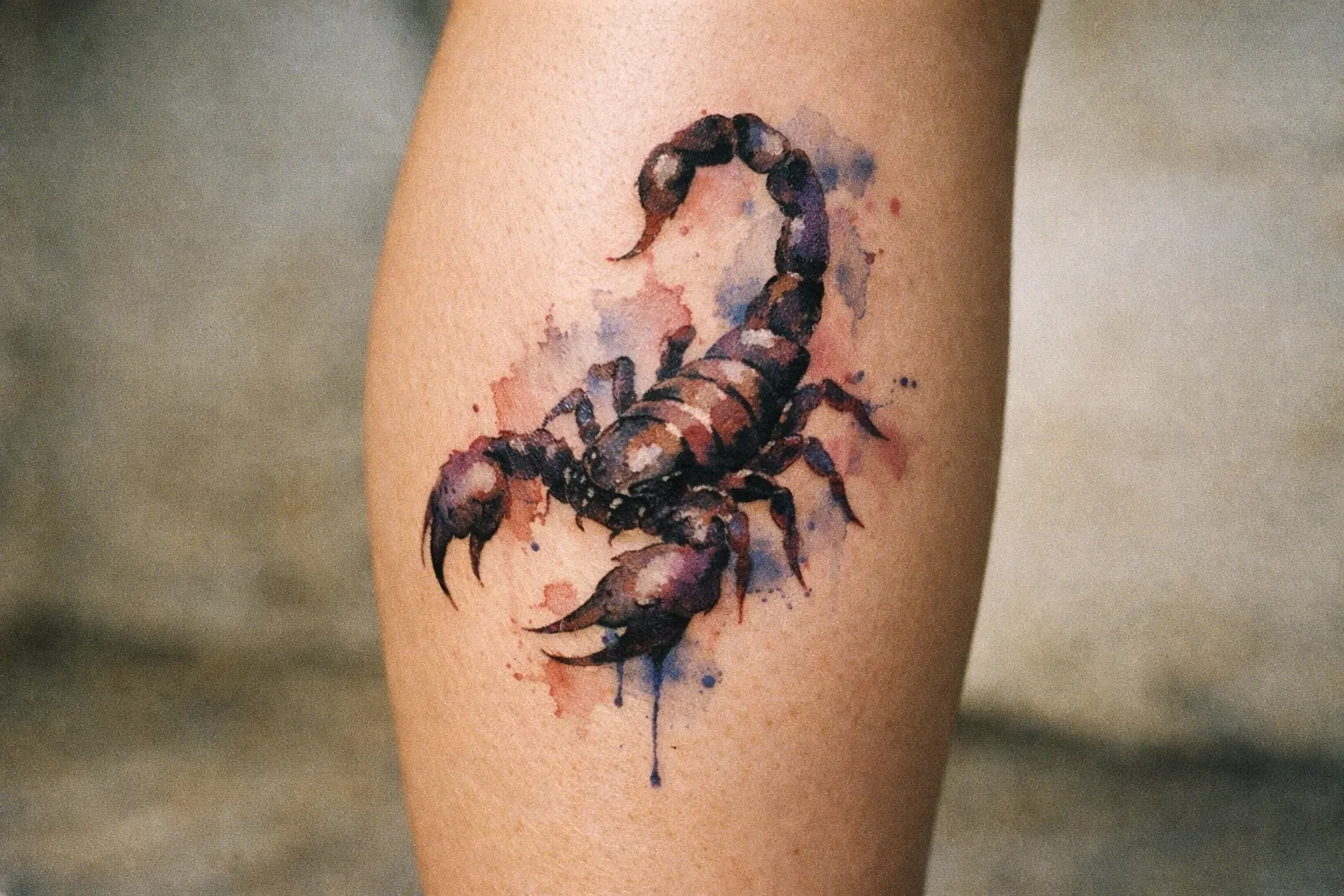
A realistic scorpion tattoo is built on 3D carapace rendering, translucent leg segments, and high-contrast lighting - almost always in black-and-grey. It’s the style that makes people do a double-take because the animal looks like it’s crawling out of the skin.
It demands a larger canvas. Fine leg segmentation and shadow work lose clarity at small sizes, so you want the upper arm, calf, belly, or upper back, with enough body length to preserve the anatomy. Go smaller and the detail blurs into a dark mass within a few years.
This is not a quick sit. Realism is layered and multi-pass by nature. I start with the darkest areas first - it keeps the skin from getting overworked before the detail passes and preserves contrast. It’s the strongest fit for narratives about confronting real danger, honoring the animal itself, or going for dramatic visual weight.
Traditional Scorpion Tattoo
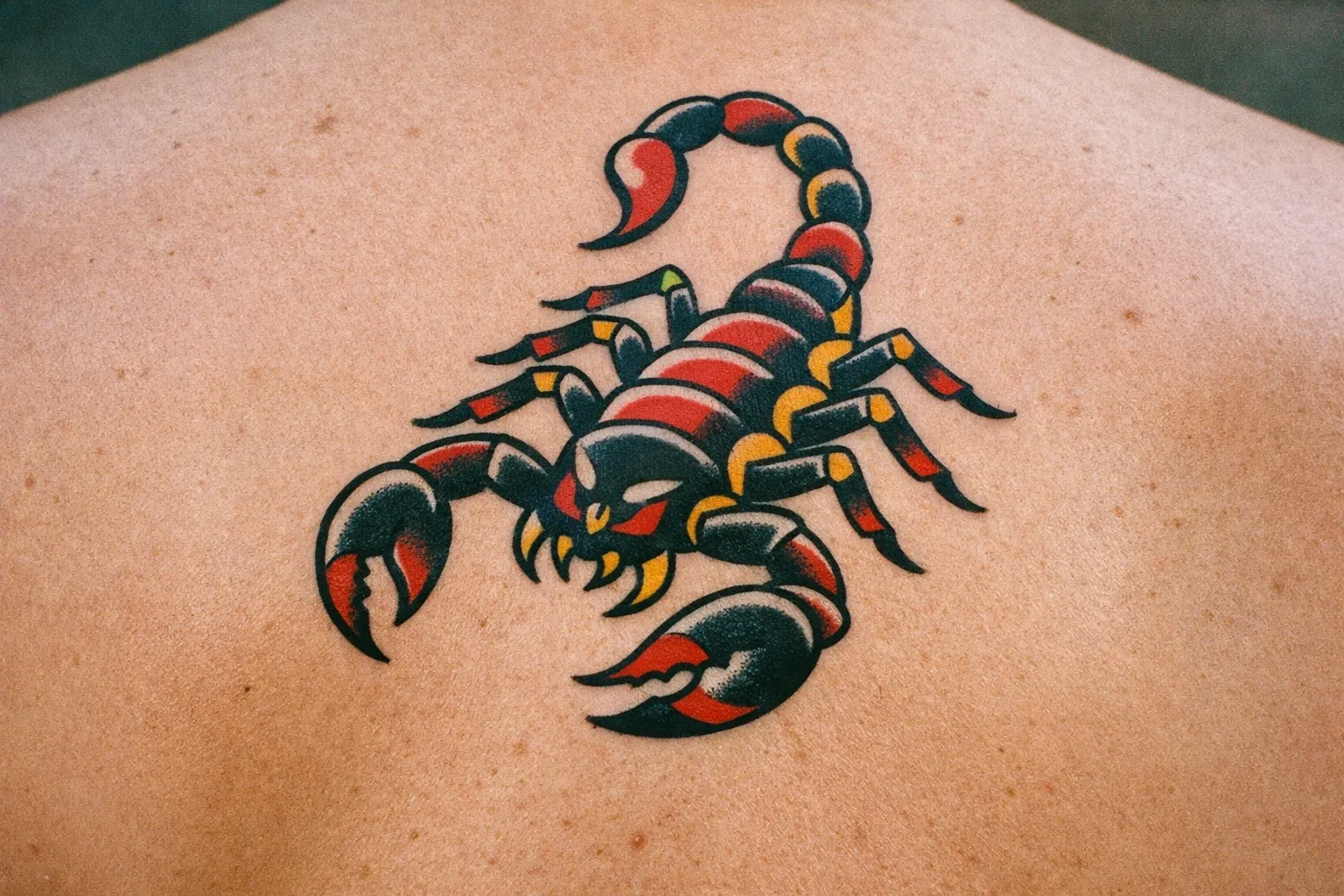
A traditional scorpion tattoo follows American traditional hallmarks: bold black outlines, a limited palette (usually red, yellow, and green), and simplified body shapes. The claws and stinger are stylized, not anatomically exact - and that’s the point. Two technical hallmarks that define the style: thick black outlines that hold their shape for decades, and a flat, limited color palette that stays readable even as skin changes. The common pitfall when artists do it badly is overcomplicating the fill - adding shading gradients that undermine the graphic flatness the style depends on.
It works well at mid-size on the elbow cap, shoulder, or forearm. Faster per square inch than realism because the shading is simpler and the color fills are solid. It ages exceptionally well: bold outlines hold their shape as skin softens, and the color stays readable even on high-movement areas.
Traditional is the pick for toughness, classic tattoo culture, and a design that stays legible for decades.
Tribal Scorpion Tattoo
A tribal scorpion tattoo is built from black curves, spikes, and negative space. It’s silhouette-driven rather than anatomically detailed, so its strength lives in the shape. Iban tattooing from Borneo has its own scorpion motif; one custom Iban-inspired design, for example, overlaps a shark and a hammerhead in a piece built to recall that scorpion (9). Those motifs belong to a specific cultural tradition with its own visual logic, not just decorative patterns. Neo-tribal versions adapt those curves into contemporary blackwork.
Strong choice for small-to-medium pieces on the shoulders, calves, or lower back. Because the design depends on shape rather than fine detail, the silhouette stays clear even as lines thicken with age. Symbolically, tribal aligns well with ancestral or spiritual protection themes - it’s the most culturally grounded style choice for a protection-focused meaning.
The pitfall: decorative tribal patterns that don’t follow the scorpion’s actual anatomy look disconnected. The curves should reinforce the body shape and flow with the segments. When they don’t, it reads as random geometric decoration with a vague scorpion shape somewhere in the middle.
Fine-Line and Minimalist Scorpion
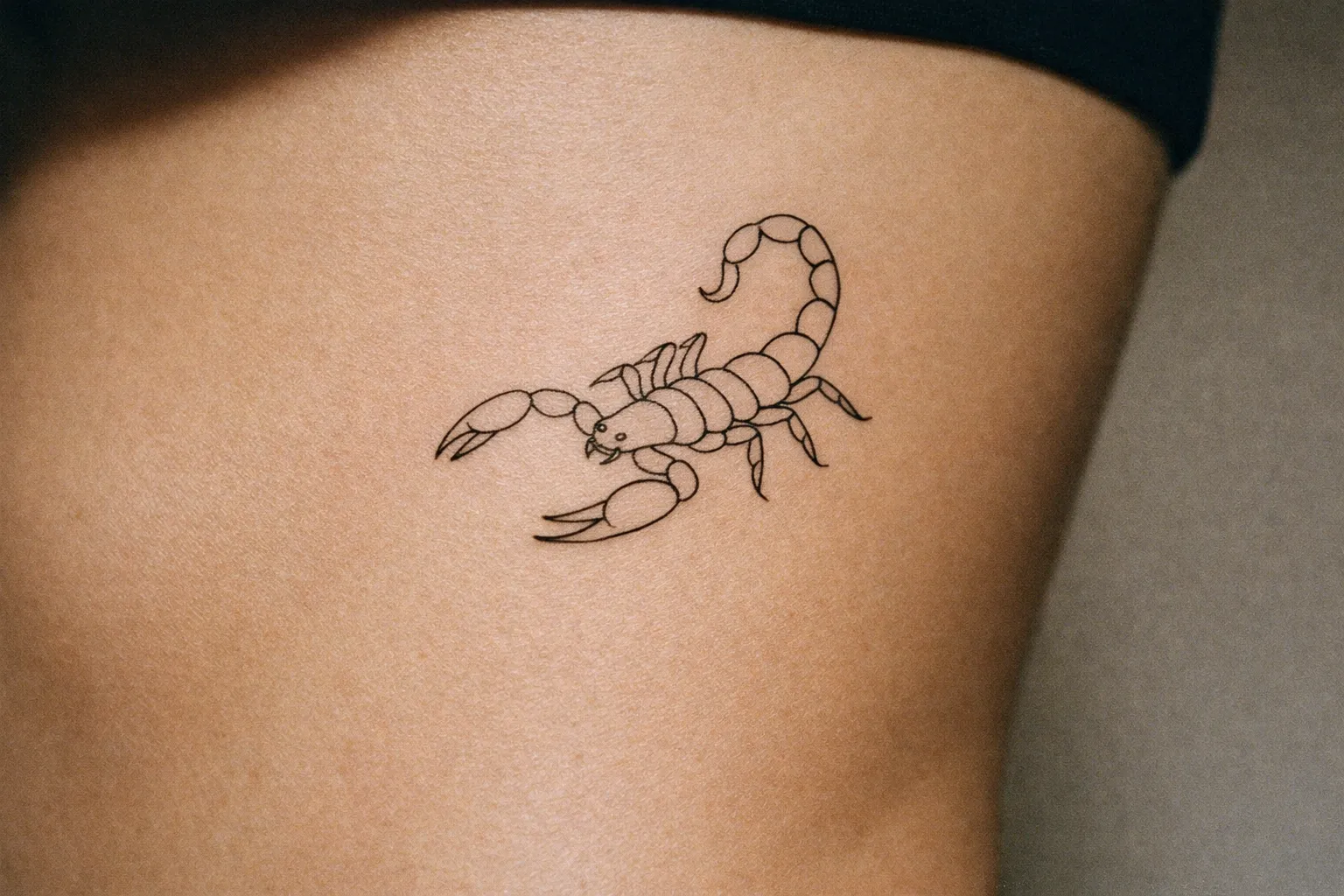
Fine-line and minimalist scorpions use single-needle or very fine outlines, and they’re trending for wrist, neck, and behind-the-ear placements. Visually elegant, but also the most fragile option on this list. Fine-line work blurs and fades sooner than bold work, especially on wrists and other high-motion areas.
At this scale, full anatomical detail simply won’t survive long-term. All eight legs, a segmented tail, individual claws - none of it holds. Simplify to a graphic silhouette or reduce the leg count so the scorpion reads as a shape rather than a specimen. This style is best for clean, simple versions where legibility comes from outline, not detail.
Do not put fine-line on fingers or knuckles. High-wear, fast-fade zones that demand frequent touch-ups - delicate lines there won’t last.
Style vs. Placement vs. Longevity
Here’s the at-a-glance comparison across the four styles. Use it to sanity-check a pairing before you commit.
Scorpion Tattoo Style Comparison
| Realistic | American Traditional | Tribal / Neo-tribal | Fine-line / Minimalist | |
|---|---|---|---|---|
| Best placements | Upper arm, calf, belly, upper back | Forearm, elbow, shoulder | Shoulder, calf, lower back | Wrist, neck, behind ear |
| Pain zone (relative) | Varies by placement | Forearm = low-moderate | Shoulder = low-moderate | Wrist = moderate-high |
| Aging durability | Medium - fine detail blurs on movement | High - bold lines hold | High - silhouette holds | Low - fades on movement |
| Session length | Long / multi-pass | Medium | Medium | Short |
The pattern is consistent: bold shapes on stable skin last longest. Fine-line work needs the most upkeep. Burned Hearts Tattoo puts it plainly: most fine-line tattoos benefit from a light touch-up every 2 to 5 years, high-friction areas like fingers or hands may need attention within 1 to 2 years, and low-friction spots like the upper arm can easily go 5 to 10 years without maintenance (13).
Placement - Where the Scorpion Reads Best
The forearm is the most popular placement for a scorpion tattoo, and for good reason. Visibility is high, the arched tail follows the arm’s natural line, and it’s a low-to-moderate pain zone - the pain chart published by M. INK Tattooing rates the outer forearm 3 to 4 out of 10 (11), which makes it a solid entry point for a first tattoo. It handles all four styles.
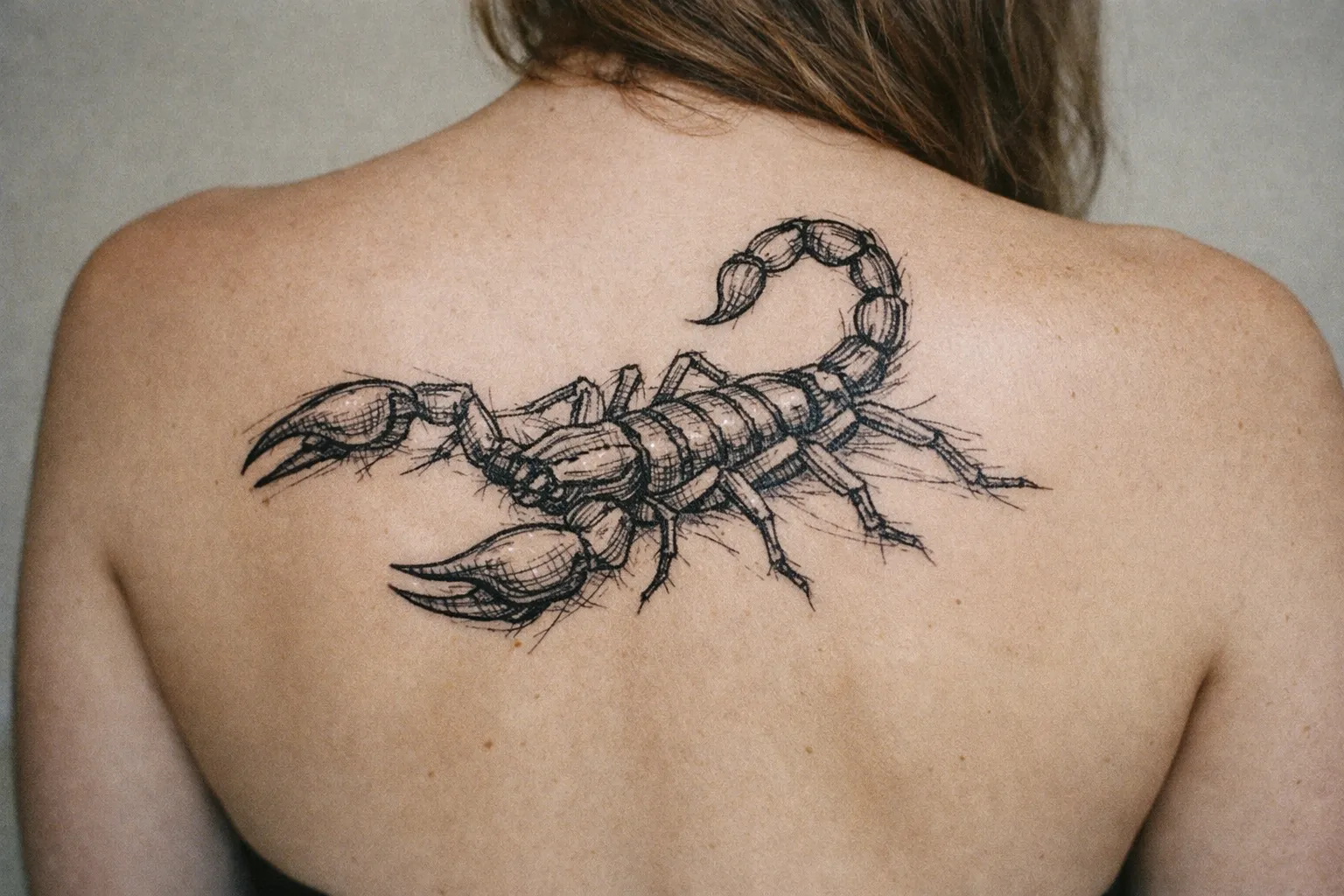
The upper arm and shoulder cap carry low-to-moderate pain and age very well, which suits realistic and traditional pieces. The shoulder cap is the classic elbow-adjacent zone for traditional scorpions - I’ve put more traditional scorpions on shoulder caps than anywhere else, and they hold up well over time.
The chest and sternum, centered over the heart, read as guarded emotion or inner strength and pair naturally with the defensive-curl pose. Be honest with yourself about pain: the chest and sternum run significantly higher than the forearm. Art n Soul Tattoo’s chart puts the sternum at 7 to 9 and the ribs at 8 to 10 out of 10, against 2 to 4 for the forearm (12), and our tattoo pain scale shows the same gap. This zone suits larger realistic or traditional pieces.
The calf is good for mid-to-large realistic or tribal work, with lower pain than the ribs. The walking pose flows naturally along the muscle.
The neck and behind the ear are fine-line or minimalist only, with the tail following the jaw or neck curve. Pain runs higher than the forearm, and the visibility carries real professional considerations worth thinking through before you book.
The hand and wrist are the most-searched placement for scorpions, and they come with the biggest caveat. High-wear, high-pain zones that fade faster and need more touch-ups. Fine-line work on fingers or hands may need attention within 1 to 2 years (13). Fine-line scorpions here will blur; bold silhouettes hold better but still require maintenance. Go in knowing you’ll be back for upkeep.
On size for legibility: at small sizes, full anatomy - all legs, segmented tail, individual claws - tends to blur as the tattoo settles and skin changes over time. For recognizable anatomy that holds up, give the design more room; the right minimum depends on the style and how much detail you’re trying to preserve.
Small scorpion tattoos - when to simplify
At micro scale, the problem is that a scorpion has a lot of thin parts, and thin parts blur first. The fix is deciding what to drop and what to keep. Drop the leg count (four suggested legs read cleaner than eight tangled ones) and drop the internal segment lines that muddy the tail. Keep the two things that make a scorpion instantly recognizable: the curved tail with the stinger, and the claw silhouette out front. A stylized or tribal-leaning form at this size will outlast a tiny attempt at realism every time. If you want small, commit to a graphic shape rather than shrinking a detailed design.
What to Discuss With Your Artist Before You Book
Pre-Appointment Checklist for Your Scorpion Tattoo
30 minutesSix practical steps to align your tattoo's message, style, and placement with your goals.
- 1
Decide on the pose first
Choose striking, defensive, or walking pose to lock in the emotional message before style selection.
- 2
Choose style based on placement and longevity
Bold outlines suit high-movement areas; realism requires enough space to hold detail over time.
- 3
Set a minimum size
Confirm the scorpion won't be too small to hold detail as it ages.
- 4
Clarify the meaning you want to project
Discuss whether the design could be misread (animal vs zodiac, resilience vs aggression).
- 5
Ask to see healed work
Request healed photos of the style you want to assess longevity, not just fresh ink.
- 6
Consider professional visibility
Neck and hand placements have real-world implications; forearm and upper arm are easier to cover.
Frequently Asked Questions
Frequently Asked Questions
- What does a scorpion tattoo symbolize?
- The scorpion symbolizes protection, danger, survival, and transformation, with roots in Egyptian, Native American, and Asian cultures. Meaning shifts with pose and style.
- What does a scorpion tattoo mean in the military?
- In military tattoo lore it is tied to combat experience; in Russian tattoo codes, a scorpion with open claws usually marks a Special Forces soldier who has seen combat.
- What does a scorpion tattoo mean in LGBT contexts?
- Within the gay community, a scorpion tattoo has been used to signal that the wearer is HIV positive. The meaning is not widely known, so context matters.
- How much does a scorpion tattoo cost?
- Cost varies by artist, location, style, and size. Small fine-line tattoos cost less than large realistic pieces. Budget for the artist's day rate, not the cheapest quote.
- Which scorpion tattoo style ages best?
- Traditional and tribal styles age best due to bold lines and solid fills. Realistic holds on low-movement areas; fine-line fades fastest, especially on wrists and fingers.
- Can a scorpion tattoo be misread as a Scorpio zodiac tattoo?
- Yes. Without zodiac symbols, it reads as an animal symbol. Tribal or traditional styles clearly read as animal, reducing zodiac confusion.
Before You Book
Three variables decide what your scorpion becomes: pose determines the message (boundary, protection, or moving on), style determines how long it holds up, and placement determines who sees it and how much it hurts. Get those three aligned and the rest is detail.
One honest closing point: the scorpion is one of the few animal tattoos that stays readable at mid-size, but only when the style matches the scale. A tiny realistic scorpion is a bad idea - the legs and segments will collapse into a smudge within a few years. A small tribal silhouette works fine. Match the style to the size and the piece will still read a decade out.
Ask to see healed work in your chosen style before you book. A fresh tattoo always looks sharper than it will in five years. The healed photo is the one that tells you the truth.
Aftercare timeline. The dedicated routine runs about two weeks, but healing takes longer, and the week-by-week aftercare rules cover each stage in detail. Days 1 to 3: the tattoo weeps plasma and ink - keep it clean with fragrance-free soap and apply a thin layer of ointment; avoid soaking it. Days 4 to 7: the skin tightens and starts to flake - do not pick it, and switch to a light fragrance-free lotion. Week 2: peeling and itching peak, the riskiest window for picking. Weeks 3 to 4: the surface looks healed while the deeper layers keep settling; stay out of pools and hot tubs until at least week 3, and keep the tattoo out of direct sun for the first 4 to 6 weeks. Around week 6: full integration. Fine-line work on the wrist or neck is more sensitive in the first two weeks, so be especially gentle with washing and avoid tight clothing rubbing the area.