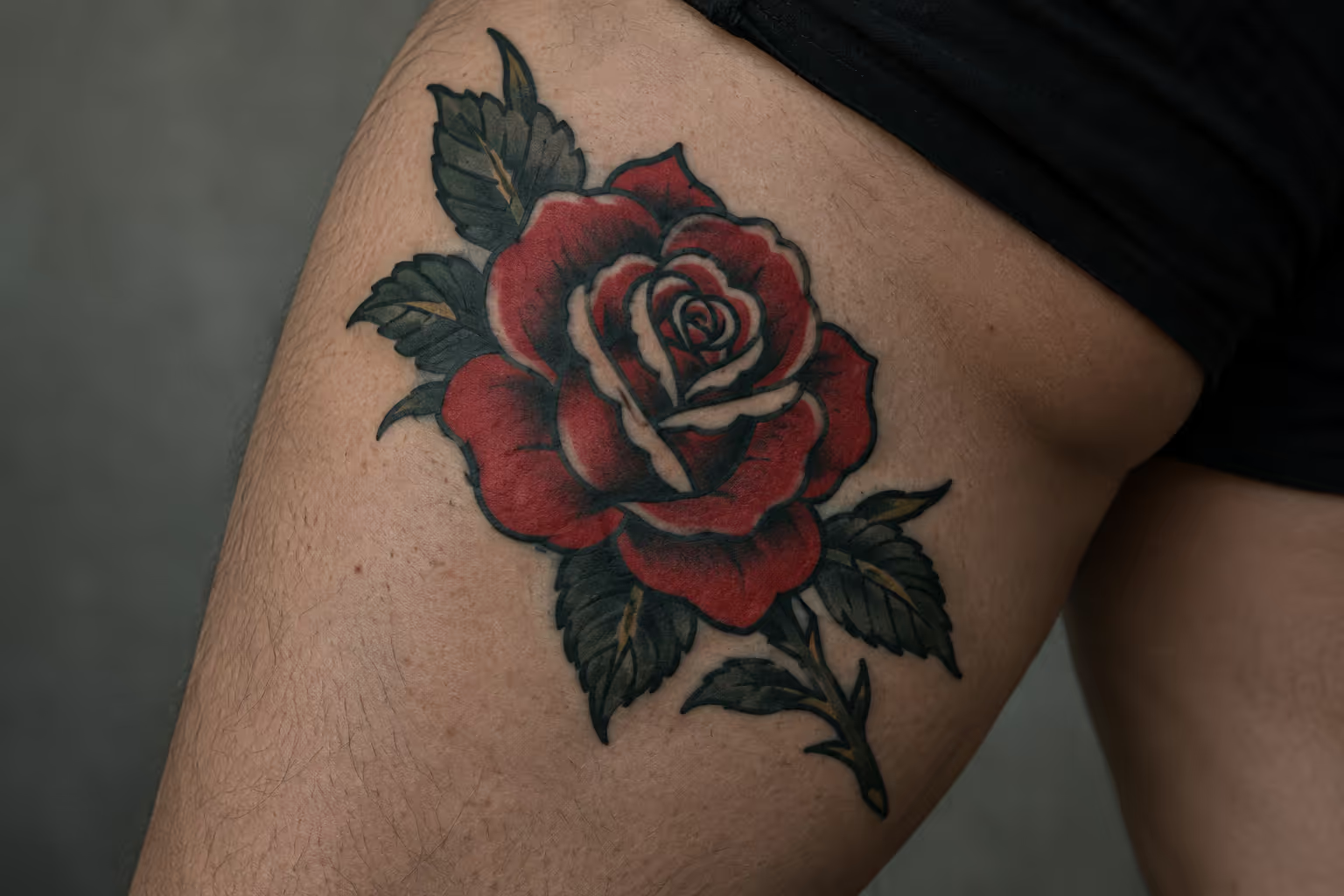
A quote tattoo lives or dies on lettering size and font choice more than on the wording itself. The same phrase at the same nominal size can read clean in one typeface and blur into a smudge in another, so the reliable move is to test the design at its true physical width before you sit in the chair. This guide covers picking the words, matching them to a placement, and choosing a letter height that still reads after the ink settles.
The tradeoff, before you commit: lettering is easy to resize, reposition, and fit into almost any spot, and the reference can be as personal as a line from your grandmother’s letters. The downside: once healed, the wording is fixed, small script is the first thing to blur, and some placements fade noticeably faster than others.
✓ Pros
- A personal phrase can carry meaning without needing a large design.
- Text can be arranged around an existing tattoo or built into a larger piece.
✗ Cons
- A wording change after healing means covering or altering the original lettering.
- Text can lose clarity if the chosen typeface and body space do not suit each other.
Choosing Words That Say Something: Ideas for Your Tattoo
The best quote tattoo ideas run 2-10 words, the range most tattoo artists recommend for readability and longevity (4). Longer phrases need more room than most placements give, and short phrases stay legible longer as the ink settles. Pick the wording first, then find the body space for it. Doing it the other way round is how people end up with a sentence crammed into a wrist.
A good test for any phrase: would you still agree with it in fifteen years? A line that fits one bad month tends to age worse than the ink does.
Inspirational and motivational lines
Motivational lines are among the most requested, and they hold up because they’re brief. Lines like “keep going,” “This too shall pass,” and “Strength through struggle” all sit comfortably inside the word range (4). “This too shall pass” has a long history: the phrase seems to have originated in the writings of medieval Persian Sufi poets, and the fable around it also appears in Jewish folklore, where it is often attached to King Solomon (7). On skin it is usually chosen as a resilience line, for getting through a hard stretch (4).
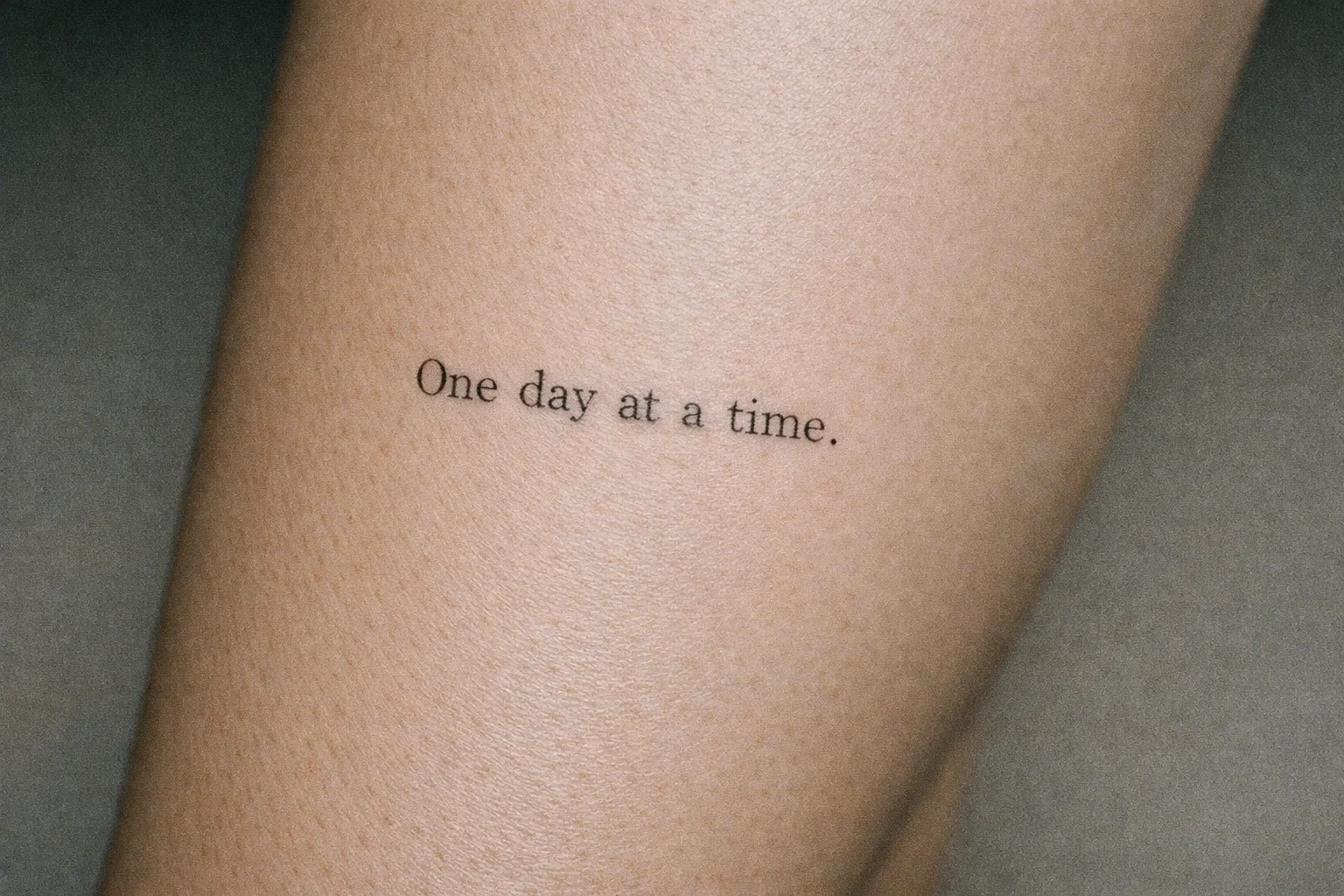
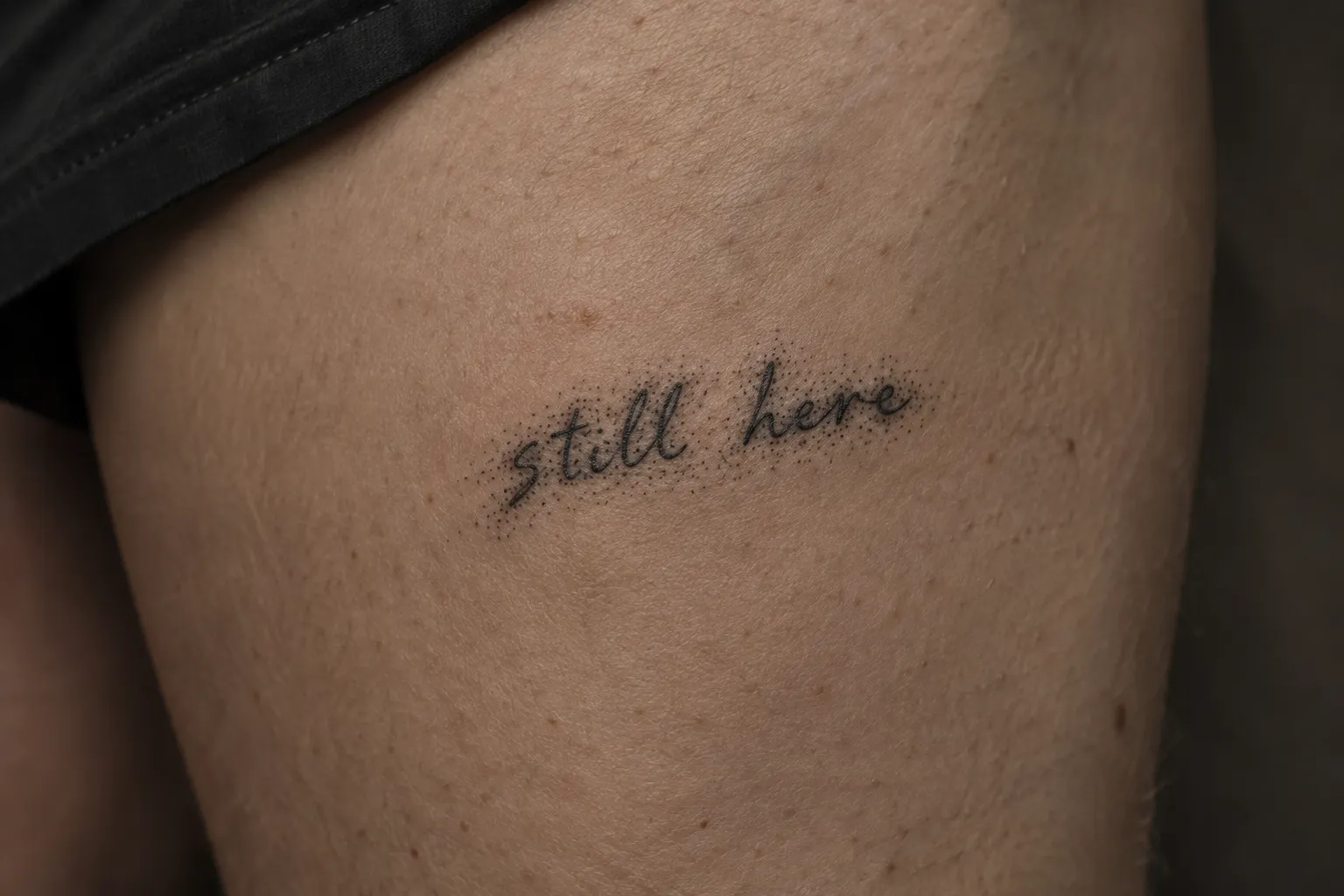
“One day at a time” is another staple. Notice the full stop in the example above: punctuation becomes part of the design, and every dot needs enough space to hold as a clean mark.
Literary, film and lyric quotes
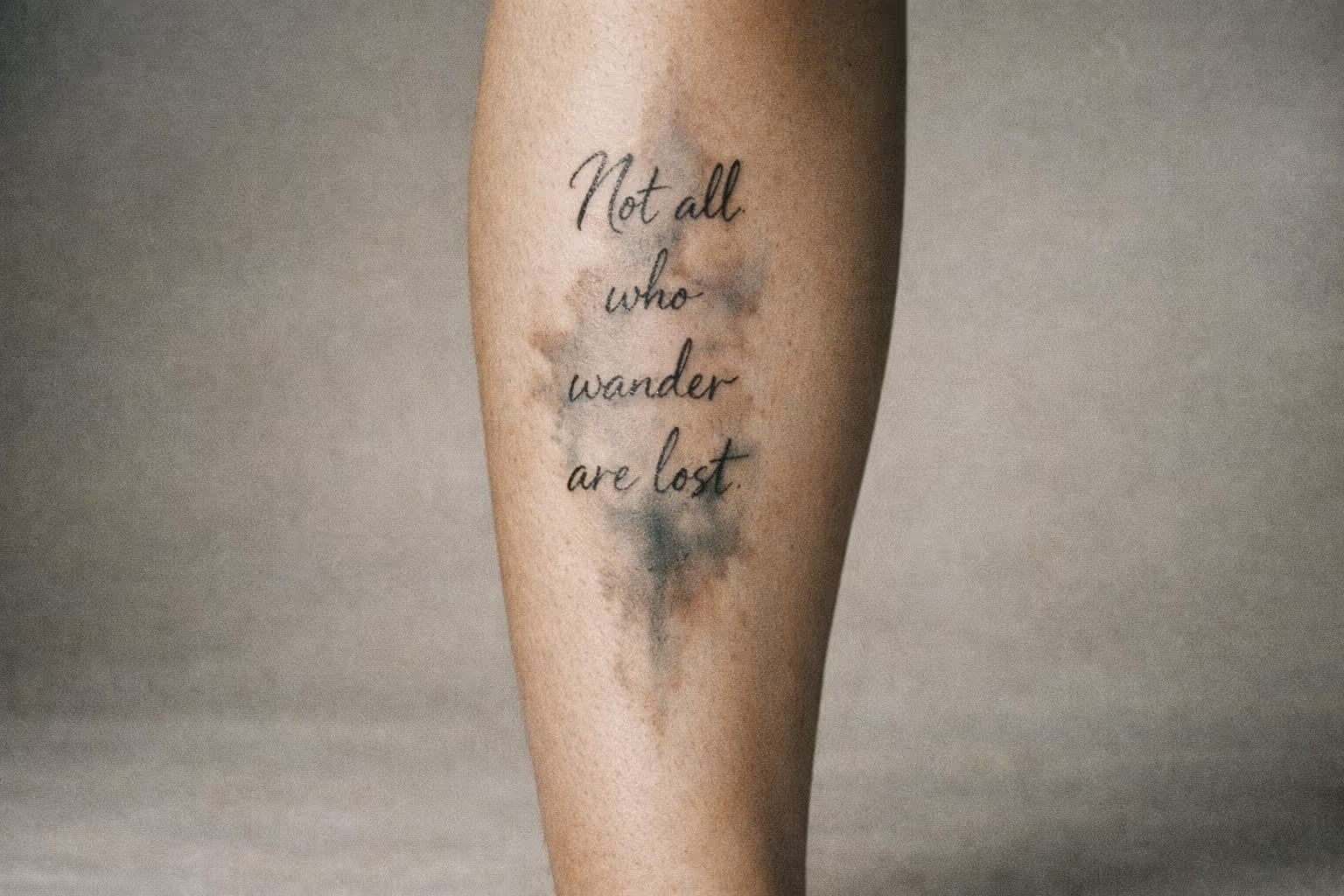
Books, poems, films, and songs supply many of the lines people choose (4). “Not all those who wander are lost” comes from Tolkien’s poem “All that is gold does not glitter” in The Fellowship of the Ring. It runs seven words, so it’s still short enough for a forearm. The popular shortening “Not all who wander are lost” drops “those”, so decide which version you want before it goes on skin. “After all this time? Always.” is from Harry Potter and the Deathly Hallows. Get the question mark right, because fans will notice. Maya Angelou’s “Still I Rise” and the Beatles’ “let it be” are both common picks (4).
If you want unique tattoo phrases rather than the top ten, look at Latin mottos with a documented history. Amor fati (“love of fate”) found its most explicit expression in Nietzsche, and the idea has also been linked to the Stoics Epictetus and Marcus Aurelius (8). Memento mori (“remember that you have to die”) is a reminder of mortality with roots in classical antiquity and Christianity (9). Two words each, and they’re easy to fit anywhere.
Family sayings and personal mottos
A family saying (4), or a line in a relative’s handwriting, is the version no one else has. Handwriting needs extra scrutiny. Scan it, and make sure it’s enlarged to at least the script letter-height floor covered below. Shaky loops don’t survive being shrunk.
Quote Tattoo Placement: Matching Length to Body Space
Quote tattoo placement should follow how many words you’re working with: short phrases fit the wrist, collarbone, ankle, or forearm, while longer lines need the spine, thigh, chest, or ribs so the letters aren’t compressed into an unreadable strip (4)(3). Choose the spot that gives the words room at a legible height. Don’t pick the spot first and shrink the words to suit it.
Short phrases: wrist, collarbone, ankle, forearm
One to four words suits the wrist or the ankle. The inner forearm faces you, reads easily and suits personal quotes (5), up to about ten words. The collarbone takes short phrases only, in a single line along the bone (5). Wrist and forearm lettering shows in short sleeves and a collarbone line in open necklines; the ankle and forearm are the easiest to cover.
Longer phrases: spine, thigh, chest, ribs
Past ten words, you need length: the spine, thigh, chest or side ribs (4). The ribs and side body suit longer phrases that flow down, and the upper back and shoulder blades take longer quotes (5), while the thigh gives longer lettering more space to stay readable (4). The chest offers wide horizontal space under the collarbones. Rather than forcing a long sentence into one compressed line, use intentional line breaks or cut the wording (3).
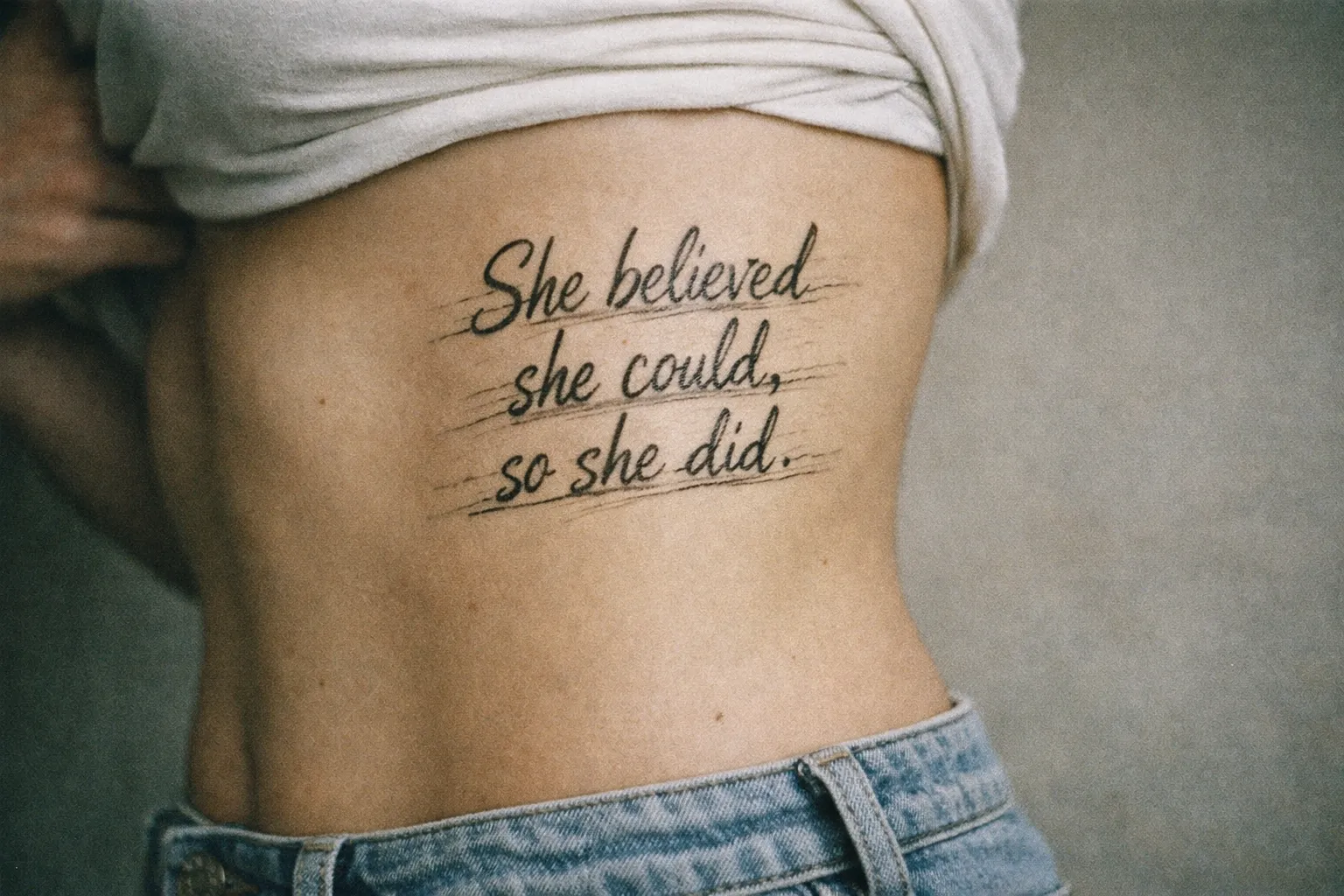
Ribs look elegant, but they are known for being more painful (4). They also stretch and shift with weight changes, so vertical text along the side body is more forgiving than a long horizontal line.
Coverability matters most on the torso. Spine, ribs, and thigh vanish under almost any work clothing. A back piece can also anchor a lettering line underneath it later if you ever build a larger design.
A banner line of text under a large upper-back piece needs to match the weight of the design. Thin script under heavy color disappears visually, even when it’s technically readable.
A quick comparison by spot:
- Wrist: 1-4 words, highest visibility, high pain, high friction, hard to cover.
- Collarbone: short phrases in one line, visible in open necklines, bony, so expect more pain.
- Ankle: 1-4 words, moderate visibility, high pain over the bone, sock and shoe friction.
- Forearm: up to 10 words, very visible, low to moderate pain, easy to cover with sleeves.
- Spine: longer phrases, low visibility, high pain over the vertebrae.
- Thigh: longer phrases, low visibility, low to moderate pain on the outer thigh.
- Chest: medium to long phrases, moderate visibility, low to moderate pain, more over the bony sternum.
- Ribs: longer phrases, low visibility, high pain.
Pain levels follow the general pattern in tattoo pain charts: spots close to bone with thin skin, such as the ribs, spine, wrist and ankle, hurt more, while padded areas such as the forearm, outer thigh, chest and back hurt less (6).
Best Spots for a Few Words: Small Placements Compared
For short quote tattoos, the inner forearm gives the best balance of visibility and coverability (4). The wrist and ankle trade that balance for more friction and faster softening of fine lines. On pain, the ribs, wrist and ankle sit among the more painful spots and the forearm among the gentler ones: anywhere the needle sits close to bone, with little fat and thin skin, hurts more than padded skin (6).
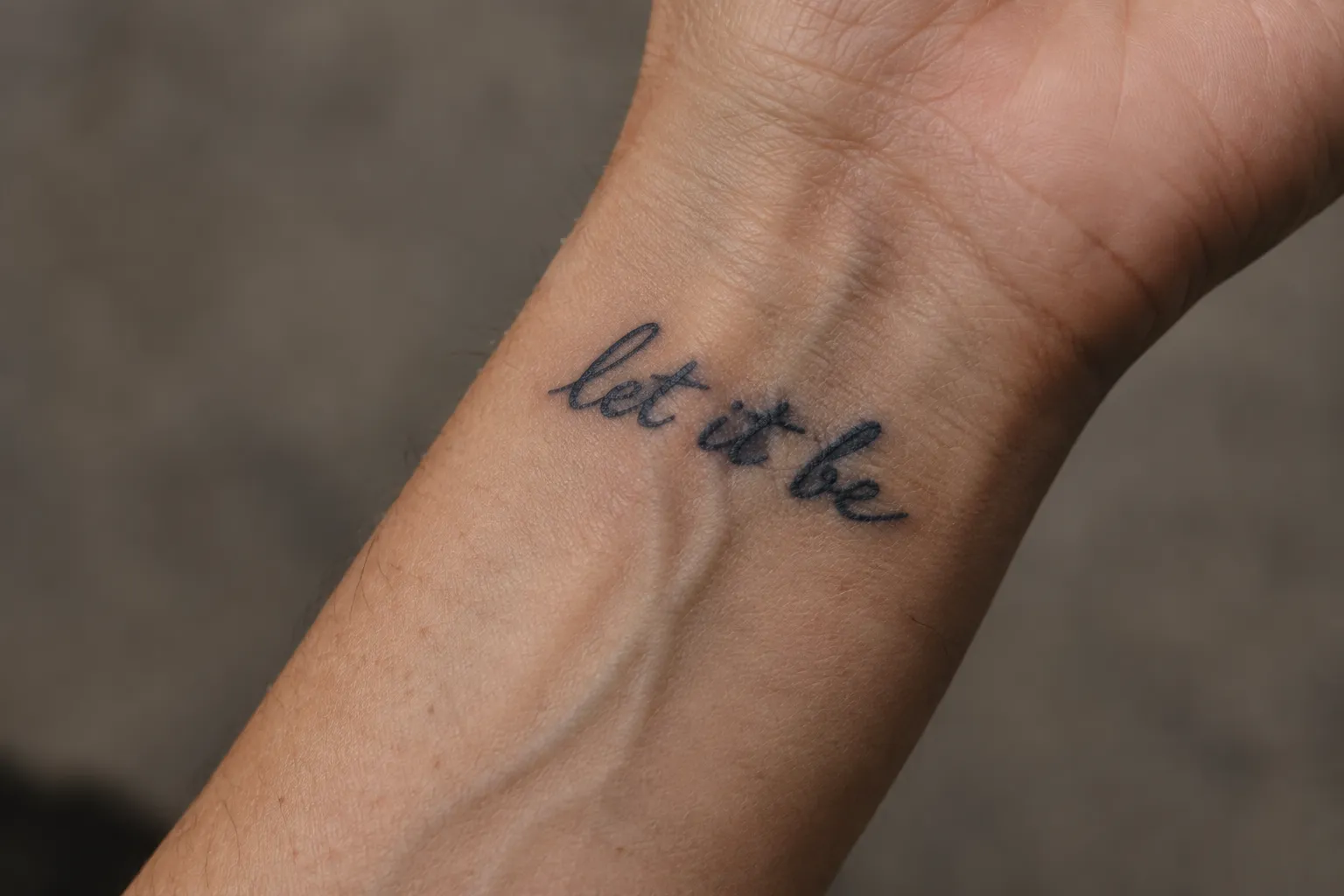
The wrist is the placement I push back on most. Watch straps, cuffs, and constant flexing wear lettering down, so keep to bold script or block lettering there: thin, intricate fonts blur over time, especially in small designs, while bold, clean fonts keep their clarity longer (4).
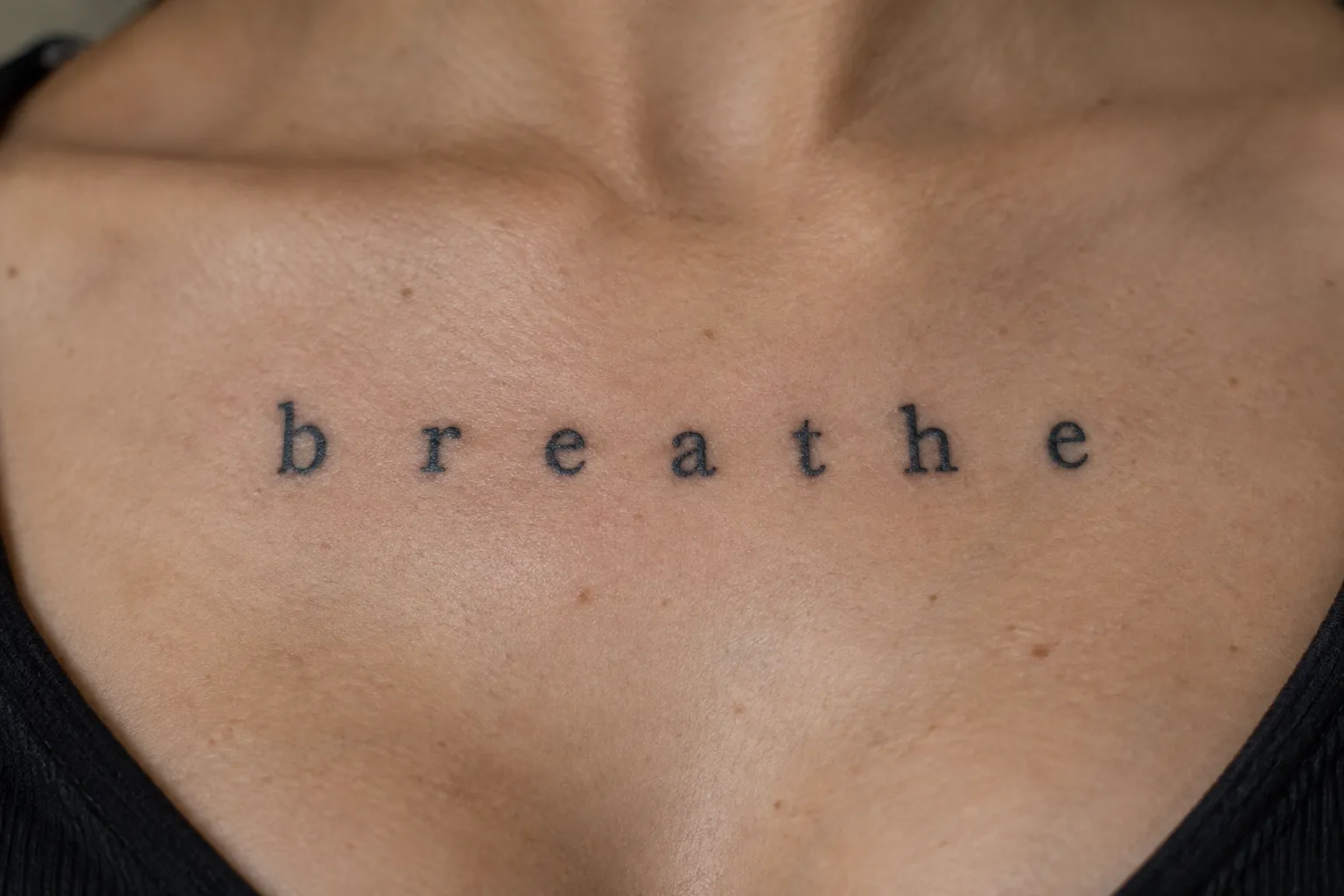
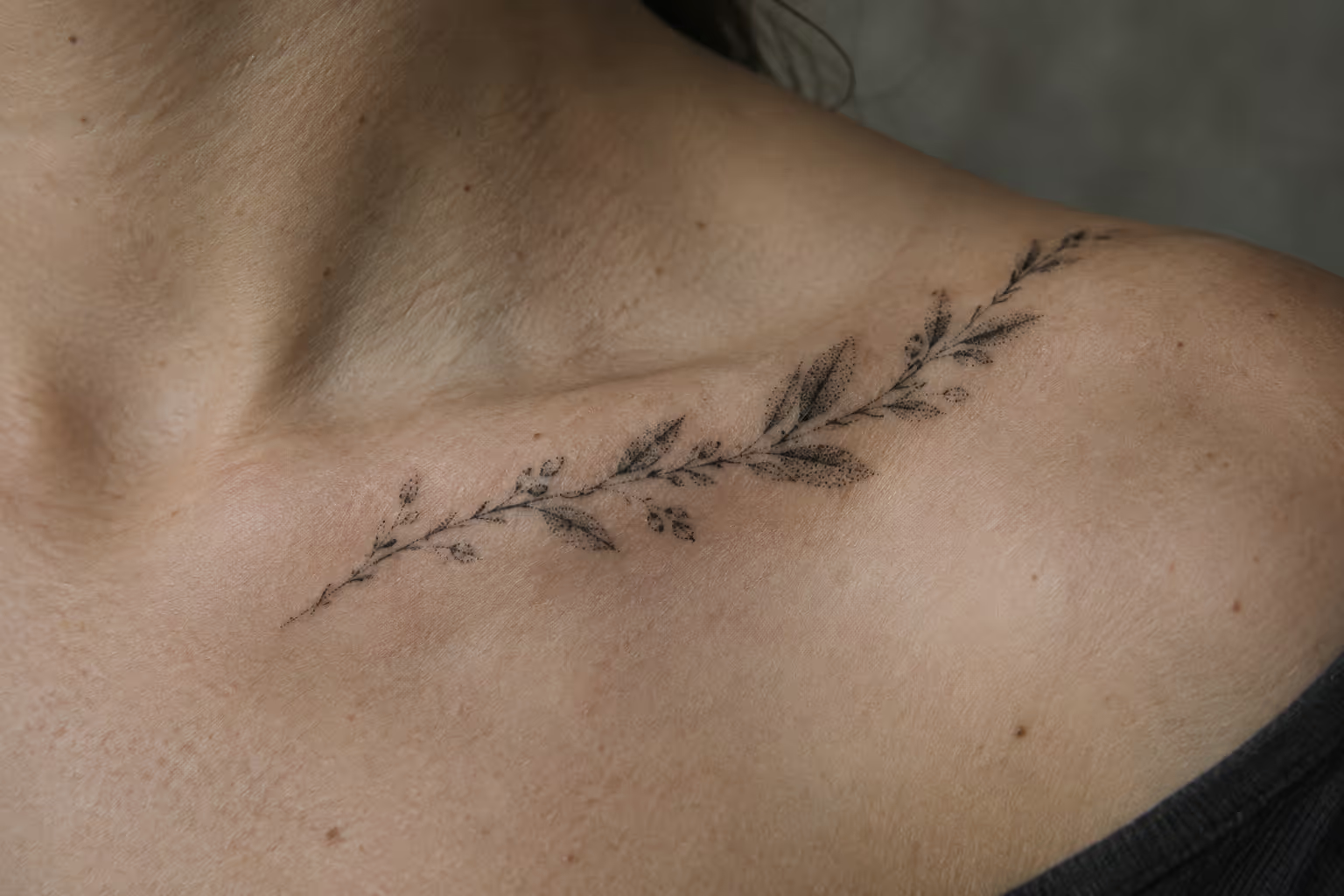
For the collarbone and upper chest, spacing is the issue. Skin over the collarbone curves, so a straight stencil can look bent when you turn your head. Ask your artist to place it while you stand in a natural posture, not while you’re lying flat.
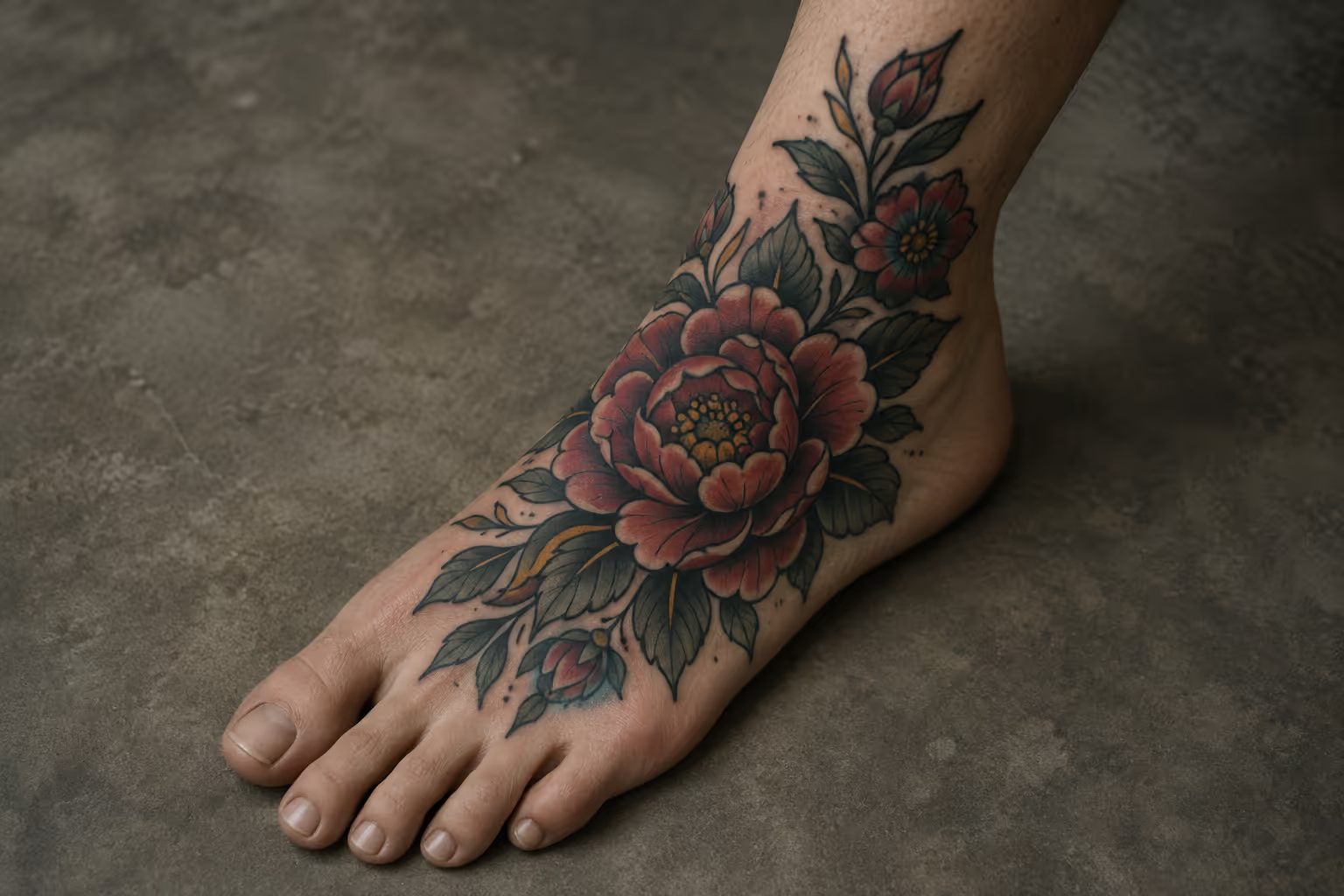
The ankle gets sock, shoe, and boot friction. It works well for one or two words in block or bold script, and it also works as a spot for bold imagery with a word or date added nearby.
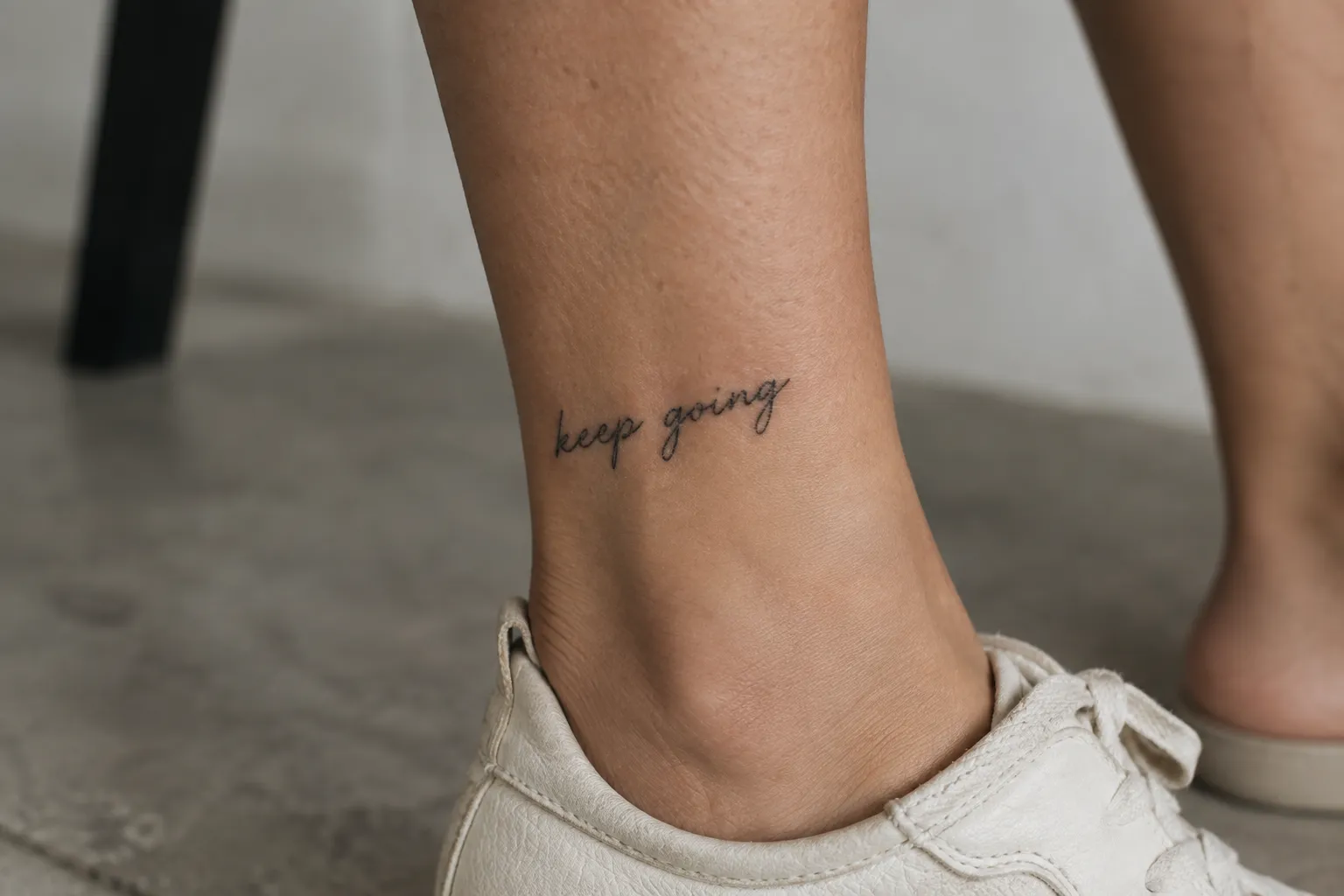
The script in this example is fine-line. It reads cleanly now, but thin lettering blurs over time in small designs, so on the ankle ask for a heavier line or bold script, which keeps its clarity longer (4).
Fonts and Lettering Styles for Tattoo Quotes
The quote tattoo font that holds up best at small sizes is clean bold lettering. Script and cursive look elegant, but thin, intricate lettering blurs over time as ink spreads slightly under the skin (4), and in connected script the narrow loops, thin connectors and tight joins are usually what fails first at small size (3). Treat font, physical size, spacing, and placement as one decision (3).
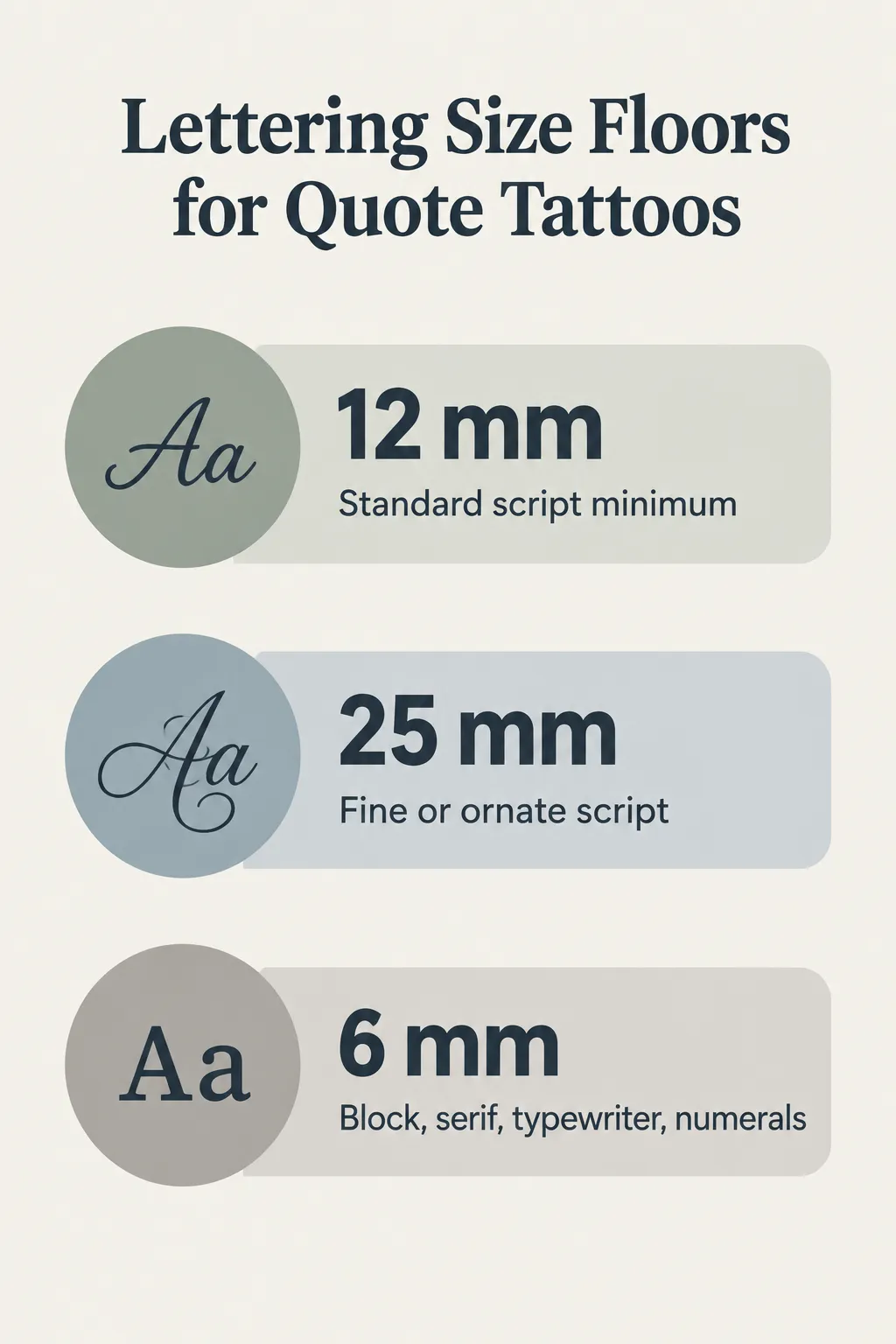 Minimum letter heights: 12 mm (1/2 in) for standard script, about 25 mm (1 in) for fine or ornate script, and 6 mm (1/4 in) for block and serif lettering.
Use these letter-height floors, the ones one lettering artist sets, measuring the full height of the letter (5):
- Standard script: at least 12 mm (1/2 in)
- Fine or ornate script: about 25 mm (1 in)
- Block and serif lettering, typewriter faces and numerals included: at least 6 mm (1/4 in)
Those are minimums, not targets. One readability guide goes further and argues there is no universal minimum letter height at all, because two fonts at the same height can carry very different counters and joins (3). You still need to test the exact phrase at size.
Script and cursive quotes
Script’s two hallmarks are connected strokes and thick-thin contrast. The pitfall is hairline thins that look perfect fresh and drop out once healed. Watch out for the common fix of widening the overall letter spacing, because connected script can break visually once letters designed to join are pulled apart. Crowded pairs need local adjustment, a different font, or more room (3).
Serif, typewriter and bold block lettering
Serif fonts give a classic tone, and typewriter styles are among the most popular for quotes (4). Typewriter’s hallmarks are uniform stroke weight and slab serifs, and its pitfall is thin serifs that vanish at small size. Bold block lettering carries the most ink per letter, and bold, clean fonts keep their clarity longer than thin ones (4).
American traditional handles lettering well for a reason. Its hallmarks are thick black outlines and a limited palette, and banner text is usually heavy brush script or block caps sized to match the linework. If you’re adding a quote to a traditional piece, match that weight.
When comparing fonts, compare them at the same final physical width, not the same pixel size. If the phrase must fit inside 80 mm (about 3.1 in), print every candidate at 80 mm (3). Typefaces have different internal proportions, so equal screen settings produce different real sizes (3).
How to Make Sure the Lettering Stays Readable
The reliable way to confirm a quote will read once tattooed is to lock the exact text, print it at 1:1 scale, and inspect the smallest letter openings before the artist starts (3). Screen zoom shows you structure, but it doesn’t prove physical size (3).
Check Quote Tattoo Lettering Before Your Appointment
Confirm the wording, physical size, letter details, and placement with your artist before the session.
- 1
Lock the wording
Settle capitalization, punctuation, accents, and line breaks before making the printout.
- 2
Print at the intended physical size
Print the design at 1:1 scale on plain paper, disable "Fit to Page," and verify the width with a ruler.
- 3
Inspect small details
Check letter openings, narrow joins, fine strokes, and spacing at the printed size; revise the font or layout if details look crowded.
- 4
Test the body placement
Place the printout on the intended area and assess how it sits on your body in a natural posture.
- 5
Get artist approval
Ask your artist to check the final printed version and confirm any needed adjustments before the session.
Healing and Long-Term Care After Getting a Quote Inked
While a new quote tattoo heals, wash it gently and moisturize it twice a day (1). Once it has healed, sun protection takes over: broad-spectrum SPF 30+ applied 15 minutes before sun exposure and reapplied at least every 2 hours, because UV light can fade tattoo ink (2). The full week-by-week routine is in our tattoo aftercare guide.
Daily healing routine, week by week
- Days 1-3: Follow your artist’s instructions on the wrap. Wash gently with mild, fragrance-free soap and warm water twice daily, pat dry, and apply a thin layer of a simple moisturizer twice daily (1).
- Days 4-7: The surface tightens and starts to flake. Don’t pick at it, and avoid soaking in pools, baths, or hot tubs until it’s fully healed (1).
- Week 2: Peeling and itching are normal (1). Keep moisturizing and wear loose clothing over the area (1).
- Weeks 3-4: Scabs heal and the flaking eases (1). The surface looks healed, but the skin underneath is still settling; the lettering reaches its healed look around week 6.
- Sun: Keep the tattoo out of direct sun for the first 4-6 weeks and cover it with sun-protective clothing outdoors, then switch to sunscreen.
Sun care once the tattoo is healed
Apply a broad-spectrum, water-resistant sunscreen with SPF 30 or higher 15 minutes before going outside, and reapply at least every 2 hours outdoors (2). Skip tanning beds and sunlamps, which also fade ink (2).
Extra care for high-friction placements
Fingers, hands, and feet may fade or blur faster (4). If your quote goes there, treat the twice-daily routine and the post-heal sunscreen as non-negotiable, and plan on a touch-up sooner than you would elsewhere.
Frequently Asked Questions
- What is a good quote for a tattoo?
- A good tattoo quote is one you can explain in your own words and still stand behind when its original context has changed.
- What is a good short quote?
- A good short quote has a clear meaning without needing its source explained; read it aloud and check that the phrasing feels natural to you.
- How can I choose a less common tattoo phrase?
- Choose a line from a source you know well, then verify its wording and context before committing it to skin.
- How do I choose an inspirational quote that will age well?
- Choose a phrase that still fits your values outside the event that first made it meaningful, rather than one tied only to a passing mood.
- How many words should a quote tattoo be?
- Most tattoo artists recommend 2-10 words for readability; then have your artist test the actual font and letter height, because a word count alone cannot tell you whether the design will stay legible.
- Which lettering styles work best for small quote tattoos?
- Simple lettering with open letter shapes is easier to read at small scale; ask your artist to assess the exact phrase rather than choosing from a font preview.
- Do quote tattoos fade faster in certain spots?
- Yes, spots exposed to repeated rubbing or frequent movement can lose crisp edges sooner; ask your artist how your daily clothing and activity affect the chosen site.
Before You Book: Words, Width and Aftercare
Let how many words you’re working with choose the placement, and treat font as a legibility decision rather than a style preference alone. Test the font at true physical size against the 12 mm script and 6 mm block floors. Heal the tattoo with twice-daily washing and moisturizing, then keep SPF 30 or higher on it whenever you’re outdoors. Bring the exact wording and a 1:1 printout to your consult, so your artist can check the counters, the joins, and the fit on your body before anything is stenciled.