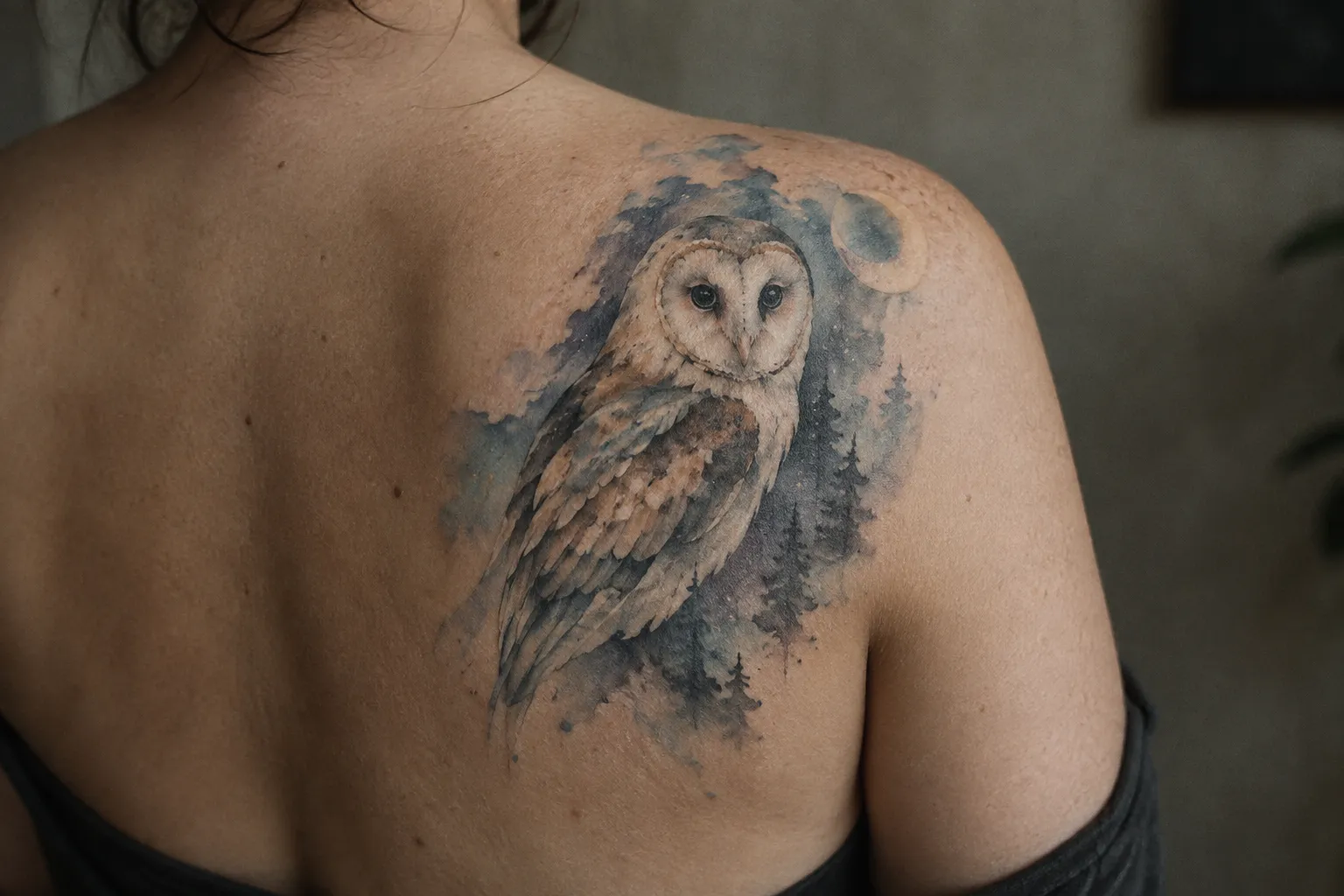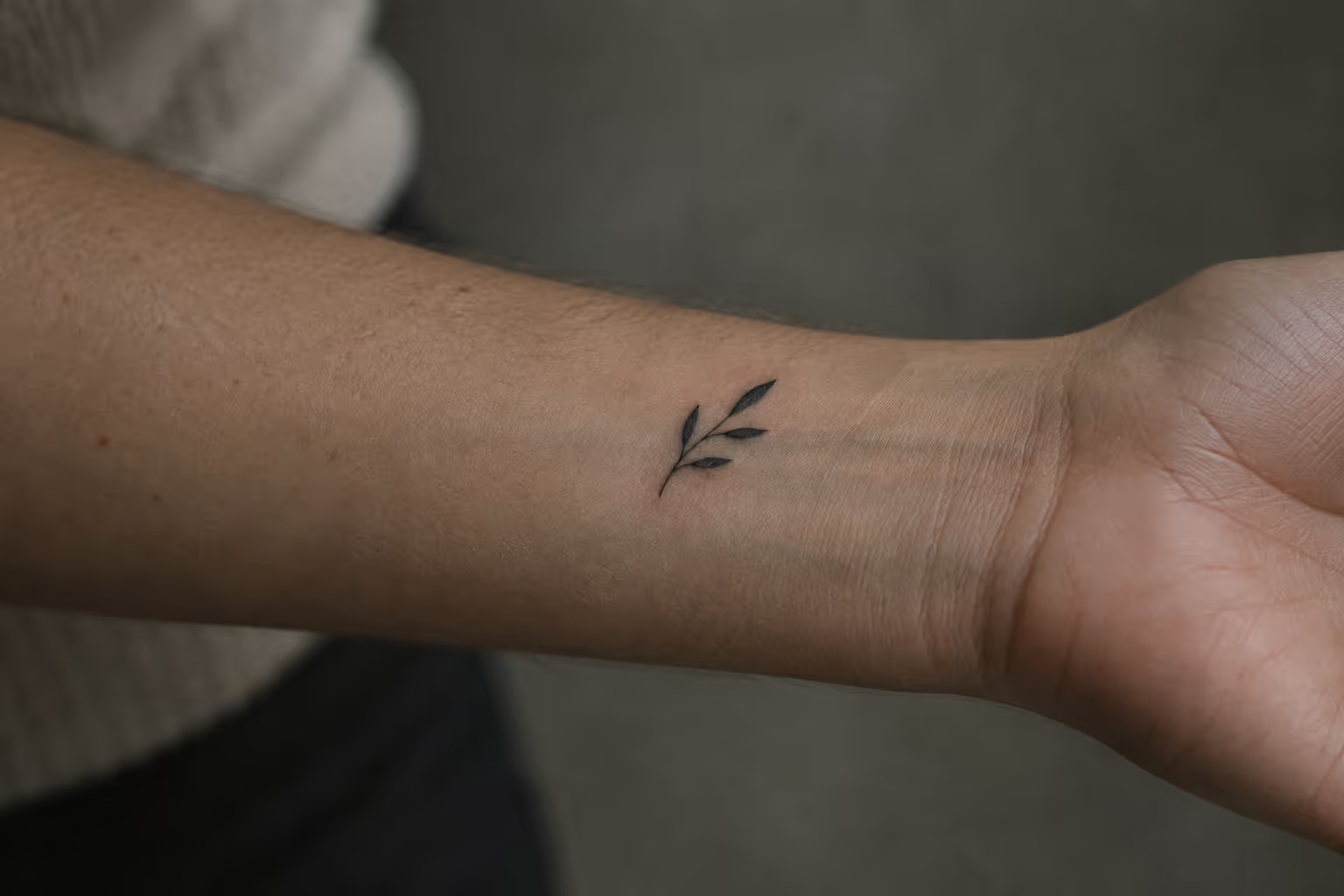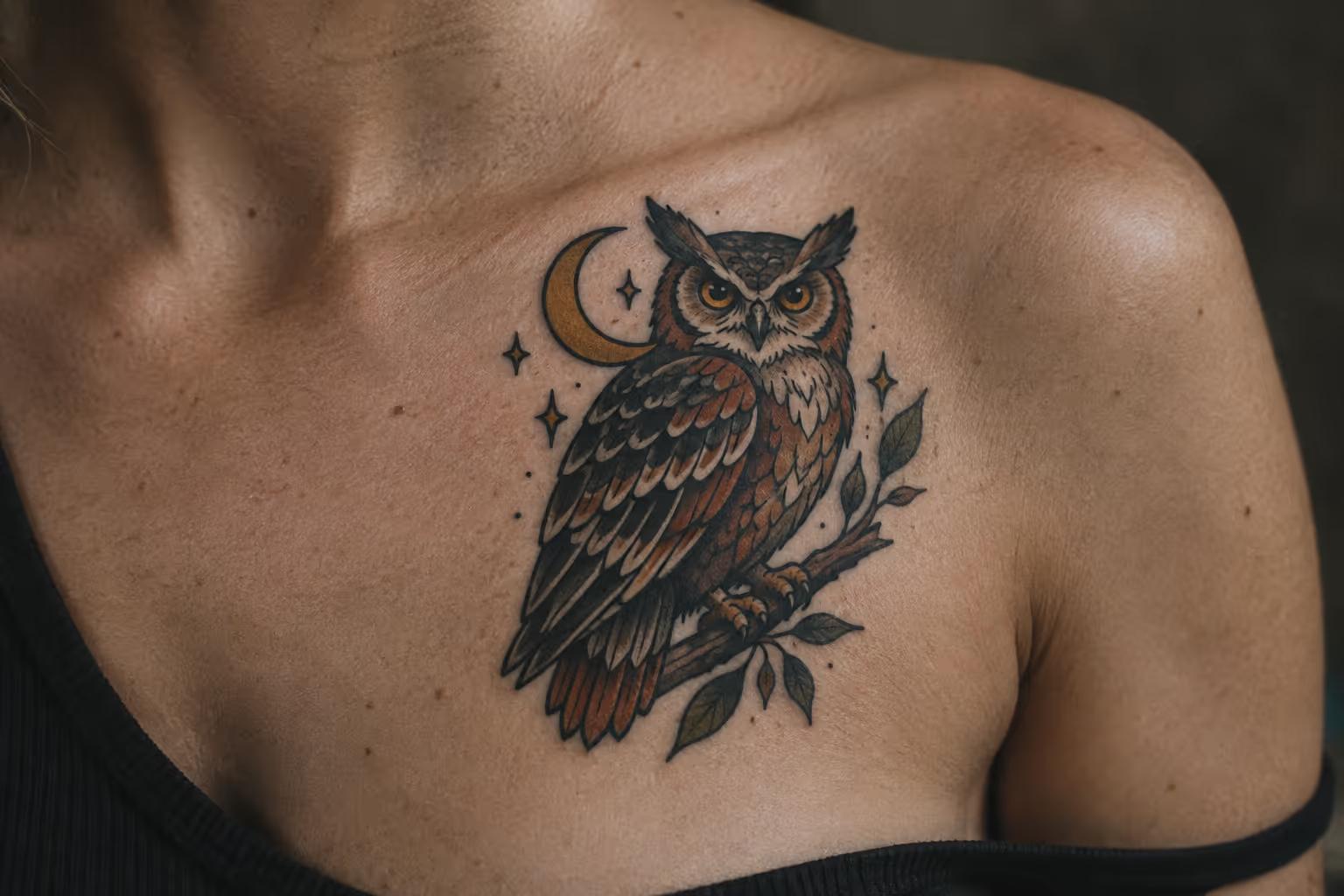
An owl tattoo has no single fixed meaning. Wisdom, knowledge, intuition, mystery and night are all common readings, and which one applies depends on the cultural reference you intend (4). Session count scales with size and detail together: small fine-line or face-only work is typically a single session, while realistic portraits and wings-spread flying owls run two to four (1). So decide what the owl stands for first, then choose a pose and a placement that can carry that level of detail.
Owl Tattoo Meaning: Symbolism and Cultural Roots
Owl symbolism changes by tradition. The same bird stands for wisdom in ancient Greece, for death and ill omen in several European folk traditions, and for protective spiritual guidance in many Native American traditions (4). That range traces partly to the owl’s biology: it hunts at night, sees in near-darkness and flies silently (4). Every one of those traits has been read as either insight or threat, depending on who was doing the reading.
The practical point is that nobody reading your arm knows which tradition you had in mind. If a specific meaning matters to you, build it into the design with species, pose and paired elements, so the owl isn’t left to explain itself.
Wisdom, Knowledge and the Athena Connection
The wisdom reading comes from ancient Greece, where the owl was linked to Athena, goddess of wisdom (4). This is the association most Western clients arrive with, and in modern Western tattoo culture it has largely flattened into “owl = smart.” That is one tradition, though, not the universal rule (4). Some pages present the design as meaning only wisdom. That understates how differently other cultures read the bird.
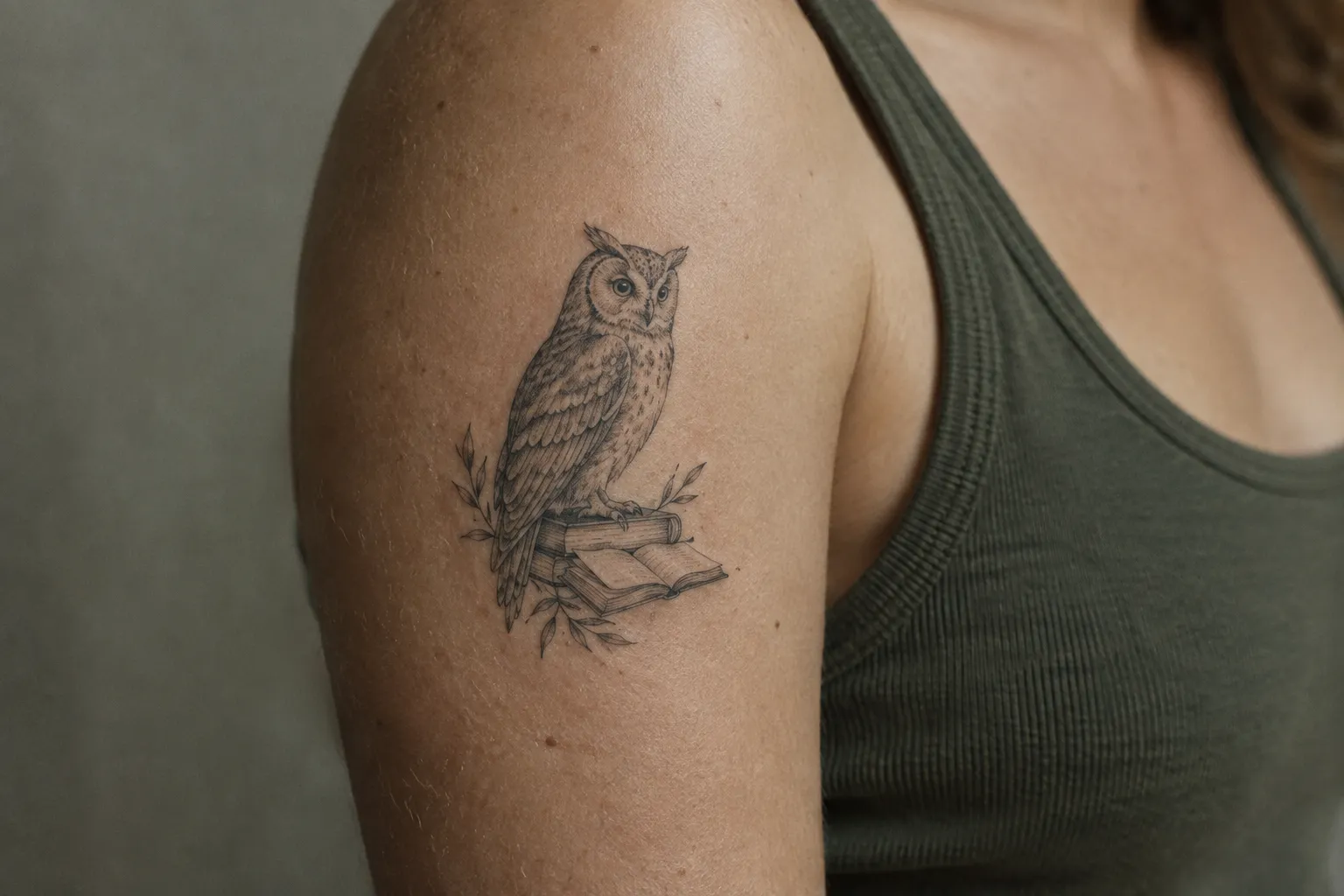
Books, scrolls or an olive branch under the owl anchor the Athena reading (5), so the piece is less likely to be read as an omen. Japanese culture offers another positive reading. The word for owl, fukurō, shares characters with words meaning “no hardship,” so the bird stands for luck and protection there and owl charms are popular gifts (6). Neither reading carries over automatically, so pick the one you mean.
Is a Night Owl Tattoo a Separate Symbol?
A night owl piece is not its own symbolic category. “Night” is one of several loosely linked interpretations, alongside wisdom, intuition and mystery, and its meaning depends on what you want the piece to represent (4). Some wearers use it as a nod to being nocturnal or working late. Others lean into mystery and darkness, the owl as a companion of seers and a watcher of hidden things (6). The European omen tradition pushes the same imagery toward death (4).
A night treatment is a mood you choose, so decide which version you want before the stencil goes on.
✓ Pros
- A strong facial silhouette stays recognizable across several styles.
- The motif can carry a specific cultural reference when paired with deliberate visual cues.
- A simple outline can be scaled down without trying to preserve tiny feather texture.
✗ Cons
- Viewers may assign a different cultural meaning than the one you intended.
- Fine feather patterns lose separation when the design is squeezed into too little space.
- Dark backgrounds and dense shading demand careful execution to avoid uneven saturation.
Where the owl earns its spot: the symbolism is flexible, the design scales from a small silhouette to a full back piece, and the round facial disc and forward-facing eyes read instantly. Where it goes wrong: the meaning gets misread across cultures, a recognizable portrait needs space and multiple sessions, and skipped safety and aftercare steps put the piece at risk.
Choosing a Pose and Style: Portrait, Perched, Flying, Day or Night
Beyond species, two choices shape an owl tattoo design: pose (face portrait, perched bird or wings spread) and treatment (day or night) (1). Pose sets the minimum size, and with it the placements that can hold the design (1). Name both when you bring references to your artist.
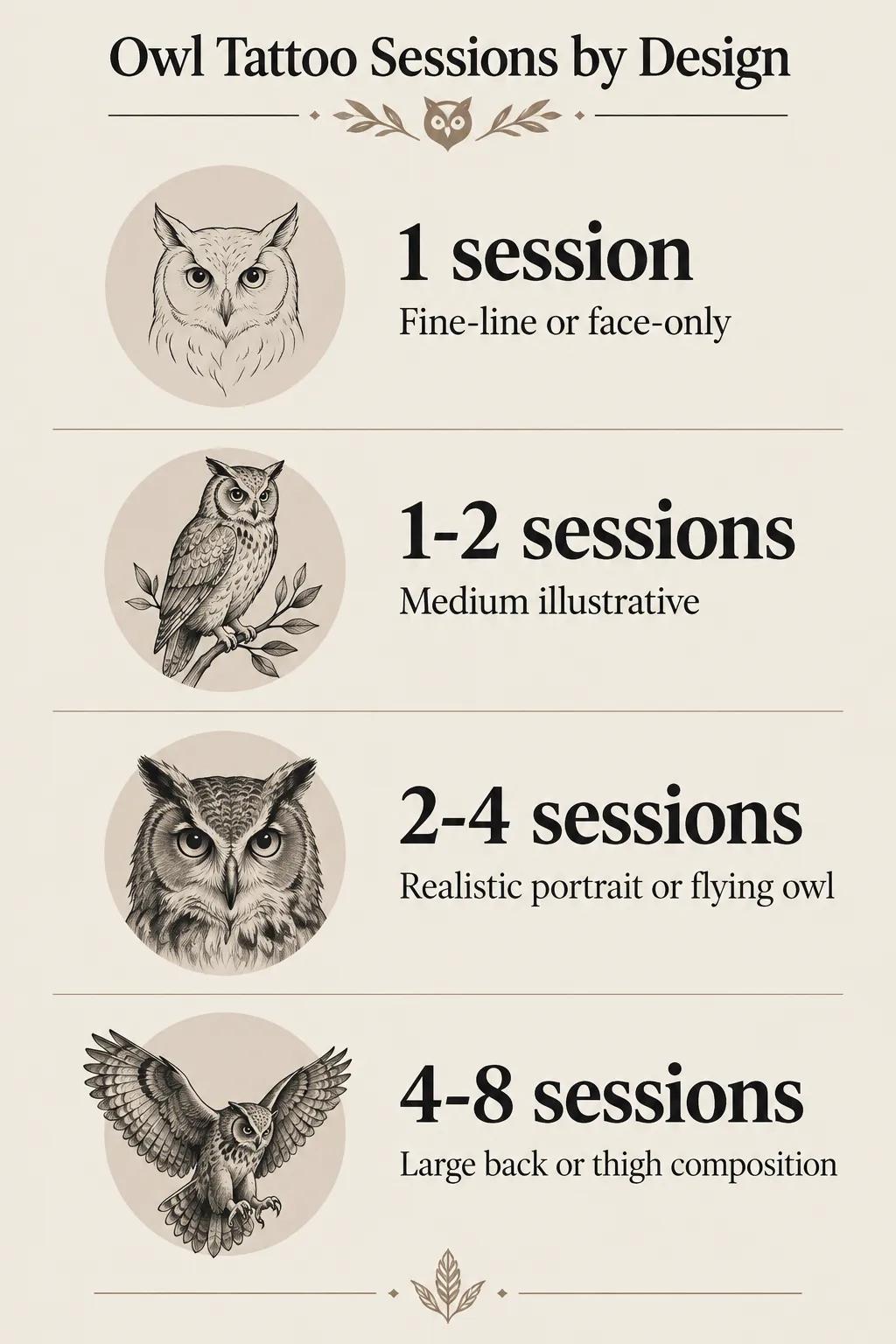 One studio’s design guide estimates 1 session for fine-line or face-only owls, 1-2 for medium illustrative designs, 2-4 for realistic portraits or flying owls, and 4-8 for large back or thigh compositions.
Portrait, Perched or Flying: What Each Pose Needs
The facial disc is what makes an owl read as an owl, and each pose has its own size requirement (1):
- Face-only portrait: works at 3-5 inches (7.5-13 cm). The eyes and facial disc carry the whole design. A forward-facing, symmetrical face suits central placements like the sternum.
- Perched full body: needs 5-8 inches (13-20 cm) so the feather detail, branch and talons all read.
- Wings-spread flying: needs 8 inches (20 cm) minimum so the wingspan has room.
Below 3 inches (7.5 cm), feather texture disappears entirely (1). At that size you are committing to a silhouette.
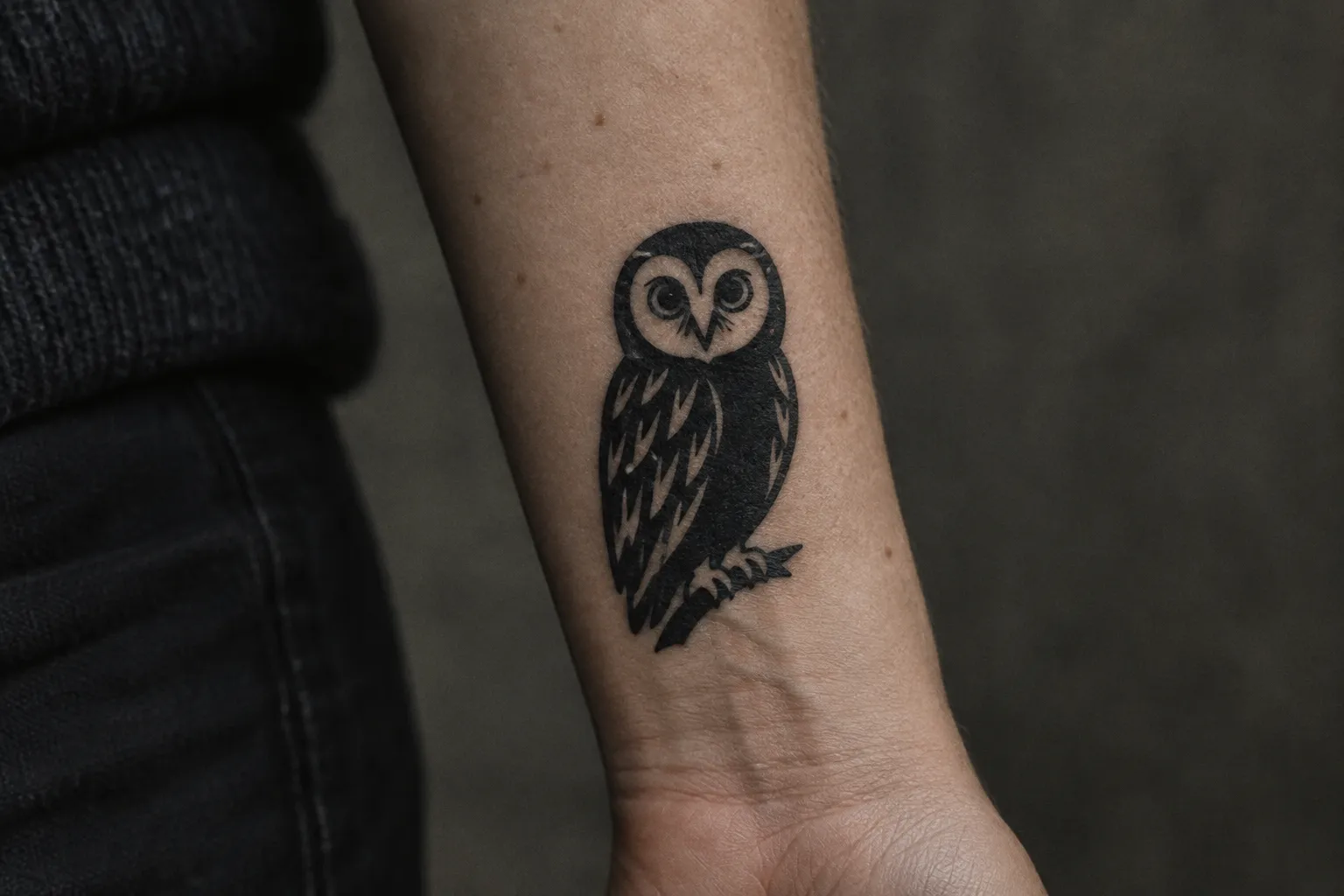
Style is the other variable. Neo-traditional owls use bold outlines, saturated color and deliberate shading, and they age exceptionally well (1). Fine-line owls rely on hairline, single-needle work, which ages faster: plan for a touch-up at 7-10 years (1). The common pitfall, whatever the style, is cramming. An artist who packs realistic feather rows into a 2-inch owl produces a design that looks crisp fresh and blurs into a grey smudge once healed. Species also sets the tone. A heart-faced barn owl reads ethereal, while a great horned owl with ear tufts reads territorial (1).
Day Owl vs Night Owl Treatment
A day treatment uses open negative space, lighter backgrounds and often florals or warm color. A night treatment uses packed black backgrounds, a moon, and eyes left as the brightest point in the piece. Solid black fields take longer to saturate evenly, so a night piece usually needs more chair time than a day piece of the same size.
Session Estimates by Detail Level
One studio’s design guide breaks session counts down by detail level (1), and the table below lays those figures out against size and placement fit. Pose works as a rough time planner. Perched and portrait styles land somewhere between one and four sessions, and realistic portraits and wings-spread flying owls run two to four. Only back panels and full-thigh compositions reach the four-to-eight range (1).
Owl Tattoo Design Sizes, Sessions and Placement
| Fine-line or face-only | Medium illustrative | Realistic portrait or flying owl | Large back or thigh composition | |
|---|---|---|---|---|
| Typical size | 3-5 inches (7.5-13 cm) | 5-8 inches (13-20 cm) | Wings-spread: 8 inches (20 cm) minimum | 8 inches (20 cm) and up; a full back holds a 12-14 inch (30-36 cm) wingspan |
| Session estimate | 1 session | 1-2 sessions | 2-4 sessions | 4-8 sessions |
| Placement fit | Sternum or another central placement | Upper arm or shoulder | Chest, upper arm or upper back | Back or thigh |
Placement Ideas: Matching Owl Size to Detail
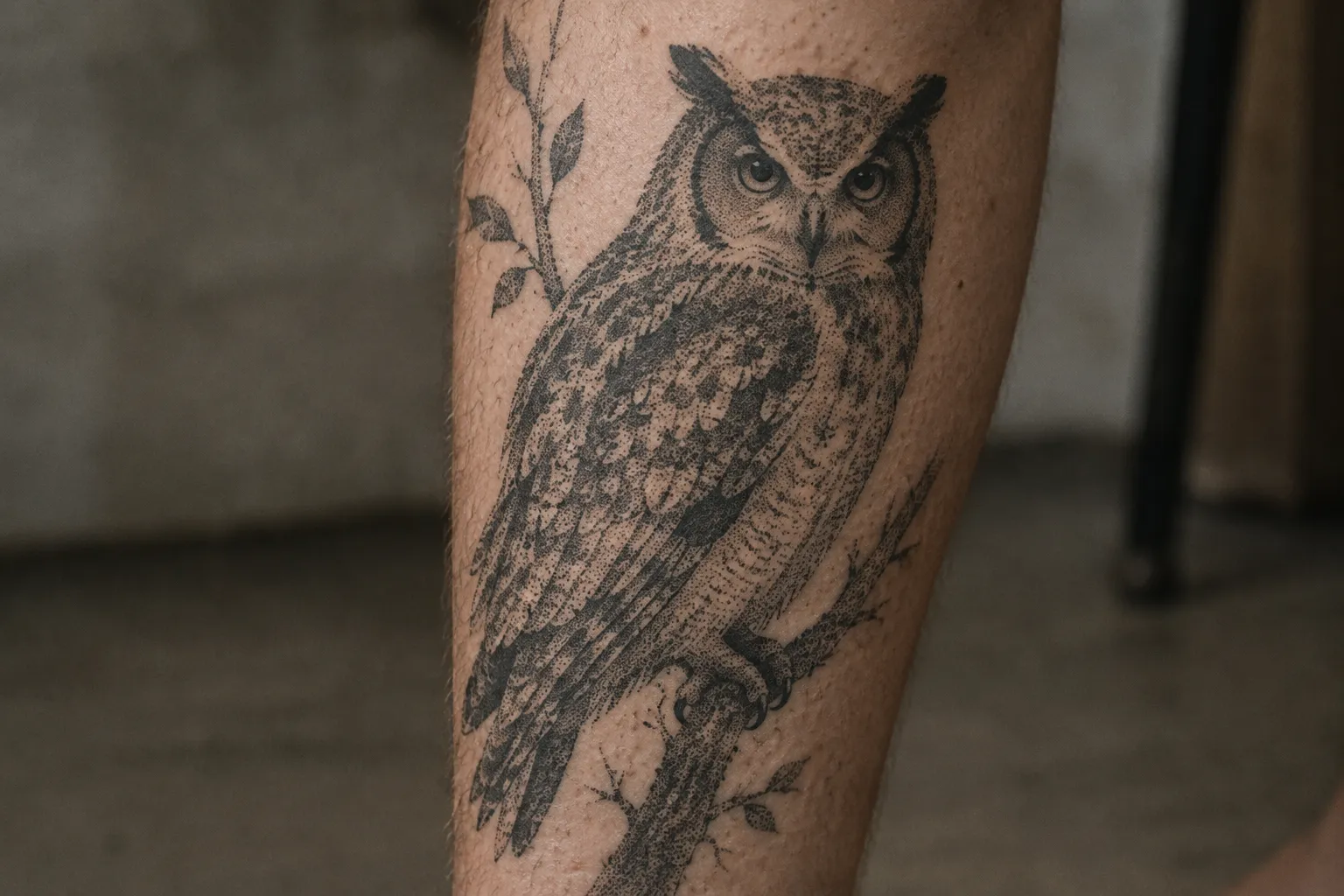
The best placement for an owl is the one that gives your chosen detail level enough room. That means small silhouettes on the wrist, forearm or ankle and portraits on the chest, shoulder or upper arm (4), with full compositions on the back or thigh (1). Ask to see the stencil at its real size on the real spot before committing.
Small and Discreet: Wrist, Forearm, Ankle
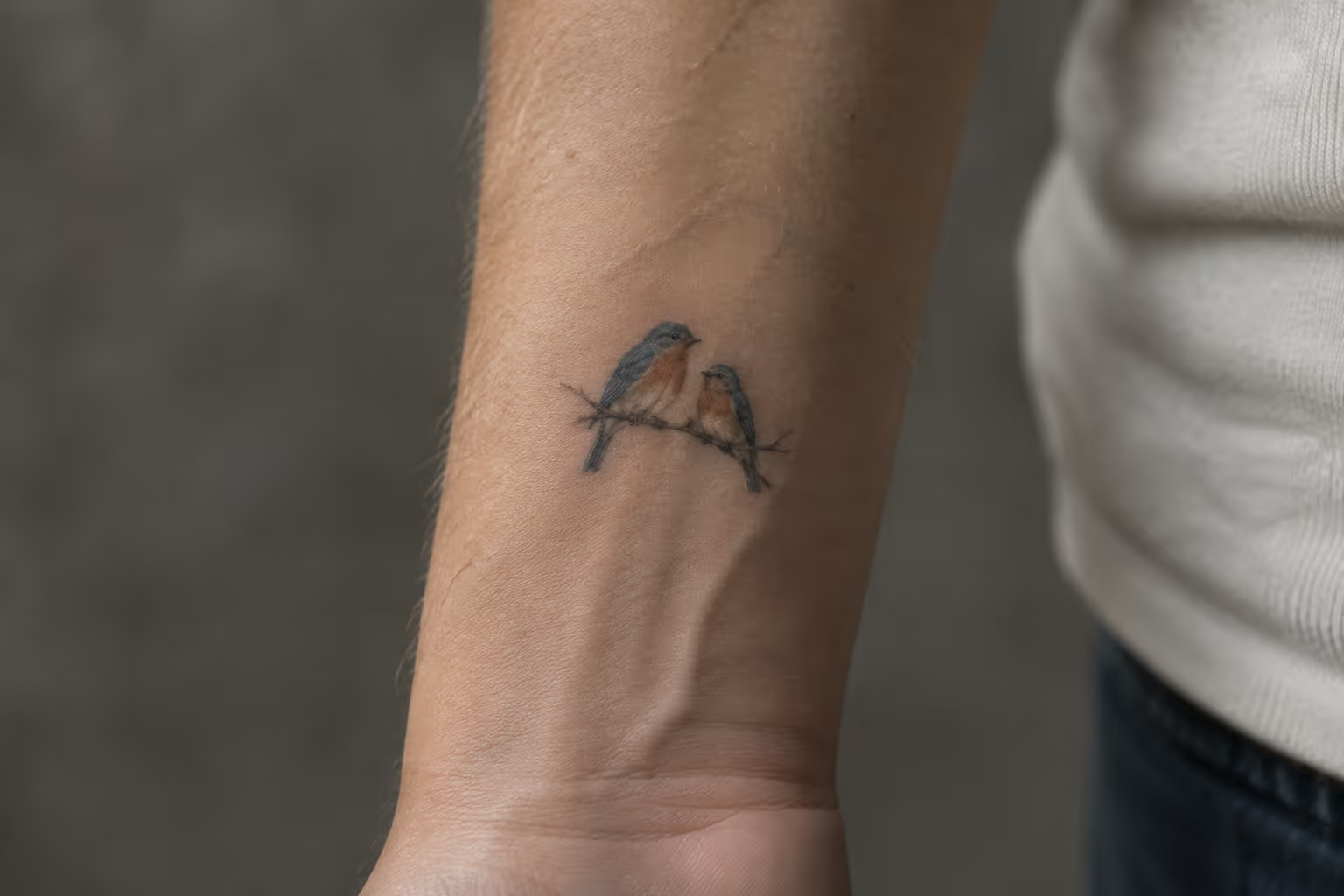
A simplified owl or owl face suits the wrist, inner forearm or ankle for a discreet piece (4). Keep it to a bold outline, two solid eyes and a clear facial disc shape. Detailed eyes, feathers and facial markings need more space to stay readable, so go simple when the spot is compact (4). Fine lines soften faster over skin that moves: on the forearm they hold, on knuckles or feet they blur (1). The wrist moves constantly and takes sun and friction, so keep fine grey detail there to a minimum.
On pain, the outer forearm and outer ankle are on the milder end. The inner wrist and the ankle bone sting more because there is little padding over bone.
Portrait-Ready: Chest, Shoulder, Upper Arm
Chest, shoulder and upper arm give you room to feature the owl’s forward-facing eyes and round facial disc (4). Plan on 2-4 sessions for a realistic portrait (1). The sternum is the natural spot for a symmetrical owl face (1), but it hurts more than the shoulder or outer arm: sternum and ribcage > upper arm > outer forearm. Pain over bony midline spots also varies a lot from person to person.
The outer upper arm is the easiest portrait spot to sit for, and it heals flat without much stretching.
Large Compositions: Back and Thigh
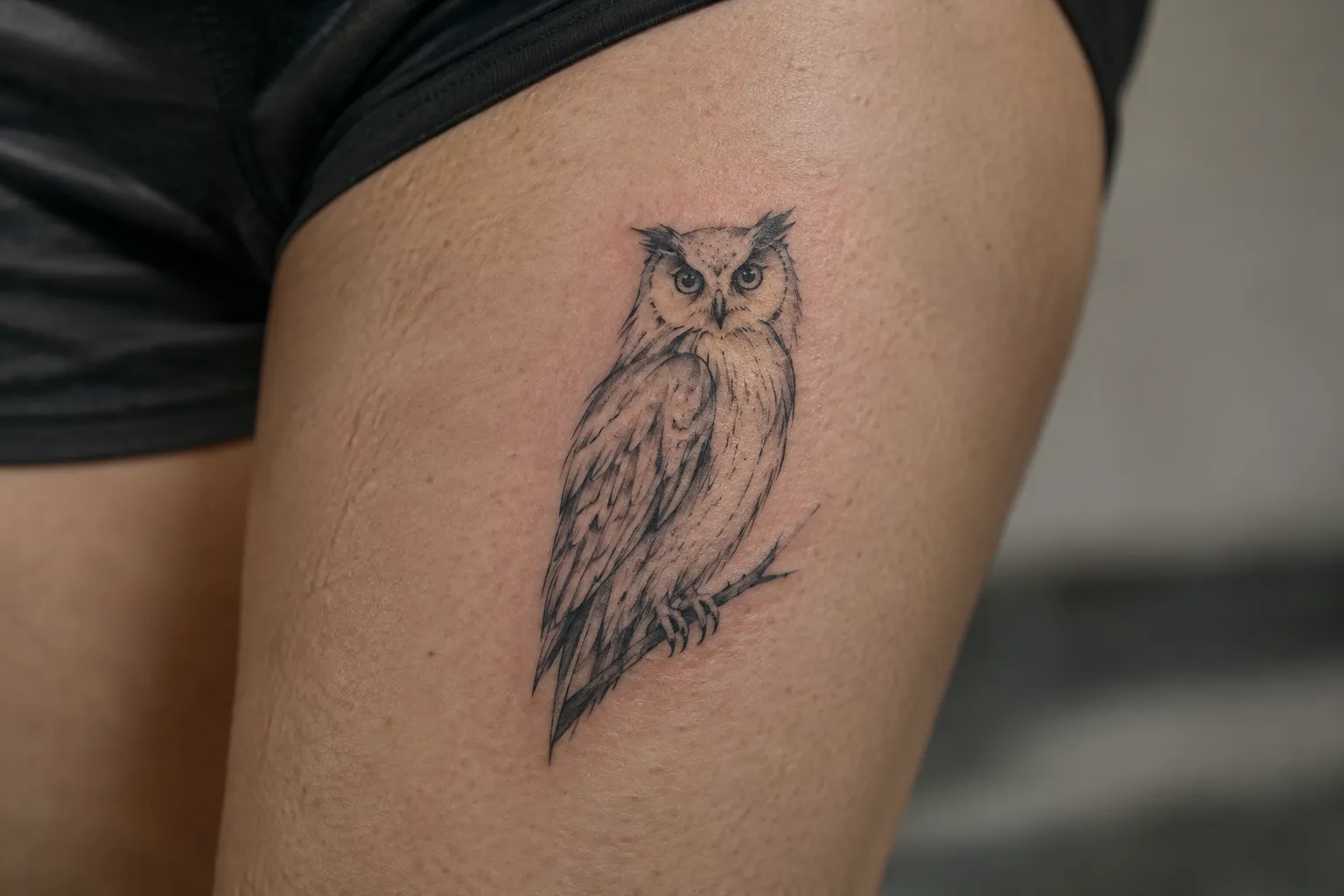
A thigh or back panel fits a large, detailed owl, while the back and chest are the only places a full wingspan fits (1). Budget 4-8 sessions for a back panel or full-thigh composition (1). A full back supports a 12-14 inch (30-36 cm) wingspan (1). That is enough width for wings, a moon and branches without crowding the face. Spine and shoulder blades hurt more than the fleshy outer thigh.
What Pairs Well with an Owl: Complementary Tattoo Elements
The elements that pair best with an owl are moons and night skies, branches and florals, and skulls or clocks. Each one pushes the piece toward a specific reading.
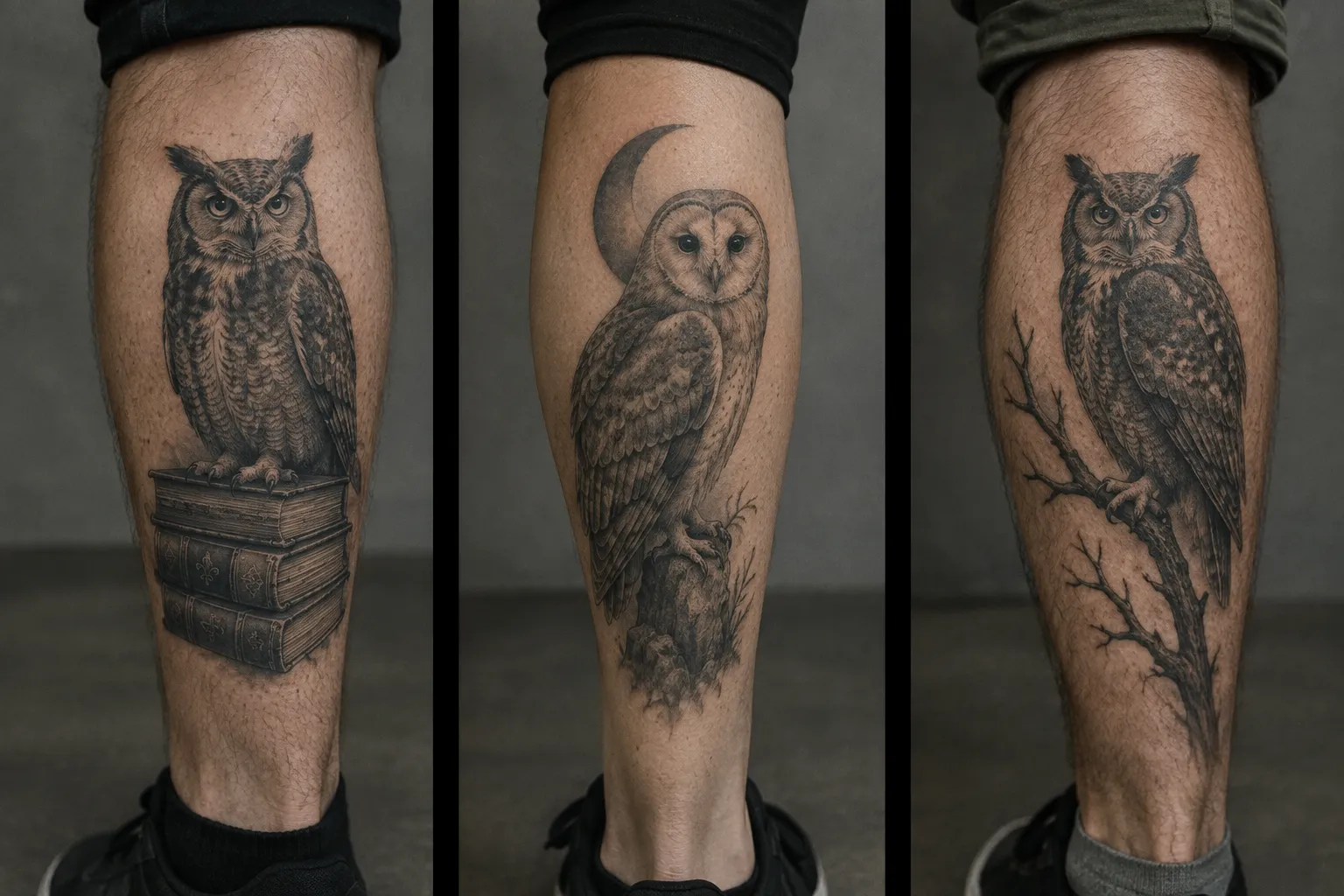
- Moon, stars and night sky: the standard night-owl setup. A crescent moon behind the head frames the face and makes the nocturnal theme obvious.
- Branches and florals: a branch gives a perched owl something to grip and adds a natural baseline. Florals soften the piece and pull it toward the day side. Peonies or cherry blossoms fit a Japanese-influenced layout.
- Books, keys or olive branches: anchor the Athena and wisdom reading.
- Skulls, clocks and hourglasses: the mystery, darkness and mortality route, drawing on the European death-and-omen tradition (4). A clock under a great horned owl reads as memento mori. The same owl beside peonies reads as a nature piece.
Added elements also add size. A perched owl sits comfortably at 5-8 inches (13-20 cm), while a perched composition with a full branch and foliage runs 8-10 inches (20-25 cm) (1). That can push it into a larger session bracket and onto a bigger placement. Plan the full composition before you pick the spot.
Ink Safety and Aftercare for Healed Owl Ink
Owl ink has two separate risk windows. The first is before the session, because the FDA says even sealed ink can be contaminated. The second is after healing, when UV light can fade the ink (2)(7).
Before the Session: Ink Questions Worth Asking
According to the FDA, unopened, sealed tattoo inks can still carry bacteria that cause infections. Infection risk can also come from non-sterile equipment or dilution water (2). Ask your tattooist to note the ink brand, color and lot or batch number of each ink used. If you develop an infection or reaction, the FDA advises asking for exactly those details, plus any diluent, so the ink can be identified (2). Your tattooist should also tell you how to care for the new tattoo and how long local discomfort may last (2).
For the healing itself, the week-by-week rules of our tattoo aftercare guide apply to owl pieces too:
- Days 1-3: keep the wrap on as long as your artist says, then wash gently with fragrance-free soap and apply a thin film of ointment, switching to a fragrance-free lotion around day 3. Some oozing and redness is expected.
- Days 4-7: the surface tightens and starts to flake. Don’t soak it in a bath, pool or the sea, and don’t pick at the flakes. Night-owl pieces with packed black may flake more visibly.
- Week 2: peeling and itching are normal; let the flakes come off in the shower.
- Weeks 3-4: the surface looks healed but the skin underneath is still remodeling, with full integration around week 6. Keep the tattoo out of direct sun for the first 4 to 6 weeks and cover it with sun-protective clothing while it heals.
Poor healing, a rash, redness, bumps or fever are reasons to contact a health professional. Report a suspected reaction to your tattooist too (2). If symptoms get worse, don’t wait it out.
After Healing: Sun Protection
The American Academy of Dermatology recommends broad-spectrum, water-resistant SPF 30+ on exposed healed tattoos. Apply it 15 minutes before going outside and reapply at least every 2 hours (7). This matters most for an owl’s fine details, since the eye highlights and feather lines are what you most want to keep sharp.
Frequently Asked Questions
- What does an owl tattoo signify?
- An owl tattoo can signal wisdom, protection, mystery or an omen; choose the cultural reference first, since the same bird carries different readings across traditions.
- What pairs well with an owl tattoo?
- Choose companion elements that clarify the intended reference: books or an olive branch for Athena, or a moon and shadow for a nocturnal mood.
- Where is the best place for an owl tattoo?
- The best placement is the spot that preserves the design's smallest defining features; test the stencil at final size before settling on a location.
- What does a night owl tattoo mean?
- A night owl can refer to a nocturnal lifestyle or suggest mystery, but "night owl" is a chosen mood rather than a separate fixed symbol.
- What owl tattoo design represents mystery?
- A shadowed owl with a partial moon can suggest mystery, while the specific species and accompanying symbols help distinguish secrecy from a death-omen reading.
- What owl tattoo design can represent darkness or death?
- A clock, hourglass or skull can steer an owl toward mortality, but that interpretation draws on European folk traditions rather than a universal owl meaning.
- How many sessions does an owl tattoo take?
- Session count follows the design's detail and shading demands; ask the artist to estimate from the finished-size stencil and planned color or blackwork.
- Is sealed tattoo ink guaranteed safe?
- No seal guarantees sterile ink; ask the artist to record the ink's manufacturer, color and batch so the product can be identified if a reaction occurs.
Choosing Your Owl
Start with the meaning you intend, whether that is Athena’s wisdom, the omen tradition or a nocturnal mood, then let the pose set the time and space. A 3-5 inch face-only owl usually takes one session and suits the inner forearm or sternum. A realistic portrait needs the chest, shoulder or upper arm and 2-4 sessions, as does a wings-spread owl on the chest or back. Full back panels and full-thigh compositions run 4-8 sessions (1). Ask for the ink batch details before the needle starts. Once the piece heals, protect it with SPF 30+ reapplied every 2 hours outdoors so the eyes and feather detail stay sharp (7).