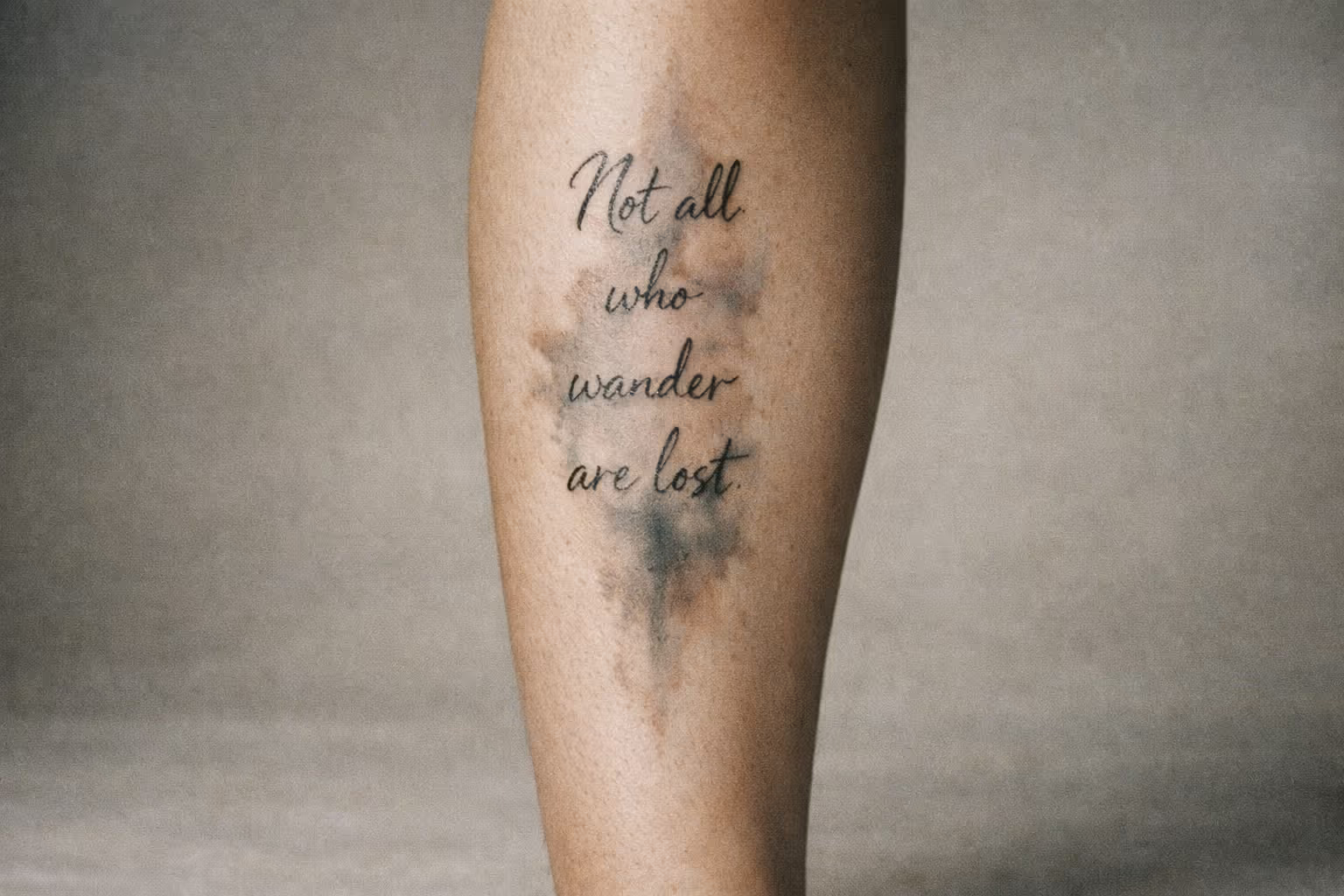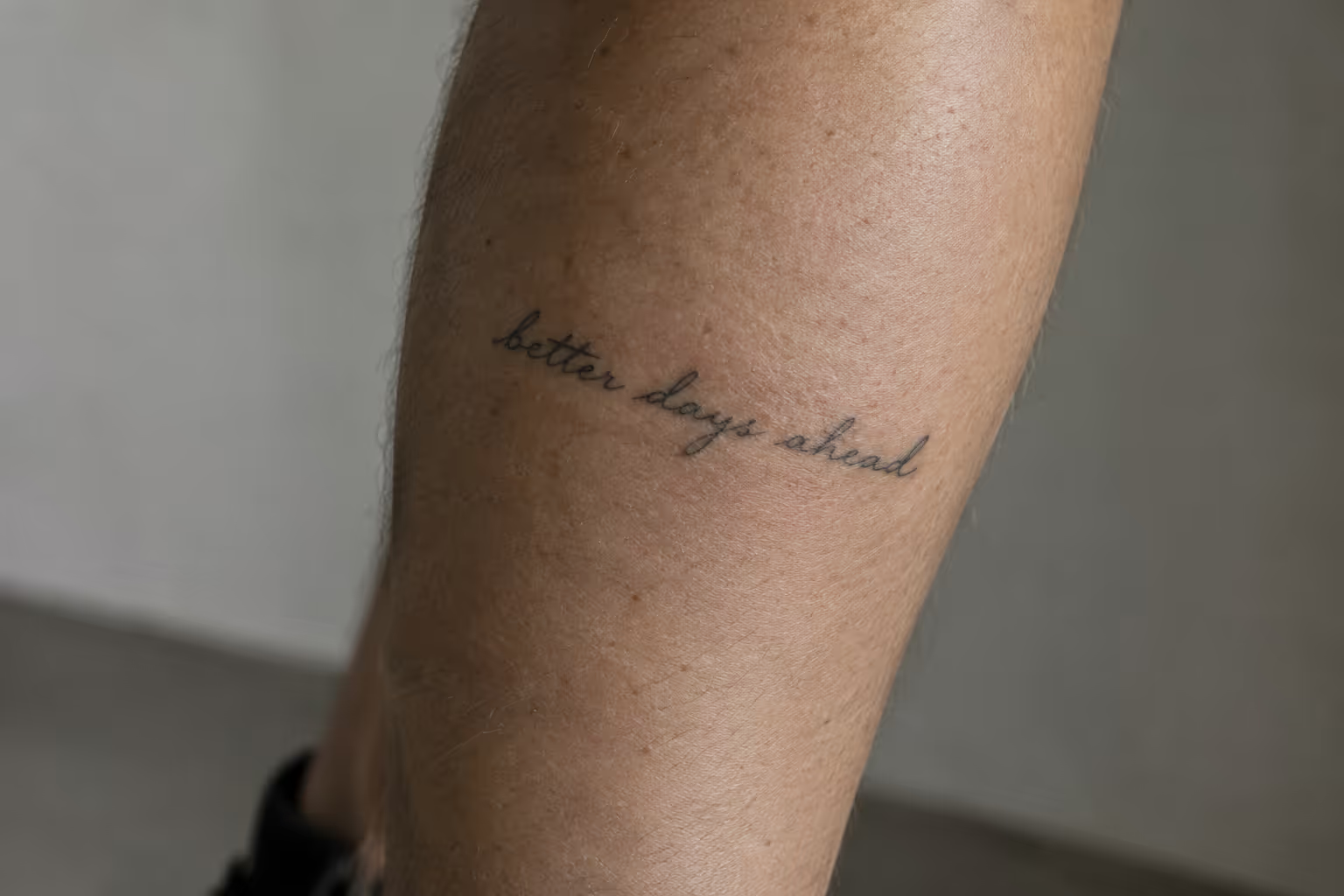
A handwriting tattoo reproduces a real person’s writing rather than a font: the drifting baseline, the heavier downstrokes, the loop someone always added to their capital M. That authenticity is also why it is harder to keep legible than a typeset quote. Yes, you can tattoo anyone’s handwriting, including your own. It works if you start from a clean sample, keep the text short, and size the letters for the placement you choose.
✓ Pros
- The original strokes preserve quirks a standard script font cannot reproduce.
- A short, familiar line can carry personal context without adding decorative elements.
✗ Cons
- Irregular letter spacing leaves less room for shrinking than a uniform typeface.
- Small edits to wording can change the balance of a traced design.
- A placement that works for one sample may not suit another person's handwriting.
The trade-off in brief: you get one-of-a-kind stroke detail and a design that carries real weight as a memorial. In exchange, the writing is harder to keep readable at small sizes, the fresh tattoo won’t look like the healed one, and wrong wording or a wrong size is hard to undo, since laser removal usually takes several treatments (1).
What handwritten lettering is, and how it differs from a script font
Handwriting is one branch of lettering tattoos, alongside script, gothic and serif styles (6). A handwritten tattoo traces an actual hand. A script font is a designed typeface that repeats every letter identically. In a font, each “a” matches the next. In handwriting, the letters vary, the line wanders off level, and pen pressure makes some strokes thicker than others.
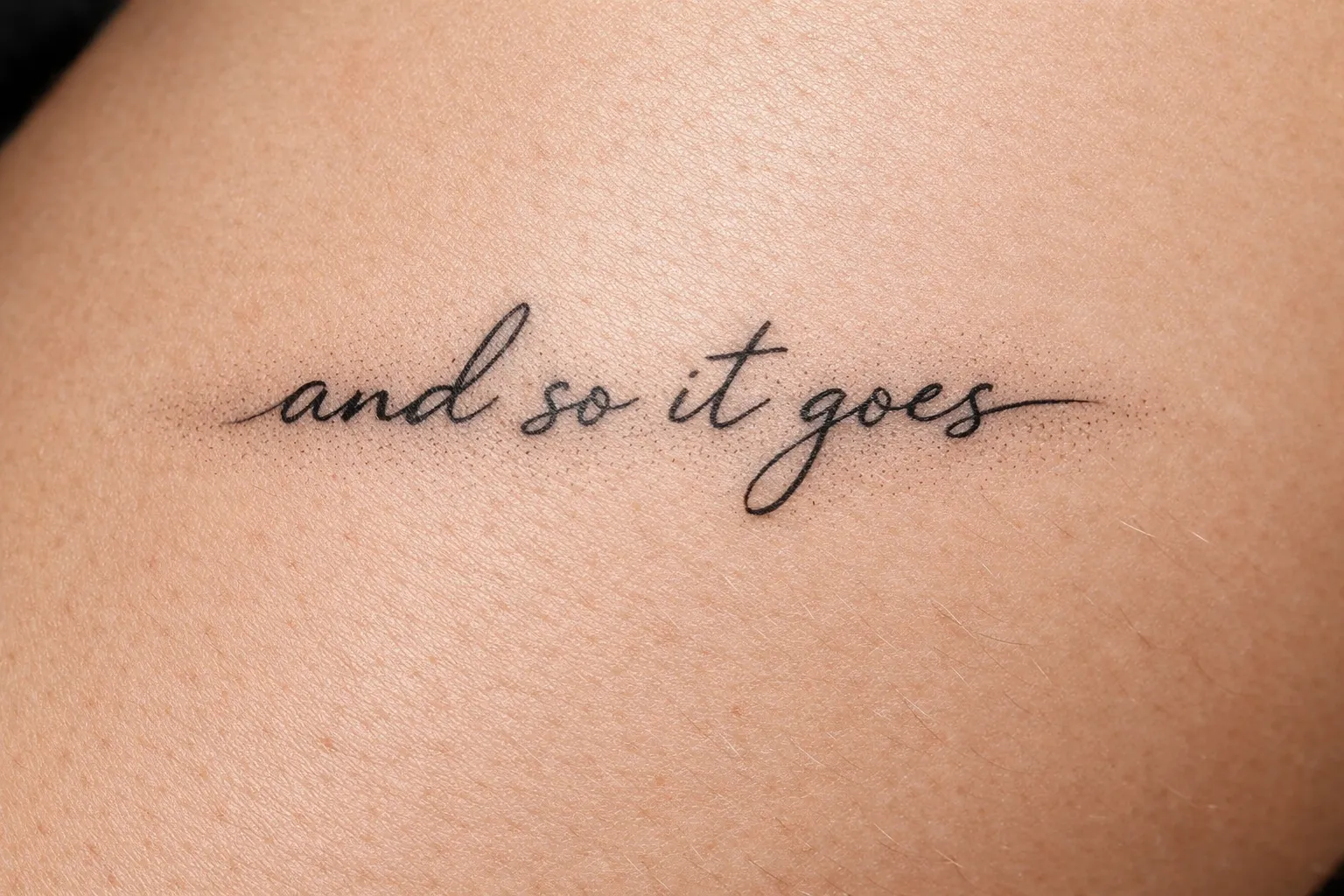
Those irregularities are the reason to choose handwriting in the first place, and they drive every later decision about size and placement. The usual sources are a signature, a note, a birthday card, or a recipe card (3)(5).
Memorial tattoos: sourcing and preparing the original writing
A memorial handwriting tattoo depends on the sample you give the artist more than on anything else. A blurry or angled photo forces the artist to guess at the strokes, and every guess moves the tattoo further from the person’s actual hand.
Getting a usable sample: card, letter, or photo
Cards, letters, recipe cards, even the note on the back of a photograph all work. Ask siblings, relatives, and old friends to check their drawers, because they often have cards you have never seen (3). Pick the example where the letters are the most distinct from each other, even if it isn’t the most sentimental one.
Photographing handwriting without losing pressure detail
The best option is a flat scan at 600 dpi (3). If you only have a phone, lay the paper on a table in indirect daylight, hold the camera parallel to the page, and turn the flash off. Flash flattens the pressure variation that makes the writing recognizable (3).
Tracing vs redrawing: what to tell the artist
Ask the artist to trace the sample rather than redraw it. If the baseline drift or shaky strokes matter to you, say so directly (3). Redrawing tends to tidy those features away. Before the first line goes in, check the stencil against the original in a mirror (3).
Prepare a handwriting sample for a tattoo
Prepare the source and check the design on your skin before the tattoo begins.
- 1
Gather the original writing
Look for a card, letter, recipe card, or photograph with distinct, readable letters.
- 2
Make a clear copy
Scan the page flat at 600 dpi, or photograph it in indirect daylight with the camera parallel to the page and the flash off.
- 3
Confirm the exact text
Lock the wording, punctuation, capitalization, and line breaks before the artist prepares the design.
- 4
Ask for a faithful trace
Tell the artist to trace rather than redraw, and point out any baseline drift or shaky strokes you want preserved.
- 5
Check the stencil on your body
View it at true size and reading direction on the intended placement before tattooing.
Handwriting tattoo ideas: choosing words and length
The safest handwriting tattoo ideas are short: a signature, one familiar word, or a brief line from a letter or recipe note (5). Short text lets each letter stay large enough to read at a given placement.
Signatures, single words, and short phrases
A signature is the classic choice. It is compact, instantly recognizable, and already built around one person’s habits. A single word like “love” or a nickname works the same way. An August 2026 cost guide puts a single word in a common script at the shop minimum of about $80-150 in most US cities, and a short clean-script quote on the wrist or ankle at about $150-300 (10). Custom-drawn lettering costs more, around $350-900 for a wrist or forearm piece (10), and some artists add a drawing fee to clean up a difficult sample (3), so treat those bands as a floor rather than a quote.
How long a quoted line can be before it stops reading well
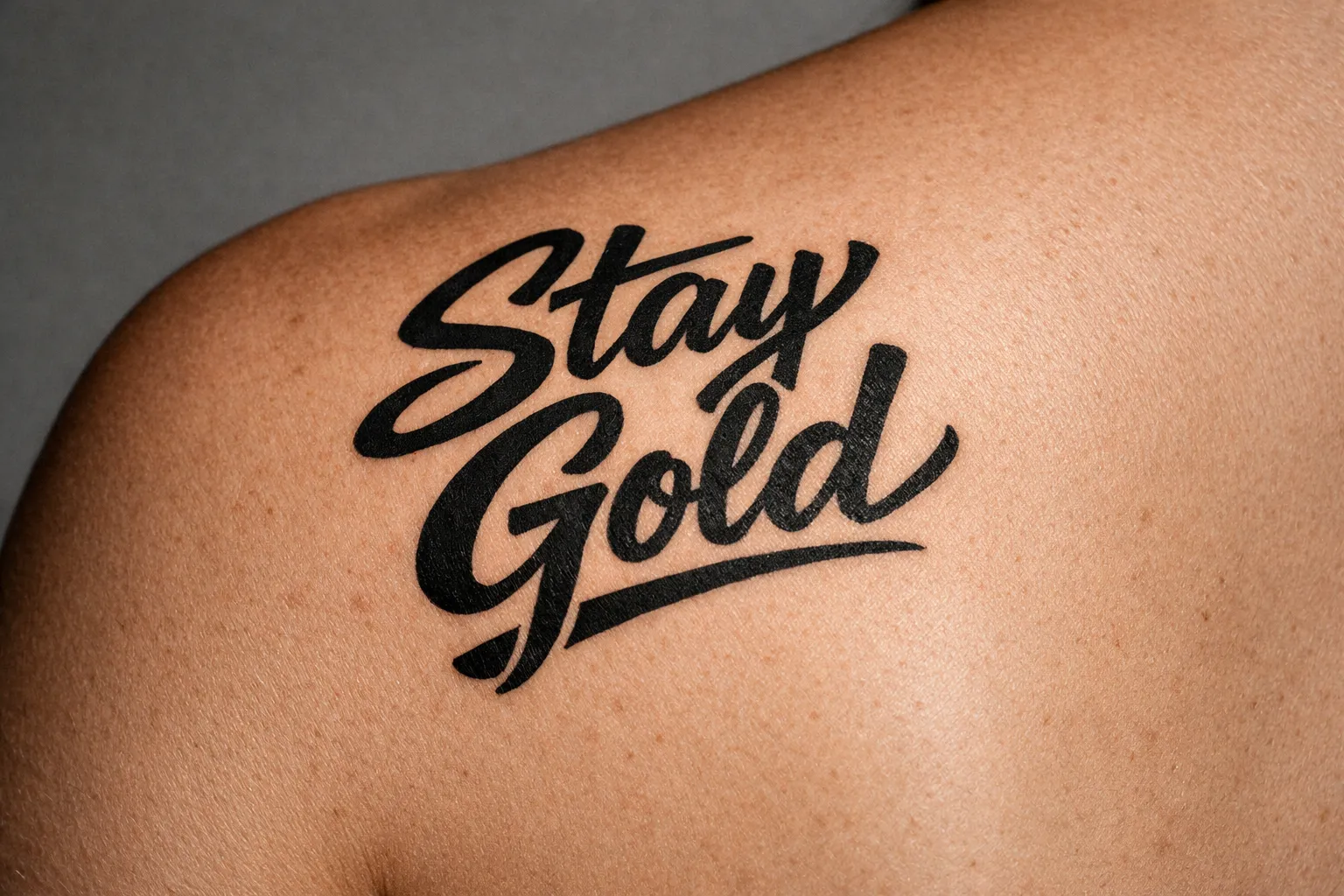
One memorial guide suggests keeping a quoted passage to five words or fewer (5). Longer lines need more skin, so a long quote belongs on the forearm, ribs, upper back or thigh rather than on the wrist (9).
Placement and letter size: what actually stays legible
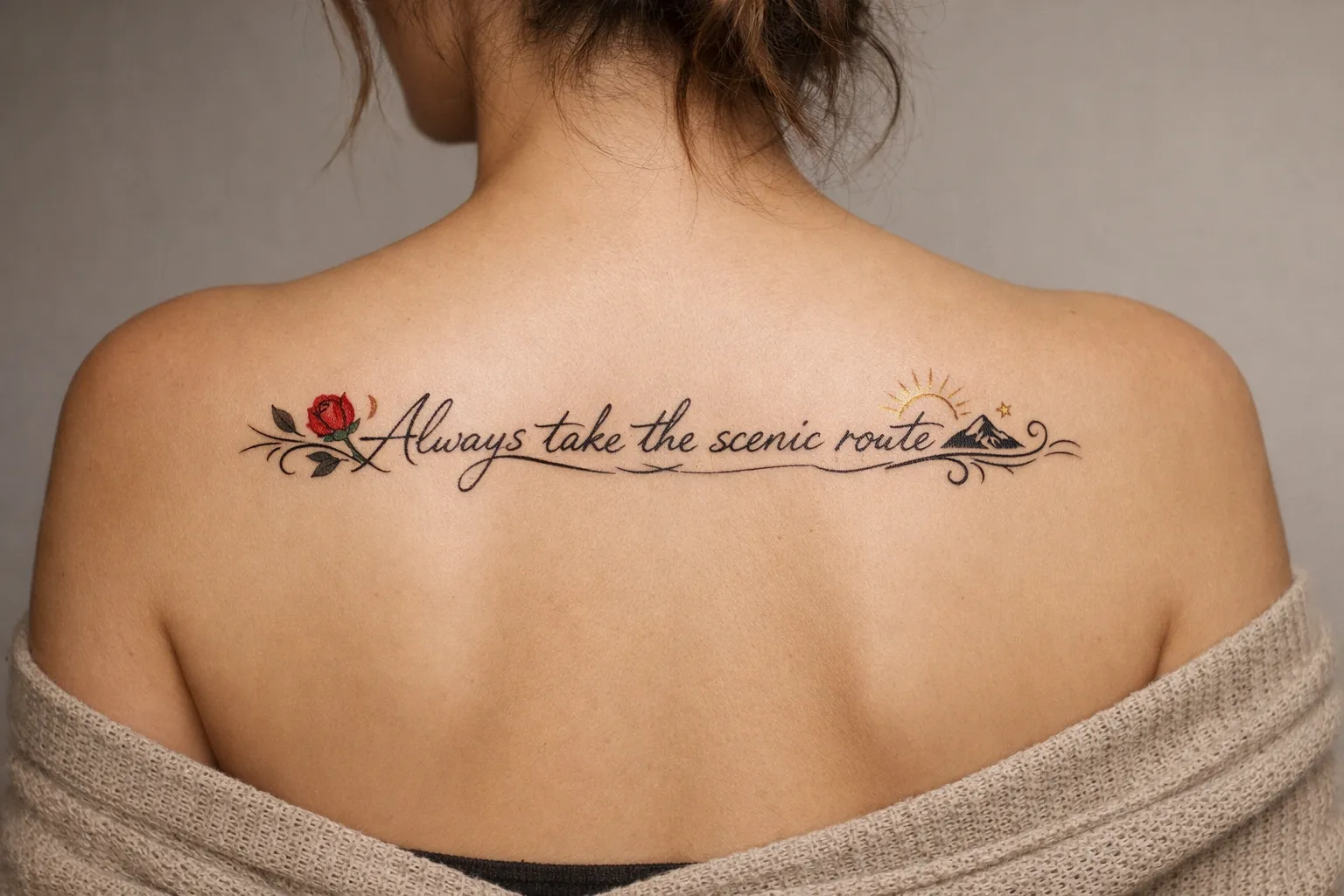
The inner forearm is the most reliable spot for a handwriting tattoo: it is flat, low-friction and rarely sun-exposed (8). Standard script there needs a letter height of at least 12 mm (1/2 in), and fine or ornate writing about 25 mm (1 in), the floors one tattoo artist sets for standard and fancy script (12). Letter height means the whole letter, from the top of the tallest stroke to the bottom of the lowest.
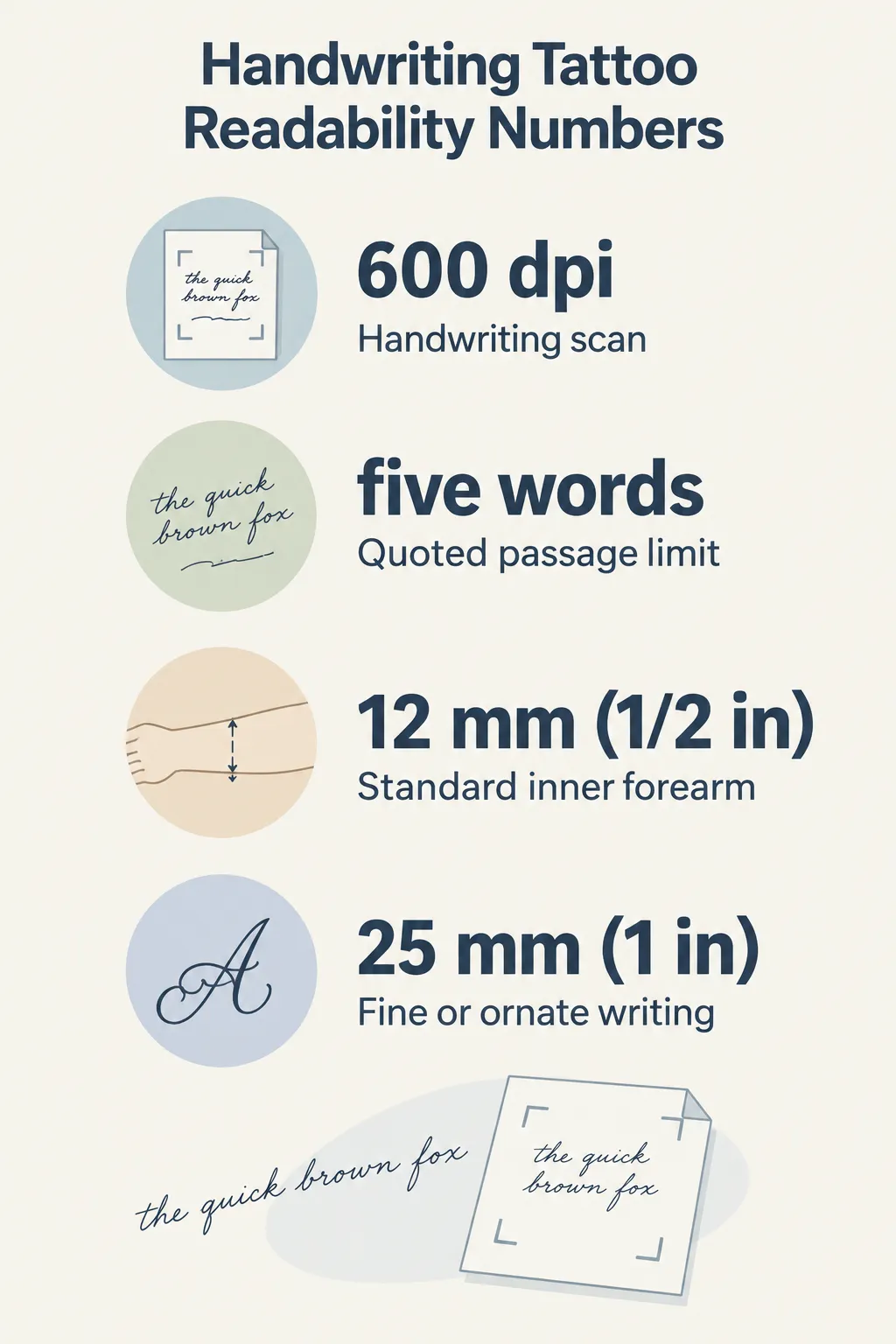 A 600 dpi scan, five words or fewer, and letters of 12 mm (1/2 in) for standard script or 25 mm (1 in) for fine or ornate writing.
Published guides disagree. One 2026 lettering guide sets its minimums by placement, from 6 mm on the forearm to 15 mm on the hand or foot for fine-line script (9). Another uses a much smaller measure, an x-height of about 2.8-4 mm, which covers only the body of the lowercase letters (8). Some of those figures fall below what I’d put on skin, so treat any printed number as a starting point. Shrinking intricate writing until the gaps close is how these tattoos fail, so ask the artist what size they recommend for your specific sample and placement (5)(9).
Forearm and wrist: where fine detail survives
A forearm can hold multi-line writing at the letter heights shown in the table below. The inner forearm and wrist are the most common memorial placements (5), but the wrist is narrow, flexes constantly and sees daily sun, which speeds fading (8). On the wrist, keep to a short word in bold script or block lettering. A thin, spidery signature there can soften into a grey smudge within a few years (3).
Hand and foot: bigger letters only
Hands and feet flex constantly, and on the hands the skin turns over fast, so fine lines soften there sooner than on the forearm (9). Hands and fingers fade and blur fastest, and some artists will not tattoo fine detail there (5). Only put a sample on the hand or foot if it is short enough to enlarge well beyond its forearm size and simplify. Intricate writing should stay on the forearm. The ribcage and ankle fall in between. The ribcage has room for a longer line (12) but, being bony, hurts more than the forearm (3). The ankle suits one or two words.
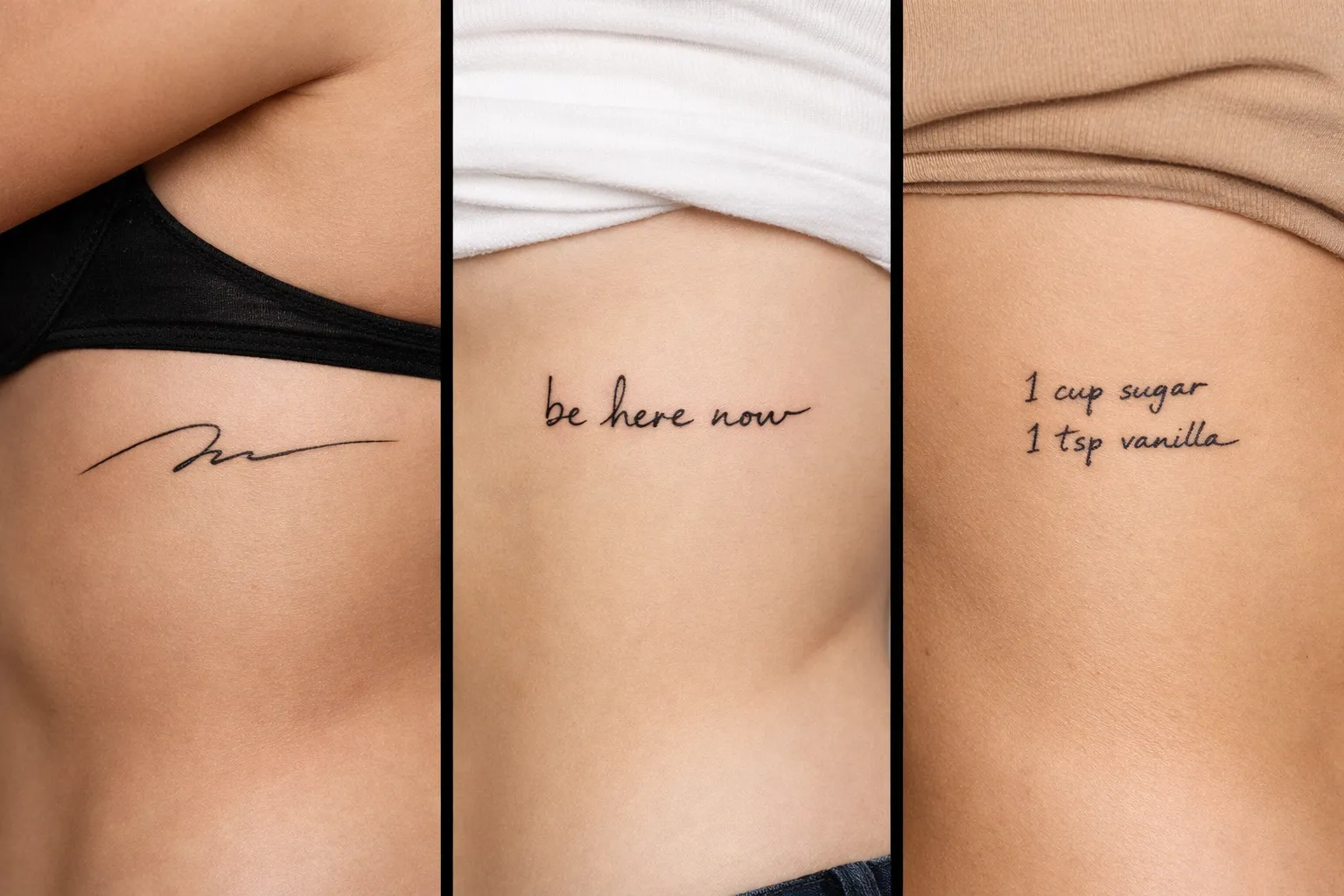
Whatever you choose, check the printed stencil on your body before tattooing. A design that looks balanced on a screen can read crooked once it wraps around a forearm (6).
Handwriting tattoo placements at a glance
| Forearm | Wrist | Hand | Foot | Ribcage | Ankle | |
|---|---|---|---|---|---|---|
| Suggested letter height | 12-25 mm (1/2-1 in) | Bold script or block lettering | Larger than on the forearm | Larger than on the forearm | Larger than on the forearm | Larger than on the forearm |
| Text that fits best | Multi-line text | A short word | Short, simplified text | Short, simplified text | A longer line | One or two words |
| Legibility risk over time | Lower when letters stay open and adequately sized | Higher for thin, spidery script | Higher because the skin flexes and turns over quickly | Higher because the skin flexes constantly | Between the forearm and the hand | Between the forearm and the hand |
| Pain or visibility note | More room than the wrist; less painful than the ribcage | Narrow; flexes and sees daily sun | High-wear, visible placement | High-wear placement | More painful than the forearm | Bony; easy to keep private |
Fading, blurring and removal: how long these tattoos last
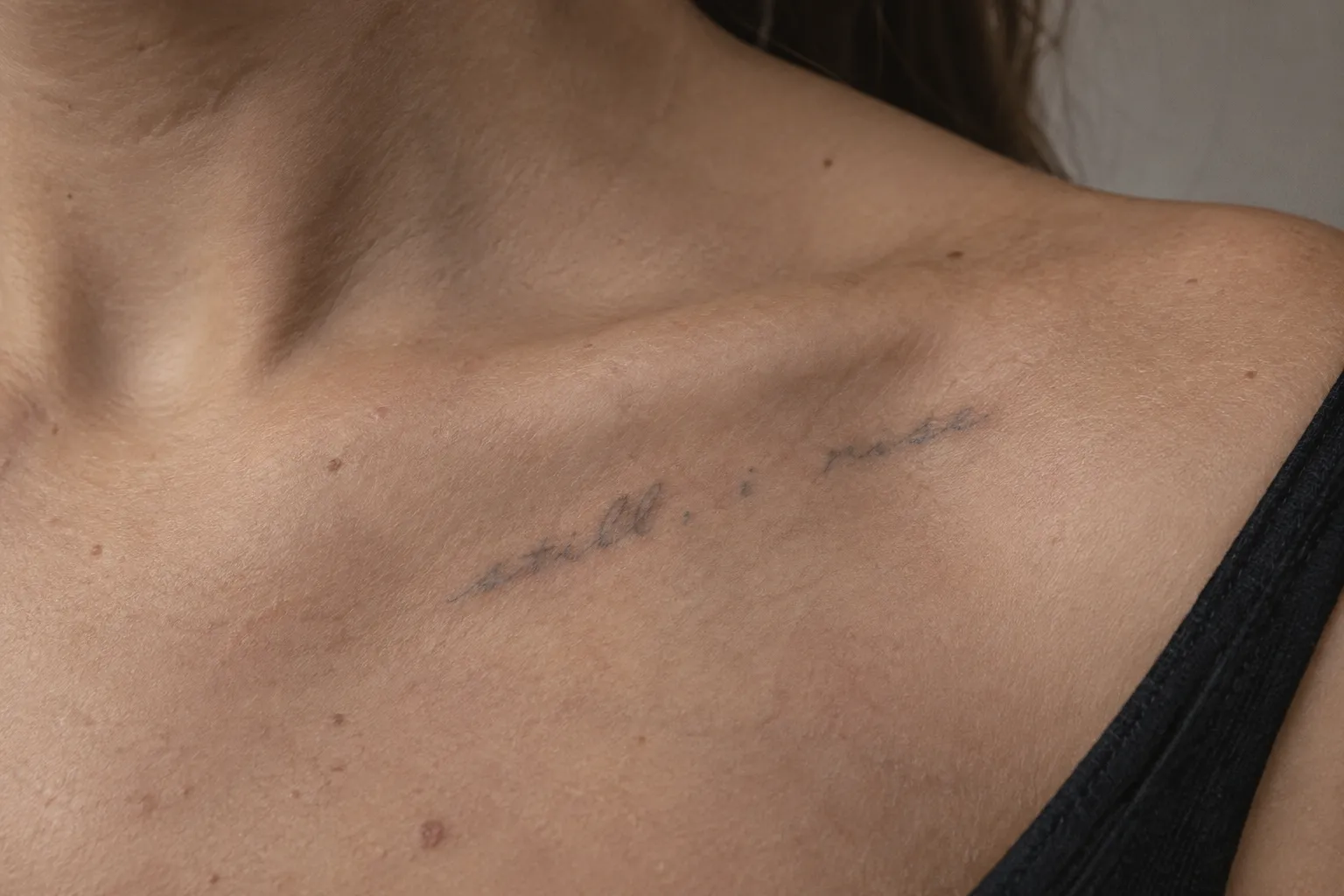
Handwriting tattoos last for decades, but they soften. The FDA notes that tattoos sometimes fade, and that pigment injected too deeply can migrate and look blurred (1). Thin, closely spaced handwriting shows that softening sooner than bold lettering does.
What a fresh tattoo doesn’t tell you
A crisp photo taken on the day of the session tells you little about how the tattoo will read in ten years. Ask to see the artist’s healed lettering at a comparable size and density (6). Healed work is the only real evidence of whether the letters stay open.
Healing care also helps keep the lines clean:
- Days 1-3: follow your artist’s washing instructions and keep the tattoo clean.
- Days 4-7: the skin tightens and starts to flake. Don’t scratch or pick the flakes, and switch to a thin layer of moisturizer (7).
- Week 2: peeling and itching. Keep your hands off it.
- Weeks 3-4: the surface looks healed, but the skin underneath is still settling; the lettering reaches its healed look around week 6.
- Sun: keep the tattoo out of direct sun for the first 4-6 weeks, covered by clothing, then use sunscreen whenever it is exposed.
- Warning signs: if redness or swelling persists after a few days, or you develop a fever or a rash, call a doctor (7).
The full week-by-week routine is in our tattoo aftercare guide.
Removal difficulty is the real durability test
According to the FDA, removal usually takes several treatments, can be expensive, and may not be complete without scarring (1). That changes the question. The durability worry is less about whether the tattoo lasts and more about getting the wording and size right before the needle touches skin.
Frequently Asked Questions
- Can an artist reproduce handwriting from a photograph rather than an original page?
- A clear, straight-on photograph can work when the original page is unavailable; ask the artist to flag any strokes the image does not show clearly.
- Will a handwriting tattoo look exactly like the original after healing?
- A healed tattoo cannot retain every fine difference in pen pressure; compare healed examples at similar letter size and spacing before choosing an artist.
- Can I use a note written in pencil or marker?
- Yes, if the sample is legible and the artist can distinguish its strokes; bring the original or a sharp scan so faint marks are not guessed at.
- Should punctuation and line breaks be included in a handwriting tattoo?
- Decide punctuation and line breaks before the design is traced, because changing them can alter the spacing and balance of the original writing.
- Can handwriting from a very old or damaged note still be used?
- It can be usable if the letters remain distinct; ask the artist to identify unreadable sections instead of filling them in from guesswork.
- What should I check in an artist's healed lettering portfolio?
- Look for healed script at a similar size and density, with the spaces between letters still open and the words readable at normal viewing distance.
Before You Book
Lock the source and the exact wording first. Then match the placement to how much text you are keeping: a signature or a single word can go almost anywhere, while a full line needs a forearm or more space. Ask to see the artist’s healed lettering at your size, and check the stencil on your body at true scale. Treat every published minimum, including the ones in this guide, as a floor to discuss with your artist rather than a guarantee.