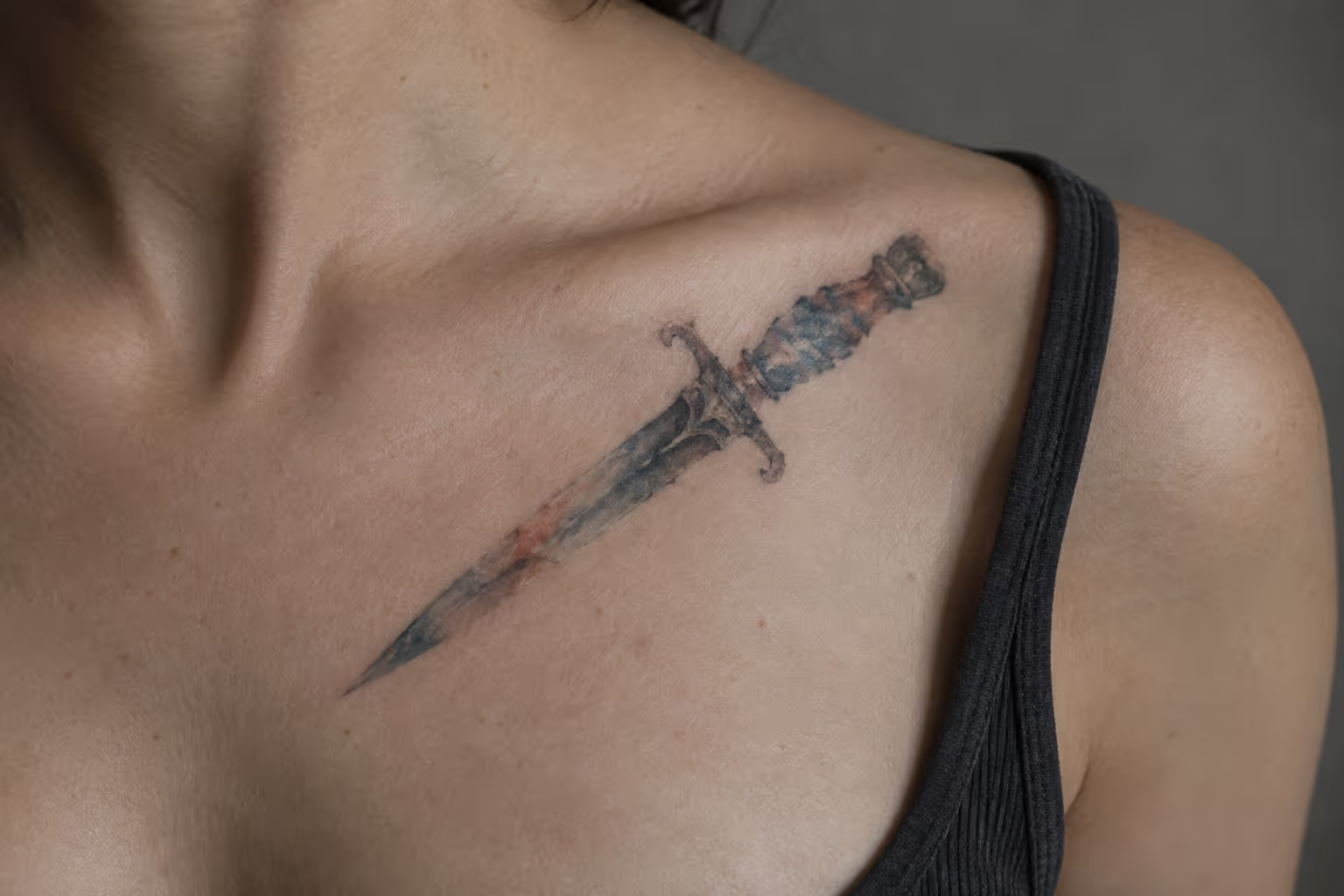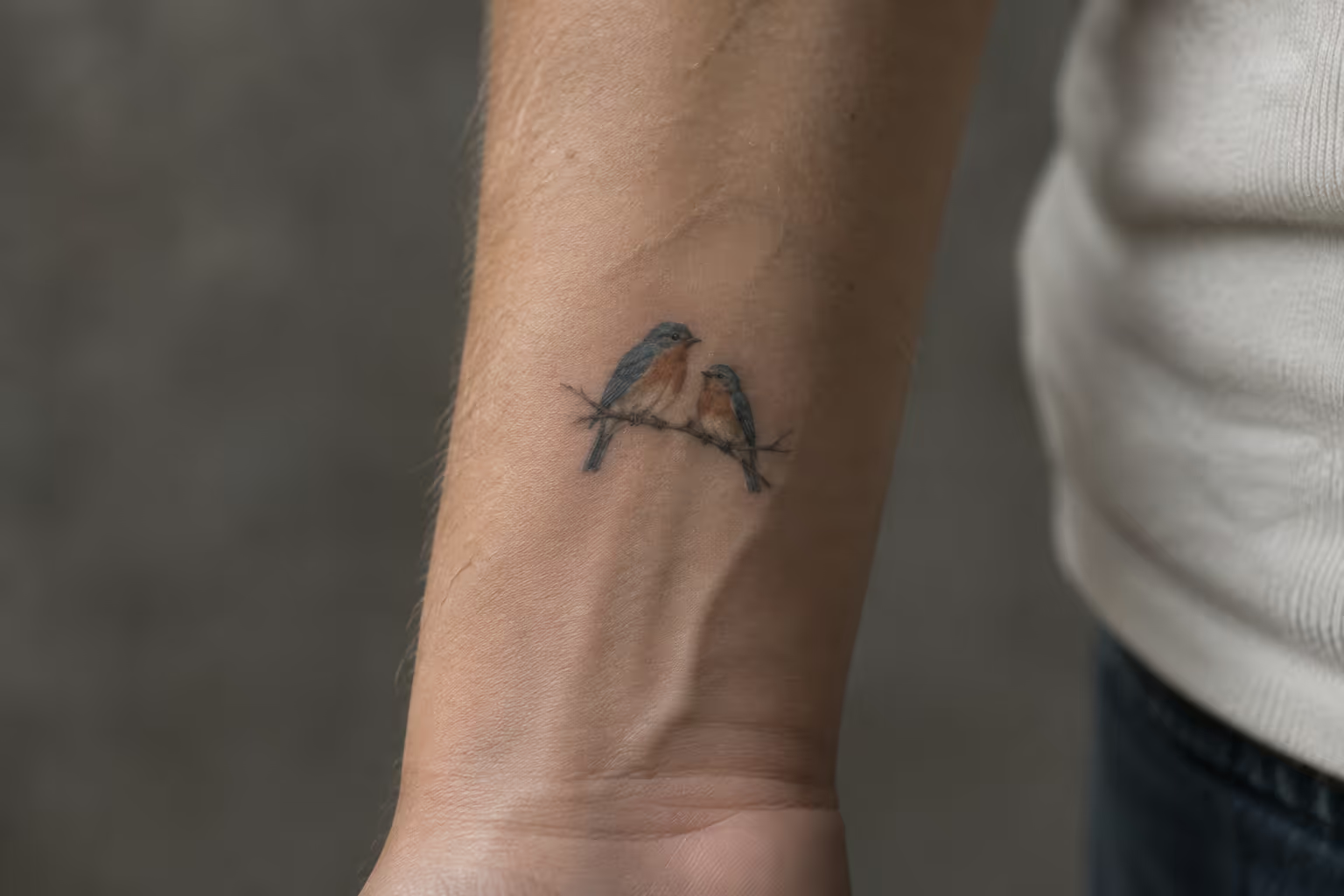
A father-daughter tattoo is either one identical symbol worn by two people or two different pieces that only make sense side by side, and you should settle which before anyone looks at a flash sheet. Most father daughter tattoos that age well start with that conversation, then a personal detail, then a placement that fits both of your lives. The image comes last.
✓ Pros
- A shared design can mark a family connection without requiring both tattoos to look identical.
- Choosing separate motifs lets each person keep their own visual style while sharing the appointment.
✗ Cons
- A paired image may feel incomplete when you see only one half on its own.
- Different preferences about visibility or style can make agreement harder than choosing a motif.
The upside is a shared ritual and a design that can be anything from a 1 in (2.5 cm) wrist dot to a full forearm piece. The downside is that two people commit to the same idea for decades, a symbol’s meaning is never universal, and a visible spot can be a problem at one person’s job even if it isn’t at the other’s.
Matching Father Daughter Tattoos vs. Complementary Designs: Making the Choice
Matching father daughter tattoos put the same design on both people, while complementary designs give each person a different piece that completes one shared concept (1). The structure you pick shapes everything after it: size, style, placement, and how the pair looks if one of you later adds more work around it.
Identical matching is the easy read. Same symbol, same size, and anyone who sees you together gets it instantly. The cost is that both of you are locked into one aesthetic. If your daughter likes delicate fine line and you’re used to bold American traditional with thick black outlines and a limited palette, someone compromises.
Complementary pairs solve that. Each half can be drawn in a slightly different line weight or scale and still read as a set. One tattoo guide’s advice is to pick the structure before you pick a subject (1).
Questions to settle before you book
Agree on these before the consultation, not in the chair:
- What the tattoo is about. A memory, a running joke, a place, a person you both lost.
- Identical or complementary. Decide the structure first (1).
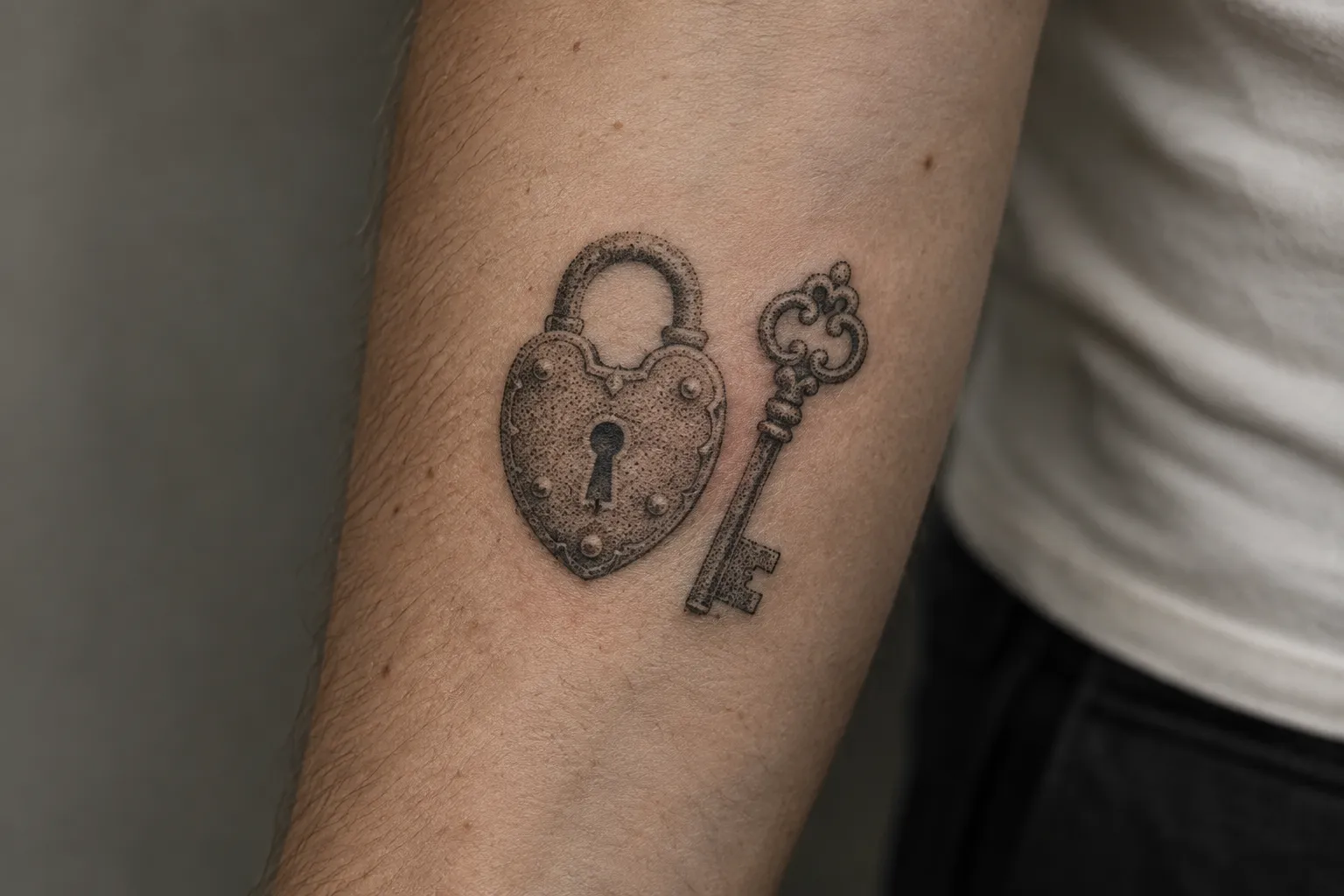
- Who wears which half. For a lock and key, decide who gets the lock and who gets the key before the stencil goes on (1). The usual arrangement gives the daughter the key and the father the lock, though some pairs reverse it on purpose (1).
- One style or two. Same artist and same linework, or each of you in your own preferred style.
- How visible each of you needs it to be. This decides placement more than the design does.
Example complementary pairs: sun/moon, lock/key, mountain/valley
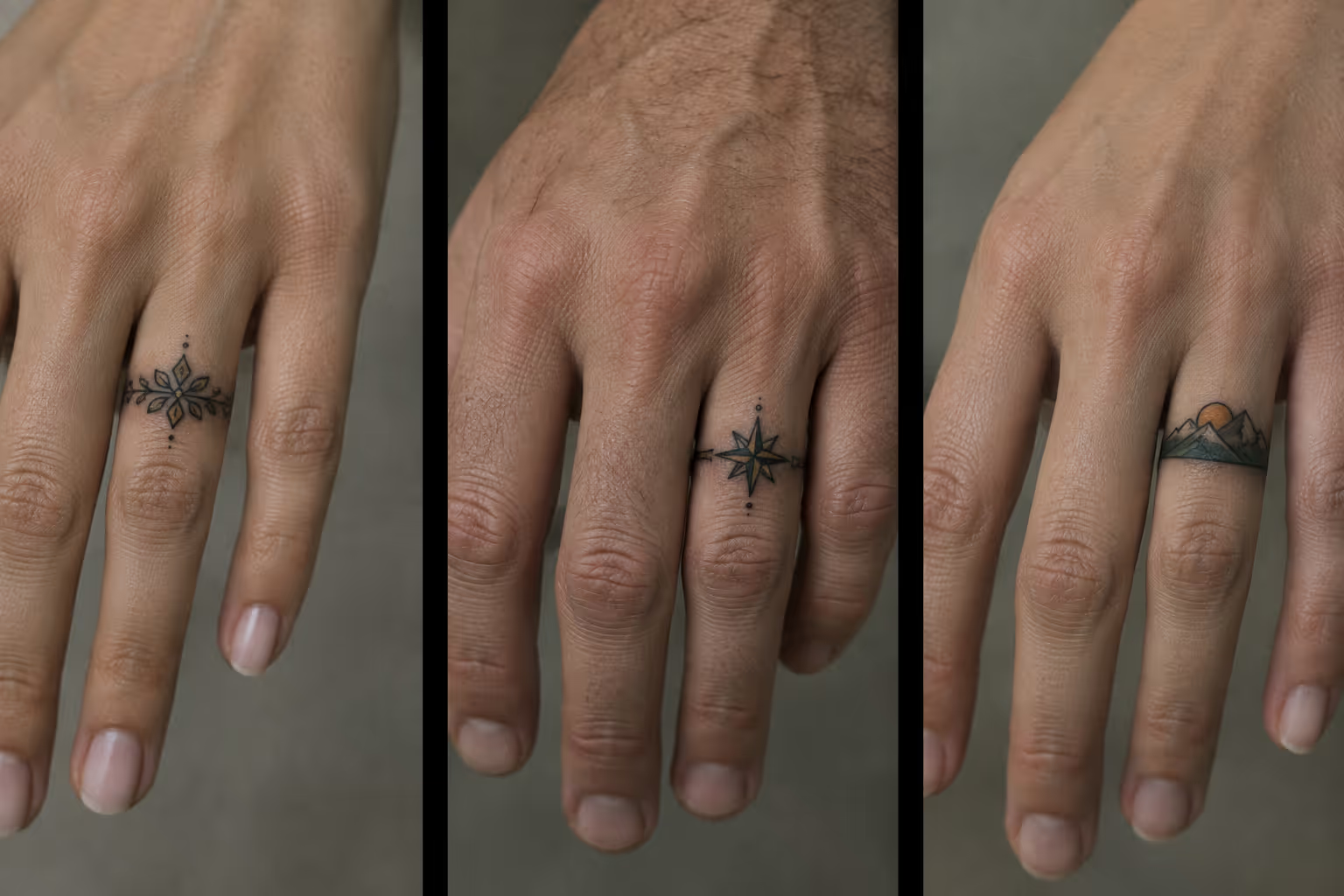
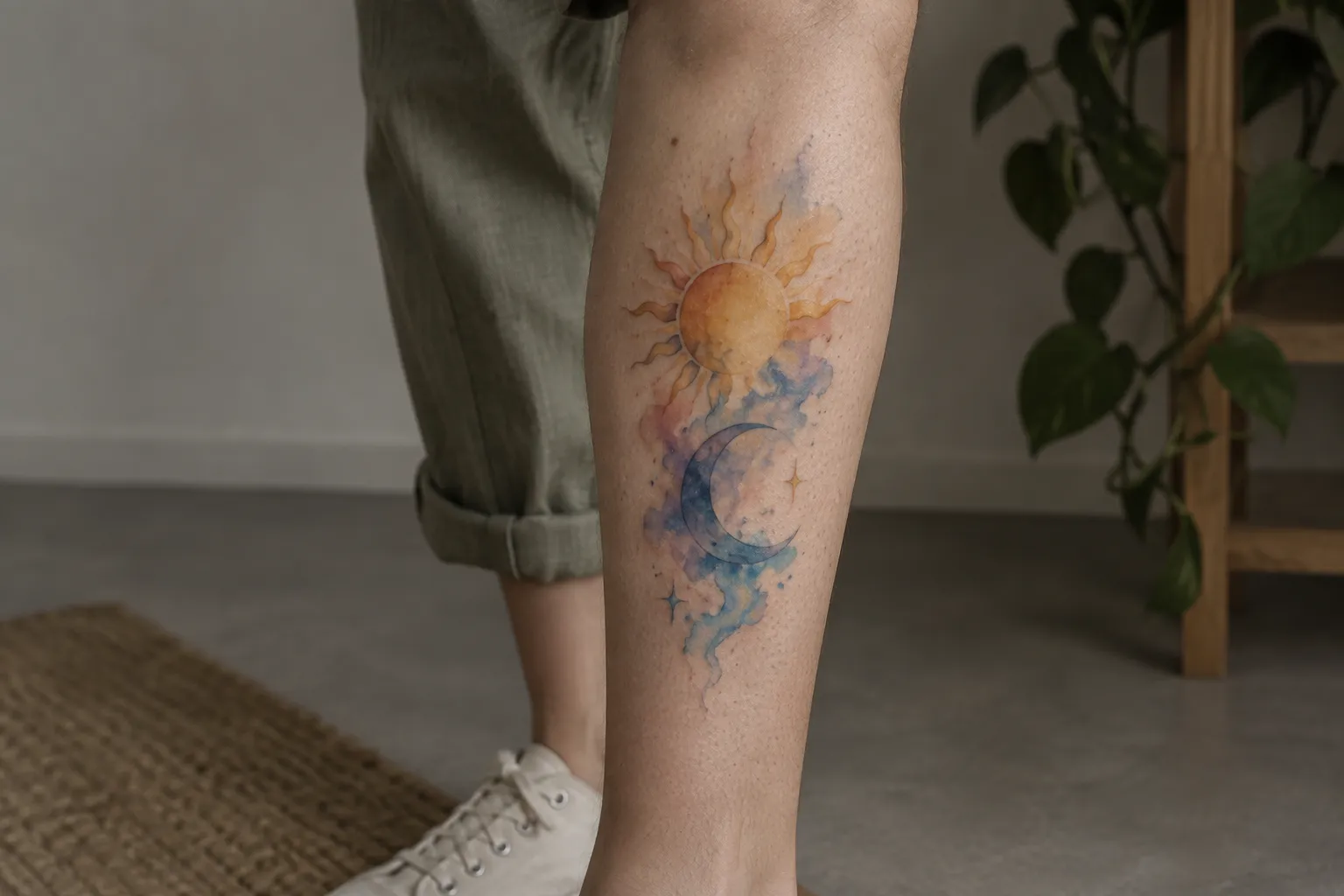
The classic complementary sets are sun and moon, lock and key, and mountain and valley; each tattoo differs but belongs to one concept (1). Sun and moon is the most forgiving because it works in almost any style, from fine line to traditional (1). For lock and key, a plain modern key holds up better at small sizes than the default ornate Victorian one (1). Mountain and valley works as two outlines that line up when you hold your forearms side by side, which means the artist has to match the horizon line height on both stencils.
Father Daughter Tattoo Ideas: Symbols With Real Meaning
There is no single official symbol for father and daughter; the shared symbols that work best are simple ones tied to a story only the two of you know. One current collection lists 21 father daughter tattoo ideas, including paired sun and moon, a compass, lock and key, coordinates, handwriting, birth flowers, arrows, shared animals, and a date in Roman numerals (1).
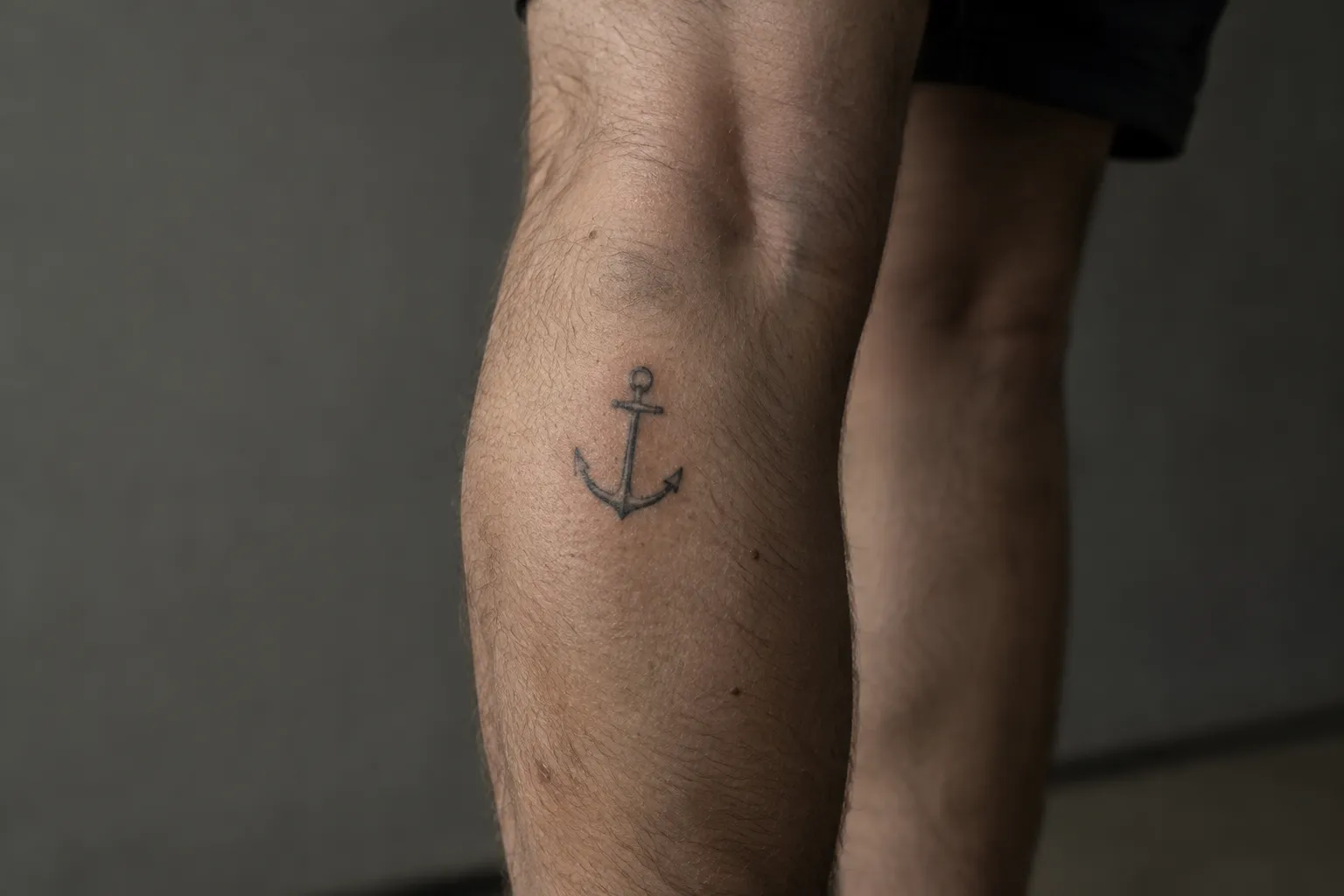
The caveat matters more than the list. Don’t assume a symbol carries one fixed meaning for every family. One guide’s advice is to pick an animal with a real connection, such as the one from the family cabin, rather than one chosen for its listed symbolism (1). An anchor means “stability” on a list post. On your arm, it should mean the boat you two fixed up, or nothing at all.
Simple shared symbols: anchor, bird, letter
For a discreet set, one guide suggests a single small identical mark, such as a star, a triangle or a single word, placed somewhere different on each person (1). An anchor, a bird or an initial works the same way.
- Anchor: comes out of sailor tattooing and the American traditional style, where it read as steadiness and hope. Modern Western idea pages now mostly frame it as “you keep me grounded,” which is a newer gloss.
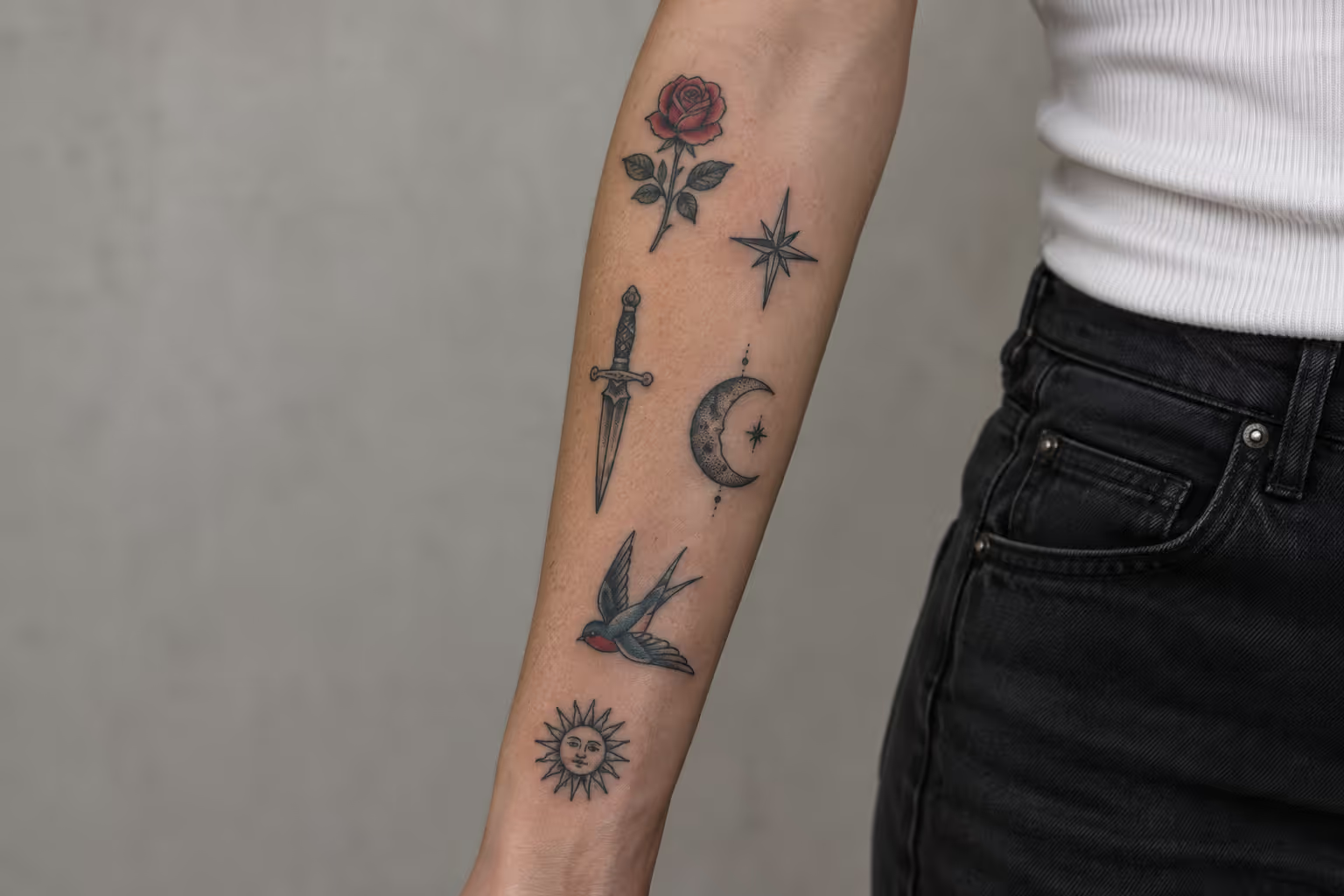
- Bird: the swallow is the American traditional version, historically a sailor’s mark tied to making it home. A small fine-line bird has drifted toward a looser “freedom” meaning in current Western tattoo culture.
- Letter: an initial is the most private option. A single block capital holds at 1/4 in (6 mm) letter height minimum, though 1/2 in (12 mm) or more ages better.
Keep any of these small: one guide’s working rule is that two to three inches ages better, costs less and hurts less than a large piece (1).
Sun and moon as a paired symbol
Sun and moon pairs show up across many cultures, so there’s no single tradition to borrow a meaning from. The usual reading on Western idea pages is “two people who are different but belong to one sky.” Decide between you which one each person is and why, and ask for the two drawings to share a line weight and a diameter so they read as a set when your arms are side by side (1).
Themed Designs Dad-and-Daughter Duos Keep Choosing
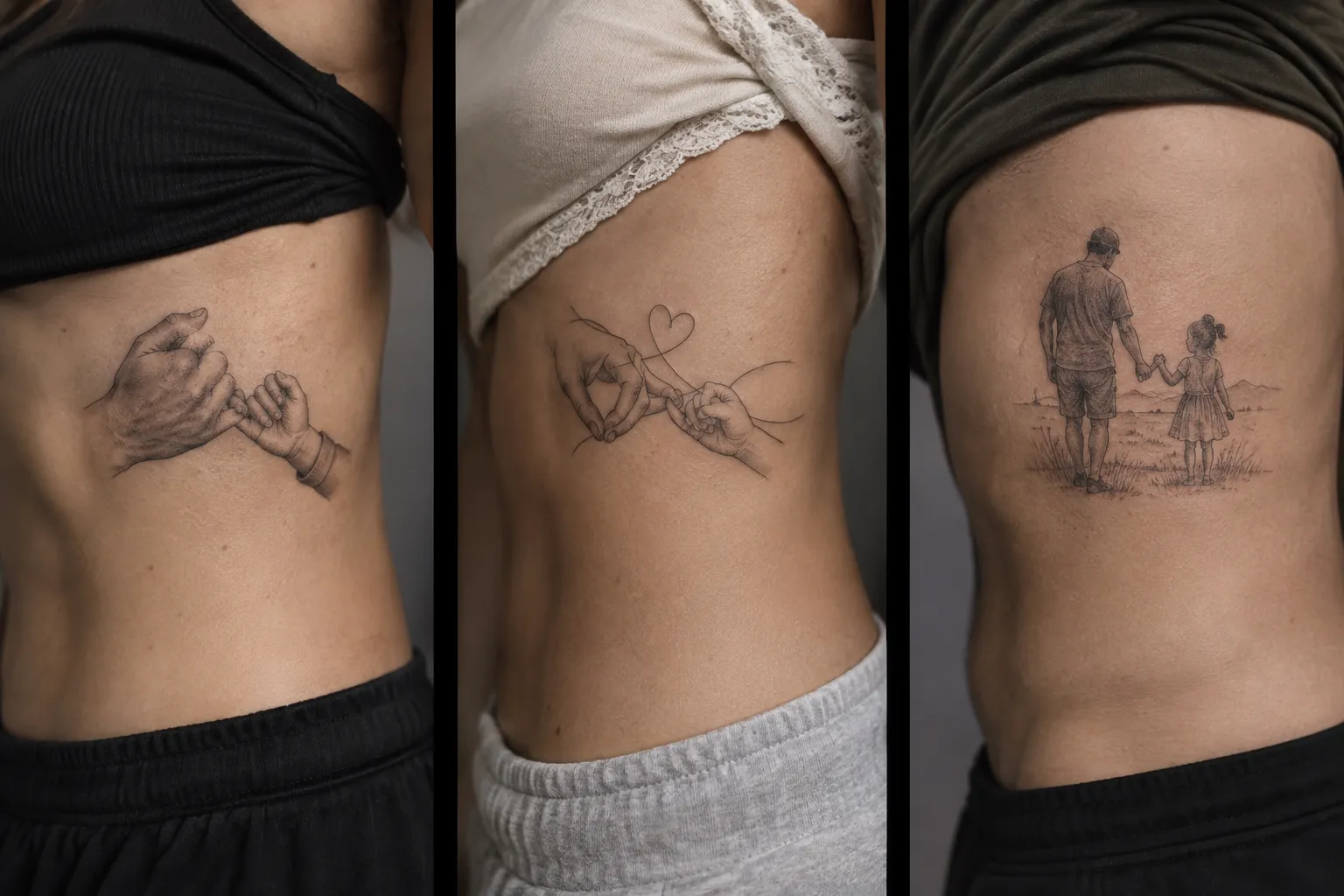
Five themed motifs come up again and again in father-daughter idea collections: pinky promises, shared photographs, sea turtles, triangles and Celtic knots (3). Only some of them carry an established cultural meaning. Know which is which before you commit.
Pinky promise and sea turtle motifs
The pinky promise is two hooked little fingers, usually done as a single-line drawing. The pinky swear is commonly traced to the Japanese yubikiri promise custom, but in Western tattooing it reads as a plain, modern “I promised and I kept it.” It’s one of the better complementary options: each of you wears one hand, and the two link when you stand together. Each half suits the outer wrist or forearm.
The sea turtle has a real cultural root. The honu appears in Hawaiian and wider Polynesian tattooing, with meanings that vary by island tradition: navigation, long life, and finding your way back. Western idea lists usually flatten that to “family” or “coming home.” If neither of you has a link to Polynesian culture, a Polynesian-style turtle built from traditional patterning is worth a frank talk with your artist; a realistic or line-art turtle avoids that question. The calf or shoulder blade gives it room.
Triangle bond symbol: the idea pages’ interpretation, not an established meaning
Two overlapping triangles are presented on idea pages as a father-daughter bond symbol, with two triangles described as representing stability (3)(6). Those are the pages’ own interpretations, not a recognized meaning from any tattoo tradition. If you like the geometry, get it, but don’t expect anyone else to decode it, and decide what it means to the two of you. Clean geometric linework needs a steady hand; a triangle that’s slightly off-true is very noticeable at small sizes.
Celtic knots and shared-photograph line art
Celtic knots appear as a design category in father-daughter idea collections, but that coverage doesn’t establish a specific father-daughter meaning (11). The interlace itself comes from early medieval Insular art, the manuscript and stone-carving tradition of Ireland and Britain. The “no beginning, no end, unbreakable bond” reading is largely a modern Western interpretation layered on later. Knotwork needs room, because the gaps between strands close as ink settles, so give it the upper arm or shoulder rather than a wrist.
A photograph of the two of you can be the starting point for a simple line drawing (10). Bring the photo, and ask the artist to trace silhouettes only: outline of a small hand in a large one, two figures on a beach. Faces don’t survive at line-art scale. The inner forearm or calf gives the drawing room. If you want each of you in your own frame, mirrored or parallel placement on matching arms works well (2).
Dad and Daughter Tattoos Made Personal: Fingerprints, Handwriting, Names
The most personal dad and daughter tattoos replace a universal symbol with a detail no one else has, such as a fingerprint, handwriting, a shared place’s coordinates, or a birth flower (1). Each of those needs some prep before the session.
Fingerprints: take an ink print before you book
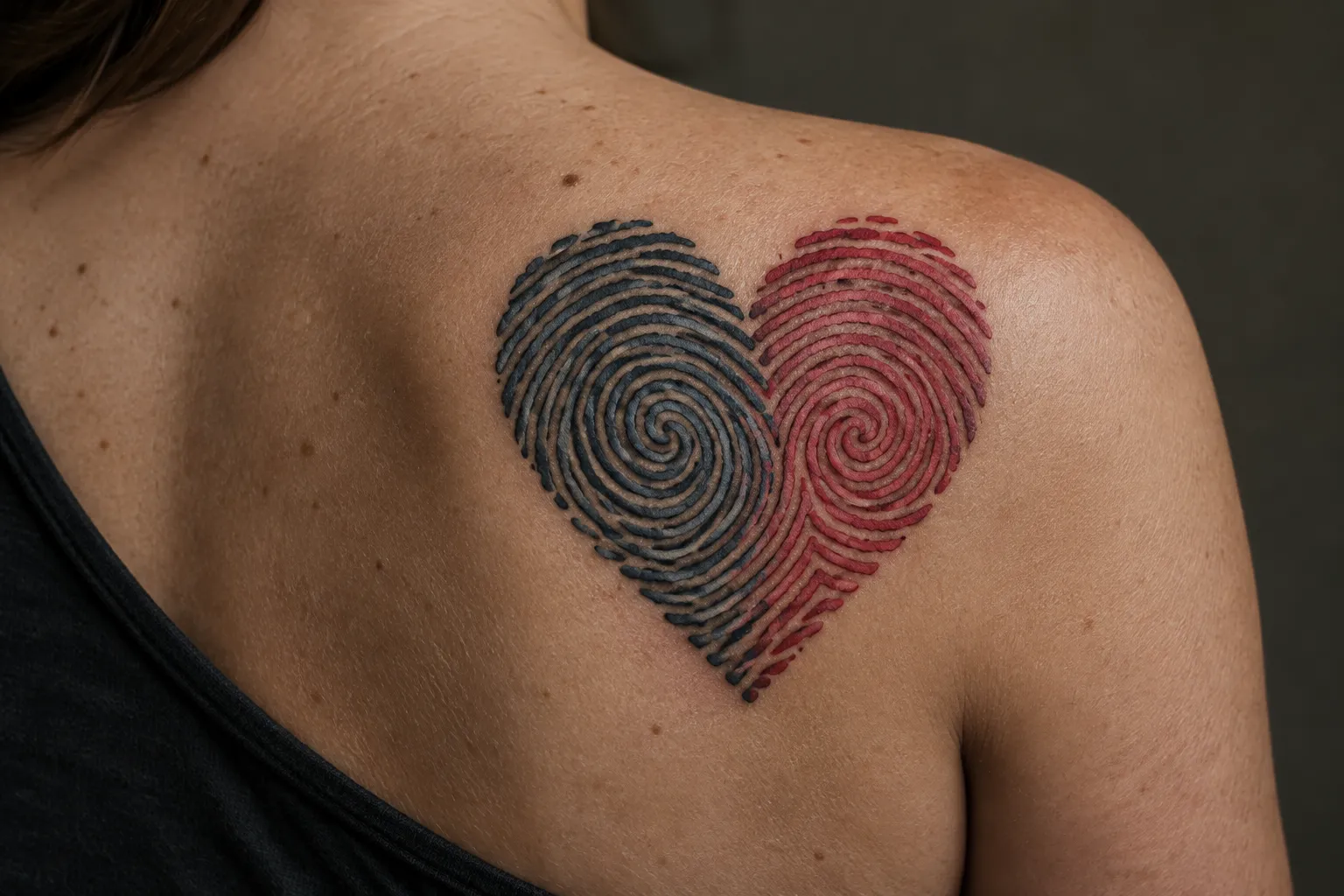
For a fingerprint design, take the print before you book, not at the shop: ink pad, plain paper, several attempts, and the cleanest one goes to the artist (1). Expect the artist to simplify it. The ridges of a literal print sit so close together that they blur within a few years, so experienced artists keep the overall whorl recognizable with fewer ridges and wider gaps (1). A fingerprint shaped into a heart (one print from each of you) is a common complementary version.
Handwriting, coordinates and birth flowers
Handwriting makes the tattoo about the person’s actual mark, not only the words: each of you wears a word written by the other (1). Write the word ten or fifteen times with a fine black pen on white paper, at roughly the size you want it tattooed, rather than writing it large and shrinking it (1). Handwriting is thin and irregular, so size it like fine script.
For coordinates, use a location meaningful to both of you, such as a home or a place you kept going back to (1). Check the numbers against a map in the exact format you’re tattooing, because degrees-minutes-seconds and decimal degrees aren’t interchangeable (1).
Birth flowers give each person a different flower in a matching style, a straightforward complementary set. Some shrink better than others: larkspur and holly stay legible at about an inch, while narcissus and marigold carry many overlapping petals (1). On pain, the forearm is comparatively easy and the ribs are not (1).
Sizing a name or quote so it holds up healed
Yes, you can get your daughter’s name tattooed; the thing that ruins it is size. Lettering is measured as letter height, the full height of a capital, and our tattoo font guide uses the same working floors as most tattooers:
- Standard script: at least 1/2 in (12 mm).
- Fine, ornate or handwritten script: about 1 in (25 mm).
- Block, serif, typewriter and numerals (coordinates, Roman numeral dates): at least 1/4 in (6 mm), roughly half the standard script floor, because their bolder strokes stay open at smaller sizes.
On the wrist, only bold script or block lettering holds. Thin script there blurs as the skin moves and ages. A name in fine script fits better along the inner forearm, where 1 in (25 mm) letters have room.
Placement Options: Visible Wrists and Forearms vs. Coverable Spots
Choose the inner forearm or wrist if the tattoo should be seen every day (2), and the ankle, calf, inner bicep or shoulder if it needs to stay covered for work (1)(2). Design size narrows the list further.
Visible: forearm and wrist
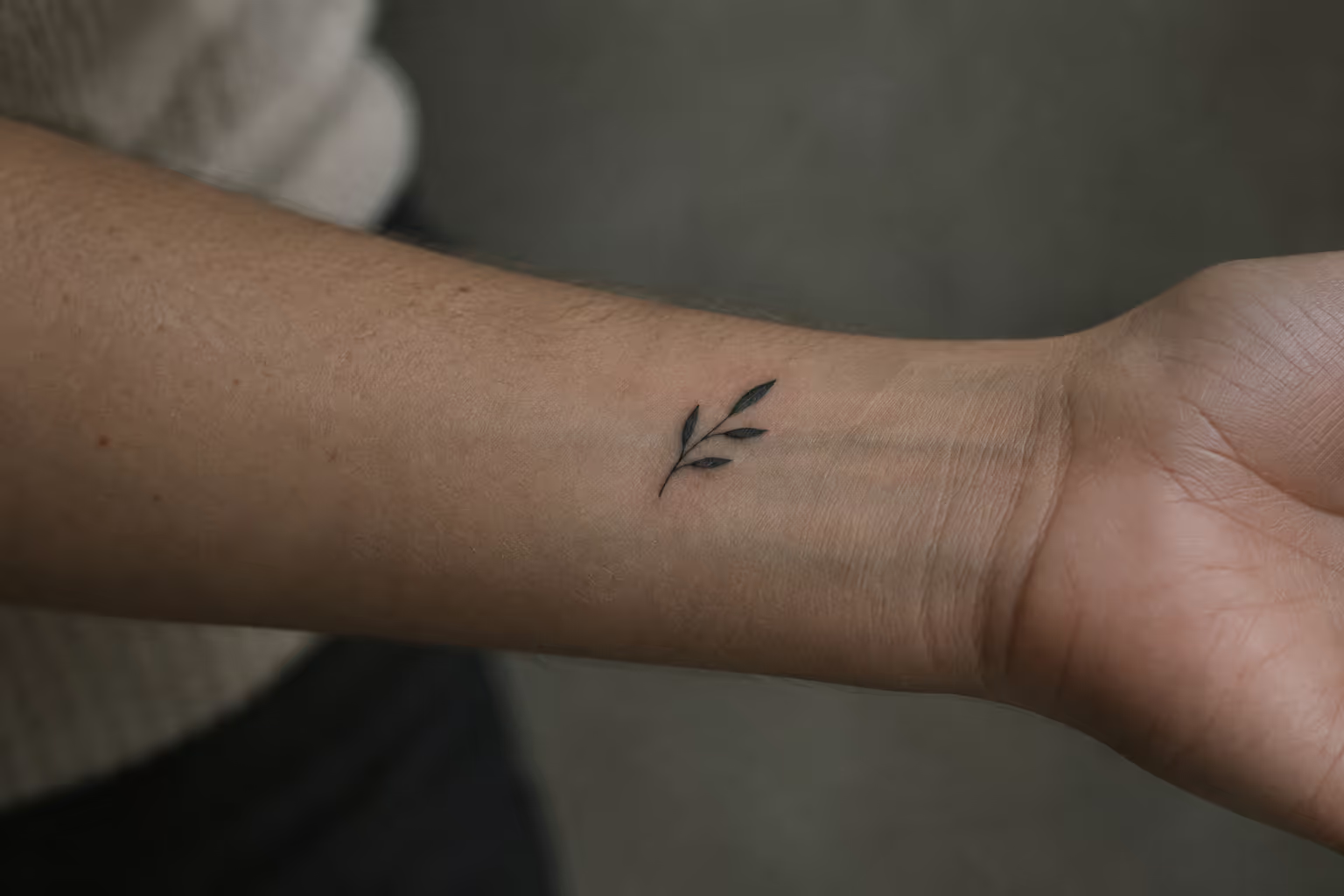
The inner forearm takes almost any design here, from a small symbol to a photo line drawing, and you see it all day. It’s easy to cover with long sleeves, which most people forget. The wrist is better for something very small, and it’s the hardest to hide short of a watch strap. Wrist ink also ages faster because of constant movement and hand-washing, so keep it simple and bold. Pain-wise, inner wrist > inner forearm.
Paired imagery benefits from mirrored or parallel placement (2). A sun on your left forearm and a moon on her right lines the two up when you stand side by side.
Coverable: shoulder, back, ankle, calf
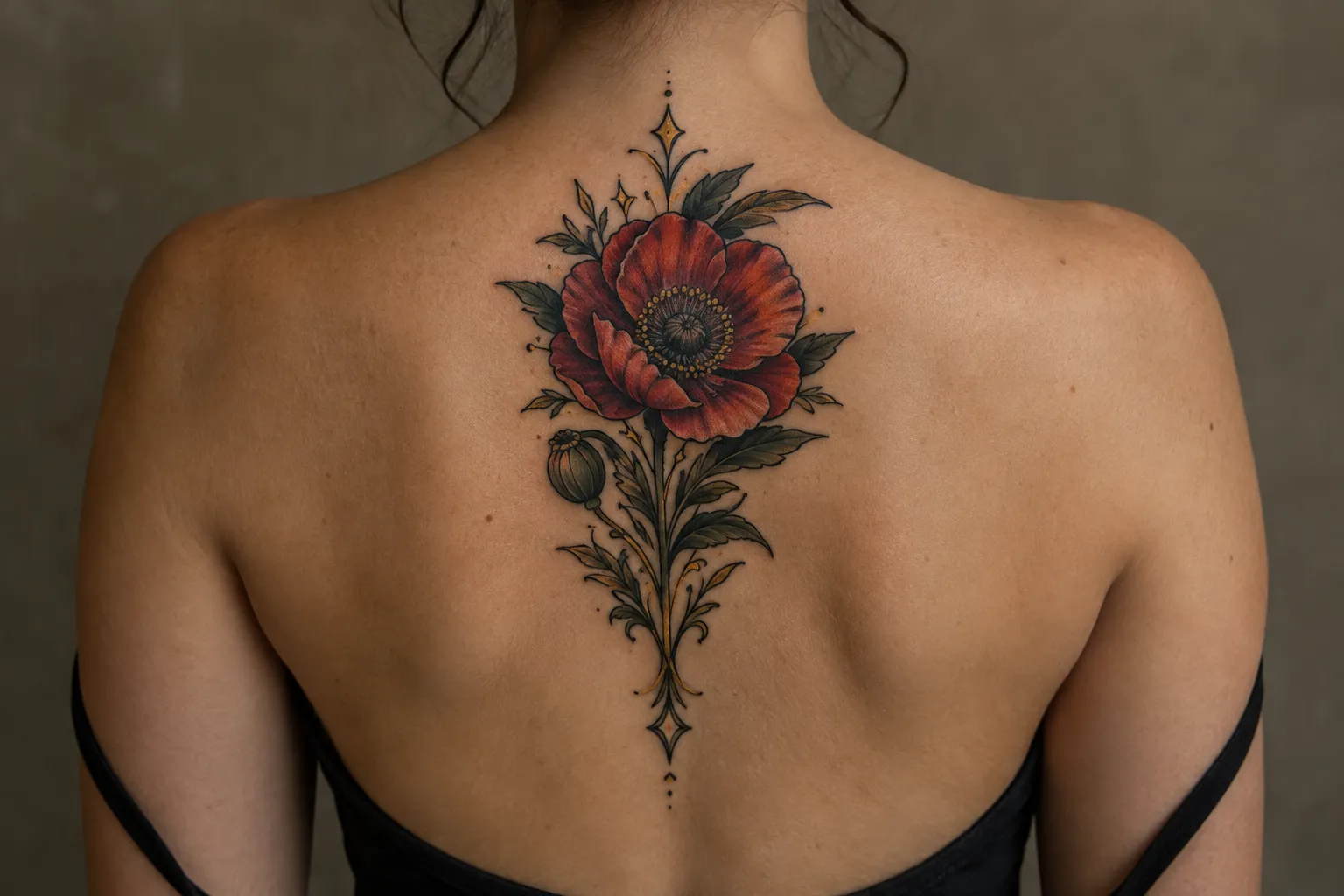
The upper arm hides under a T-shirt sleeve and suits mid-size work. Shoulder and upper back take the largest pieces, knotwork, flowers, a full scene, and stay covered almost all the time. The ankle is good for a small symbol but hurts more than the calf because the skin sits right on bone. The calf is the easy middle: room for a larger piece, covered by trousers, visible in shorts.
If one of you works somewhere with strict dress rules and the other doesn’t, you don’t need the same spot. Same design, different placement still counts as matching.
Independent Tattoos, Same Day: When the Moment Matters More Than Matching Ink
If you want to mark a shared moment rather than share an image, get two independent tattoos on the same day with the same artist; the shared event becomes the connection (1). One guide calls it the option people forget, and in its author’s experience the one with the fewest regrets (1).
This is also the answer when a dad asks whether to let his daughter choose. In this format each of you picks your own design. She might get the fine-line flower she’s wanted for years, and you might get your first American traditional swallow. What ties them together is the date and the chair, not the drawing.
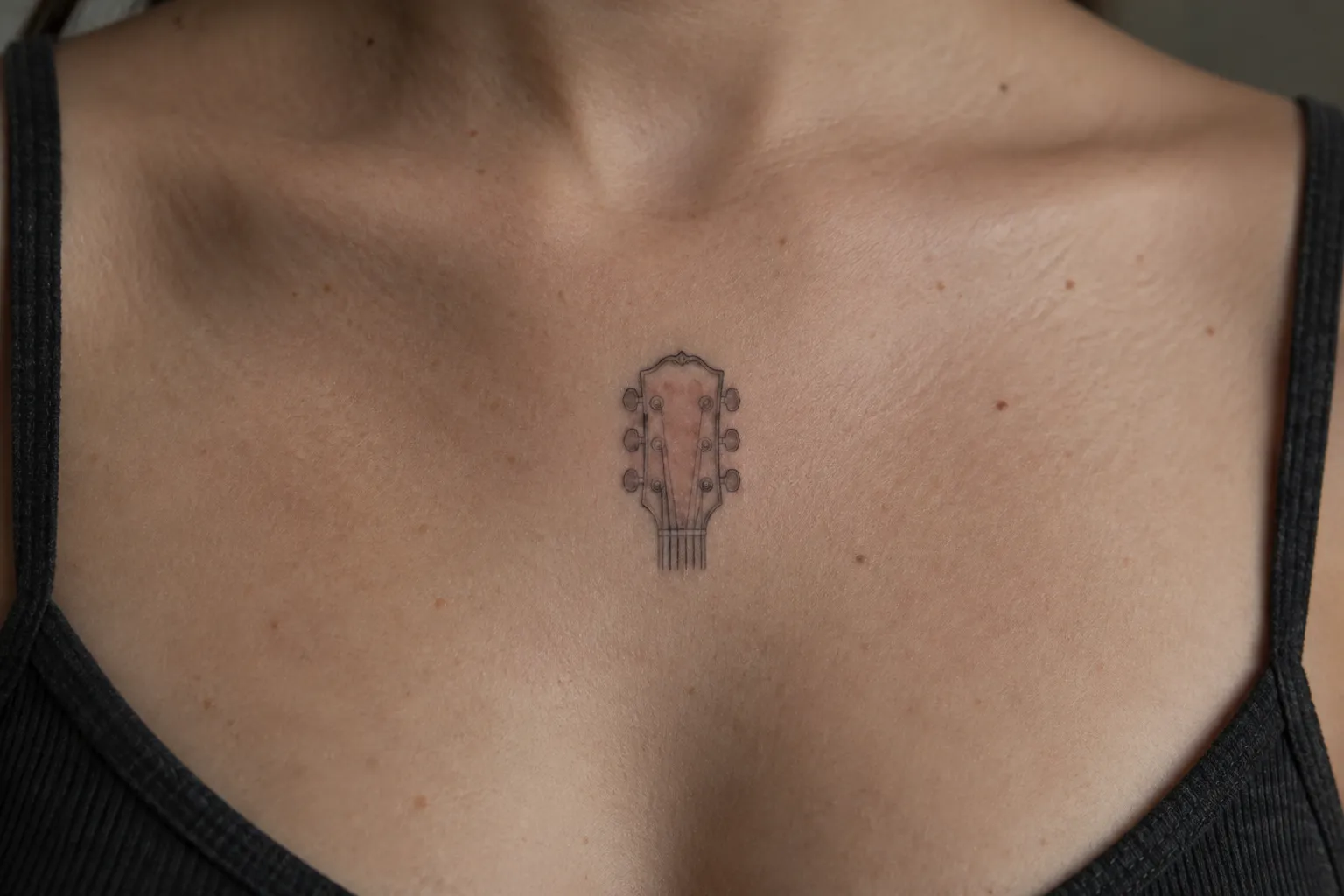
Activity-based concepts fit this approach well. If you fish together, one of you gets a hand-tied fly and the other a lure. Runners might pick a route outline or a race date in block numerals. Music can go one way as a guitar headstock and the other as a line of lyric. These can be loosely related or not related at all.
Practically, book a two-person slot and ask who goes first. The second person usually gets less nervous after watching. Small pieces keep the shared session manageable: a design under two inches usually takes well under half an hour (1).
Safety, Studio Hygiene and Aftercare Before You Book
Before booking, ask the artist which inks they use and how equipment is sterilized, because the FDA links tattoo infections to unsterile equipment and contaminated ink (7)(9). Have that conversation in the same week as the design one.
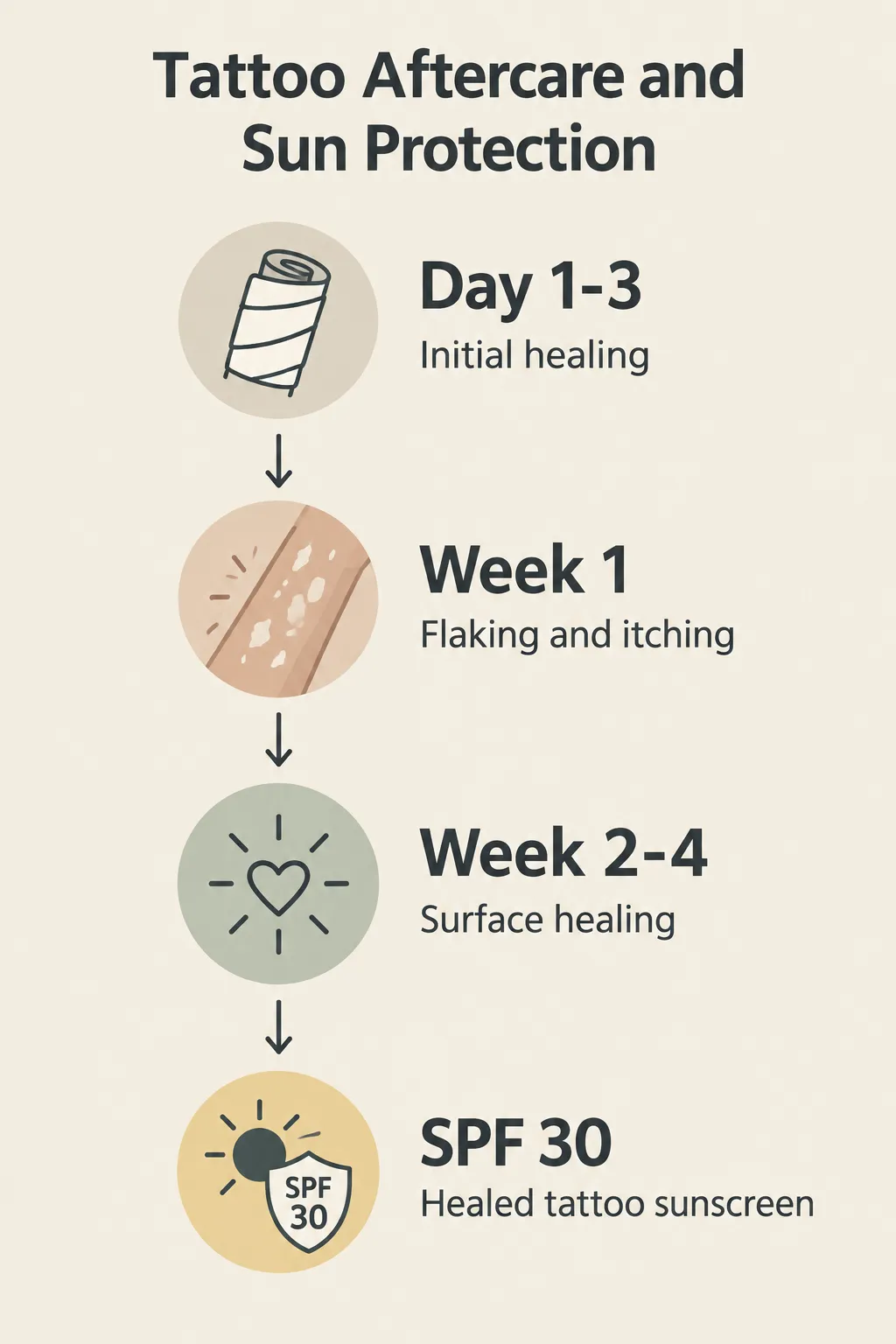 Healing runs from the wrap in days 1-3 to SPF 30 sunscreen once the tattoo has healed.
What to ask before booking
The FDA has received reports of infections from contaminated tattoo inks and notes that even unopened, sealed inks can harbor microorganisms (7). In May 2025 it advised consumers and artists to avoid certain Sacred Tattoo Ink products found contaminated with bacteria (9). Ask:
- Which ink brands and lines do you use, and can I see the bottles?
- Are needles single-use and opened in front of me?
- How is reusable equipment sterilized?
- Can you place the tattoo on skin with no moles? Tattoos can make early signs of skin cancer harder to see (8).
Tell your artist about any medications you take. If a tattoo isn’t healing or develops a rash, contact the artist and a health professional, especially if you have a fever (7).
Healing and sun protection timeline
Healing follows the same rough schedule for both of you; our tattoo aftercare guide covers it week by week.
- Day 1-3: keep the wrap on as long as your artist says, then wash gently with lukewarm water and a fragrance-free soap and pat dry. Thin layer of ointment only.
- Day 4-7: the skin tightens and light flaking starts. Don’t pick. Switch to a fragrance-free moisturizer; the AAD recommends a water-based lotion or cream for dry tattooed skin (8). No swimming or soaking.
- Week 2: peeling and itching. Let the flakes come off in the shower and don’t scratch.
- Week 3-4: the surface looks healed, but the skin underneath keeps settling until around week 6. Keep it out of direct sun for the first 4 to 6 weeks, with sun-protective clothing rather than sunscreen.
- Once healed: UV can fade some inks, so use a broad-spectrum, water-resistant sunscreen of SPF 30 or higher, applied 15 minutes before going outside and reapplied at least every 2 hours (8). Skip tanning beds and sunlamps, which can fade tattoos and may cause skin reactions (8).
Frequently Asked Questions
- What is the symbol for father and daughter?
- There is no universal father-daughter tattoo symbol; choose a motif whose significance comes from a shared memory rather than an assumed meaning.
- What symbolizes a father-daughter bond?
- A father-daughter bond can be represented by a design tied to a private family story, which avoids relying on symbolism other people may interpret differently.
- What tattoo can I get to honor my dad?
- A detail in your dad's own handwriting can make a memorial feel specific to him; check an old card or note for a sample before designing.
- What are some inspirational quotes for a father-daughter tattoo?
- A short line you both use is easier to letter legibly than a familiar long quote, and it can carry meaning without needing explanation.
- What does a shotgun tattoo symbolize for a dad with a daughter?
- A shotgun motif usually references the Western pop-culture joke about a protective father confronting his daughter's date, not an established tattoo tradition.
- Should I ask my daughter what tattoo design to get?
- Yes; ask before choosing a shared motif, and treat her answer as part of the design decision rather than a last-minute approval.
Deciding in the Right Order
Settle the structure first: identical or complementary, and who wears which half. Then swap any generic symbol for a detail only the two of you own, sized so it holds up once healed: as a general rule of thumb among tattooers, standard script reads best around 1/2 in (12 mm), fine handwriting closer to 1 in (25 mm), and block or numerals around 1/4 in (6 mm), roughly half the standard script height, since their bolder strokes stay open at smaller sizes. Pick placement by visibility, with the inner forearm for daily view and the shoulder, back or calf for coverage. Before you pay a deposit, ask about the inks and sterilization, and plan SPF 30 sun protection for the years after it heals.