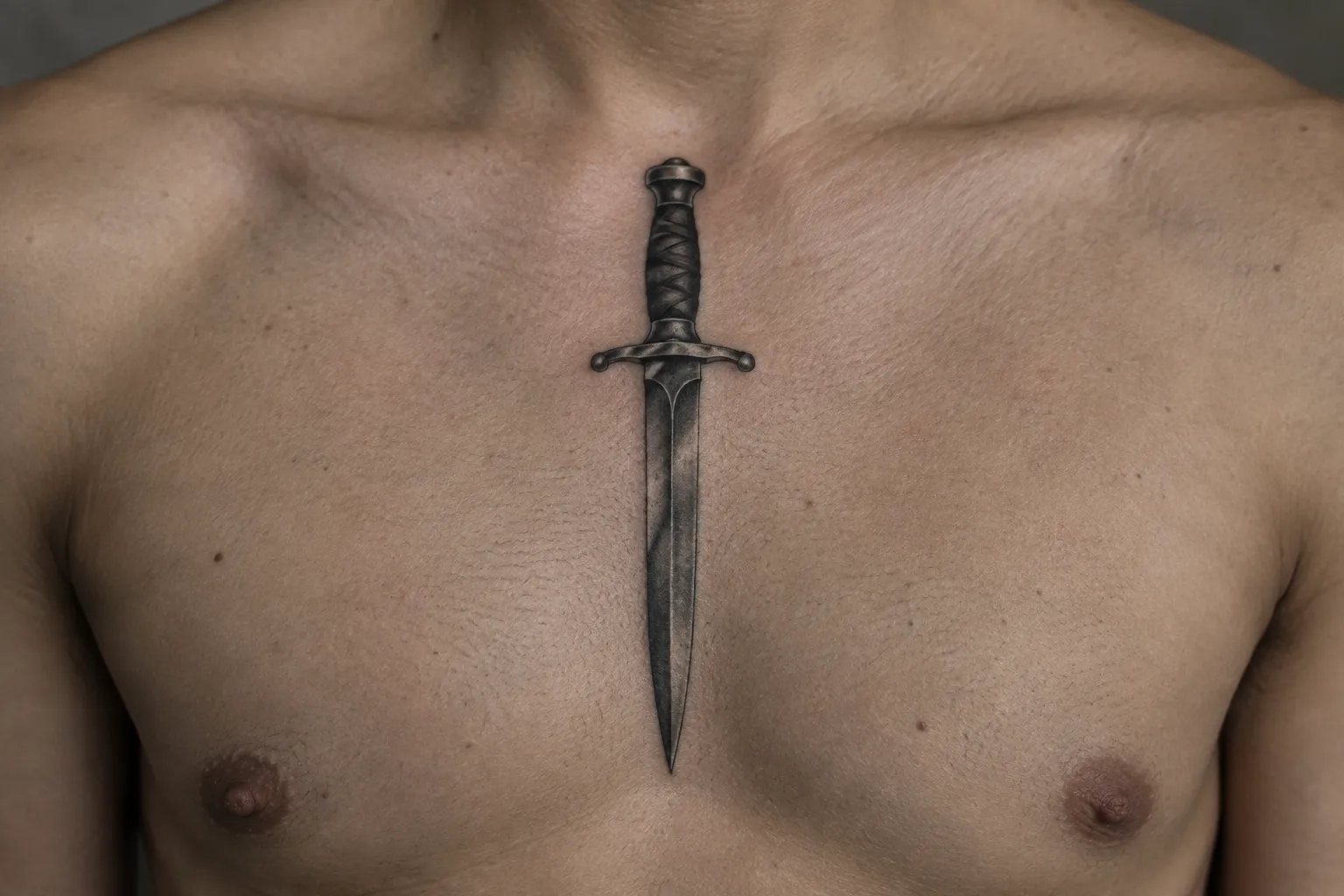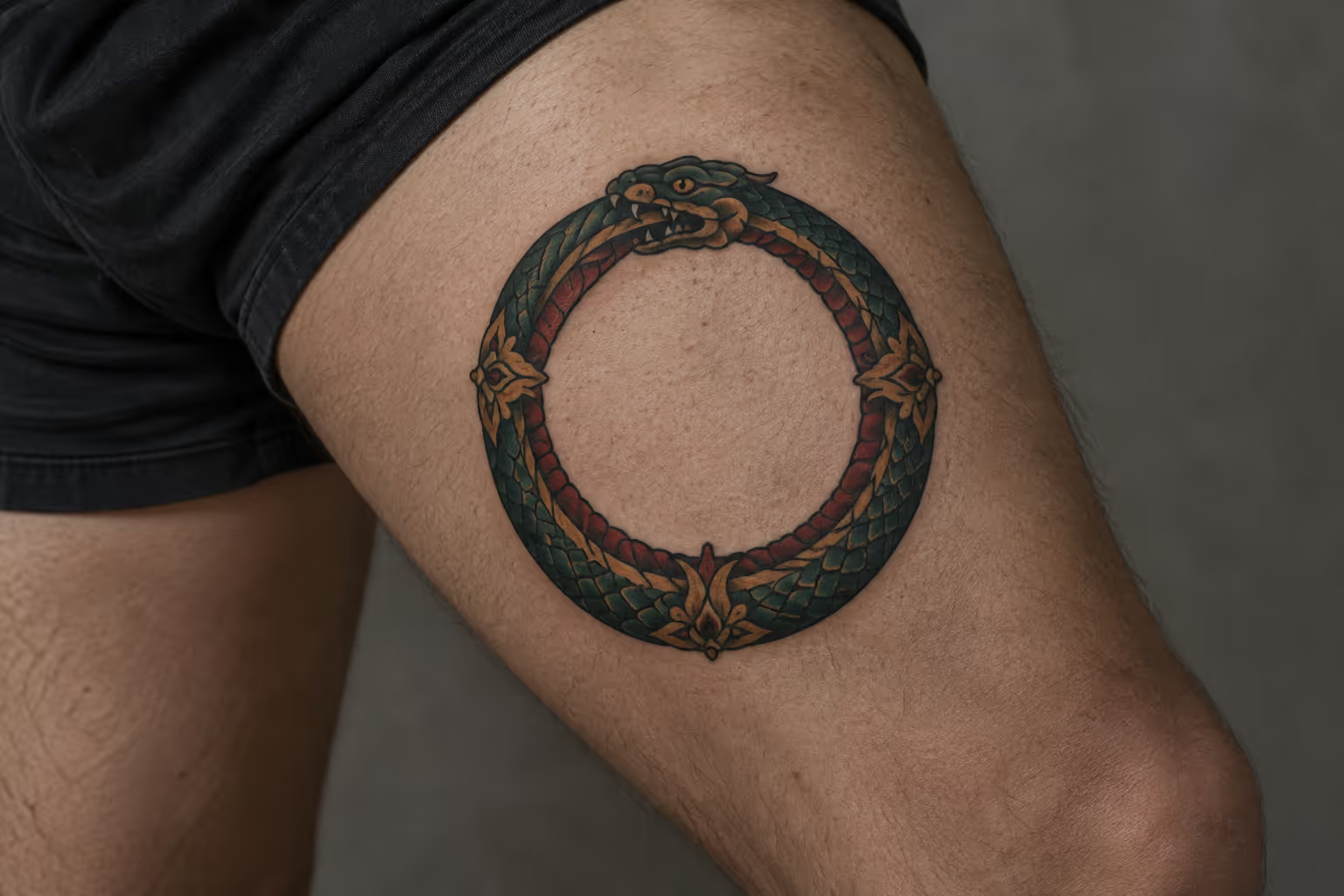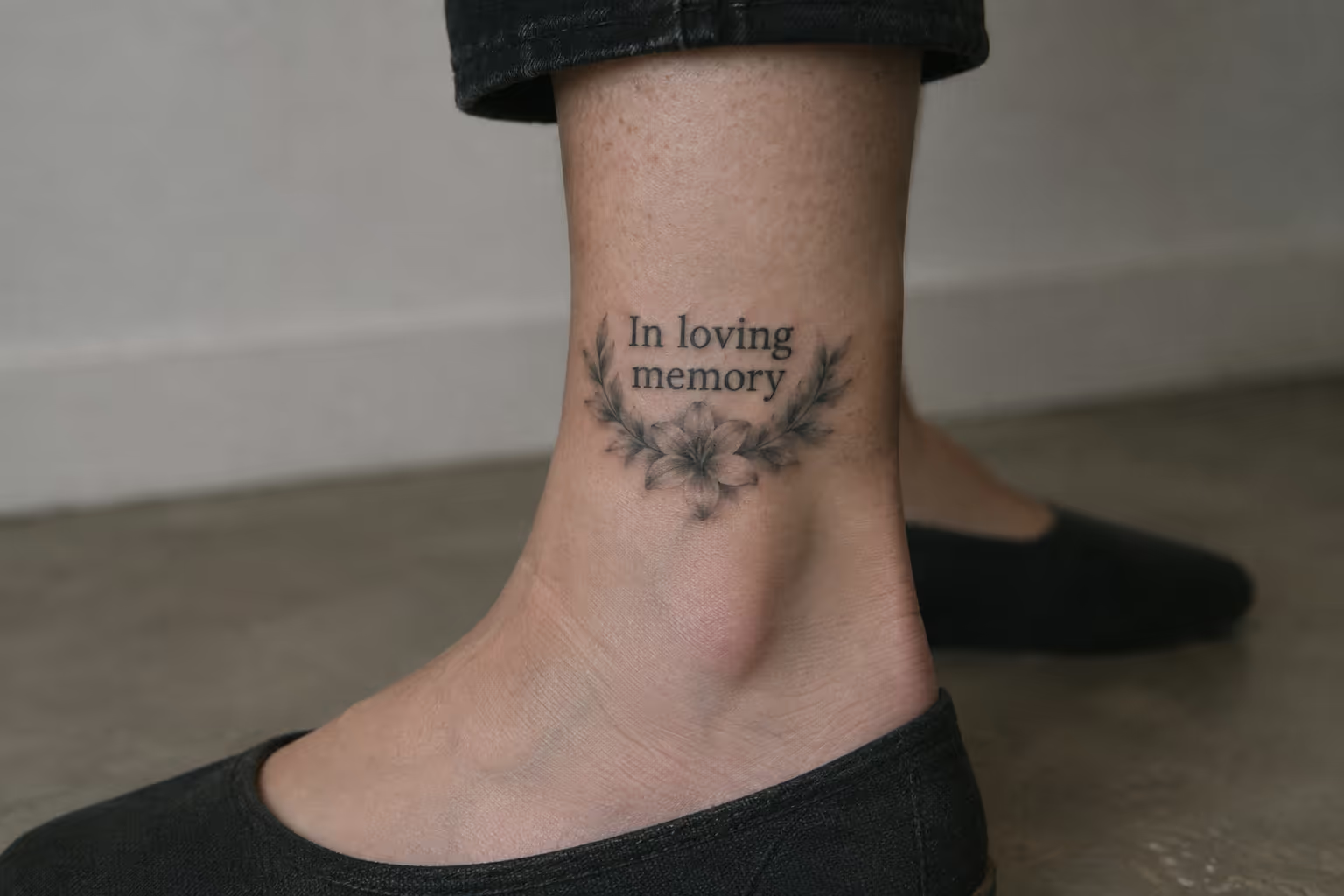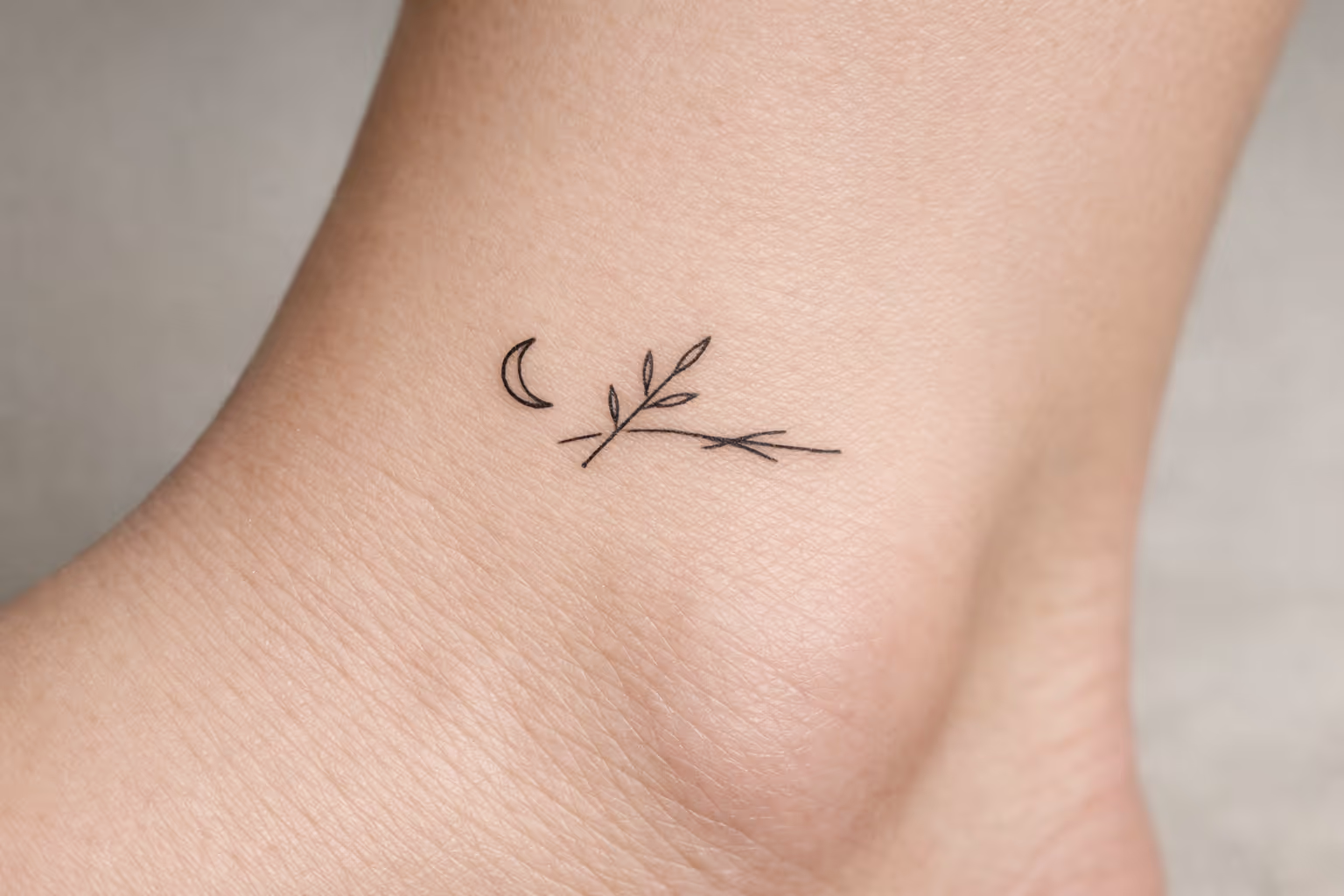
A dagger tattoo reads differently depending on what the blade is doing. On its own, a dagger usually stands for protection or courage. Drive the same blade through a heart or wrap it in a rose, and the reading shifts toward loss, pain, betrayal, or sacrifice (10)(1). The meaning comes from the whole composition, so settle it with your artist before the stencil goes on.
✓ Pros
- The blade gives the design a clear central shape that can anchor a larger composition.
- A dagger can connect separate motifs into one readable piece rather than a cluster of unrelated images.
✗ Cons
- The weapon imagery can feel confrontational to viewers even when the wearer intends a protective meaning.
- A blade passing through another object leaves little room for stencil placement errors.
Here is the trade-off. The design is versatile in meaning, works as bold traditional or fine line, and pairs easily with other motifs. On the downside, it gets misread if you haven’t talked through direction and pairing, small versions lose detail fast, and any blade-through-object design needs careful stencil review so the blade lines up on both sides.
Dagger Tattoo Meaning: What the Blade Symbolizes
Dagger tattoo meaning depends on context. Tattoo-design sources tie the blade to protection, courage, sacrifice, betrayal, danger, and survival, and none of these is the one fixed definition (5). A standalone dagger most often suggests courage, protection, or sacrifice (10).
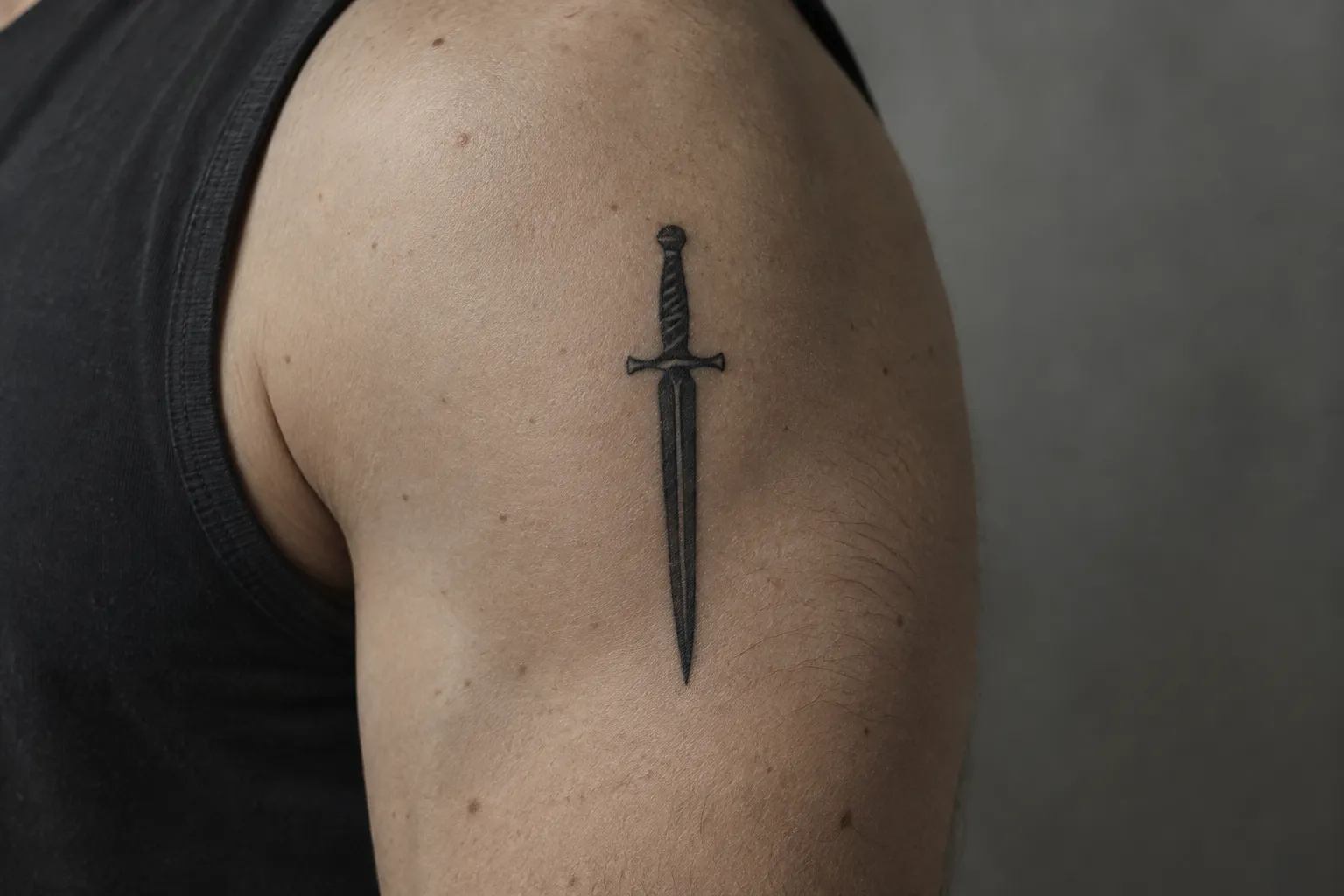
The Western tattoo version comes out of sailor and servicemember flash. There, a clean upright blade worked as a reminder of duty (10). The readings also include survival and resilience alongside danger and sacrifice (5), so a dagger can mean “I got through something” as easily as “don’t cross me.”
Your personal meaning is the one that counts. Sources support several readings, so tell your artist yours instead of assuming they’ll guess it (5)(10).
Is a dagger tattoo aggressive by default?
A dagger tattoo is not aggressive by default. Sources list protection, courage, sacrifice, and survival among its readings, and one states that many dagger tattoos are not about violence at all (5). How aggressive it looks comes down to execution: a dripping blade next to a snarling panther reads hostile, while a plain upright dagger with a banner reads as flash.
Blade Direction: Point-Up, Point-Down, and Why There’s No Fixed Rule
Blade direction has no universal code. One source describes point-down as rest or sacrifice and point-up as readiness, then cautions that these cues aren’t a fixed code and that artists and wearers read them differently (10). Another guide assigns firmer meanings, with point-up for aggression and point-down for peace or memorial (1). Since the guides disagree, tell your artist the meaning you intend rather than rely on a directional rule. So if you’re asking what a dagger facing down means, the answer is “whatever you and your artist agree it means.”
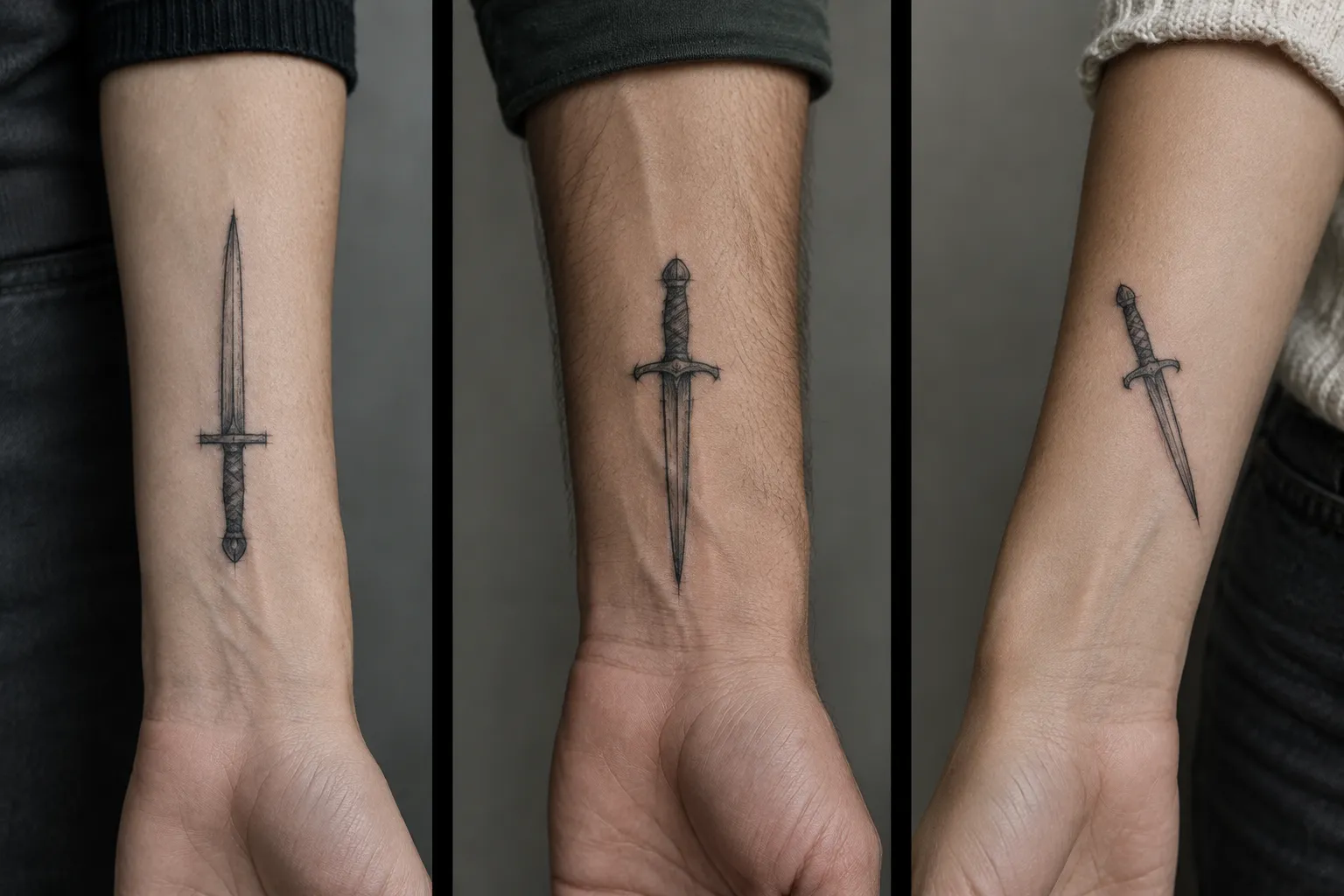
The practical rule is to show your artist the reference in the exact orientation you want. Then say what it represents in one sentence. The same image can read differently when flipped or paired with another motif (10)(1). Also think about which way it faces when your arm hangs at your side, because that is the orientation most people will see.
Dagger and Rose Tattoo: Contrasting Beauty and Danger
A dagger and rose tattoo is read as a contrast between love or beauty and pain or danger (2)(3). Artists often play soft petals against hard steel with contrasting color (2), which is why this pairing holds up well in a limited traditional palette: red rose, grey or white blade, black outline.
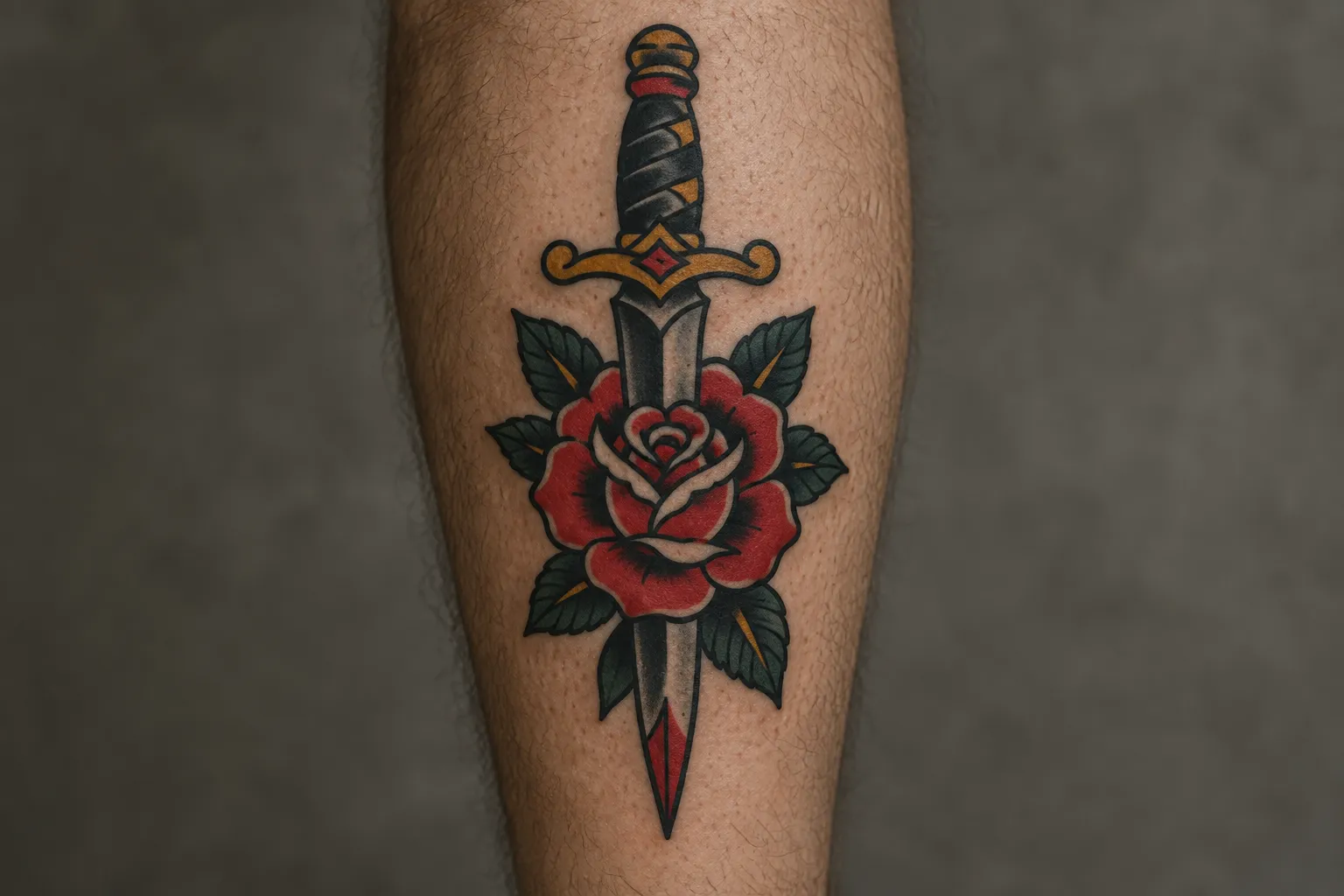
Picking a companion motif means picking a symbolic direction. A rose steers the piece toward beauty versus danger (2). A pierced heart steers it toward emotional injury (1). A snake steers it toward struggle and survival (5). None of these is a fixed rule, but each one pushes the reading somewhere different. A skull pushes it toward mortality (4).
Snake and dagger: struggle and survival
A snake and dagger pairing is often described as facing danger, protection, or survival (5)(12). One source frames it as victory over an enemy (10). A blade coiled by a serpent is a classic pairing in old-school American traditional tattooing (10). It needs vertical space: one guide sizes a detailed dagger with one companion element, such as a rose or a snake, at 5-8 in (13-20 cm), a length that suits the outer forearm or calf (1).
Skull and dagger: facing mortality
A dagger-and-skull pairing may invoke death or a confrontation with mortality (4). It can read as memorial or as defiance, depending on the skull’s expression and whether you add flowers or a name.
Dagger Through the Heart: Heartbreak, Betrayal, and Emotional Weight
A dagger through the heart tattoo is widely associated with heartbreak, betrayal, and emotional pain (1)(14). That makes it a separate reading from the rose pairing: the rose balances pain with beauty, while the pierced heart puts the injury front and center. Heart imagery stresses vulnerability, especially once a blade goes through it (1).
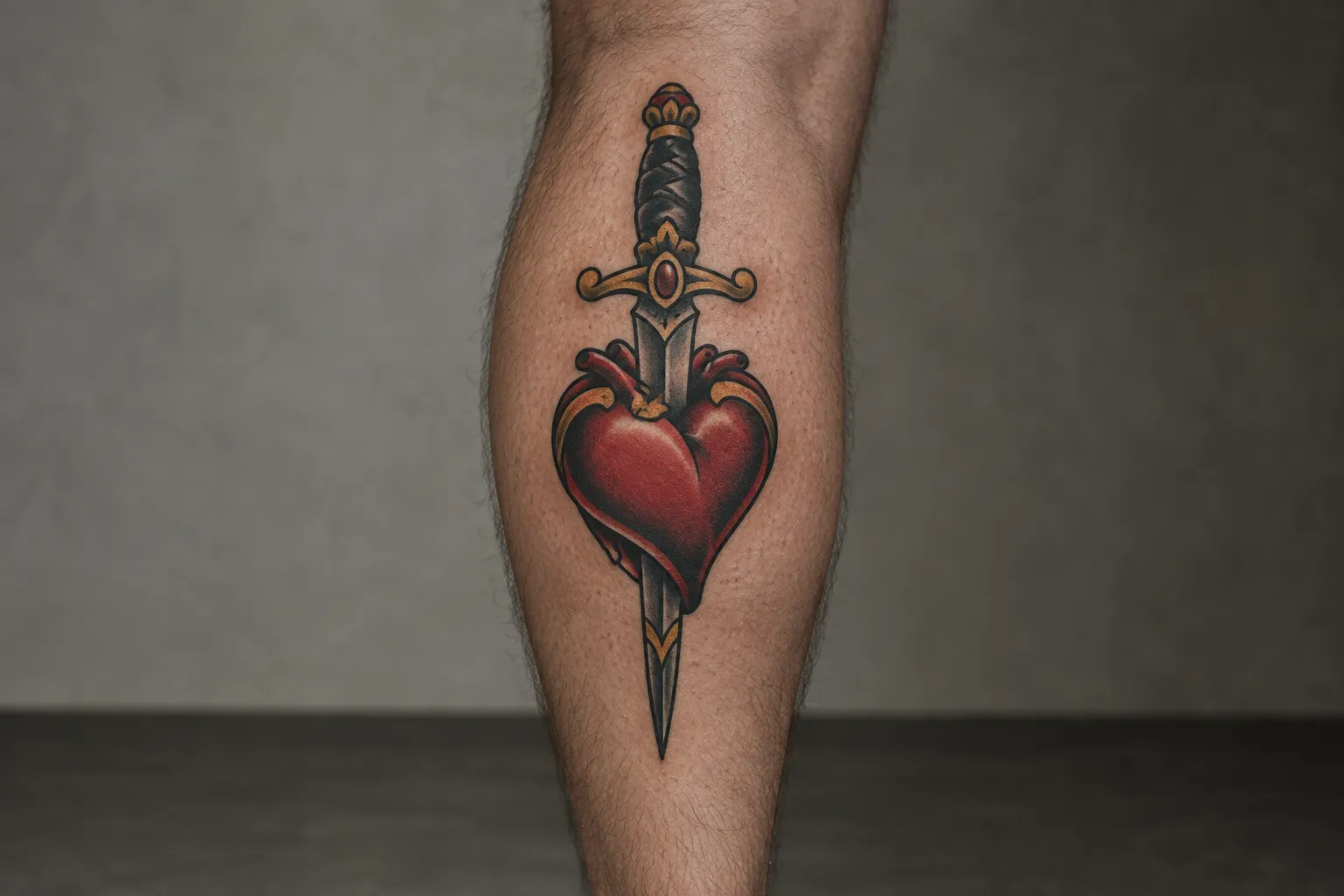
Technically, this is the design where stencil review matters most. The blade has to enter and exit the heart on a straight line, and on a curved forearm or calf a slight misalignment makes the blade look snapped. Stand in front of a mirror and check it with the limb relaxed. On the outer forearm or upper arm, leave enough length for a readable heart and a hilt with some detail.
Traditional-Style Daggers: Bold Lines Rooted in Sailor Tattooing
A traditional dagger tattoo follows the American traditional style: bold black outlines, a limited color palette, and motifs drawn from sailor tattoos (11). The dagger is among the classic old-school designs (11), and tattoo-design sources tie it to the sailors and soldiers of the early 1900s (1). Those two hallmarks, a heavy outline and few colors, are why these pieces stay legible after decades.
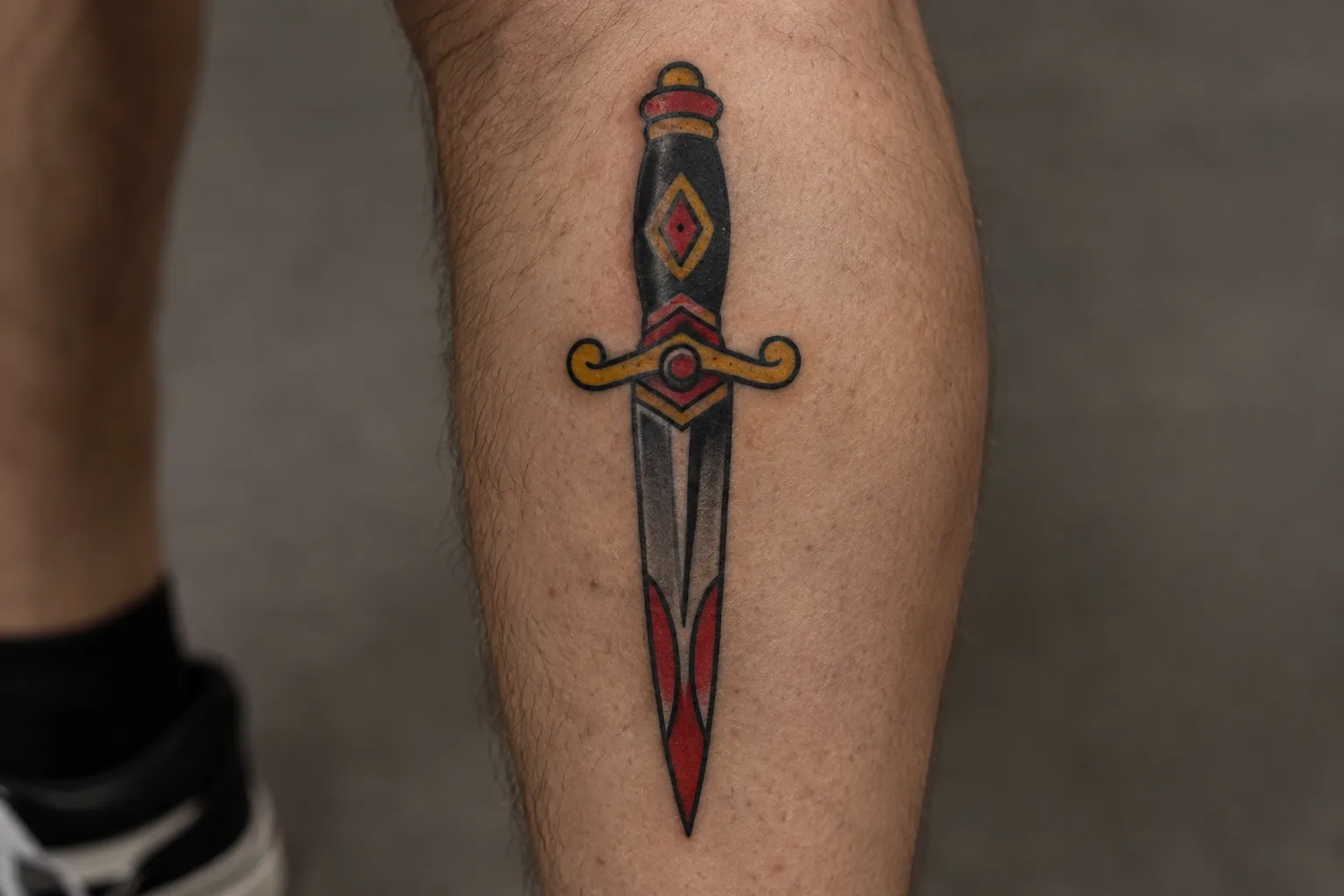
The common pitfall is a thin or shaky outline filled with too much detail. Artists who do this badly try to render every hilt ornament and blade reflection inside a traditional frame. The result muddies as the ink settles, and the “bold” look turns into a grey smudge. Before you book, ask to see healed traditional work, not just fresh photos, and check that the outlines stayed crisp (1).
Realistic and detailed daggers: what changes
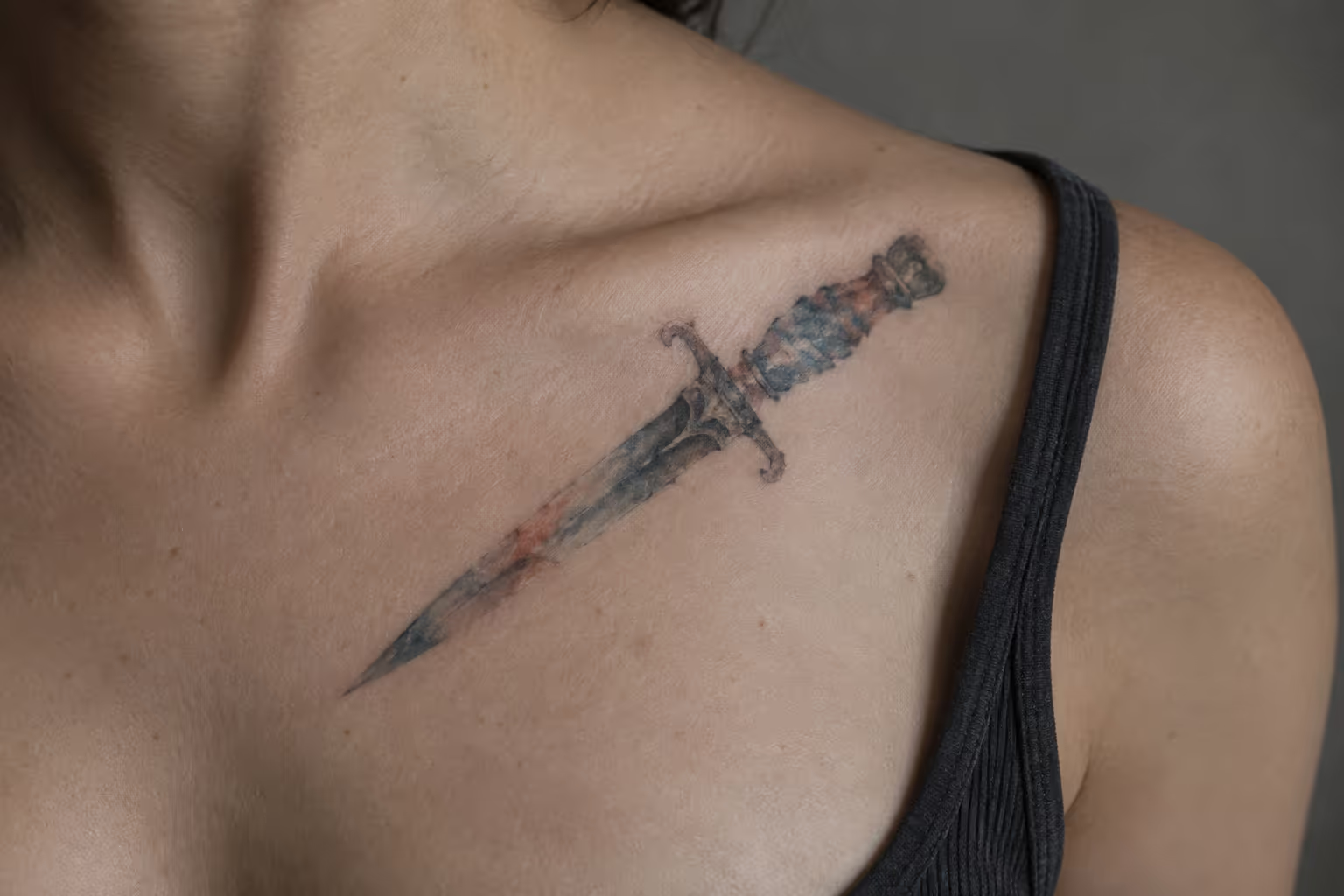
A realistic dagger swaps the outline for soft grey shading, metallic highlights, and engraving detail. Doing that well takes a realism specialist and a portfolio that shows it (1). Realism also needs more room, and its fine details can fade over the years (1), so plan it larger than a traditional piece, on the forearm or thigh.
Small Daggers: Sizing, Placement, and Simplifying Detail
A small dagger tattoo works when you cut the detail down to outline, a simple hilt, and maybe one line of shading. Then review the stencil at the intended size with your artist. One small-tattoo studio prints each stencil in several sizes at the appointment so client and artist can pick the right one for the design and placement (13).
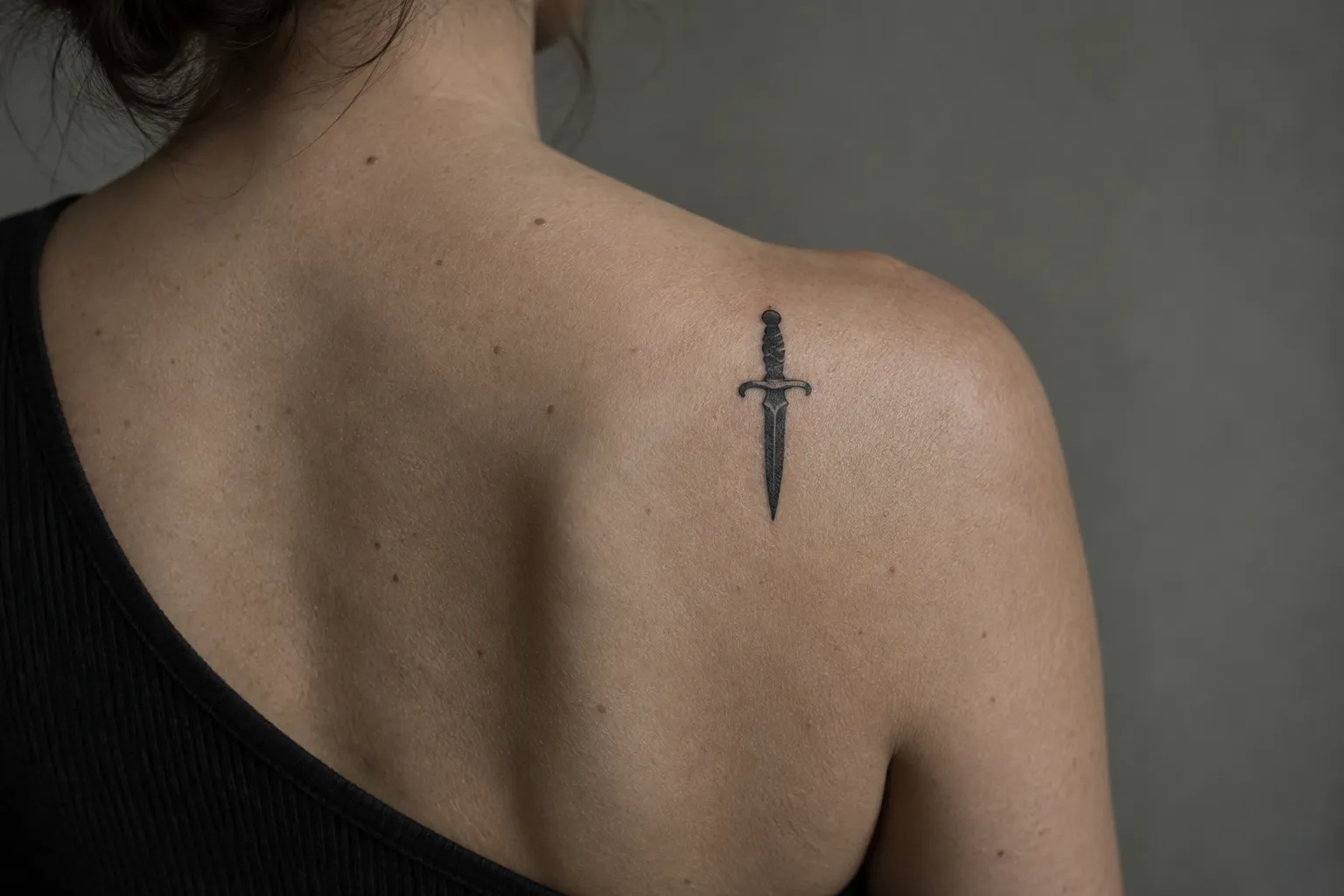
The same studio sizes all its designs, its mini dagger included, between 0.25 and 2.5 in (about 6 mm to 6.4 cm) across (13). That range covers its own simplified flash, so it does not tell you how small a detailed dagger can go. A broader dagger guide puts a small, simple dagger with minimal detail at 3-5 in (7.5-13 cm) (1). Placement then decides how much detail survives:
- Inner forearm: simple outline, with room for a little shading
- Wrist, ankle, or behind the ear: outline only, kept shorter than on the forearm
- Collarbone or side of the ribs: room for a small rose
Drop the lettering on a banner at small sizes. It is the first thing to blur, and each lettering style has its own minimum height, covered in our tattoo font guide.
Where placement affects detail and pain
Placement changes both how the line holds and how the session feels. One dagger guide rates the forearm at 3-4 out of 10 for pain and the chest at 6-8, with pain highest over the sternum (1). High-friction areas such as hands and feet age worse than protected ones (1), and wrists move constantly, so fine line softens faster there. A tiny detailed dagger on the finger ages badly. The same design on the forearm holds.
Choosing an Artist, Aftercare, and When to See a Doctor
Pick an artist whose healed portfolio matches your style, and confirm that their equipment is sterile. FDA guidance warns that unsterile equipment and contaminated ink can cause infection (7)(9), and unsterile needles can transmit diseases such as hepatitis (9). Tell your artist about any medications you take.
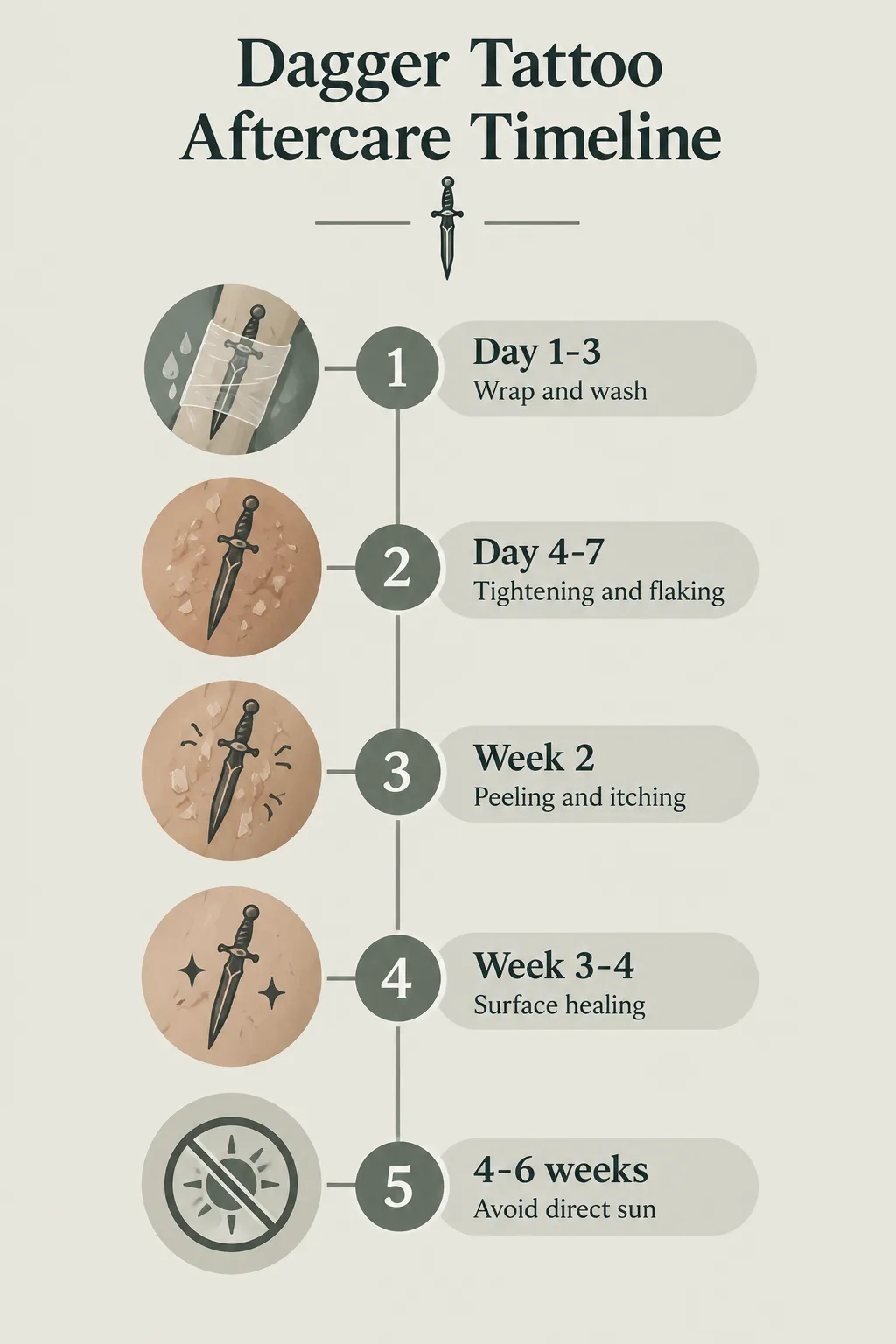 The article’s dagger tattoo aftercare timeline covers Day 1-3, Day 4-7, Week 2, Week 3-4, and 4-6 weeks of sun protection while the tattoo heals.
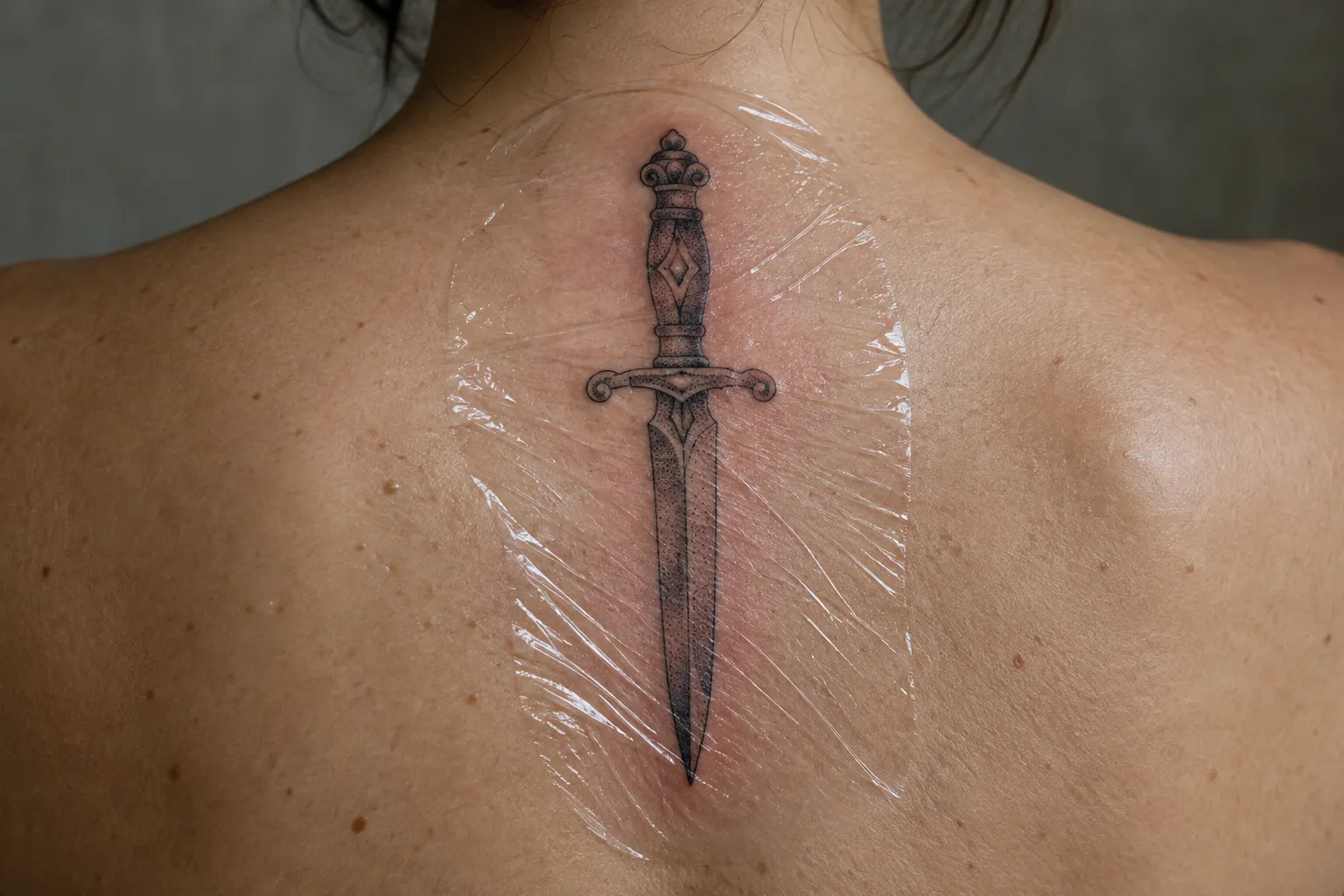
Aftercare timeline:
- Day 1-3: Keep the wrap on as long as your artist says, then wash gently and apply a thin layer of fragrance-free moisturizer.
- Day 4-7: The skin tightens and starts to flake. Don’t pick, soak, or swim.
- Week 2: Peeling and itching. Let flakes come off on their own.
- Week 3-4: The surface looks healed, but the skin underneath is still settling; full integration takes about six weeks.
- Sun: Keep the tattoo out of direct sun for the first 4-6 weeks, covering it with sun-protective clothing rather than sunscreen while it heals.
Our tattoo aftercare guide covers each stage in detail.
Once the tattoo has healed, the American Academy of Dermatology recommends a broad-spectrum, water-resistant sunscreen of SPF 30 or higher. Apply it 15 minutes before sun exposure and reapply at least every 2 hours (6).
How to Prepare for a Dagger Tattoo
Choose a design that suits the intended placement, confirm the stencil and studio practices, then follow the healing and sun-care instructions.
- 1
Choose a style and gather references
Collect healed examples in the style you want, and note the blade direction, companion motifs, and details you want to keep.
- 2
Check the stencil at the intended size
Review the stencil on the actual placement and at the planned size; check that any blade entering or exiting another object lines up.
- 3
Confirm studio hygiene
Ask how the artist keeps equipment sterile and check that the healed portfolio matches the style you chose.
- 4
Follow aftercare and protect healed skin
Follow the artist's instructions through healing, then use broad-spectrum, water-resistant SPF 30 or higher on the healed tattoo.
- 5
Get persistent symptoms checked
Contact a doctor if redness, swelling, warmth, or a rash persists or spreads after the first few days.
Signs to see a doctor, not wait out
If redness, swelling, warmth, or a rash persists, or spreads after the first few days, see a doctor, especially if you develop a fever (8). FDA guidance identifies both infection and allergic reactions to ink as tattoo risks (7)(8). Those symptoms are not a normal part of healing you should try to wait out.
Frequently Asked Questions
- What does a dagger tattoo mean?
- A dagger tattoo gets its meaning from its composition and the wearer's intent, not from the blade alone. Tell your artist the reading you want.
- What does a dagger facing down mean?
- A point-down dagger has no universal meaning. If orientation matters to you, specify it on the reference and check it on the stencil.
- Where should I place a dagger tattoo?
- Choose a placement with enough uninterrupted length for the blade and hilt. Check the design while your arm or leg is in its usual resting position.
- Does adding flowers change a dagger tattoo's meaning?
- Flowers can shift the emphasis toward remembrance or tenderness, but the species, arrangement, and other imagery shape the reading.
- Are dagger tattoos painful?
- Pain depends on where you put it more than what the design shows. Bony, thin-skinned spots hurt more than fleshy ones, so ask your artist how your chosen placement compares.
- Can I integrate a dagger with existing tattoos?
- A dagger can work between existing pieces if its outline weight and visual density suit the surrounding tattoos. Ask your artist to assess the layout together.
Before You Book the Dagger
A dagger’s meaning shifts with composition, pairing, direction, and style, so explain the reading you want instead of assuming your artist shares it. Choose an artist whose healed work matches your style, whether bold traditional or detailed realism. Check the stencil at full size, on the actual placement, with your arm relaxed. Then follow the healing timeline and keep SPF 30+ on the healed piece so the outline stays sharp for years.