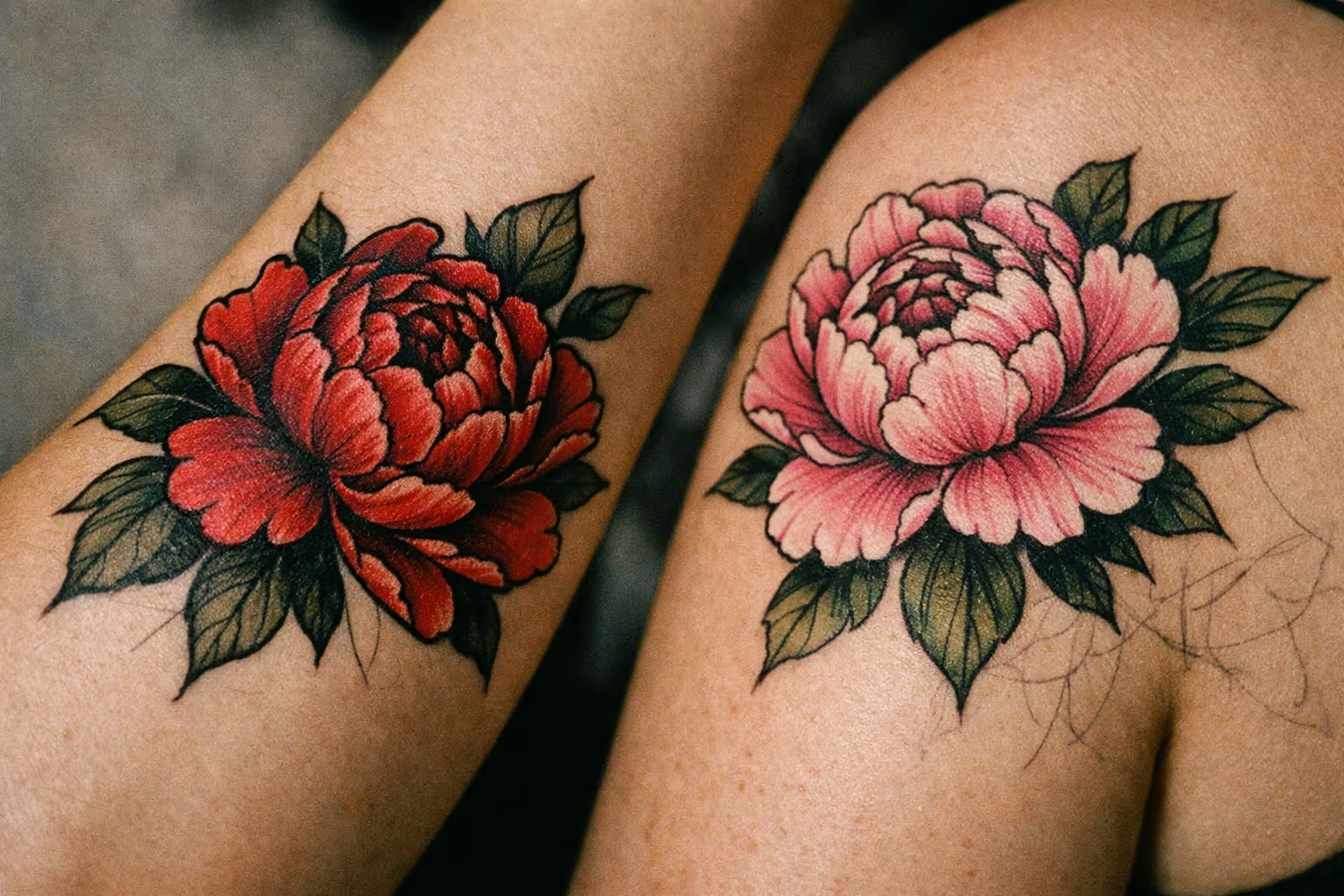
With a peony tattoo, the color you pick quietly rewrites the meaning - and most people choose it for looks alone, not realizing pink, red, and white each say something different. It’s a flower with real cultural weight, especially in Japanese work, so the shade isn’t a small call. Get it wrong and the piece means something you didn’t intend. Here’s what a peony’s colors signify, plus placement, sizing, and price.
What Does a Peony Tattoo Symbolize?
A peony tattoo is one of the few floral designs that scales cleanly from a 2-inch fine-line piece behind the ear to a full Japanese backpiece with a dragon coiled around it. The flower carries real weight in both Eastern and Western tattoo traditions, which is why peony tattoo meaning comes up in client consultations more than almost any other bloom. I’ve had clients come in with nothing but a color swatch and a vague sense that they “want something floral” - and we end up spending twenty minutes just on what the peony actually means before we touch a sketchpad.
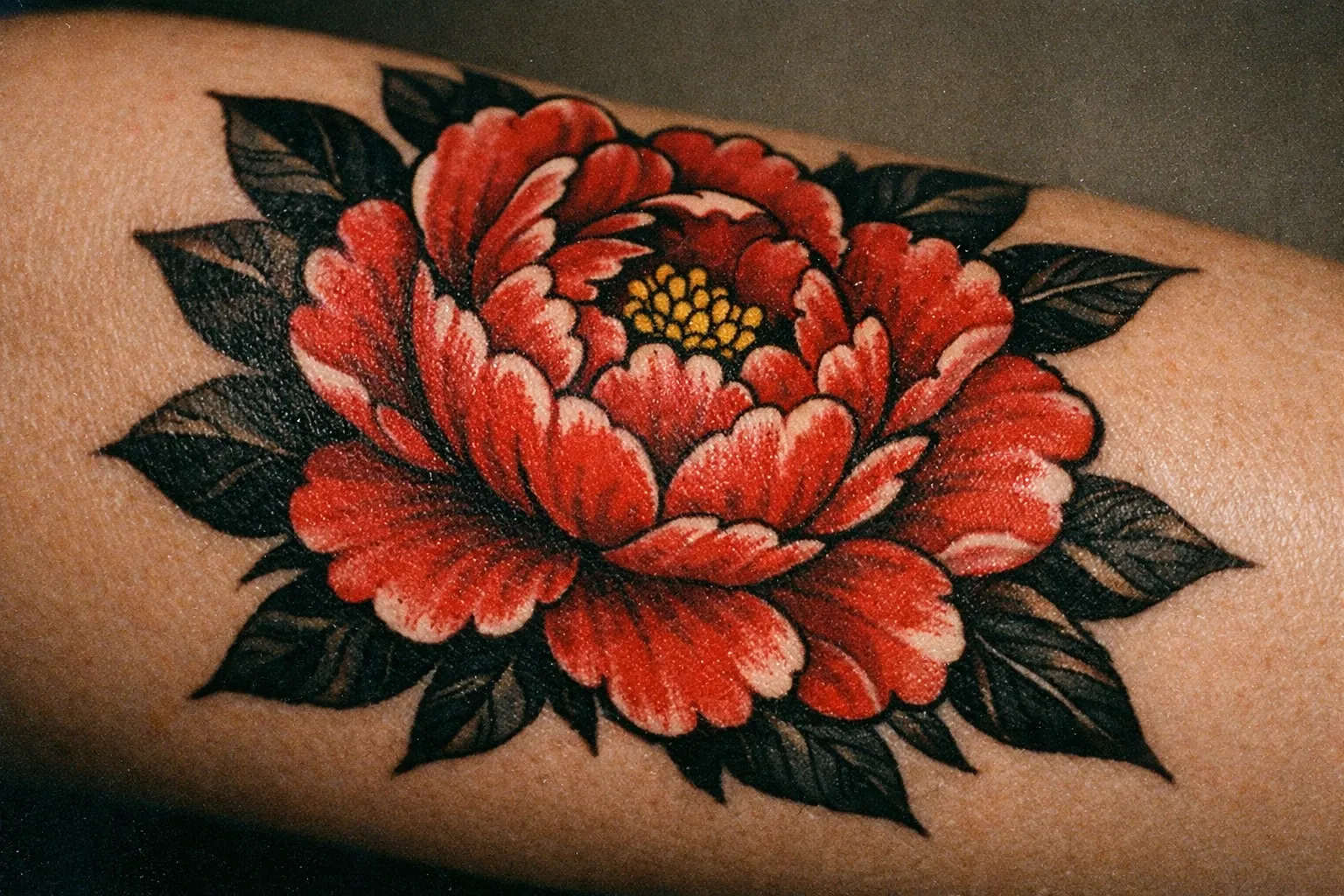
This guide covers the symbolism, how color shifts the meaning, which styles hold up over decades, placement and size in real numbers, and what you should expect to pay in 2026.
Peonies carry a stack of meanings, and which ones apply to your piece depends on the cultural lens, the color, and what you pair them with.
The core symbolism cluster across most traditions:
- Wealth and prosperity - the dominant association in Chinese culture, where the peony is called the “king of flowers” in Chinese tradition (6)
- Honor and nobility - tied to imperial status in East Asian art (3)(6)
- Beauty and romance - the Western floriography reading, often tied to marriage and love (4)
- Bravery and courage - the Japanese irezumi reading, especially when paired with lions or dragons (3)(5)
- Healing and transformation - drawn from Greek mythology, where Paeon was turned into the flower to escape divine wrath
- Strength beneath beauty - the modern Western reading that’s made peonies popular for cover-ups and post-recovery pieces
One nuance worth knowing: in Victorian floriography, peonies could also signal bashfulness or shame (2)(4). Most people ignore this thread today, but if you care about historical accuracy, it’s there.
✓ Pros
- Rich symbolism across multiple cultures and colors
- Scales well from small fine-line to large backpieces
- Styles like traditional and Japanese age exceptionally well
✗ Cons
- Fine-line and watercolor styles can fade or blur quickly if too small
- Complex symbolism requires thoughtful color and motif choices
- Large Japanese pieces require significant time and multiple sessions
The Colors of the Peony and What Each One Means
Color choice changes the meaning more than most clients realize. If you walk into a consult asking for “a peony tattoo” without a color in mind, you’re handing the symbolic decision to your artist by default. Here’s what each color carries (1)(2)(4):
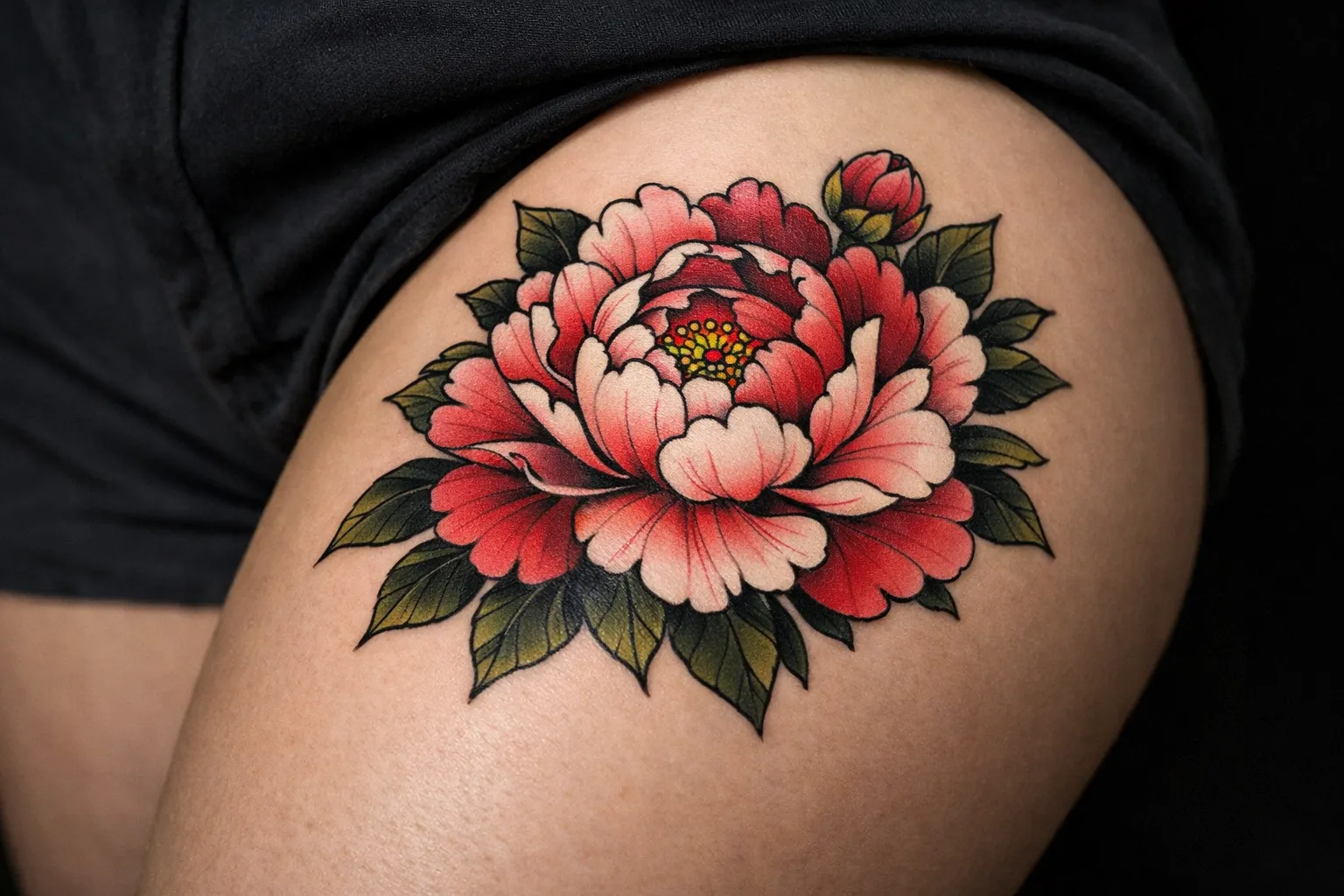
- Red peony - passion, love, honor, strength, wealth. The most common Japanese choice and the most legible from a distance.
- Pink peony - romance, femininity, admiration, good fortune. Reads soft; pairs well with fine-line work.
- White peony - purity, honesty, remembrance, apology. Also the historical Victorian reading of bashfulness. Good for memorial pieces.
- Purple peony - royalty, nobility, ambition, spiritual growth. Reads luxurious; uncommon enough to feel personal.
- Yellow or gold peony - happiness, friendship, new beginnings, prosperity. Often used in Japanese work to signal good fortune.
- Black peony - mourning, formality, respect, enlightenment. Don’t pick black for “cute aesthetic” without knowing this reads as funereal in Japanese contexts (2).
- Coral peony - success, abundance, strong relationships. A newer color in the symbolic conversation.
Stacking colors is how clients communicate complex intent. Red plus gold for love and prosperity. Pink plus coral for lasting relationship happiness. Black plus red for grief turned into protection. Tell your artist what the piece is for - they’ll build a palette that actually says it.
Traditional Styles in American and Western Contexts
A traditional peony tattoo in the American sense means thick black outlines, a limited palette of saturated reds, pinks, and greens, and simplified petal shapes. Two technical hallmarks: heavy, even line weight that doesn’t taper much, and bold color packed flat without much gradient. The common pitfall when artists do it badly is treating “traditional” as an excuse for sloppy outlines. The linework should be deliberate, not chunky by accident.
These designs age exceptionally well. The bold outlines and solid color blocks hold up at 10 and 20 years, which is why the style has stayed dominant since the WWII sailor era. I’ve seen traditional peonies on clients who got them in the early 2000s that still read clean and sharp - that’s not an accident, it’s the design logic of the style doing its job. If you want a single forearm peony at 4-6 inches that still reads clearly when you’re 60, traditional is the safest bet.
Neo-traditional pushes the same fundamentals further: still bold outlines, but with expanded color palettes, more shading depth, and decorative elements like daggers, moths, or banners.
Japanese Peony Tattoo (Botan): The Deepest Symbolic Lineage
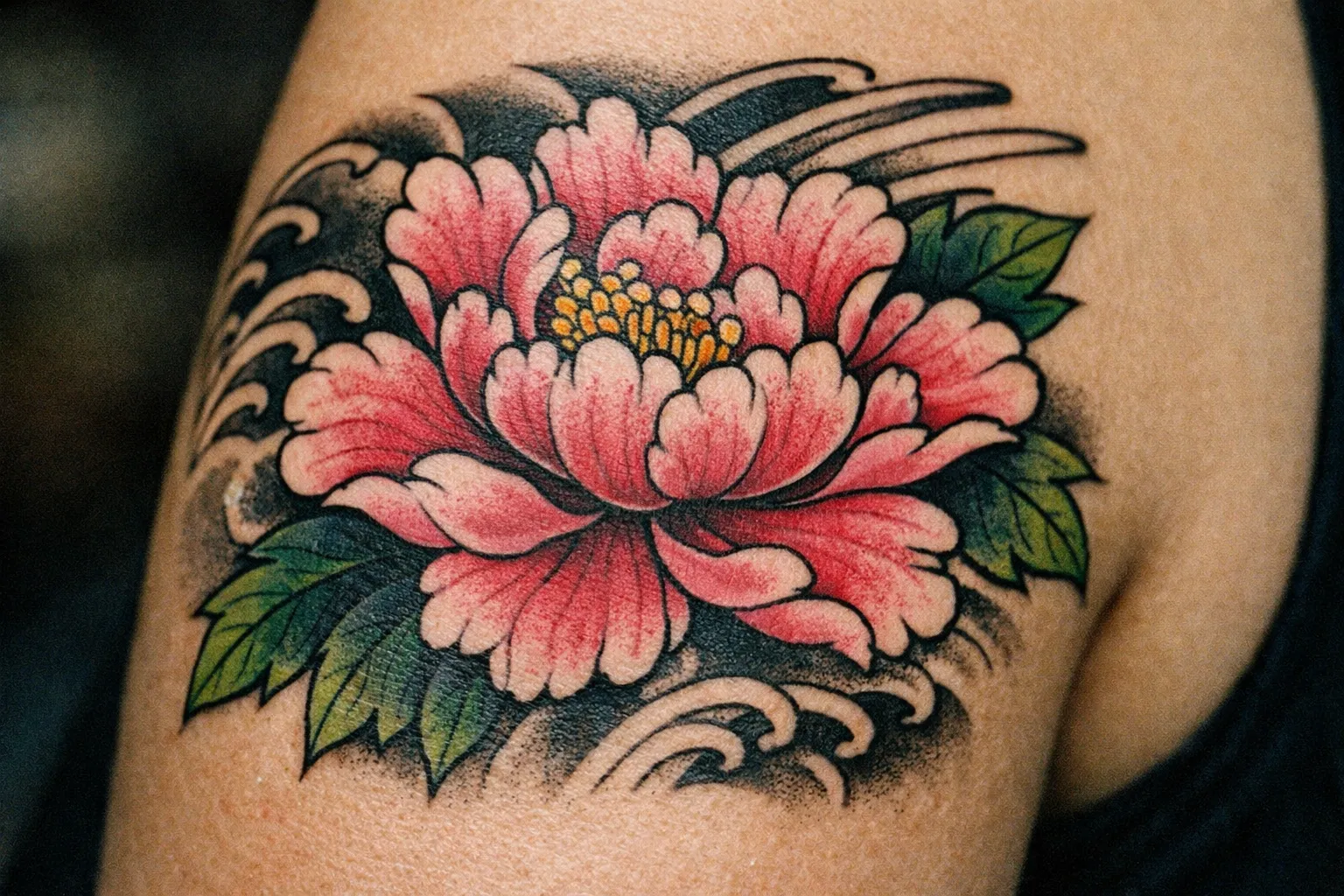
The Japanese peony tattoo - botan - is the version with the longest cultural tradition and the richest symbolic vocabulary. In irezumi it represents nobility, courage, prosperity, and masculine energy (3)(5)(6). The flower is almost never tattooed alone in classical Japanese work. It’s paired with:
- Karajishi (lion dogs / shishi) - the most traditional pairing. The lion is the king of beasts, the peony is the king of flowers in Chinese culture - a title that carried over into Japanese irezumi symbolism. Together they signal courage protecting beauty and wealth (3).
- Dragons - for power and wisdom flowing around prosperity.
- Koi - for perseverance and transformation.
- Tigers - for raw strength balanced against the softness of the petals.
Two technical hallmarks of Japanese peony work: bold outlines that survive scaling (designed to read clearly from 6-10 feet away, which is why petals are simplified into large readable shapes), and windbars, clouds, or waves as background to create flow across the body. The common pitfall is artists who copy the look without understanding the composition rules - peonies that don’t follow muscle curves end up looking pasted on.
This is a style where artist specialization matters a lot. I always tell clients: look for portfolios with at least 10-20 healed Japanese floral pieces, not fresh photos. Fresh tattoos always look good. Healed ones tell the truth.
What the Peony Means for Men
There’s an old assumption that florals read feminine. In Japanese tattoo culture, that’s never been true - the peony is one of the most masculine-coded motifs in the irezumi vocabulary (3)(6). For male clients, peony tattoo meaning typically lands on:
- Strength and masculinity - especially when paired with a tiger, dragon, or shishi
- Courage and honor - the samurai association from feudal Japan
- Prosperity and wealth - the inherited East Asian symbolism
- Personal transformation - using the peony to mark a turning point
- Cultural respect - for clients with East Asian heritage, or those engaging respectfully with the tradition
Sample concepts that work well for men: a half-sleeve with a single large peony and a shishi on the upper arm, finished with windbars; a chest panel with a dragon coiling through scattered peonies; a rib-to-hip piece with peony and koi swimming up the side. These read powerful, not delicate.
Realistic, Watercolor, Black and Grey, and Fine-Line Styles
Beyond traditional and Japanese, the peony adapts to most modern styles - with varying results.
Realistic peony tattoo - photographic detail, layered shading, often no visible outline. Best at 6+ inches on the thigh, upper arm, or back where there’s room for the detail to breathe. The pitfall: realism crammed into 2 inches turns to mush within 5 years. I’ve seen it happen faster than that on clients who went too small.
Watercolor peony tattoo - soft washes of pink and red bleeding into each other, minimal line work. Looks stunning fresh. Ages harder than other styles - without a foundational line, the color can blur over a decade. Only book this with an artist who can show you healed watercolor work at 3+ years, not just fresh photos.
Black and grey peony tattoo - all the form, none of the color. Shading carries the whole image. This style reads elegant and gender-neutral, and it lets the petal structure do the work instead of the palette. Excellent for cover-ups and for clients who want florals without the bright color commitment.
Fine-line peony tattoo - single-needle outlines, minimal shading. Best small (under 3 inches) on the wrist, ankle, collarbone, or behind the ear. The pitfall: lines thinner than roughly 0.2 mm equivalent can blow out or fade fast, especially on areas with a lot of movement or sun exposure. Don’t ask for “as thin as possible.” Ask for “as thin as ages well.”
Small Designs: Size, Placement, and What Actually Holds Up
A small peony tattoo (under 3 inches / 7.5 cm) is doable, but the design has to be edited for the size. You can’t shrink a detailed Japanese botan to 2 inches and expect it to read - the petals will merge. What works small:
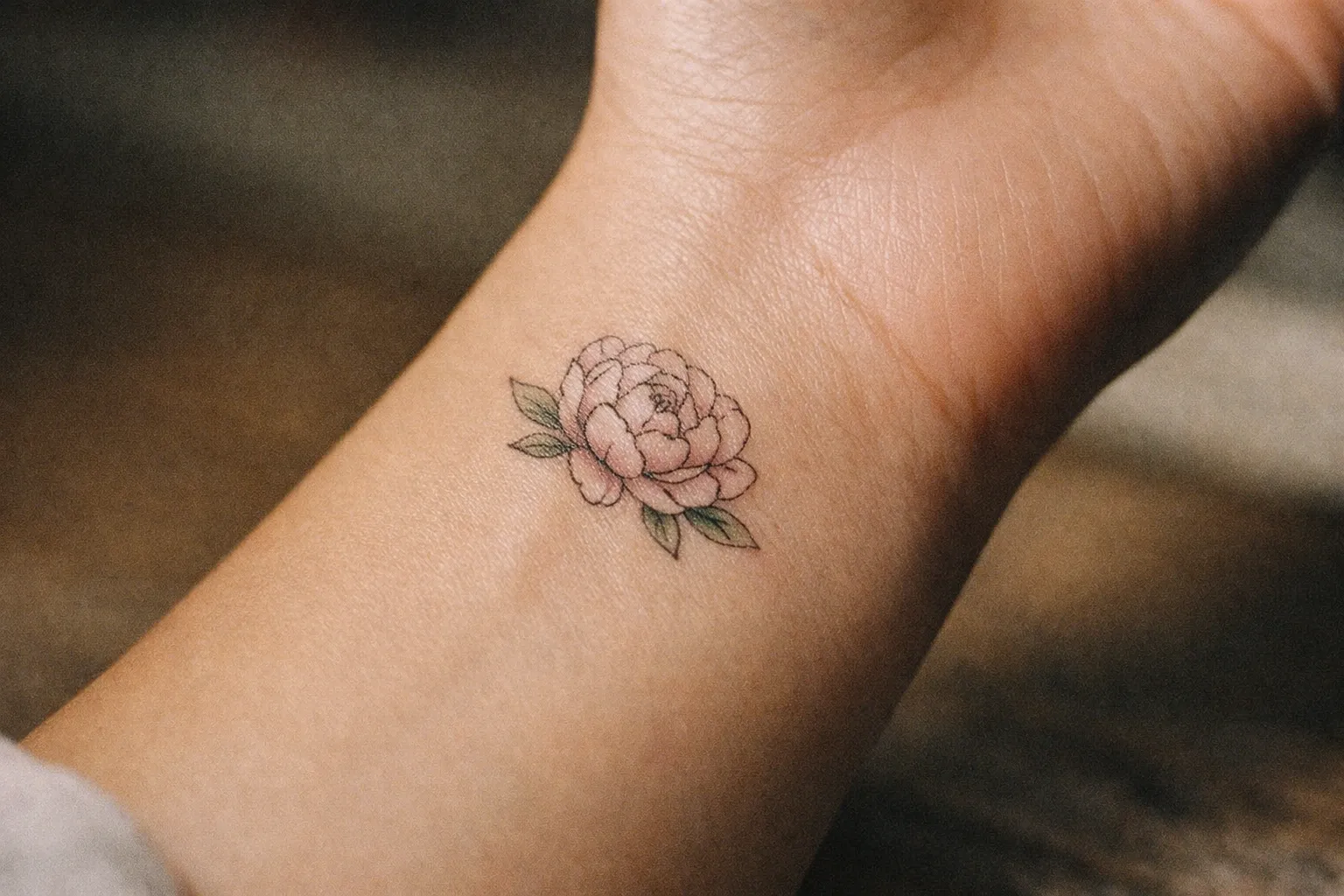
- Single bloom, simplified petals, 2-3 inches on the inner forearm, ankle, or back of the shoulder
- Fine-line outline with minimal color wash, 1.5-2.5 inches behind the ear or on the sternum
- Black and grey single peony, 2-3 inches on the inner bicep or ribs
Placements I’d push back on for a small peony: the side of the wrist (high movement, fades fast) and the fingers (blow out quickly and rarely hold detail past 2 years). Possible? Yes. Recommended? Not really.
Peony Flower Tattoo Placement: Where It Actually Blooms Well
Placement isn’t just about visibility. Peonies are round, and they need a body area that lets the circular shape sit naturally. Best placements by size:
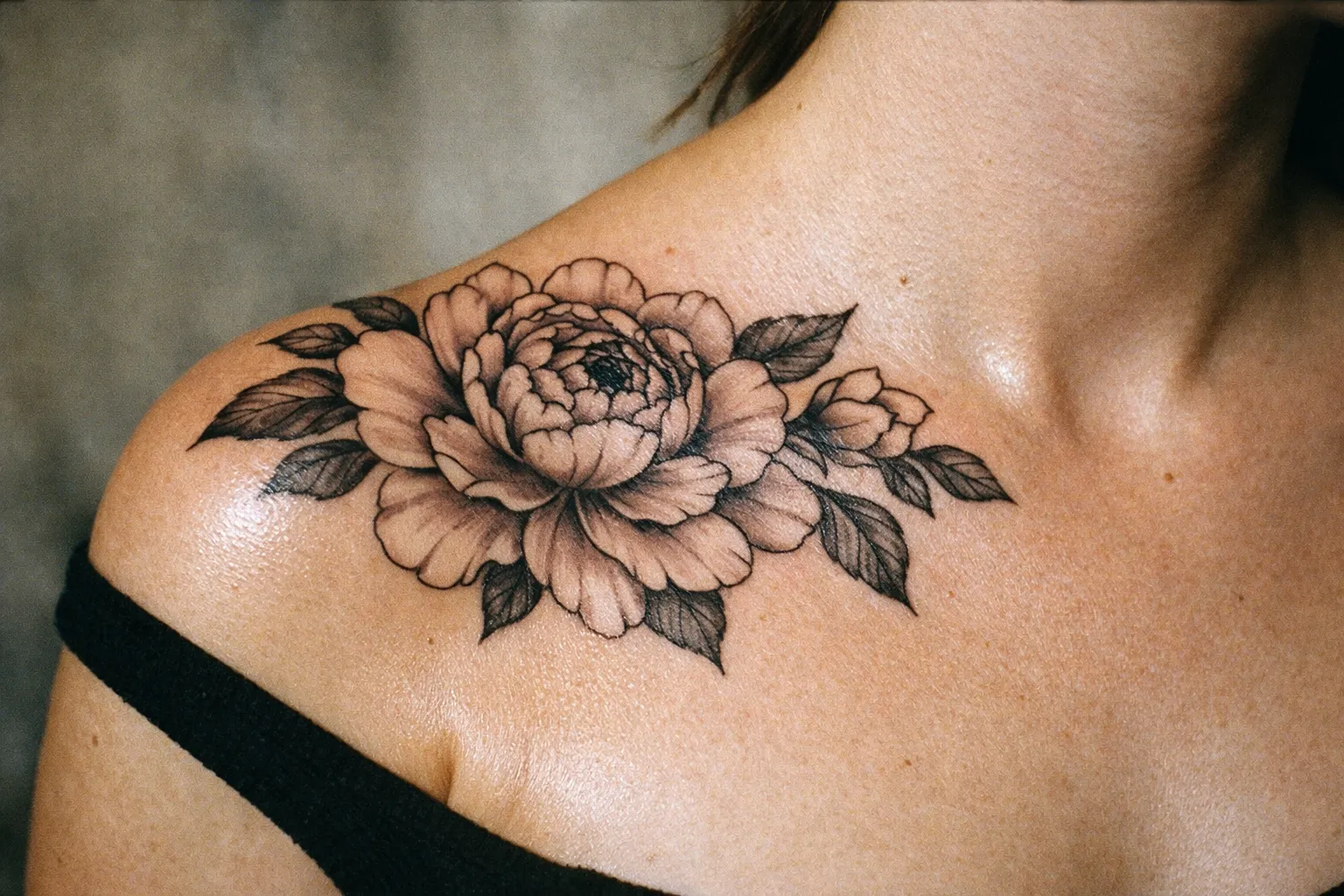
- Small (2-3 in / 5-7.5 cm) - inner forearm, ankle, back of neck, behind ear, sternum
- Medium (4-6 in / 10-15 cm) - outer forearm, shoulder blade, calf, thigh, ribs
- Large (8+ in / 20+ cm) - upper arm wrapping to shoulder, full back panel, full chest, full thigh
- Japanese sleeve or backpiece - designed across the whole canvas, not “placed” so much as composed
Peonies bloom best over curved muscle - bicep, calf, shoulder. They look cramped on very flat areas like the top of the foot or the inner wrist.
Pain notes: ribs and sternum hurt the most for a peony placement. Outer thigh and outer forearm are the most tolerable. Inner bicep and behind the knee fall in the middle but feel sharper than they look. Ribs > sternum > spine > inner bicep > forearm.
Cost and Time in 2026
US studio rates have climbed over the past few years. Current ranges, assuming a competent artist working at $150-$200/hour:
- Small fine-line peony (2-3 in) - $150-$300, 1-2 hours
- Medium peony with leaves (4-6 in) - $300-$650, 2-4 hours
- Japanese half-sleeve with peonies plus a secondary element (lion, dragon, koi) - $1,000-$2,500, 8-14 hours across 2-4 sessions
- Full backpiece with peonies and a major animal - $4,000-$9,000+, 25-45+ hours across 6-12 months
Booking lead times: 4-12 weeks for most reputable specialists. Artists with strong Japanese portfolios often book 6-12 months out. If you want a specific artist, plan accordingly.
Session counts for Japanese work are the thing clients underestimate most. A half-sleeve isn’t one three-hour appointment - it’s a linework session, then 2-4 color and shading sessions, with healing weeks in between. I’ve had clients genuinely surprised by this even after I explain it upfront.
The 1/3 Rule and Composition for Larger Peony Pieces
For sleeves, backpieces, and any large project, many Japanese-style artists work loosely to a one-third rule: your primary focal motifs (the main peony plus the main animal) take up roughly a third of the composition, secondary peonies and leaves fill another third, and background elements (windbars, clouds, negative space) make up the last third. This keeps the piece readable instead of turning into a wall of detail.
Applied to a peony tattoo specifically: don’t ask for “as many peonies as will fit.” A backpiece with three or four large, well-placed blooms reads better at 20 feet than one with twelve crammed blooms. The negative space is doing real work.
Aftercare and Healing
Color-heavy peonies - especially reds, pinks, and yellows - are some of the most pigment-sensitive tattoos to heal. Aftercare matters more here than for a blackwork piece.
Day 1-3: Keep the second-skin bandage on for the time your artist specifies (usually 12-24 hours, sometimes up to 5 days for newer film bandages). Once it’s off, gentle wash with fragrance-free soap, pat dry, leave open to air. Expect plasma weeping and some color leaking onto your clothes - this is normal.
Week 1: Apply a thin layer of fragrance-free moisturizer 2-3 times a day. No swimming, no soaking, no saunas, no gym sweat sessions. Light flaking starts around day 5-7.
Week 2-4: Itching peaks. Do not scratch. The flakes will lift on their own and pull color with them if you pick. Keep moisturizing. The tattoo will look dull and milky during this phase - that’s the new skin layer over the ink, not faded color.
Long term: Reds and pinks fade fastest under UV. Use SPF 30-50 on any peony tattoo that gets sun exposure, ongoing, for the life of the tattoo. Pair that with sun-protective clothing on days when you can’t reapply. This is the single biggest factor in whether your color still pops at year 10.
Full dermal healing takes up to 3 months. The piece will only look “settled” - final color, final crispness - around the 6-8 week mark.
Design Ideas by Life Theme
If you’re stuck on what you actually want, work backwards from meaning instead of style:
- For prosperity or a new chapter - red or gold peony, medium-to-large, paired with a dragon or coin motif. Japanese or neo-traditional.
- For love or partnership - pink peony near the sternum, ribs, or over the heart. Fine-line or watercolor.
- For healing or recovery - peony covering or framing a scar, often black and grey or muted color, paired with a phoenix or butterfly.
- For remembrance - white peony with a date or initial, often on the inner forearm or ribs.
- For strength and masculine power - Japanese sleeve or backpiece with peony plus tiger, dragon, or shishi.
Related Floral and Japanese Motifs Worth Considering
If you’re drawn to peonies, you’re probably also drawn to a few neighboring motifs. Worth a look during your reference-gathering:
- Chrysanthemum (kiku) - the other “noble” Japanese flower; symbolizes longevity and the imperial line
- Cherry blossom (sakura) - impermanence and the beauty of fleeting moments
- Lotus - purity emerging from difficulty; strong in Buddhist symbolism
- Rose - the Western parallel to the peony in symbolic weight
- Magnolia - softer alternative with similar petal structure
Some clients end up with a peony as the centerpiece and one of these as a secondary motif in a larger piece. That’s often a stronger composition than two peonies competing for the same real estate. If you’re exploring flower tattoo ideas more broadly, combining birth flowers or pairing a peony with a complementary bloom can yield a richer, more personal design.
The chrysanthemum tattoo is worth a close look if you want a second noble Japanese flower that pairs naturally with the botan - the kiku carries its own deep symbolism around longevity and the imperial line that layers well alongside peony meanings. Similarly, a cherry blossom tattoo makes a strong secondary motif for clients who want to balance the peony’s associations with wealth and power against the sakura’s message of impermanence and fleeting beauty.
For clients leaning toward the Western symbolic tradition, a rose tattoo offers a useful point of comparison - both flowers carry weight around love and honor, but the rose’s blackwork and hybrids age differently than a peony’s layered petals, and understanding that contrast helps you choose the right focal point for a larger piece.
Choosing Your Artist
A peony tattoo lives or dies on the artist. Three things to check:
- Healed photos in the style you want. Fresh photos lie. Ask specifically to see work that’s at least 1-2 years healed.
- Style match. A traditional artist is not a Japanese artist is not a fine-line artist. Don’t book the wrong specialist because the price is right.
- Communication on meaning. A good artist will ask why you want a peony, not just sketch the first reference you send. If they don’t ask, they’re not designing - they’re copying.
Avoid: heavily filtered Pinterest-perfect designs from artists who only post fresh work, ultra-low prices that signal inexperience or rushed sessions, and any studio that won’t show you their sterilization setup.
Frequently Asked Questions
- What do peonies symbolize in a tattoo?
- Peonies symbolize wealth, beauty, honor, courage, romance, and healing, with emphasis varying by culture and color. Japanese irezumi associates them with nobility and masculine power, while Western tattooing highlights romance and strength beneath beauty.
- What is the 1/3 rule tattoo?
- It's a composition guideline for large tattoos where primary motifs occupy about one-third of the space, secondary elements another third, and background or negative space the last third, maintaining readability especially in sleeves and backpieces.
- Are peony tattoos only for women?
- No. In Japanese tradition, peonies are heavily masculine-coded, especially when paired with lions or dragons. The idea that florals are feminine is a recent Western framing, not universal.
- How long until I can swim with a fresh peony tattoo?
- Wait at least two weeks, ideally three, before swimming. Submerging color-heavy peonies too early causes pigment loss, especially in reds and pinks.