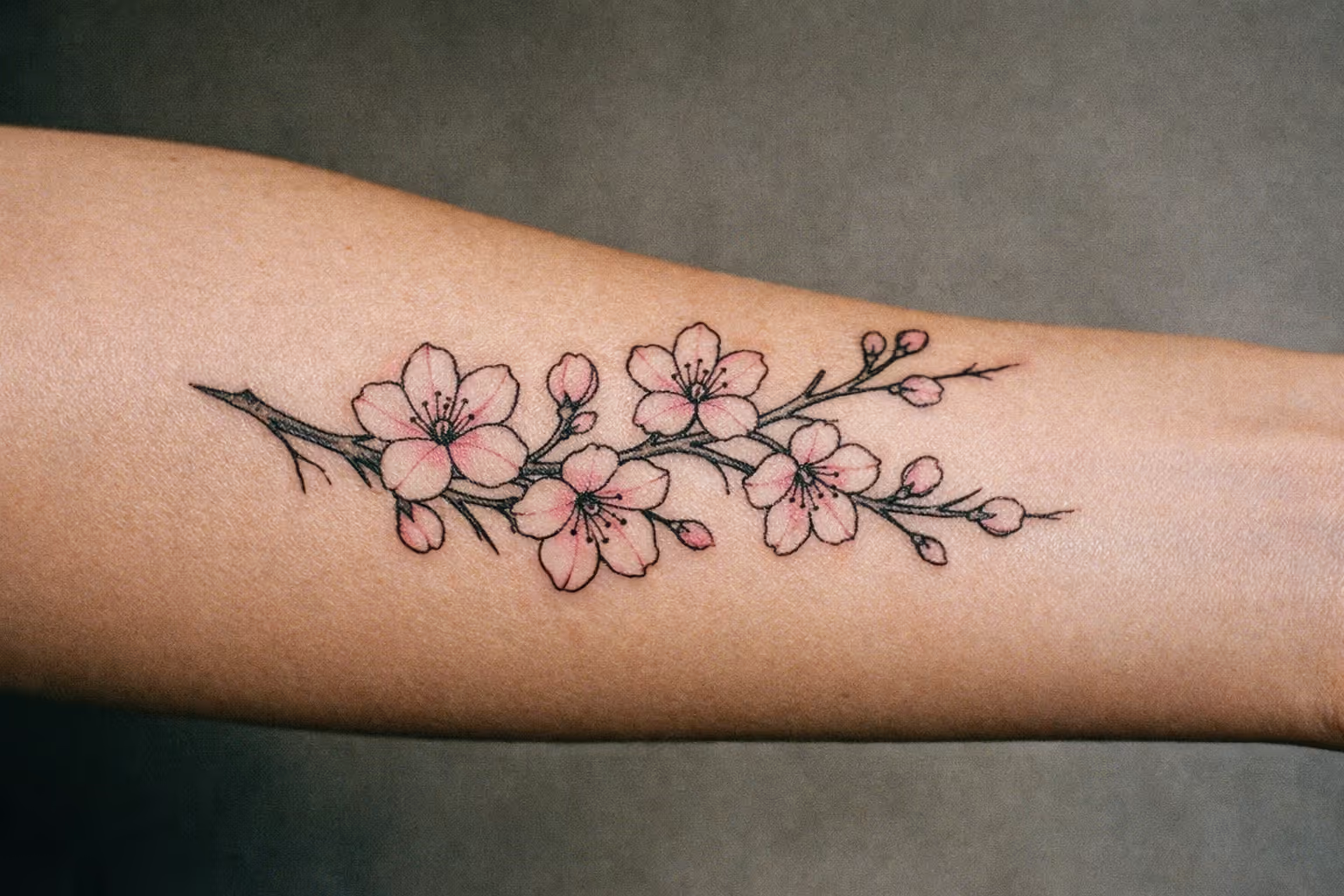
One detail most people get backwards on a cherry blossom tattoo: falling petals read as grief, not healing. It’s a heavier, more specific flower than the soft-pink Pinterest version lets on, and the direction of the petals is only the first of several calls that change what your piece says. Get them wrong and the symbolism quietly works against you. Here’s what the flower actually stands for, and the design decisions that decide how it ages, costs, and lands.
Cherry Blossom Tattoo Symbolism: What the Flower Actually Stands For
The dominant reading of cherry blossom tattoo symbolism comes from Japan, where sakura is tied to the Buddhist concept of impermanence - the idea that everything beautiful is temporary, and that’s the point (5)(6). The aesthetic term for this is mono no aware: a quiet, slightly bittersweet awareness that the moment in front of you is already passing.
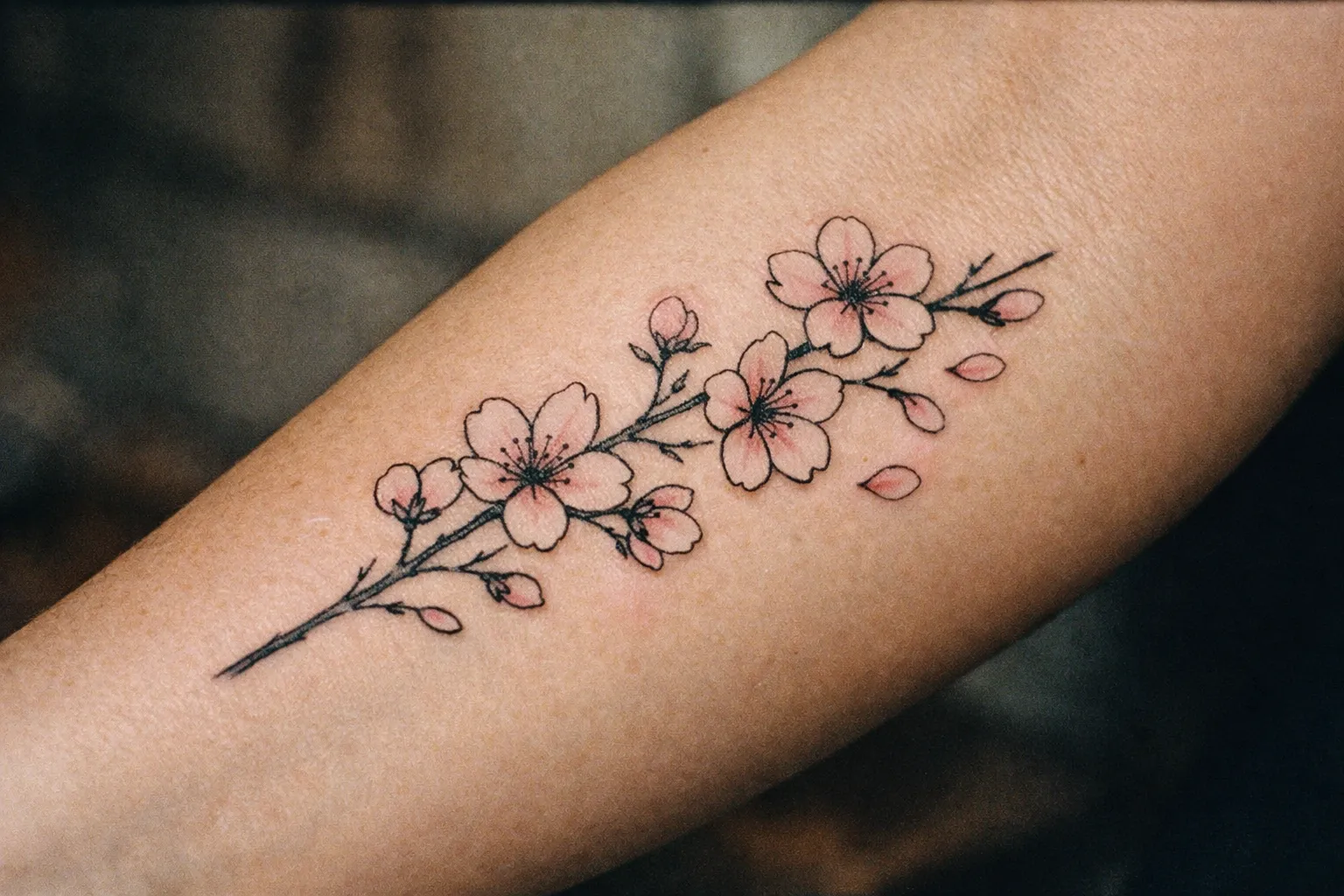
A few specific meanings show up over and over:
- Impermanence and the passing of time - the core Japanese reading, often visualized through falling petals (4)(6).
- New beginnings and rebirth - sakura blooms at the edge of spring, so it doubles as a winter-is-over symbol (3)(5).
- Strength under pressure - the tree survives hard winters and still flowers early. In Samurai culture, this paralleled the Bushido ideal of facing death with composure (3).
- Femininity, love, and grace - especially prominent in Chinese readings, where the flower leans toward feminine power and independence (3)(5).
- Remembrance - sakura is a common tribute motif for someone who has died (1).
The meaning is not fixed across cultures, which matters before you ink one on. A cherry blossom on a Japanese-style sleeve and a cherry blossom on a Chinese-influenced design are reading from different scripts.
How Cherry Blossom Meaning Shifts Across Cultures
If you’re building cherry blossom tattoo meaning into a piece deliberately, the cultural source you’re drawing from changes the design choices - sometimes significantly.
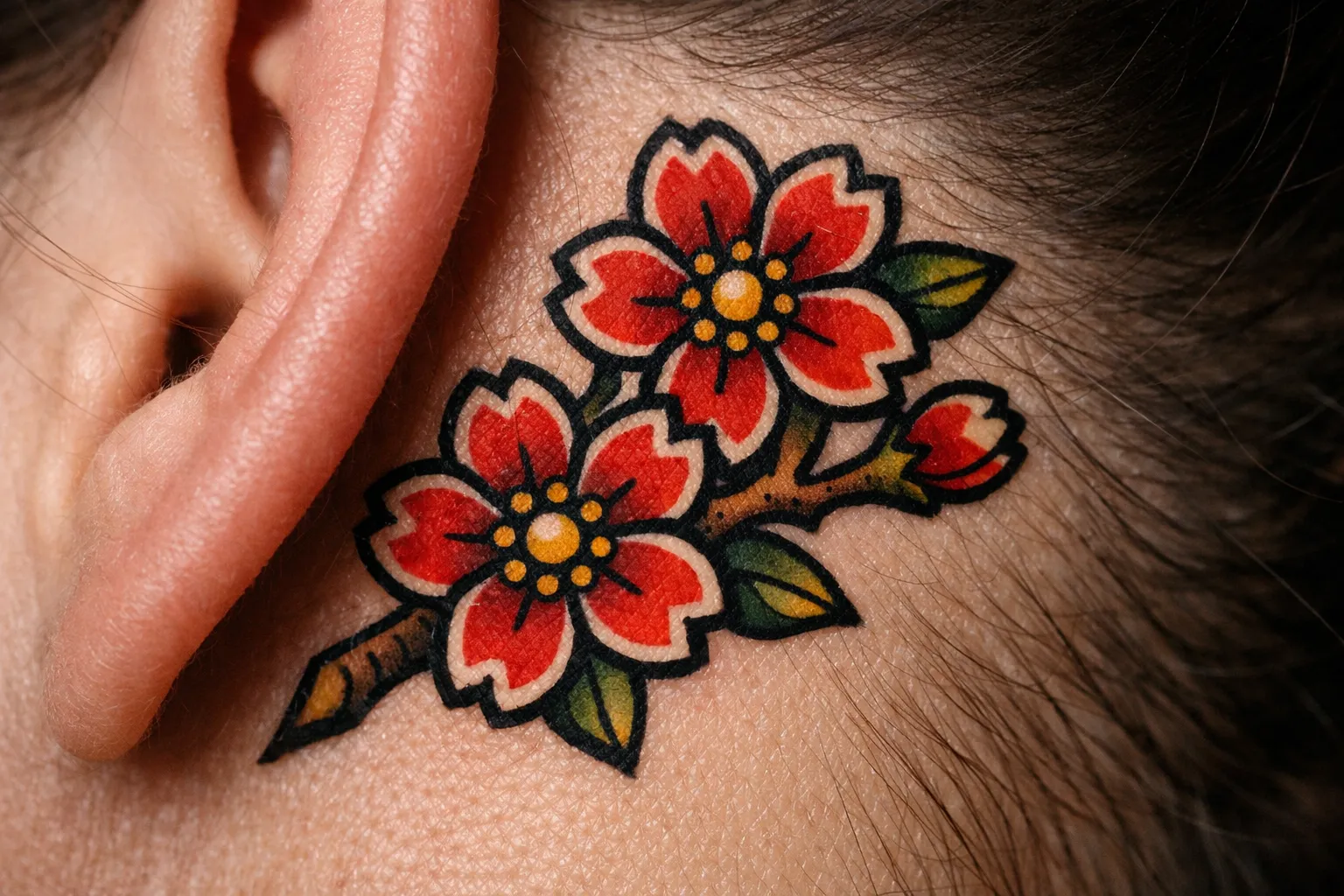
Japanese (sakura) - the tradition most tattoo artists work from. Sakura here means transience, the Buddhist mono no aware, and historically the Samurai/Bushido ideal: a short, intense, honorable life. Heavy black outlines, wind bars, and water motifs are standard. Often paired with koi, dragons, tigers, or geisha in a full irezumi composition (3).
Chinese - cherry blossoms lean toward love, feminine strength, sexuality, independence, and harmony with nature (3). Designs work well with calligraphy, cranes, or bamboo. Color tends to be softer and the composition less dense than Japanese irezumi.
Korean - cherry blossoms appear in Korean culture as a spring symbol associated with romance, happiness, and fresh starts (5), but their status is more complicated than a straightforward national symbol. Due to Japan’s colonial-era promotion of sakura in Korea, the flower carries contested associations for many Koreans - some embrace it as a seasonal motif, others view it with ambivalence. If you’re drawing from Korean cultural context specifically, it’s worth knowing that history before you frame the symbolism.
If you don’t have a strong cultural connection to any of these traditions, pick the symbolism that genuinely lines up with your reason for the tattoo and tell your artist which one you’re drawing from. That single conversation prevents a lot of designs that “look Japanese” but mix motifs that contradict each other. I’ve seen it happen more times than I can count - a client comes in with a reference image that’s half irezumi, half Chinese ink painting, and they’re surprised when the finished piece feels visually confused.
Design Styles: What a Sakura Cherry Blossom Tattoo Actually Looks Like
The phrase sakura cherry blossom tattoo covers a wide range visually. The four styles you’ll actually choose between:
Traditional Japanese (irezumi) - thick black outlines, limited palette (pink, red, black, sometimes white), and a background of wind bars or water. Built for scale: forearm, full sleeve, back. Common pitfall when done badly: the outlines are too thin, so the piece looks like Western color realism with Japanese motifs glued on, and it loses the graphic punch within a few years.
Fine-line / minimalist - delicate single-needle outlines, soft shading, 3-7 blossoms on a thin branch. Great for first tattoos. Works at small scale: behind the ear, inner wrist, collarbone, ankle. Pitfall: artists who don’t specialize in fine-line will use a liner that’s too heavy, and the petals look chunky instead of airy. Look at healed work, not fresh photos. Fresh fine-line always looks sharper than it will at six months.
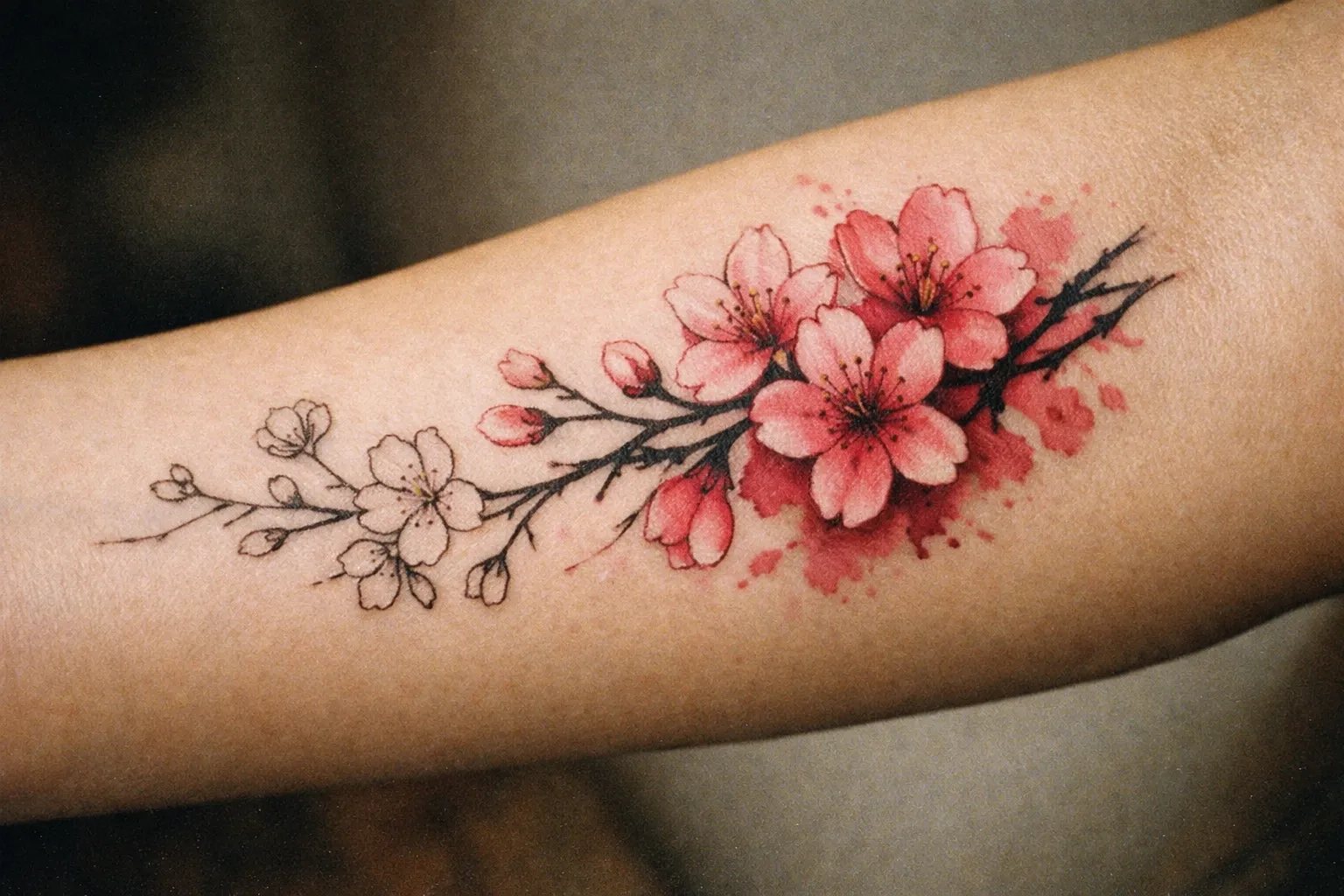
Watercolor - soft pink and magenta washes, sometimes with splashes around the branch. Visually striking when fresh. Honest caveat: without strong linework underneath, watercolor sakura tends to lose definition faster than other styles. How soon you’ll need a touch-up depends heavily on placement, sun exposure, and how the individual artist lays in the pigment - there’s no universal timeline, but sun-exposed pieces on high-friction spots can soften noticeably within a few years, while a well-protected sternum piece might hold longer.
Black and grey - branches and petals rendered entirely in greyscale. Subtle, ages well, and a good option if you want the symbolism without committing to pink. Common pitfall: artists pack too much grey into petals, which kills the lightness that makes the flower read as a cherry blossom rather than a generic five-petal flower.
Cherry Blossom Tree Tattoo Compared to Branch and Single Bloom Options
The amount of plant you put on your skin changes the meaning. A cherry blossom tree tattoo reads differently from a single branch, and both read differently from a loose scatter of petals.
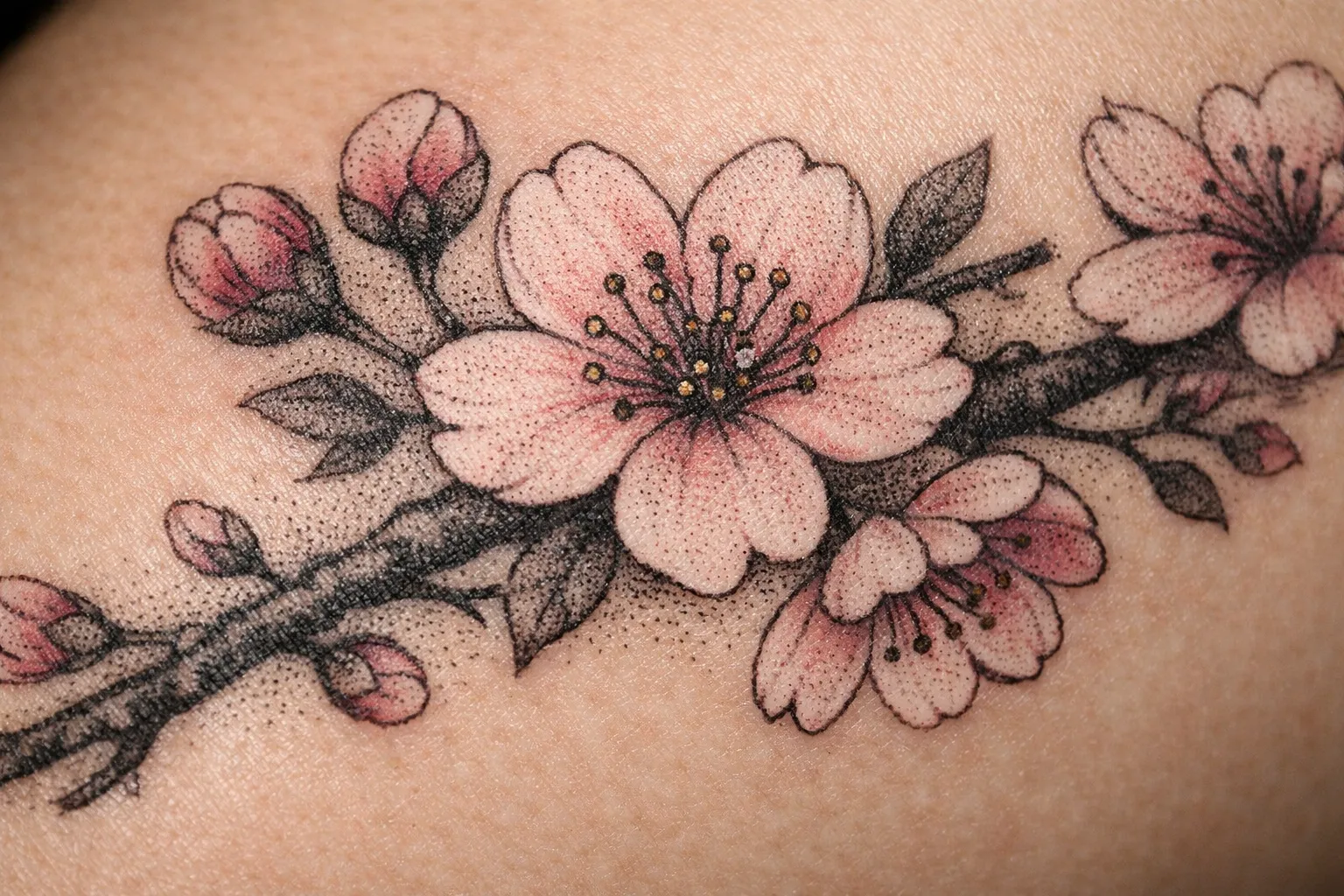
- Full tree - works as a life-cycle motif: roots, trunk, branches, blooms, falling petals. Best on the back, full thigh, or as the central piece of a sleeve. Needs at least 8-10 inches of real estate to keep the trunk and branches legible at healing-and-aged scale.
- Branch (most common) - a 4-8 inch curved branch with clustered blossoms. Reads as a personal-growth or transition piece. Flatters anatomy if the curve follows the forearm extensor line, collarbone, or shoulder cap.
- Single bloom or small cluster - 1-2 inches, fine-line, often behind the ear, on the inner wrist, or behind the ankle. Reads more as a quiet personal token than a cultural statement.
- Falling petals only - petals drifting across the ribcage or down the spine without a visible branch. Strong “letting go” or grief symbolism (2). Be honest with yourself about which one you’re choosing - petals on their own rarely read as “happiness.”
That last point matters more than people expect. I’ve had clients come in wanting something light and optimistic, show me a reference of scattered petals, and not realize the visual language they’re working with until we talk it through.
Popular Placements and How They Age
A few practical placement notes from working on these over the years:
- Forearm - the most forgiving spot for a medium branch (4-6 in). Holds detail well, ages slowly, easy to show or cover.
- Shoulder and upper back - best for full tree designs or compositions with koi/dragon. Skin doesn’t stretch much, so detail stays crisp.
- Sternum and ribcage - visually dramatic for falling-petal designs, but pain is significantly higher than forearm or shoulder, and the skin movement here can soften fine lines over time.
- Behind the ear, inner wrist, ankle - best for micro fine-line pieces (1-2 in). Avoid the side of the finger and the outer edge of the foot; high-friction zones eat fine-line petals within a few years.
- Full sleeve - Japanese-style sakura sleeves work best when blossoms spiral gently around the arm rather than sitting flat on the front, so you don’t get awkward cropping when you move.
Pain ranking, roughly: ribcage and sternum > inner bicep > ankle > shoulder cap > outer forearm. Plan placement around pain tolerance and how visible you want it, not just aesthetics.
What It Costs and How Long It Takes in 2025-2026
Prices vary by city and artist, but these ranges are accurate for mid-tier US studios right now:
- Small fine-line piece (1-2 in, 30-60 min): $80-$200, often hitting the studio minimum.
- Medium branch (4-6 in, forearm or shoulder, 2-4 hours): $250-$600.
- Half-sleeve cherry blossom composition (6-10 hours over 2-3 sessions): $700-$1,800 at $100-$180/hour.
- Full Japanese sleeve with sakura, koi, dragon, waves (20-40 hours): $2,000-$6,000+. Senior irezumi specialists in major cities charge $200-$300/hour.
Sessions are usually spaced 2-4 weeks apart to let skin heal between sittings. Build a 20-30% buffer into your budget - good artists often want extra time for petal saturation and clean linework, and rushing that is how you end up needing a touch-up at year two.
A Symbol for Anxiety and Emotional Healing
If you’re looking at sakura as an anxiety or recovery tattoo, the symbolism actually does the work - but only if the design matches the feeling you want to land on.
The flower’s core meaning is acceptance of change (2)(5). For anxiety specifically, that translates well into designs that visualize moving through a hard moment rather than holding onto one:
- Buds transitioning to full bloom along a branch - visually maps healing over time. Place the more open blossoms higher on the design, closer to the heart or shoulder.
- A single open bloom with a few falling petals - reads as “this feeling is real and it will pass.” Cleaner than scattering petals everywhere.
- A branch that slightly thins toward the end - a subtle way to encode mono no aware without anything overtly spiritual on your skin.
What to avoid if the goal is grounding rather than grief: heavy showers of falling petals, dark backgrounds, and dates. Those compositions read as memorial pieces in tattoo language, not as “I’m getting better” pieces (2). If grief and anxiety are tangled together for you, that’s a conversation to have with the artist before stencil - they’ll weight the design differently.
Sakura works well for this category because it doesn’t romanticize struggle. It says the hard part is real, and so is the next bloom.
What Cherry Blossoms Mean Spiritually
Spiritually, cherry blossoms sit at the intersection of Buddhist and Shinto thought. The Buddhist reading is impermanence - anicca, the principle that every moment is changing - which in Japanese aesthetics becomes mono no aware, the bittersweet awareness that beauty exists because it’s temporary (6).
The Shinto reading is closer to hanami: the seasonal practice of gathering under the trees to actively notice the bloom. It’s spirituality through presence rather than doctrine - being where you are, while the petals are still on the branch (6).
In Chinese tradition, the spiritual angle leans Taoist: harmony with natural cycles, the body in tune with the seasons, feminine principle in balance with the rest of the world.
For a tattoo, you don’t have to pick one. But knowing which tradition you’re closest to helps you and your artist make small calls - the density of petals, whether the wind is moving them, whether the branch is in full bloom or half-finished - that all push the spiritual reading one way or the other. These details look minor on paper. In the finished piece, they’re the difference between a design that feels intentional and one that just looks like a flower.
Is the Cherry Blossom the Prettiest Flower to Tattoo?
“Prettiest” is subjective, but among the most-tattooed flowers - rose, lotus, peony, sunflower, cherry blossom - each one has a specific visual strength:
- Rose wins for bold realism and color depth. Best when you want a single dominant subject.
- Lotus wins for symmetry and mandala-style compositions. Best for centered, geometric pieces.
- Peony wins for layered, dense petals and Japanese-style filler. Often pairs with sakura in irezumi.
- Sunflower wins for graphic shape and yellow saturation. Hard to do subtly.
- Cherry blossom wins for flow, negative space, and the ability to wrap a body part organically (2).
If you want a tattoo that follows the curve of your arm or moves with your body - and reads softly rather than loudly - cherry blossoms outperform the others. If you want a bold focal point, rose or peony is the better pick. They’re not competing for the same job.
Common Mistakes to Avoid
A few mistakes that show up repeatedly in cover-up consultations:
- Random kanji paired with sakura. Miswritten or context-free characters are one of the most common cover-up requests. If you want text, work with someone who reads the language.
- Mixing motifs that contradict each other. Sakura plus chrysanthemums plus cranes plus koi in a 4-inch forearm piece is a muddy tattoo by year three. Pick a focal motif and let the rest support it.
- Underestimating sun fade on pink. Pale pinks and whites fade fastest. SPF 30-50 on the tattoo any time it’s in the sun is the difference between vivid at year five and washed-out at year three.
- Choosing falling petals when you wanted happiness. Falling petals carry grief weight (2). If the tattoo is about a good thing, keep the blossoms on the branch.
- Going too small on detailed Japanese designs. Irezumi compositions need scale to breathe. A 3-inch sakura-and-dragon piece will blur into a smudge over time.
That last one is where I push back hardest in consultations. Clients see a reference image at full sleeve scale and want to shrink it to fit a forearm. The design doesn’t survive that compression - not at 10 years, anyway.
Aftercare Timeline
Pink pigment and fine petal lines need slightly more care than a black-only piece. Standard timeline:
- Day 1-3: Leave the artist’s wrap on as instructed (usually second-skin for 3-5 days, or plain wrap for 2-4 hours). After removal, gentle wash 2-3x daily with a fragrance-free soap. Thin layer of a fragrance-free healing ointment. Expect oozing and some color on the bandage - that’s normal.
- Week 1: Switch from ointment to a fragrance-free moisturizer once the surface dries. No soaking, no swimming, no sunbeds. The tattoo will feel tight and look slightly dull. Light flaking starts around day 5-7 - do not pick it.
- Week 2-4: Skin surface looks normal but pigment is still settling. Keep moisturizing daily. Avoid direct sun. The pinks may look slightly hazy under the new skin - this lifts as it heals.
- Long-term: SPF 30-50 any time the tattoo is in the sun. Sun-protective clothing works even better than sunscreen for pieces that are regularly exposed. A touch-up around year 3-5 is reasonable for watercolor or fine-line pinks; traditional Japanese pieces with strong outlines usually go longer between touch-ups.
Full settling - color, line crispness, and texture - takes 4-8 weeks. For a deeper look at what to expect during each stage of healing, the week-by-week healing rules cover the full process in detail.
Decoding Cherry Blossom Tattoos from Inspiration Photos
Most people show up to a consultation with a stack of saved images. A few quick reads to translate what you’re actually looking at:
- Heavy black background with sakura - that’s a traditional Japanese piece, almost certainly part of or designed for a sleeve. Expect 8+ hours of work and a budget over $1,000 for anything that looks like the full version.
- Soft pastel sakura with no outlines - that’s fine-line or watercolor work. Realistic budget $200-$500 for a forearm-size piece. Plan for a touch-up around year 3-5.
- Single branch on white skin, no shading - that’s a fine-line minimalist piece, usually 2-4 inches, $150-$400.
- Sakura with koi or dragon - full irezumi territory. Don’t bring this to an artist who doesn’t specialize in Japanese; bring it to one who does, and budget accordingly.
Knowing which category your inspiration falls into before you book saves a lot of “this isn’t what I thought it would be” conversations at the stencil stage.
Frequently Asked Questions
- What does a cherry blossom tattoo symbolize?
- It symbolizes the transient nature of life, beauty, and renewal rooted in Japanese culture, with additional meanings of love and femininity in Chinese tradition and patriotism and fresh starts in Korean culture.
- What's a good tattoo for anxiety?
- Cherry blossoms that emphasize movement through change - like buds opening along a branch or a single bloom with a few falling petals - work well. The imagery should convey 'this passes' rather than 'this stays.'
- What do cherry blossoms mean spiritually?
- They represent Buddhist impermanence and the Japanese *mono no aware*, Shinto presence through *hanami*, and Taoist harmony with natural cycles in Chinese tradition.
- What is the prettiest flower to tattoo?
- Prettiness depends on the design goal: cherry blossoms excel at flowing, organic wraps; roses at bold, realistic focal points; lotuses at symmetrical geometric pieces; peonies at dense layered petals.
- Does a cherry blossom tattoo fade faster than other tattoos?
- Yes, pink and white pigments fade faster, especially without sun protection. How quickly fine-line and watercolor styles need a touch-up varies significantly by placement, sun exposure, and the artist's technique - there's no fixed interval. Traditional Japanese pieces with strong black outlines generally hold up longer between touch-ups.
- Is it cultural appropriation to get a sakura tattoo if I'm not Japanese?
- Most Japanese tattoo artists see sakura as a shared motif if you understand its meaning, avoid mixing contradictory motifs, and work respectfully with knowledgeable artists.