Most tattoo infections don’t announce themselves on day one - they take hold around days 3-5, right when the early redness is supposed to be fading and you’ve stopped watching closely. That’s also exactly when normal healing (some redness, clear ooze, flaking) looks most like the start of something worse. Telling them apart is the whole game. Here’s how to read an infected tattoo, what’s normal, and the point where it’s urgent care, not more ointment.
Overview: What an Infected Tattoo Actually Is
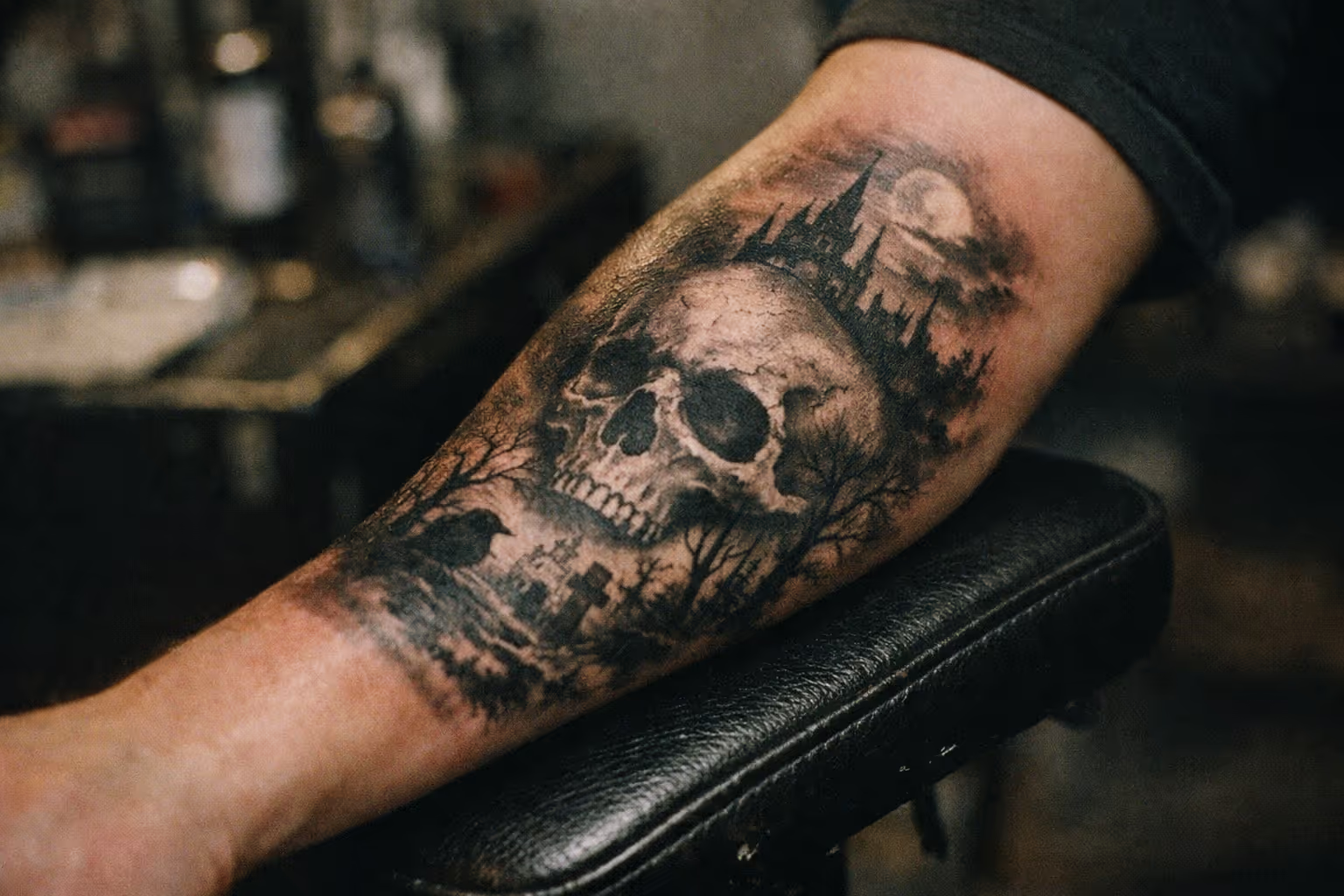
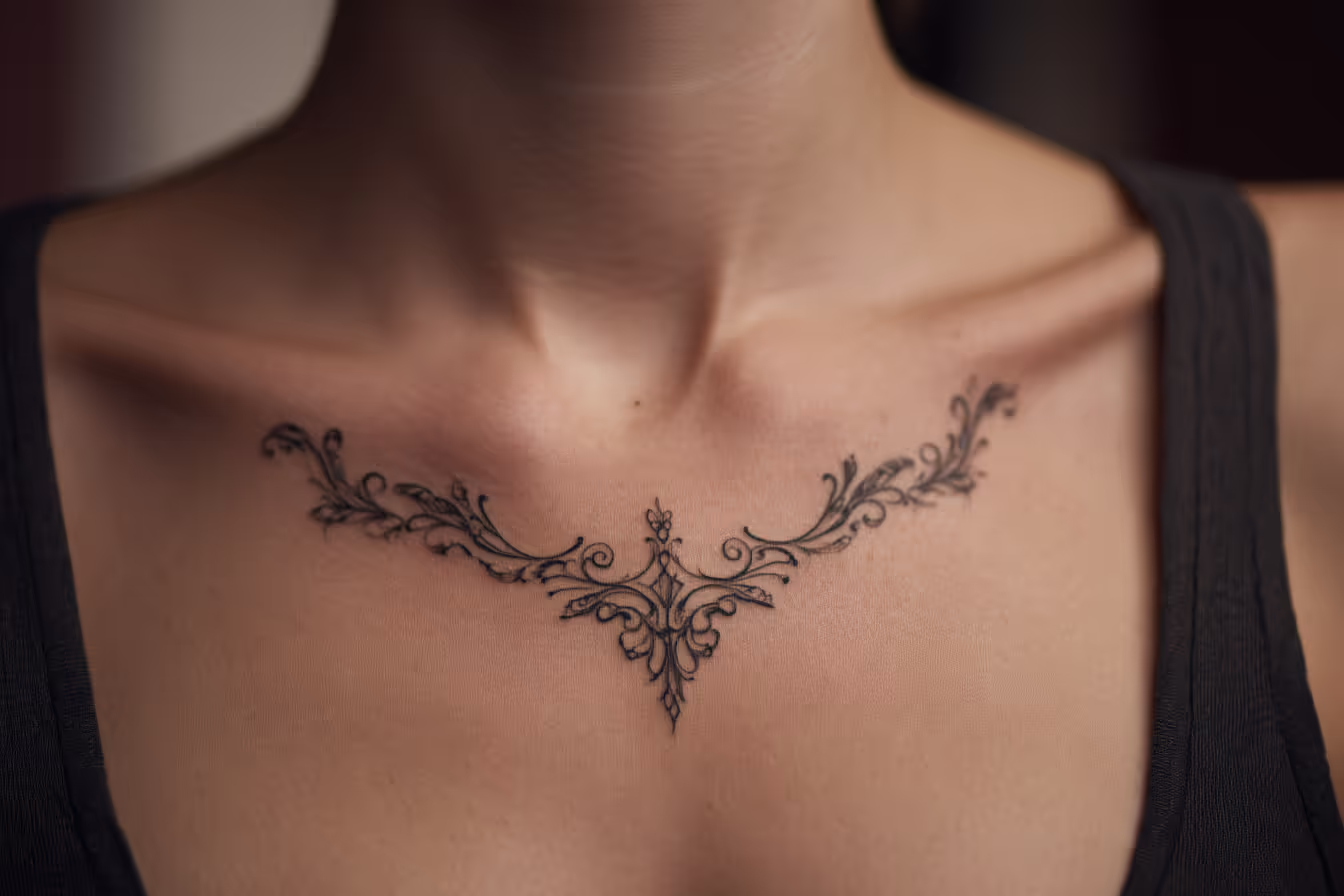
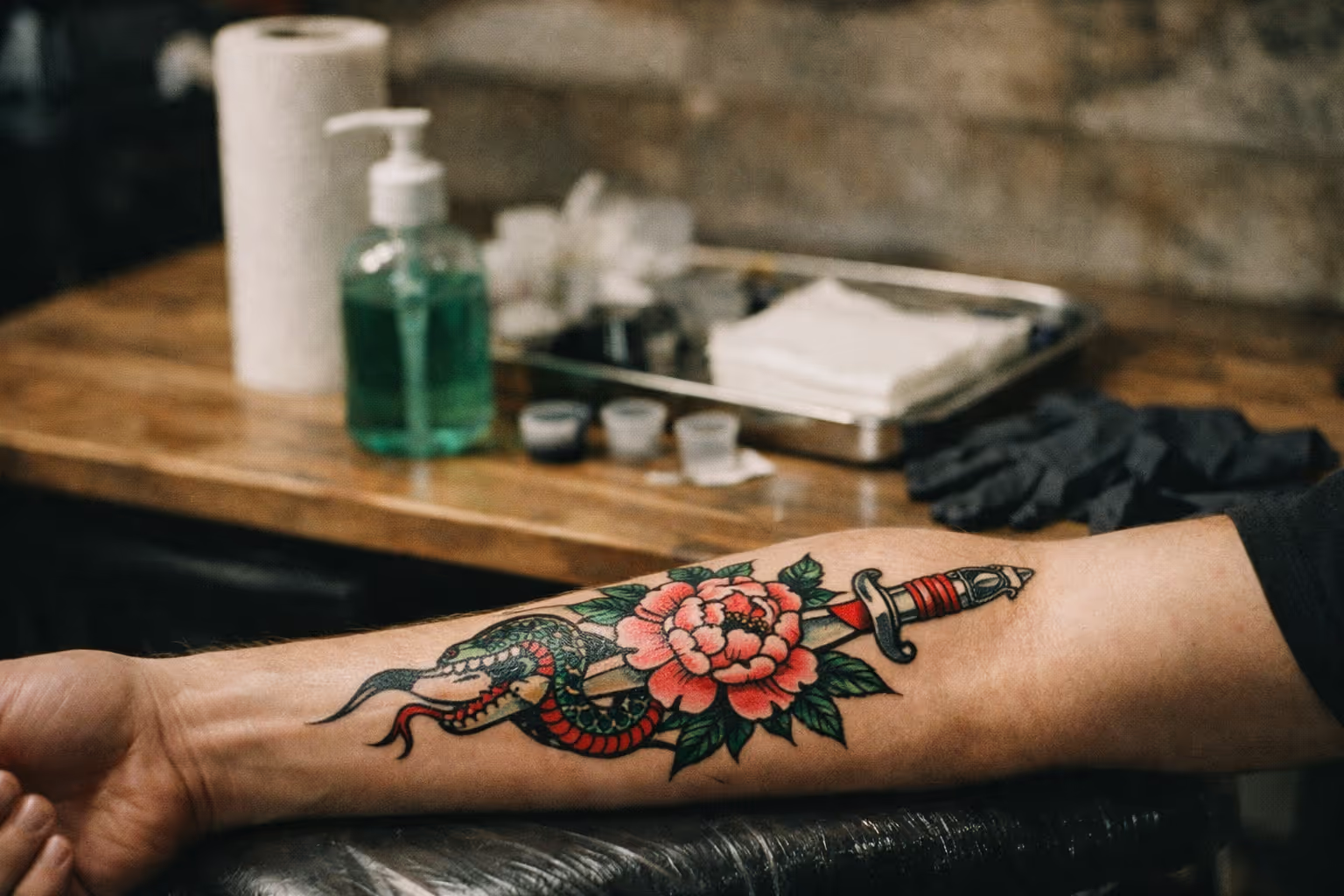
A tattoo is a controlled wound. The needle drives pigment past the epidermis into the dermis, and your immune system spends the next two to four weeks closing that wound. An infected tattoo is what happens when bacteria - most often Staphylococcus aureus or Streptococcus species - colonize that wound before it heals. I’ve seen this play out across every style I work in - American traditional pieces on the forearm, fine-line work on the sternum, small Japanese-influenced designs behind the ear - and placement matters more than most people realize. A 3-4 inch piece on the inner forearm heals in a different environment than a 2-inch design tucked behind the ear, and the infection risk profile shifts accordingly.
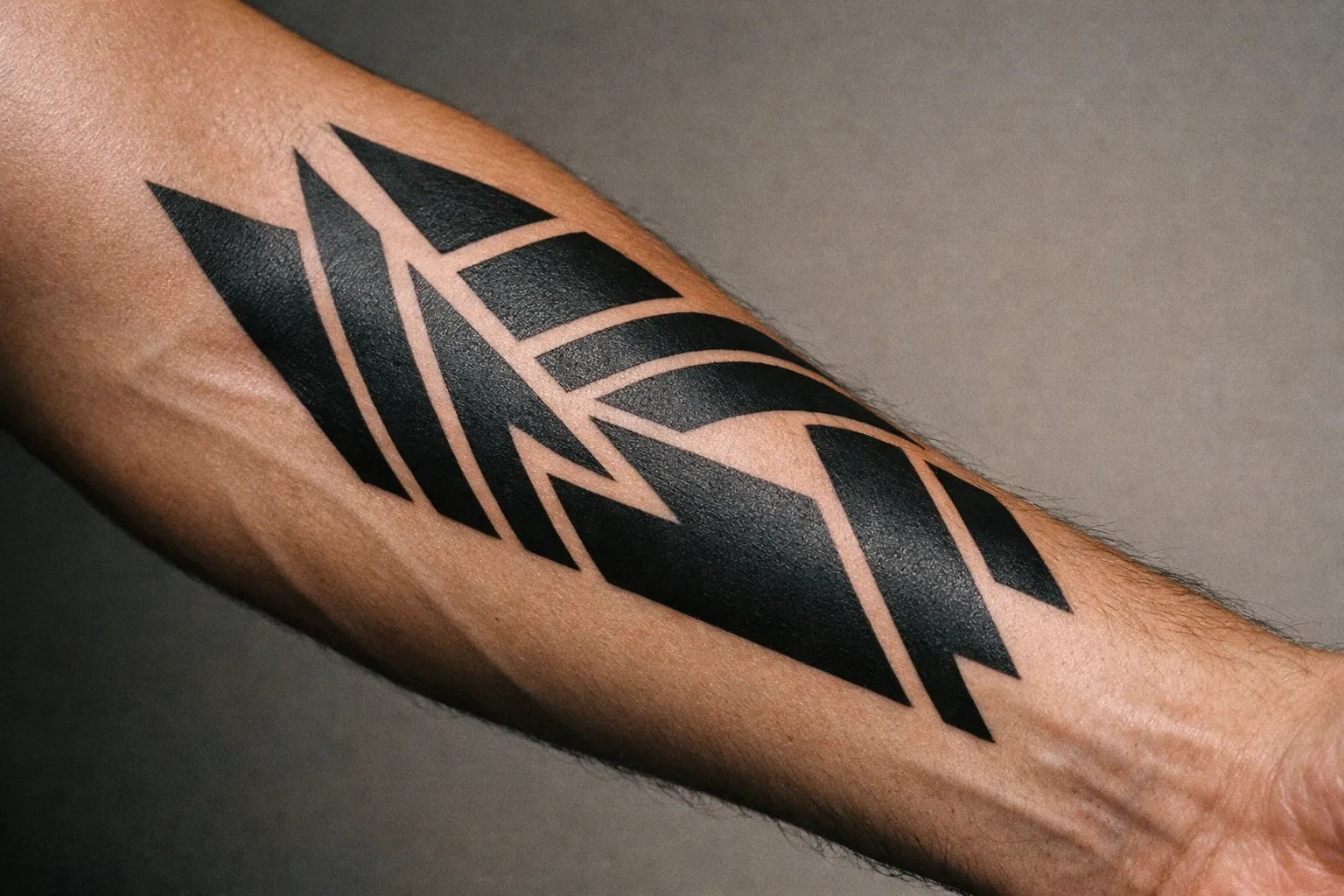
Roughly 30-40% of U.S. adults have at least one tattoo, and small clinical series put the post-tattoo infection rate somewhere between 1% and 5%. That’s not a trivial number. Most cases are minor and resolve with oral antibiotics, but untreated infections can escalate into cellulitis, abscesses, or sepsis requiring hospitalization and IV antibiotics.
The infection usually comes from one of a few sources:
- Non-sterile needles or equipment
- Contaminated ink or dilution water
- Aftercare lapses - touching the tattoo with dirty hands, sleeping on dirty sheets, swimming too early
- Friction from tight clothing breaking down fresh scabs
- Pre-existing conditions like diabetes or immune suppression that slow healing (3)
The risk window is real, but it’s narrow. Past day 14 with no signs of infection? You’re almost certainly clear from a bacterial standpoint.
✓ Pros
- Early detection and treatment usually prevent serious complications.
- Most infections resolve with oral antibiotics within two weeks.
- Clear self-check guidelines help distinguish infection from normal healing.
✗ Cons
- Infections can escalate quickly to cellulitis or sepsis if untreated.
- Delayed treatment increases risk of scarring and pigment loss.
- Some risk factors like immune suppression complicate healing.
Symptoms: The Full List
Here are the infected tattoo symptoms that should put you on alert. Not all need to be present - two or three together after day 3 is enough reason to call a clinician.
-
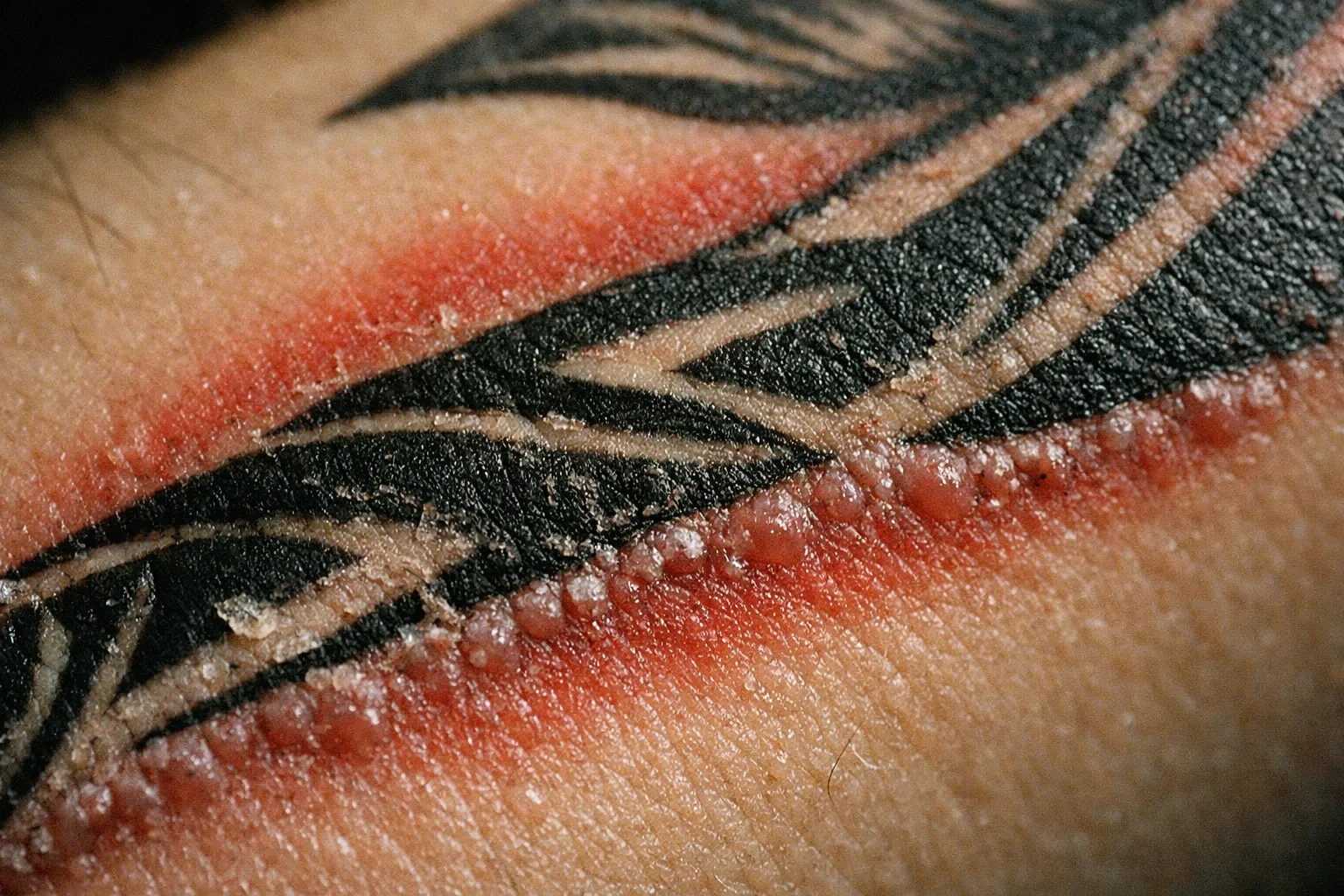
Spreading redness. A normal healing tattoo has redness tight to the lines that fades after 24-48 hours. An infected one has redness that grows, often beyond the tattoo border, and may shift from pink to deep red or purplish (1).
-
Worsening pain after 48-72 hours. Pain should peak on day one or two and improve from there. A tattoo that hurts more on day four than day two is a flag (1)(3).
-
Heat that feels hot, not warm. Infected tattoos often feel noticeably hot to the touch, sometimes with a throbbing or pulsing sensation (6).
-
Pus or thick discharge. Yellow, green, brown, or foul-smelling drainage is infection. Thin, clear, slightly yellowish plasma in the first 48 hours is not (1)(6).
-
Foul odor. Healing tattoos don’t smell. A smelly tattoo is an infected tattoo.
-
Raised bumps, pustules, or a rash. Red papules, pustules, or fluid-filled lesions in or around the design suggest bacterial infection or, less commonly, an allergic ink reaction (4)(7).
-
Red streaks. Linear red lines extending away from the tattoo are a sign of lymphangitis - the infection is traveling through your lymphatic system. Same-day urgent care. No waiting (4)(6).
-
Fever, chills, sweats, or nausea. Systemic symptoms mean the infection isn’t localized anymore. Go to urgent care or the ER (4).
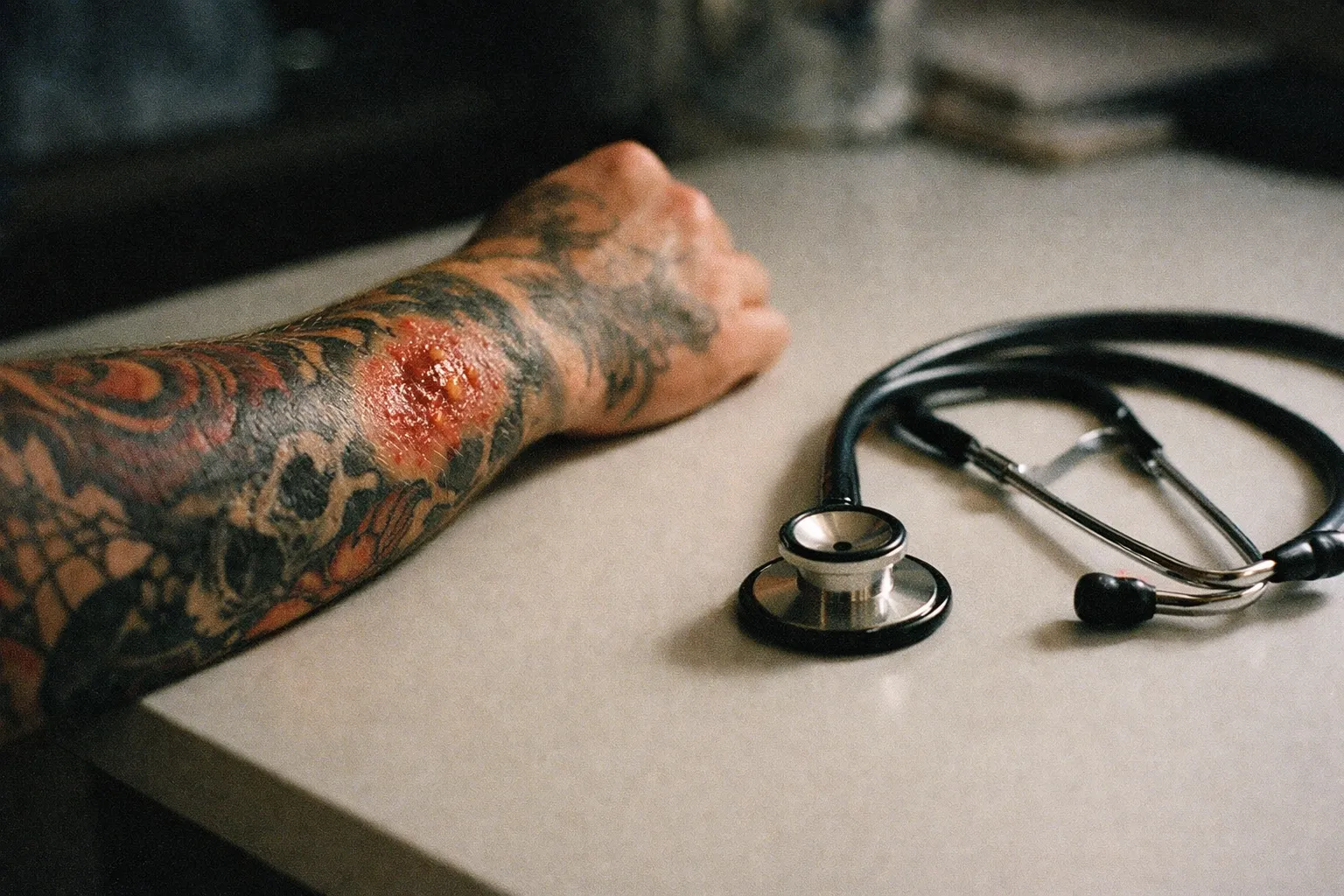
What Does an Infected Tattoo Look Like?
This is the question most people are Googling at 2 a.m. on day five. So here’s the visual breakdown.
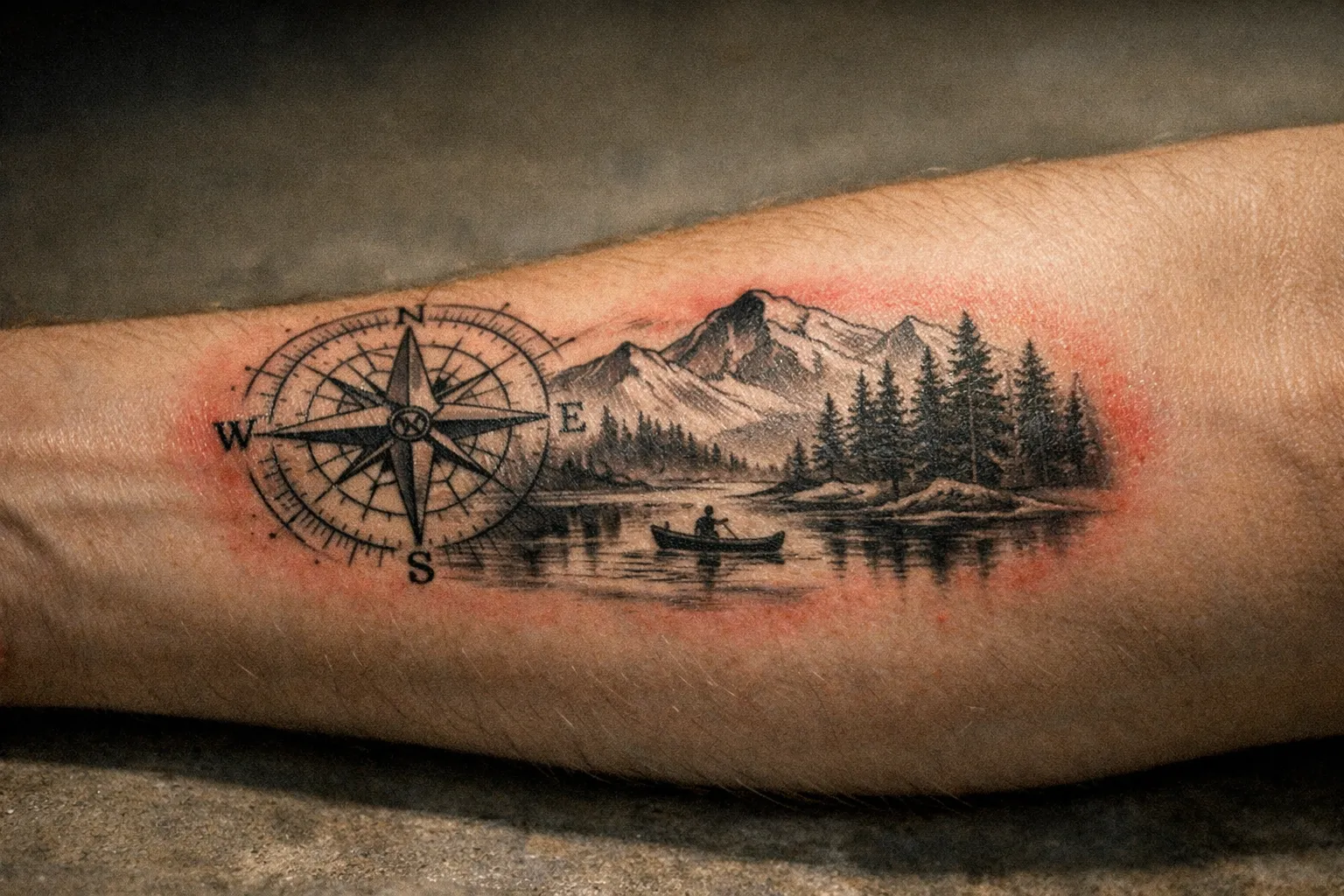
Day 1-2: Skin is red around the lines, slightly swollen, weeping clear-to-pale-yellow plasma. This is normal.
Day 3-5: A healing tattoo should be calming down - less red, less weepy, scabs starting to form thin. An infected tattoo gets worse in this window. The redness fans out beyond the design. The area feels hot. Drainage thickens and may turn yellow, green, or brown.
Day 5-7: A healing tattoo is scabbing and may itch. An infected tattoo may develop pustules, hard nodules under the skin, or red streaks traveling outward. The skin around the tattoo may feel firm or board-like, which is cellulitis presenting in the tissue.
After day 7: Any persistent rash, drainage, or worsening swelling past one week is abnormal and warrants a doctor’s visit (4).
One thing I want to flag specifically: in dark skin tones, the spreading redness of cellulitis can look more purple, brown, or simply darker than the surrounding skin - not the bright red you see in most clinical photos. Trust the heat, swelling, pain, and discharge over color alone. Color is the least reliable indicator here.
How to Tell If a Tattoo Is Infected (or Just Healing)
Here’s the simplest decision tool I give clients. At day 3 to 5, ask yourself three questions:
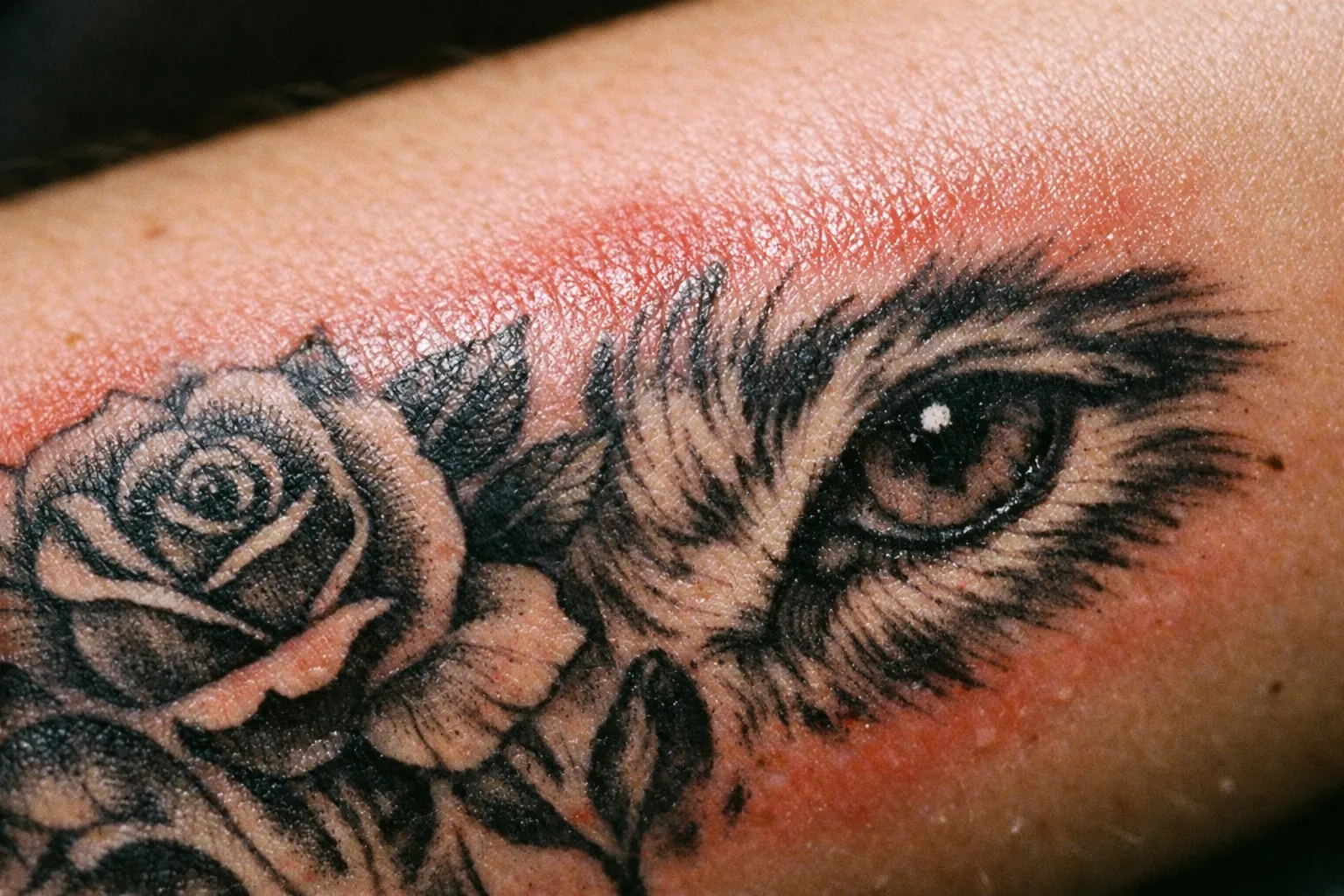
- Is the redness shrinking back toward the lines, or spreading beyond them?
- Is the pain less than yesterday, or more?
- Is any fluid clear and decreasing, or thick, colored, and increasing?
Two “worse” answers - contact a healthcare provider within 24 hours. All three “worse” plus a fever - urgent care today.
Normal healing signs (not infection):
- Mild redness along the lines, fading after 48 hours
- Thin, clear plasma weeping for the first day or two
- Itching during week two as scabs lift
- Dull soreness that improves daily
- Light flaking and peeling around week two
Infected tattoo signs:
- Redness that intensifies and spreads after day 3
- Yellow, green, or brown pus
- Foul smell
- Hot skin, not just warm
- Fever, chills, swollen lymph nodes
- Red streaks moving away from the tattoo
- Pain that gets worse, not better
One more thing worth knowing: what does an infected tattoo look like versus an allergic reaction to ink can overlap visually. Allergic reactions - most often to red ink, sometimes yellow - also produce redness, bumps, and itching, but they tend to be intensely itchy, chronic, and limited to whichever color is triggering them. Infections bring heat, pus, and systemic symptoms. A localized rash confined to the red parts of your tattoo with no fever points toward allergy, not infection. Both need a doctor’s visit, but the treatment is different, so the distinction matters.
How Do You Treat It?
The honest answer: if you think you have an infection, you see a clinician. Self-treating with leftover antibiotics from your last sinus infection is how minor problems become surgical ones.
That said, here’s what treatment actually looks like at each level.
Mild local irritation (no pus, no fever, no spreading)
If you’re at the edge of “maybe” - slight redness past day 3, mild tenderness, no pus or fever - you can try 24-48 hours of attentive aftercare before booking an appointment:
- Wash twice daily with fragrance-free liquid soap and lukewarm water
- Pat dry with a clean paper towel, not a cloth towel - cloth towels harbor bacteria
- Apply a thin layer of fragrance-free moisturizer. Aquaphor for the first few days, then a lighter cream-based lotion. Thin means the skin looks matte, not greasy
- Keep clothing loose and breathable
- Skip the gym, pools, hot tubs, and lakes
- Take daily photos in the same lighting to track what’s actually happening
If it’s not visibly better in 48 hours, stop guessing and go to urgent care.
Moderate infection (clear redness spreading, pus, no systemic symptoms)
This is the territory of infected tattoo antibiotics. Expect:
- An exam, possibly a swab or culture of any discharge
- A 10-14 day course of oral antibiotics - commonly cephalexin (Keflex) or doxycycline, depending on local resistance patterns and any allergies
- A topical antibiotic ointment in some cases
- Instructions to continue gentle washing and thin moisturizer
- A follow-up visit at 3-7 days to confirm improvement
Finish the full course even if symptoms clear in a few days. Stopping early is how you breed resistant bacteria and end up back in clinic.
Severe infection (red streaks, fever, chills, abscess, rapid spreading)
ER or urgent care today. Not tomorrow:
- IV antibiotics, sometimes started in the ER and continued at home or inpatient (3)
- Incision and drainage if an abscess has formed - done under local anesthesia in clinic
- Imaging (ultrasound or CT) if deep tissue involvement is suspected
- In rare cases of necrotizing or deep mycobacterial infection, surgical debridement plus multi-month antibiotic regimens
Most tattoo infections - when caught early - resolve within about a week of starting antibiotics with good cosmetic outcomes. The cases that scar are the ones where treatment was delayed.
When You Need Antibiotics: What to Expect
A few practical notes on the antibiotic side, because I get these questions constantly.
Topical first? Minor superficial infections may respond to a topical antibiotic plus gentle wound care (2). But don’t slather over-the-counter Neosporin on a fresh tattoo as a precaution - heavy occlusive ointments can trap bacteria, and some people develop contact allergies to neomycin.
Common oral choices: Cephalexin and dicloxacillin for typical staph/strep coverage; doxycycline or clindamycin if MRSA is suspected or you have a penicillin allergy. Your clinician picks based on your history and local resistance data, not a general preference.
Length of course: Typically 10-14 days for straightforward skin infections. Deep, resistant, or atypical infections - including atypical mycobacterial infections traced to contaminated tattoo ink - can require several months of therapy.
IV antibiotics: Reserved for severe cellulitis, sepsis, or infections that haven’t responded to oral therapy. Cost runs from $500 to $2,000+ for an ER visit with IV antibiotics, depending on labs and length of stay.
Generic oral antibiotic cost: Most common options run $4 to $40 for a full 10-14 day course at retail pharmacies, often cheaper with discount programs.
Do not start antibiotics on your own from old prescriptions, a friend’s leftover bottle, or anything purchased online. The wrong antibiotic at the wrong dose makes diagnosis harder when you do eventually see a clinician.
The Daily Care Routine
Whether you’re managing a mild case at home with clinician approval or you’re on day three of a prescribed antibiotic course, the daily infected tattoo care routine looks the same.
Twice daily, at minimum:
- Wash your hands thoroughly before touching the tattoo
- Rinse the tattoo with lukewarm water
- Lather a small amount of fragrance-free liquid soap in your hands and gently wash the area - no washcloths, no scrubbing
- Rinse until all soap is gone
- Pat dry with a clean paper towel
- Apply a thin layer of fragrance-free moisturizer
- If draining, cover with a sterile non-stick pad and hypoallergenic tape; otherwise leave uncovered to breathe
Avoid:
- Picking, scratching, or peeling scabs
- Hydrogen peroxide, rubbing alcohol, or harsh antibacterial soaps - they damage healing tissue
- Petroleum-heavy products in thick layers (3)
- Tight clothing over the area
- Swimming, hot tubs, saunas, or contact sports for at least 2 weeks
- Direct sun and unprotected tanning
Do:
- Sleep on clean sheets and change them every couple of days during active infection
- Take photos in the same light daily to track improvement
- Drink water and eat - tissue healing is metabolically expensive
- Finish your full antibiotic course
Healing timeline after treatment starts:
- Day 1-3 of antibiotics: Pain and heat should start to ease; redness may take longer to recede
- Week 1: Visible improvement; drainage should slow or stop
- Week 2-4: Full skin healing in most cases, longer for larger or deeper infections
If you’re not seeing improvement by day 3 of antibiotics, call your clinician. The bacteria may not be sensitive to the antibiotic that was chosen.
Can It Still Heal Properly?
Yes - most do. The cosmetic outcome depends almost entirely on how fast treatment starts.
Caught at the “spreading redness, mild pus” stage and treated with a 10-14 day antibiotic course, most tattoos heal normally with no visible distortion. The ink sits where it was placed, the skin closes cleanly, and you’d never know it was infected.
Caught late - after abscess formation, deep tissue involvement, or extensive scabbing and skin loss - outcomes get worse. Possible long-term consequences include:
- Patchy color loss where infection ate into pigment-loaded dermis
- Blowout-like distortion of fine lines as scar tissue contracts
- Hypertrophic or keloid scarring, especially on the chest, shoulders, and upper back
- Texture changes that catch light differently than surrounding skin
If your tattoo does scar from an infection, wait at least 6 months after full healing before considering touch-ups or cover-ups. Scar tissue takes ink unpredictably for the first few months. Expect to pay $150-$250/hour for revision work, with most cover-ups running $300-$1,000+ depending on size and complexity. A skilled artist working over healed scar tissue can hide a surprising amount, but they’ll usually steer you toward bolder linework and a limited palette - think American traditional-style thick outlines and solid fills - rather than fine-line or micro-realism, which doesn’t sit reliably on damaged dermis. Japanese-influenced designs with heavy black shading can also work well over scar tissue for the same reason: the style tolerates slight texture variation better than a 1mm fine-line piece would.
Preventing Tattoo Infections in the First Place
Prevention does more than treatment ever will. Here’s where to actually focus.
Choosing the studio and artist:
- Verify state and local licensing - most U.S. jurisdictions require both for the studio and the individual artist
- Confirm single-use, individually packaged needles - they should be opened in front of you
- Confirm autoclave sterilization for any reusable equipment
- Confirm fresh ink poured into single-use caps, not dipping back into shared bottles
- Look at the floor, the workstation, the bathroom. Cleanliness is a system, not an aesthetic
- Ask directly: “Do you use an autoclave? Are all needles single-use and pre-wrapped? What ink brand do you use, and how is it diluted?” Any hesitation or annoyance at those questions is a flag (2)
Pre-session:
- Eat a real meal and hydrate
- Shower before your appointment
- Skip alcohol the night before - it thins blood and increases swelling
- Tell your artist about any chronic conditions, medications, or skin issues at the consult, not when you’re already in the chair
Aftercare for the first 14 days:
- Follow your artist’s specific tattoo aftercare instructions - they vary by studio and bandage type (Saniderm vs. traditional wrap)
- Wash twice daily with fragrance-free soap
- Moisturize thinly with a fragrance-free product
- Keep clothing loose and breathable
- No swimming, hot tubs, saunas, or lakes for at least 2 weeks
- Use sun-protective clothing rather than sunscreen on a fresh tattoo for the first month, then high-SPF sunscreen for life
Monitor:
- Take a daily photo for the first 10 days
- Run the day 3-5 self-check
- Have a low threshold to call a clinician if something feels off
When to Call a Doctor - and Where to Go
Call your primary care or visit urgent care within 24 hours if:
- Redness is spreading after day 3
- Pus or thick colored drainage is present
- Pain is worsening past day 3
- A rash or bumps aren’t resolving
- Any drainage is persisting past day 7 (4)
Go to the ER today if:
- Fever, chills, or shaking
- Red streaks moving away from the tattoo
- Rapidly spreading swelling or hot, hard skin
- You feel systemically unwell - nausea, weakness, confusion
Urgent care typically runs $100-$250 without insurance for the visit, plus $50-$150 for basic labs or a wound culture. Most generic oral antibiotics are $4-$40 for a full course. An ER visit with IV antibiotics commonly runs $500-$2,000+. The cost gap between catching an infection at urgent care versus the ER is one of the strongest arguments for not waiting.
Frequently Asked Questions
- How do you treat an infected tattoo?
- Mild cases sometimes resolve with 24-48 hours of careful washing twice daily with fragrance-free soap, thin moisturizer, and no swimming or tight clothing. Moderate infections require a clinician visit and typically a 10-14 day course of oral antibiotics like cephalexin or doxycycline. Severe infections - fever, red streaks, abscess - need urgent or emergency care, IV antibiotics, and sometimes surgical drainage.
- How do I tell if my tattoo is infected?
- Use the day 3-5 check: is redness shrinking or spreading, is pain less or more, is fluid clear or thick and colored. Two 'worse' answers warrant a clinician call within 24 hours. Fever, chills, or red streaks are emergencies regardless of how the tattoo itself looks.
- Can an infected tattoo still heal properly?
- Most do, especially when treated early. Antibiotics typically resolve infection within about a week, and most tattoos heal with no visible distortion. Delayed treatment increases the risk of color loss, scarring, and line distortion that may require cover-up work later.
- Is it normal for a tattoo to ooze for a few days?
- Thin, clear-to-pale-yellow plasma for the first 24-48 hours is normal. Thick yellow, green, or brown drainage, foul smell, or any drainage after day 3-5 is not.
- Can I use Neosporin on an infected tattoo?
- Don't self-treat a suspected infection with over-the-counter antibiotic ointments. Heavy occlusive products can trap bacteria, and neomycin sensitivity is common. See a clinician - prescription topicals or oral antibiotics are more appropriate.