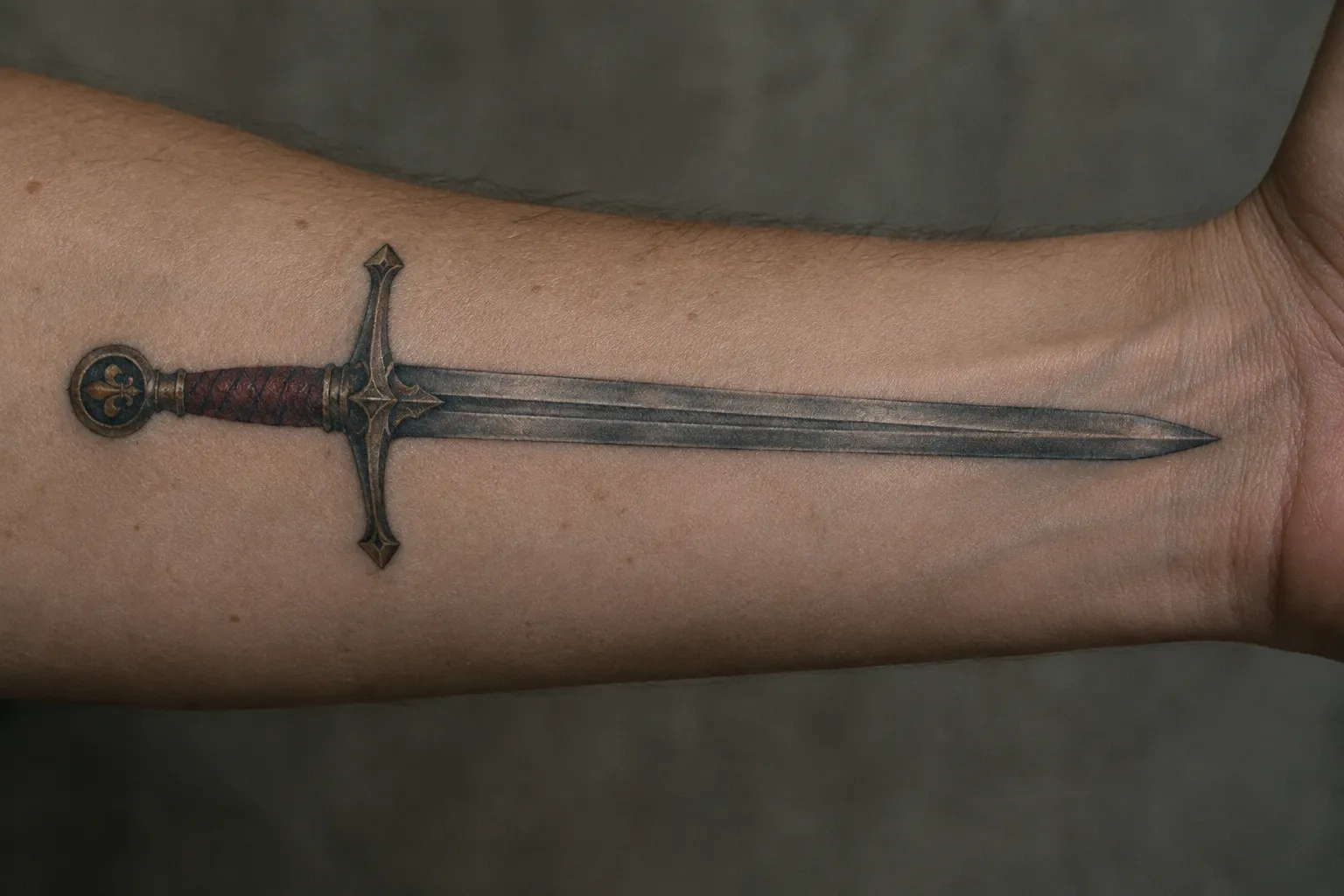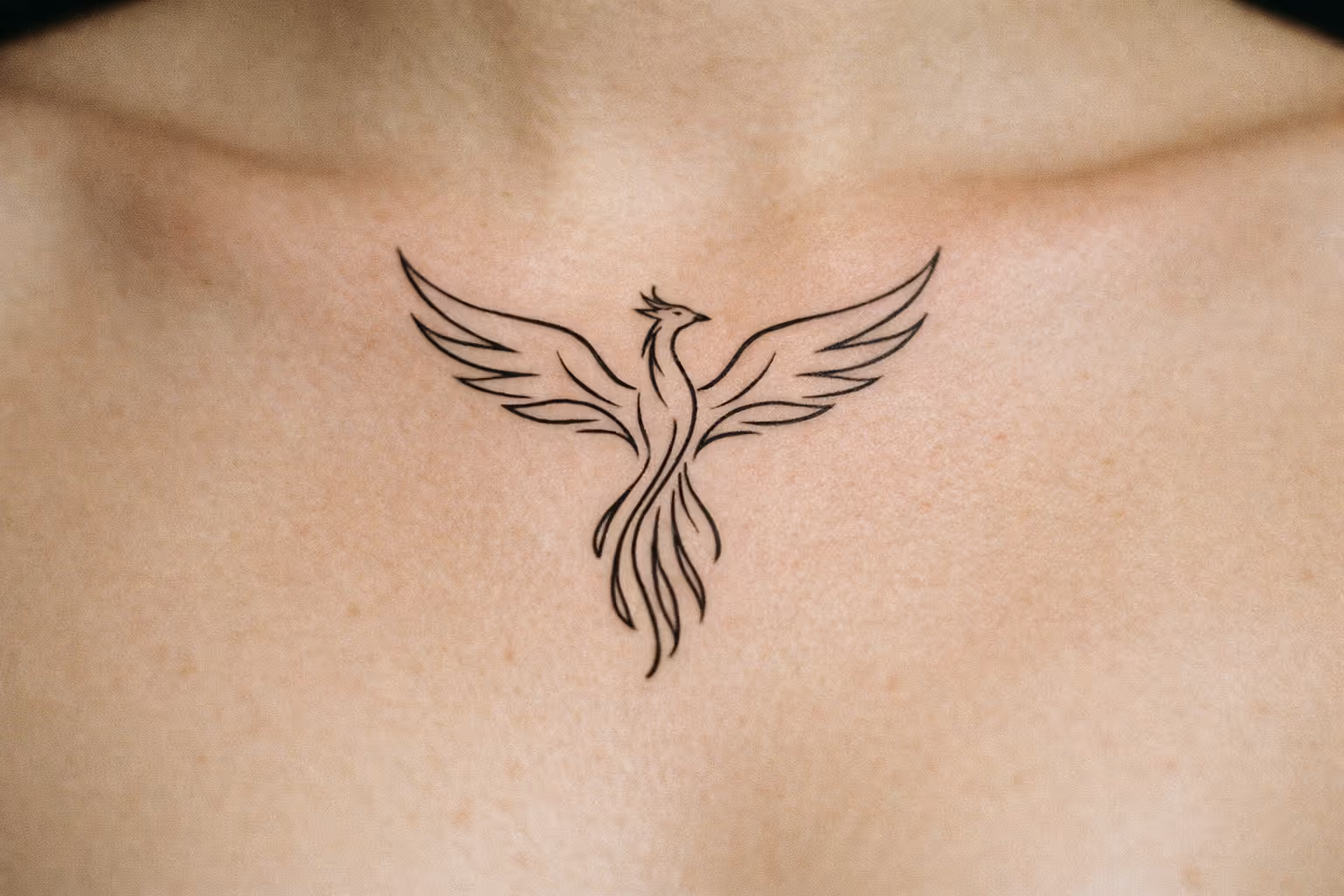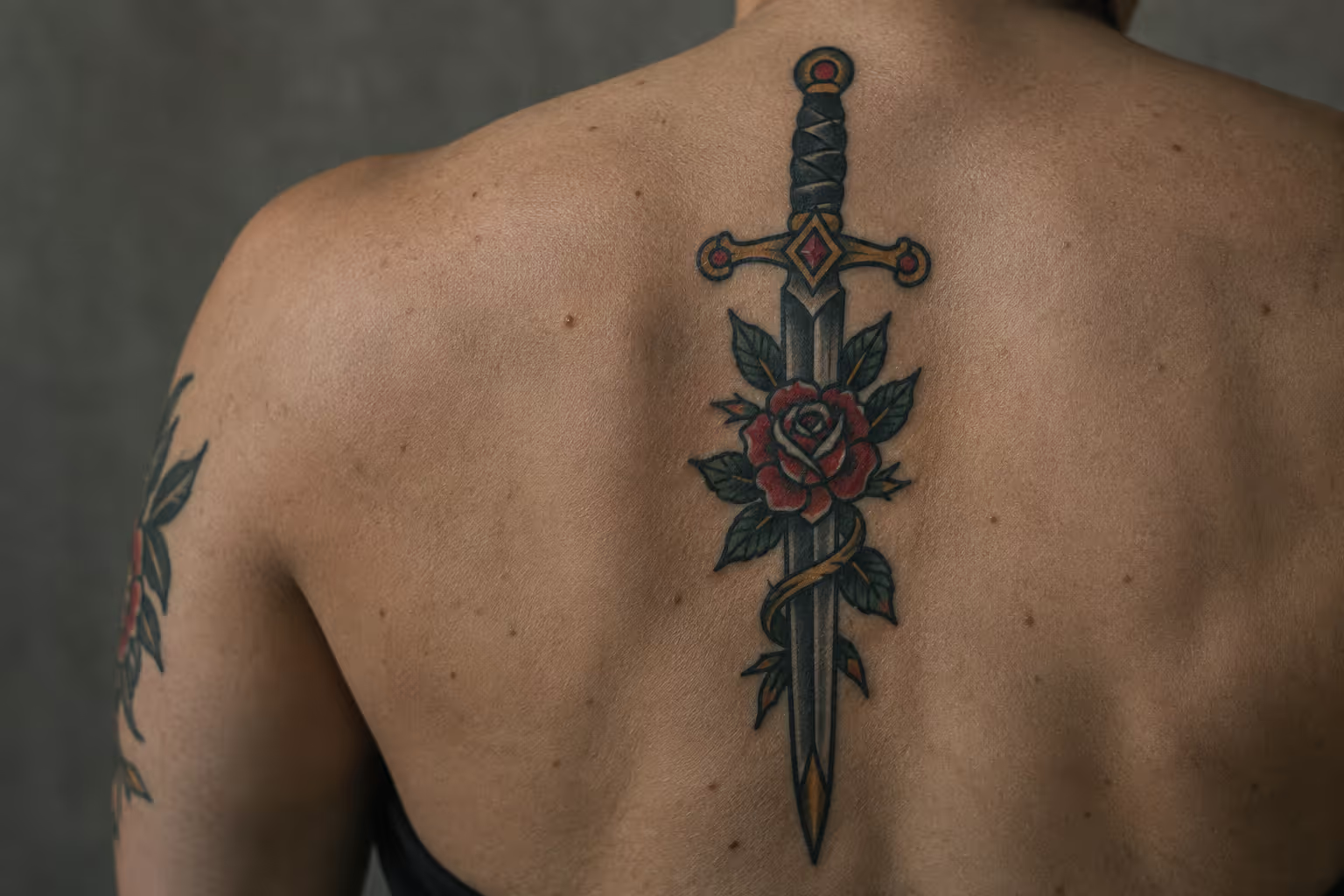
A sword tattoo changes meaning with the blade you pick. A katana leans on Japanese Bushido discipline, a European longsword on chivalry and justice (1). Size matters as much as symbolism: a blade that reads cleanly running down a forearm can look thin and lost floating on a thigh. This guide covers what each blade and pairing signals, the sizes that keep a sword legible, and which placements hurt more.
✓ Pros
- The blade's outline can make the design recognizable without relying on small decorative details.
- A single sword can carry a clear focal line, leaving room to add a second motif later if the placement allows it.
✗ Cons
- A sword's familiar shape can read as a weapon before viewers notice the intended symbolism.
- Straight edges and symmetrical hilts leave little room to disguise uneven execution.
Swords have a lot going for them as a motif. The symbolism flexes across blade styles, the design scales from a 2-4 in (5-10 cm) fine-line piece to a 6-14 in (15-35 cm) katana (1), it pairs well with roses, skulls and snakes, and it works on both easy and brutal placements. The downsides are real too. Detailed hilts need an artist with clean linework. Ribcage and spine placements hurt a lot more than limbs. Overly fine lines can soften over the years. And the meaning gets muddy if you don’t pick a blade style on purpose.
Sword Tattoo Meaning: What Each Blade Style Says About You
Sword tattoo meaning depends mostly on blade style. Strength, justice, protection, honor and transformation are the shared core, and the blade narrows down which one you mean (1). The same guide ties the reading to the blade you choose and to the motifs paired with it (1).
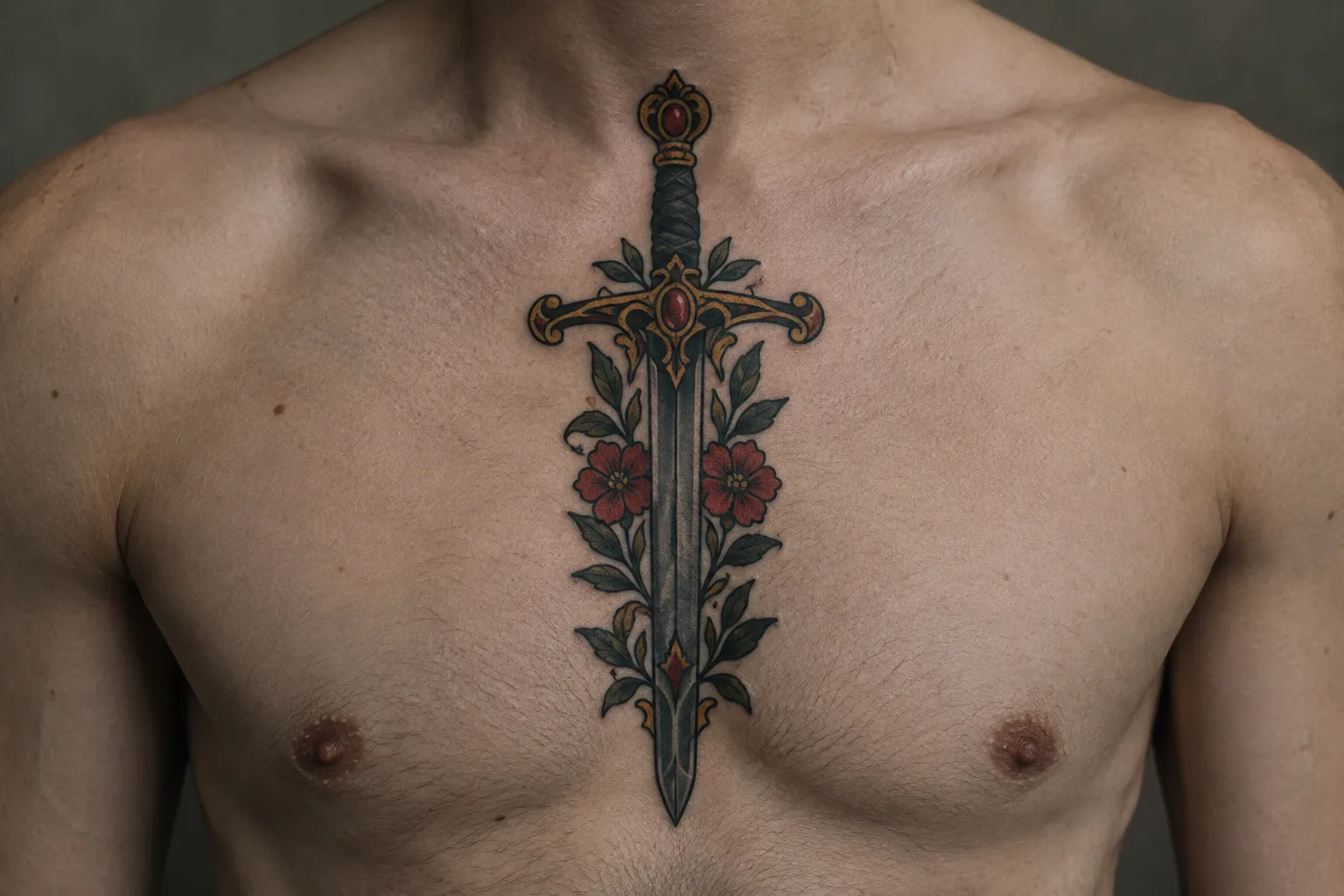
One design source makes a sharp point: a sword is the only weapon with no second use, which is why it reads as commitment rather than violence (5). The hilt tells the viewer where the blade comes from. A straight crossguard reads European, a cage of curving bars reads as a sixteenth-century rapier, and a small round guard over a curved single edge reads Japanese (5). Decide which one you want before the stencil goes on.
Katana: Honor and Bushido Discipline
The katana comes from Japanese samurai culture and carries honor and Bushido discipline (1). In Western shops it has drifted. Plenty of people wear one as a general “warrior” image or an anime reference, with no tie to Bushido at all. That’s fine, but know which reading you’re claiming. The wrapped handle and the tsuba need room to resolve, so plan for 6-14 in (15-35 cm) on the forearm, back or as part of a sleeve (1).
Longsword: Chivalry and Justice
The knight’s longsword stands for chivalry and justice (1), rooted in medieval European imagery and in the Western convention of Justice holding a blade. The straight crossguard also forms a cross, so some viewers will read a religious meaning whether you intend one or not.
Dagger: Secrecy and Swift Action
A dagger signals secrecy or swift action (1). It is also a staple of American traditional flash, usually a dagger through a rose, heart or skull. Done right, that style means thick black outlines and a limited palette (red, yellow, green, black). The common failure is thin linework inside a traditional design, which loses its punch once healed. A dagger suits the forearm, calf or chest (1).
Excalibur: Destiny and Leadership
Excalibur draws on Arthurian legend from medieval Britain and stands for destiny and leadership (1). The sword in the stone is the usual composition. Fantasy and mythic blades like this want 10+ in (25+ cm) on the back, thigh or a sleeve (1).
Sword and Rose Tattoo Pairings (Plus Skull, Snake, and Dragon Combos)
A sword and rose tattoo pairs love with danger. Adding a skull points to mortality instead, and a snake points to wisdom, healing or transformation (1). Pick the pairing for the specific story you want, because each one shifts the blade’s meaning in a different direction.
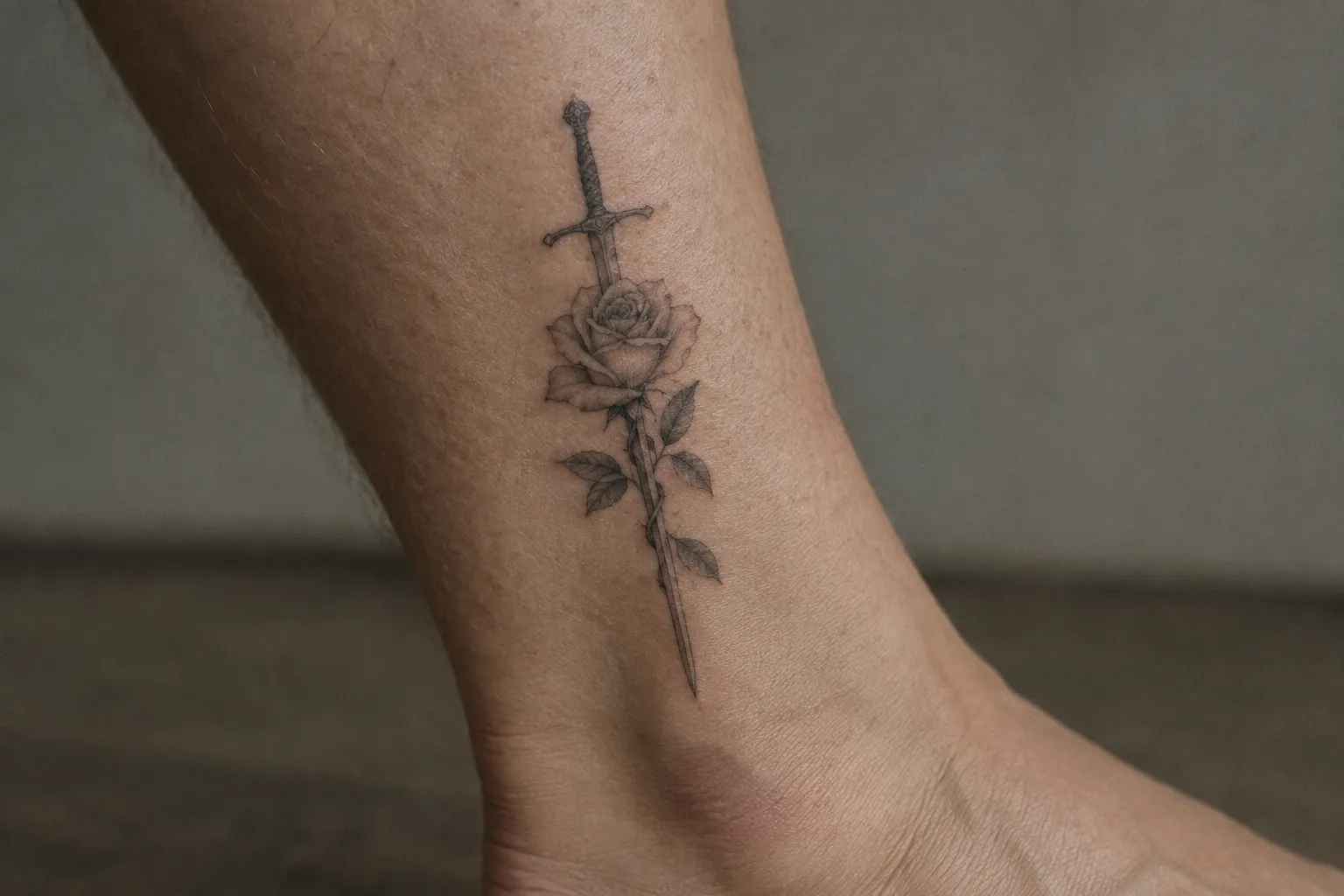
Sword and Rose: Love and Danger
A sword and rose tattoo reads as beauty with danger, or love with sacrifice (1). The classic layout runs the blade through the bloom with petals or leaves around the guard. Roses eat width, so this pairing works better on a forearm or calf than squeezed onto a wrist.
Sword and Skull: Memento Mori
A sword-and-skull design is a memento mori motif, representing mortality, conquest over death, or rebellion (1). The idea comes from the European “remember you will die” tradition in art. In modern Western tattooing it often leans more toward rebellion than reflection.
Sword, Snake, and Dragon: Layered Transformation Themes
The snake-and-sword pairing suggests healing, wisdom or transformation (1). That reading shouldn’t be confused with the Rod of Asclepius, a staff entwined by a snake that stands for medicine, not for swords (9). In Christian iconography, though, the snake stands for temptation, so the same image can be read two ways.
Dragons split even harder. A Japanese dragon (ryū) is traditionally a water deity tied to rainfall, while a European dragon is usually the foe a knight’s blade slays. A sword, snake and dragon together is three symbols, and a lone sword already wants 20 to 30 cm (about 8-12 in) on most placements (5), so a triple pairing belongs on the back, thigh or a sleeve. On a small design, stick to one pairing.
Small Sword Ideas: Daggers, Fine Lines, and Where They Work Best
A small sword tattoo works best as a fine-line minimalist blade of 2-4 in (5-10 cm) or a dagger of 3-6 in (7.5-15 cm), placed on the wrist, forearm or behind the ear (1). At these sizes, a readable silhouette beats detail every time.
Minimalist Fine-Line Swords (2-4 Inches)
Strip the hilt down to a clean guard, grip and pommel, and leave out filigree. Fine lines spread a little as skin ages, so ornate hilt work at 2 in turns into a grey smudge over the years. One guide puts the working minimum for a full sword at 15 cm (about 6 in) (5). Anything smaller should be designed as a simplified mark from the start, not a shrunken illustration.
Dagger Tattoos (3-6 Inches)
Here’s the trap. If you compress a sword into a short field, its proportions turn it into a dagger, which is a different subject with a different meaning (5). If you want something compact, commit to a dagger design instead of a squashed longsword.
Best Spots for a Small Sword: Wrist, Forearm, Behind the Ear
- Inner wrist: a short vertical fine-line blade, at the low end of the 2-4 in (5-10 cm) range (1). The wrist moves constantly, so keep the hilt simple.
- Inner or outer forearm: 3-6 in (7.5-15 cm). This is the easiest spot for a dagger, with flat space for the detail.
- Behind the ear: a minimal blade running along the hairline. It’s bonier than the forearm, so expect more sting.
Placement and Size: Matching a Blade to Pain Tolerance and Scale
For a large sword piece with less pain, the outer thigh beats the spine or ribcage: one guide rates the thigh and the outer forearm at 3-4 out of 10, the ribcage at 7-8 and the spine at 7-9 (1). Treat any ranking like this as an estimate, not a guarantee: tattoo pain varies by person and by exact spot, and a session over the knee edge of the thigh feels nothing like the outer middle.
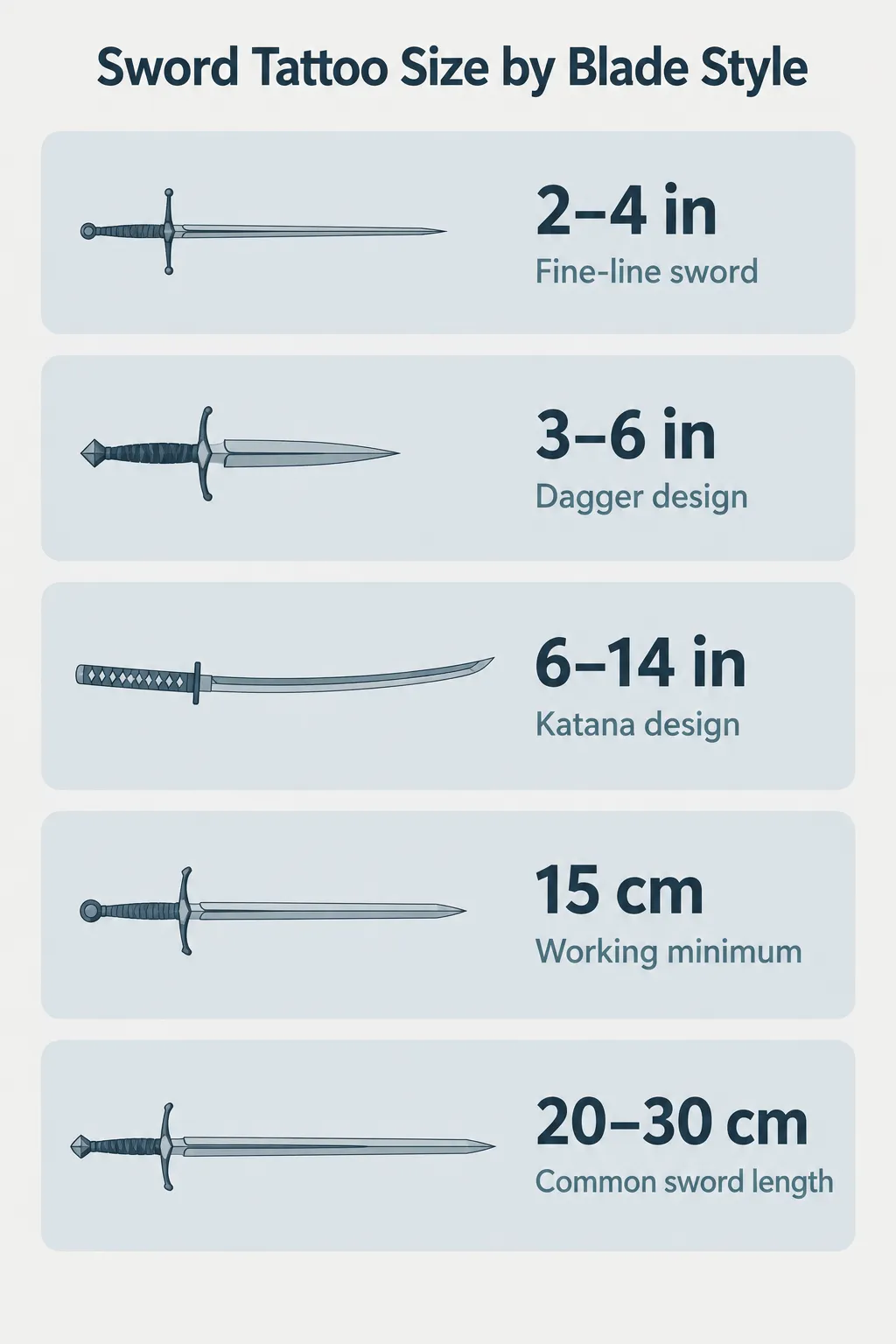 One guide gives 15 cm as a working minimum and 20-30 cm for most placements; another sizes minimalist fine-line swords at 2-4 in, daggers at 3-6 in and katanas at 6-14 in.
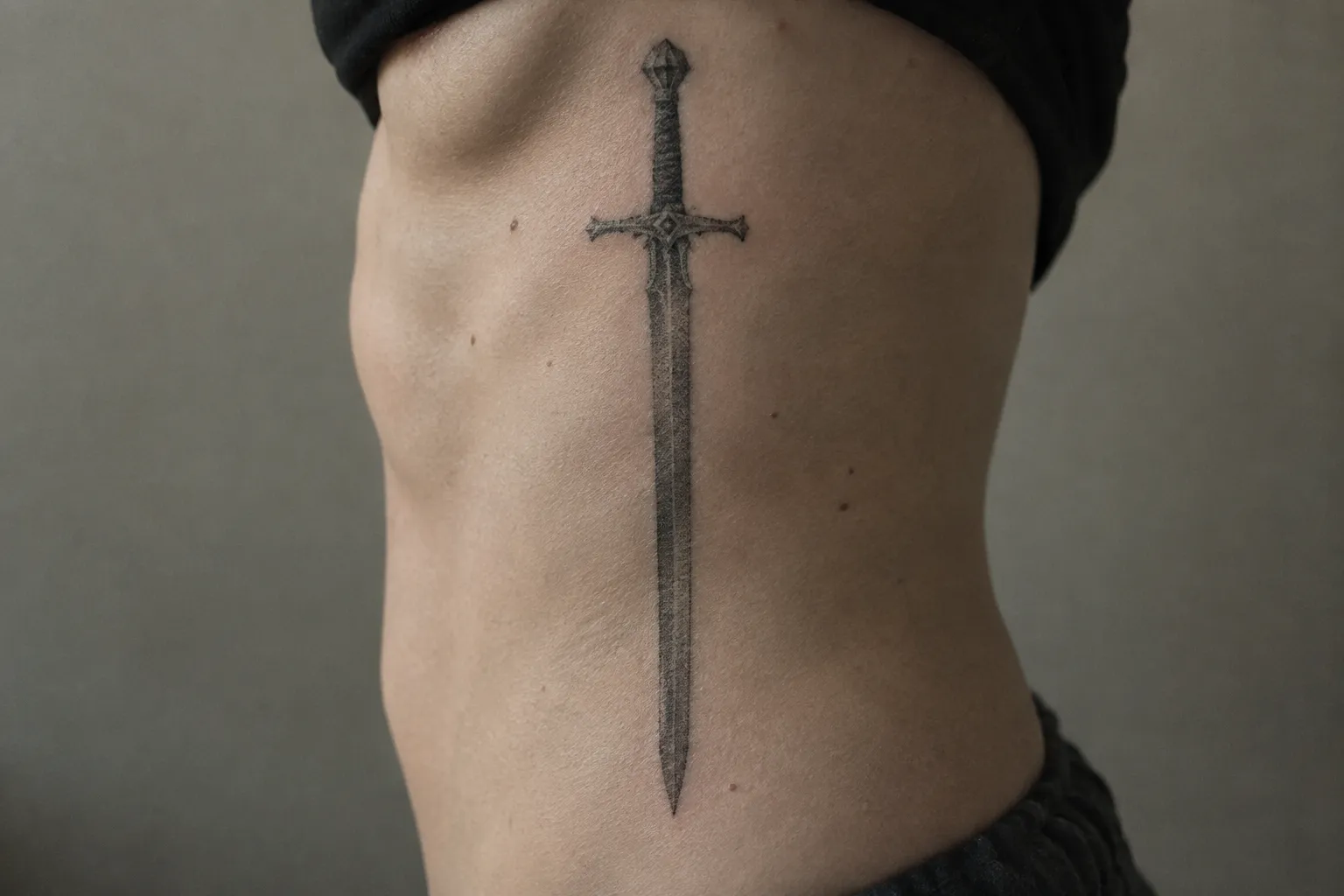
Pain by Placement: What the Rankings Don’t Tell You
A ranking can’t account for your own pain tolerance, how long the session runs, or whether the artist is working over bone versus muscle. Ask your artist which part of the placement they’d pick for the least discomfort before you commit to a spot.
Why a Longer Blade Needs a Longer Canvas
A sword has to be long rather than large, so the blade stays proportionate to the grip (5). That guide’s 15 cm minimum and 20-30 cm working length (5) convert to about 6 in and 8-12 in, inside another guide’s 6-14 in katana range (1): the metric and inch figures describe the same practical range, not two competing standards.
The sword’s vertical shape follows the forearm, calf or spine (5). The spine gives the strongest alignment but comes with a real pain tradeoff, covered in the table. For realistic black-and-grey work, or for a hilt with added imagery, use the forearm, thigh or back (1).
Sword Tattoo Placement: Pain and Scale
| Outer thigh | Outer forearm | Ribcage | Spine | |
|---|---|---|---|---|
| Relative pain | Mild | Mild | High | Highest |
| Suited size range | 6-12 in (15-30 cm) | Dagger to 20-30 cm (8-12 in) | Long blade following the ribs | Long, straight vertical blade |
| Blade that fits | Full katana or illustrative sword | Dagger or longsword | Longsword or dagger with added imagery | Longsword or Excalibur-style blade |
Aftercare, Healing Red Flags, and Design Mistakes to Avoid
Keeping a sword’s straight edges crisp starts with a clean shop and a standard healing routine, then sun protection once the skin has closed. Shop hygiene starts before the needle. Even unopened, sealed tattoo ink can harbor bacteria, so “sealed” is not proof of sterility (8). State and local authorities oversee tattooing in the US (8), so check that your shop is licensed.
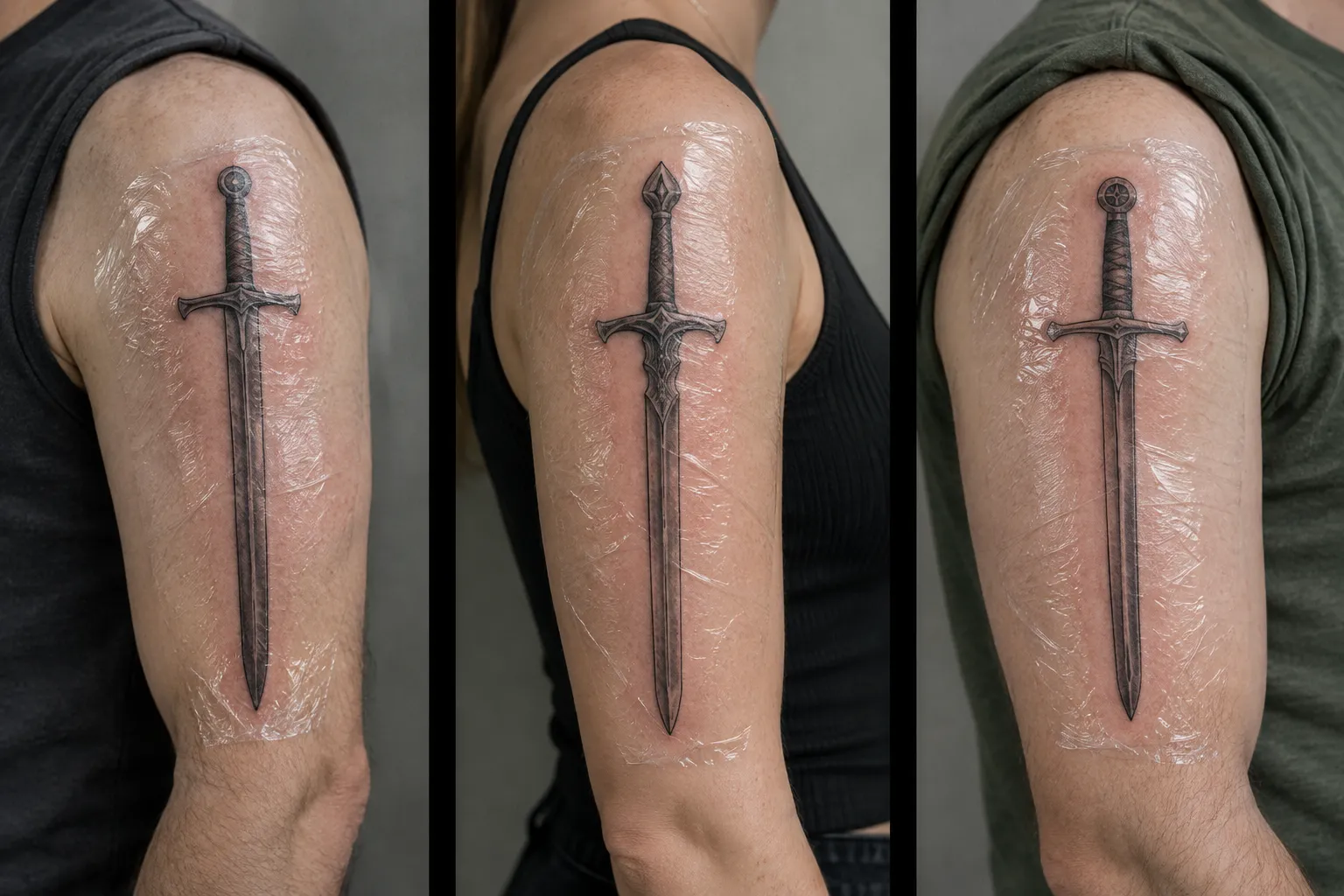
Tell your artist about any medications you take. The usual healing timeline, covered stage by stage in our tattoo aftercare guide, looks like this:
- Day 1-3: Keep the bandage on as long as your artist says, then wash gently with fragrance-free soap and pat dry (6).
- Day 4-7: The skin tightens and starts to flake. Apply a thin layer of fragrance-free moisturizer and don’t pick at flaking along the blade’s edges.
- Week 2: Peeling and itching. Let flakes come off on their own, and don’t soak the tattoo in pools or baths (6).
- Week 3-4: The surface looks healed, but the skin underneath keeps settling until about week 6. Keep it out of direct sun for the first 4-6 weeks, under sun-protective clothing.
Signs of Infection to Watch For
The Cleveland Clinic lists fever, increasing pain, spreading redness, warmth, or significant drainage as reasons to seek medical attention (6). The FDA notes that inks can also trigger allergic reactions (8). If a healed area develops a rash or changes later, the AAD advises seeing a board-certified dermatologist (4).
Sun Protection Once It’s Healed
UV light fades some inks. The AAD recommends broad-spectrum, water-resistant sunscreen with SPF 30 or more, applied 15 minutes before going outside and reapplied at least every two hours (4).
Design Mistakes That Age Badly
- An ornate hilt on an undersized canvas, which blurs into a blob.
- Hairline single-needle blades on the wrist or hands.
- Three or more symbols crammed into under 15 cm.
- Assuming the symbol has one fixed meaning.
Ask to see an artist’s healed straight-line and detailed-object work, not just fresh photos (1). A wobbly blade edge is impossible to hide.
Frequently Asked Questions
- What does getting a sword tattoo mean?
- A sword tattoo can signal strength, justice, protection, honor, or transformation; the blade's cultural tradition and surrounding imagery shape which reading comes through.
- What does a katana tattoo mean?
- A katana refers to Japanese samurai culture and Bushido discipline, though modern Western tattoos also use it as a broader warrior or pop-culture image.
- Are small sword tattoos a good option?
- Small sword tattoos work best as simplified silhouettes; intricate guards and fine interior lines need more room to remain distinct as the ink settles and ages.
- What does a snake and sword tattoo symbolize?
- A snake and sword can suggest healing, wisdom, or transformation, while some Christian interpretations associate the snake with temptation.
- Where should I place a sword tattoo?
- Choose a placement that suits the blade's direction and your linework priorities: a forearm supports a visible vertical design, while the thigh offers more room for illustration.
- How big is a $500 tattoo?
- A $500 budget does not correspond to a fixed tattoo size; ask the artist for a quote based on the design, dimensions, detail, and their rate.
- What tattoo mistakes should I avoid?
- Avoid shrinking detailed hilts until they lose separation, and check healed examples of the artist's straight lines before committing to a blade design.
Before You Book the Consultation
Blade style sets the meaning, the pairing shifts the story, and placement decides how long the blade can be and how much it will hurt. Lock in those three choices first. Then bring the artist your reference, your target size in inches or centimetres, and a request to see healed examples of straight-edged work. A sword that’s long enough for its placement, kept out of the sun once healed, will hold its edge for decades.