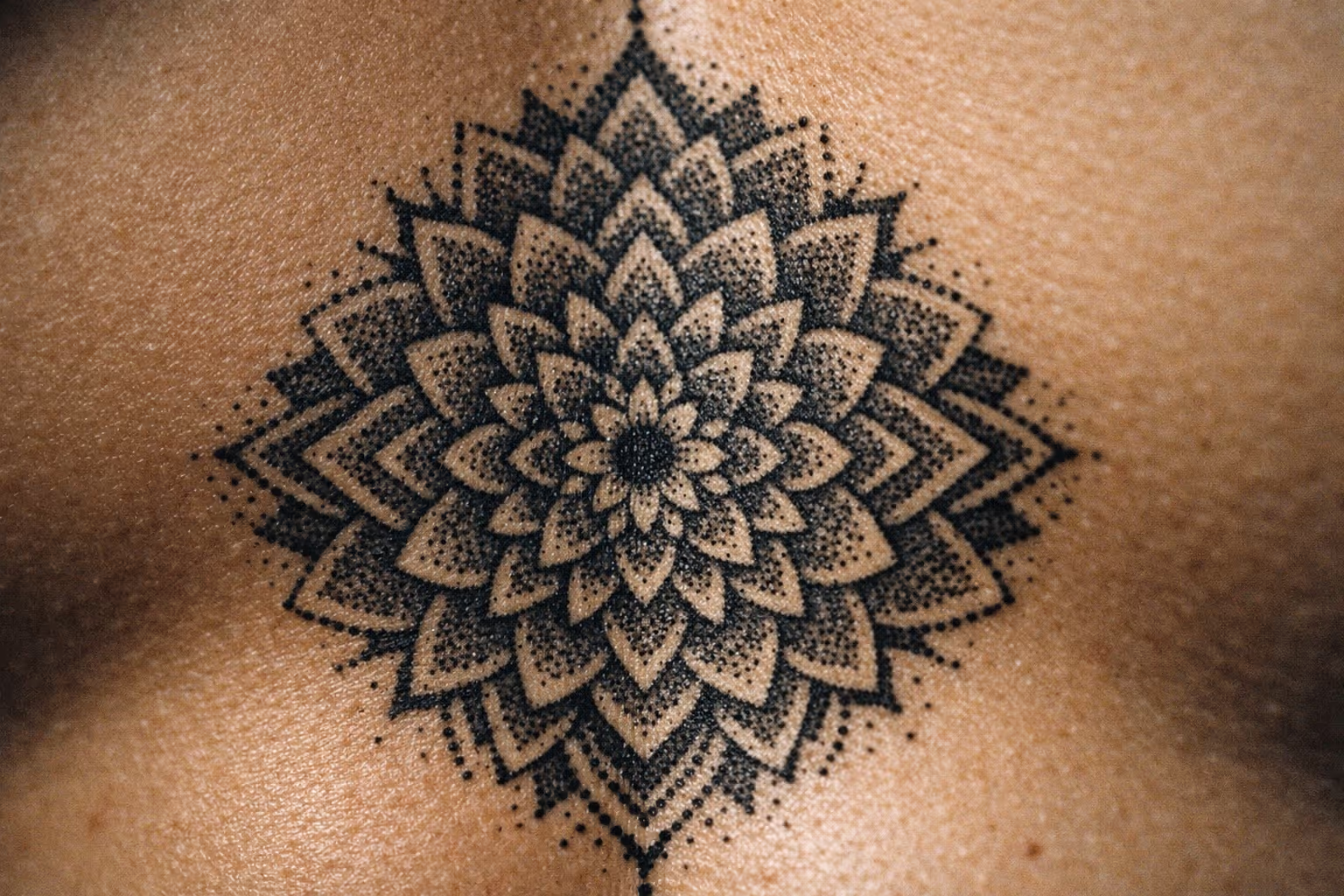
Breast tattoos cover two completely different worlds that rarely get discussed on the same page: decorative sternum, underboob, and side-rib designs chosen for how they look, and post-mastectomy, scar-cover, and nipple-areola tattoos chosen to reclaim a body after surgery. I’ve worked across both ends of that spectrum for over a decade, and the gap between how each gets covered online versus what clients actually need to know is genuinely frustrating. This guide takes both seriously. You’ll get the placement zones, an honest read on pain, design ideas that hold up over time, the survivor-specific work most articles skip, and the timing rules that matter more than anything else you’ll decide.
If you’re planning ornamental dotwork down your breastbone, keep reading. If you’re a survivor weighing 3D areola work or florals over a mastectomy scar, the timing and specialist sections are written specifically for you.
✓ Pros
- Highly concealable under everyday clothing
- Placement follows natural body curves well for flowing designs
- Meaningful context for survivors: documented body-image and mental-health benefits
- Wide range of styles work here (fine line, blackwork, botanical, geometric)
- Paramedical NAC tattoos can be partially covered by reconstruction pathways in some systems
✗ Cons
- Among the higher-pain placements - thin skin, proximity to bone
- Healing complicated by bra friction and chest movement
- Designs under the bust can distort with pregnancy or significant weight change
- Scar tissue and radiated skin require specialist artists and longer wait times
- Pastel and fine-line ink fades faster on the chest than on forearms or calves
Where Exactly Are Breast Tattoos Placed?
Breast tattoos fall into five distinct zones, each with its own sizing, distortion risk, and pain profile: the sternum, the underboob fold, the side ribcage, the nipple-areola complex, and the full chest across mastectomy lines. Which zone you’re working with changes almost every other decision - design, session length, artist type, and how long the result holds.
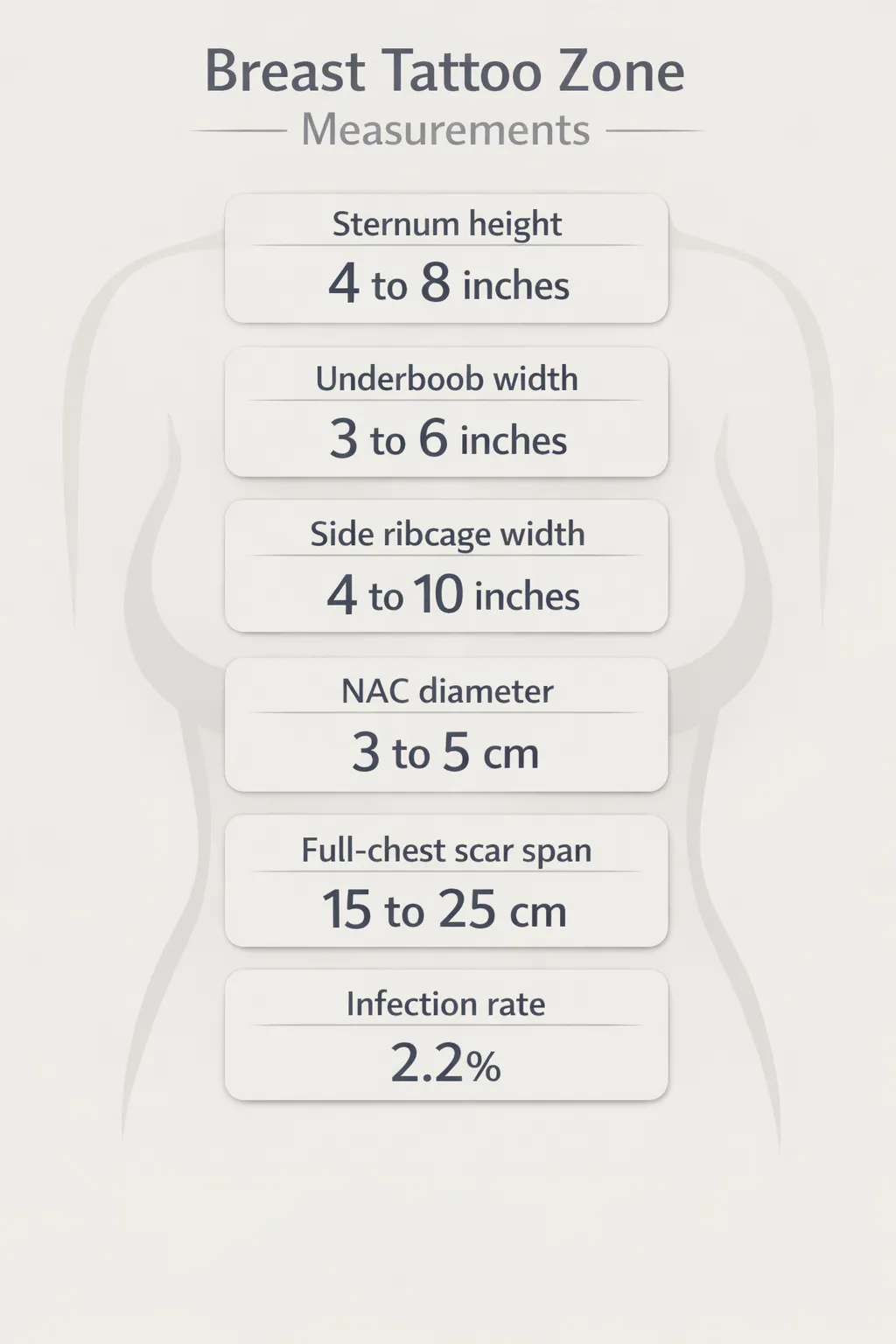 Breast tattoo placements and size ranges across zones: sternum 4 to 8 inches, underboob 3 to 6 inches, side ribcage 4 to 10 inches, NAC diameter 3 to 5 cm, scar span 15 to 25 cm, infection rate 2.2%.
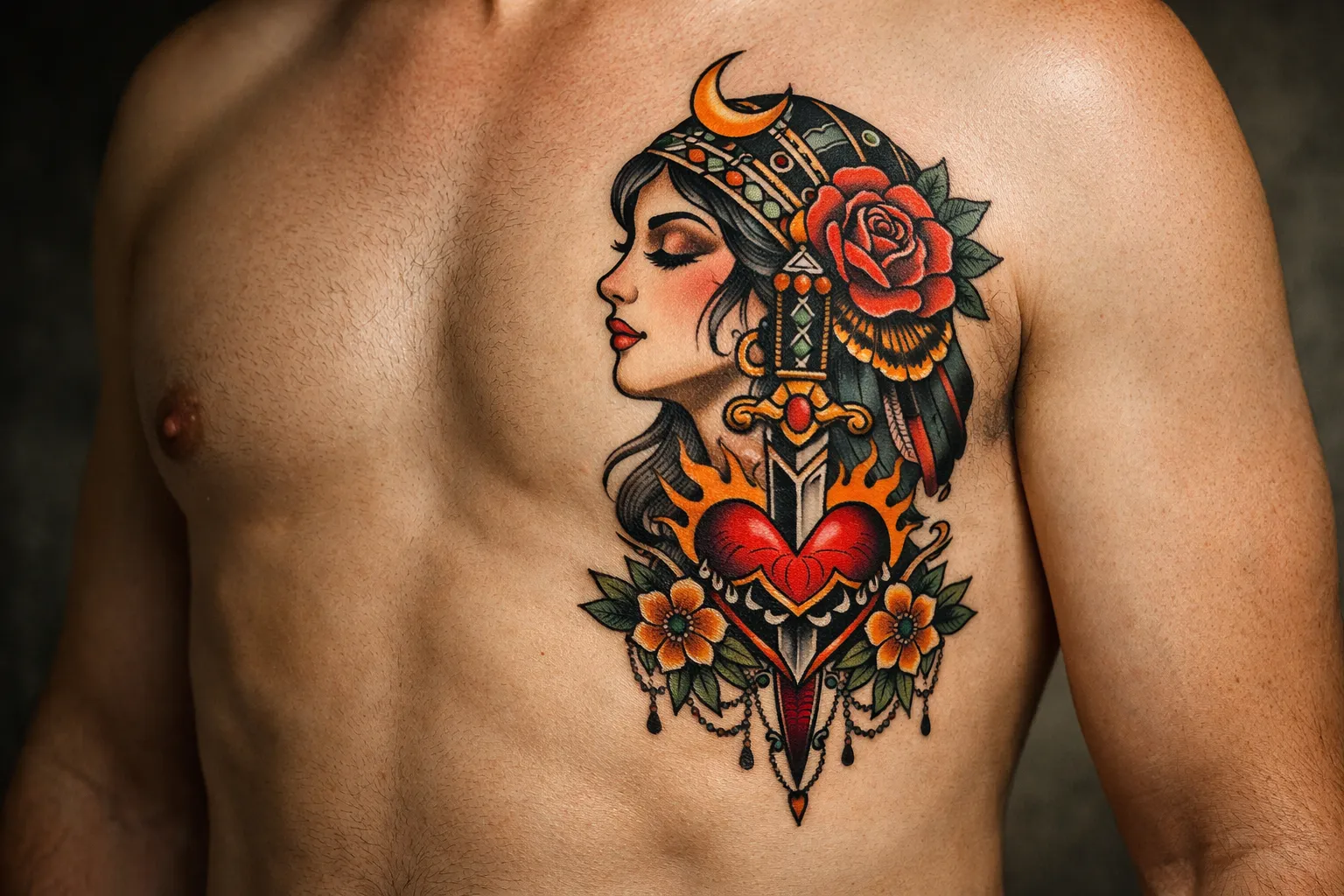
The sternum and underboob are the most requested aesthetic placements. The nipple-areola complex (NAC) and full-chest scar-cover work are the most medically significant. All five sit under standard clothing and only show in swimwear or a low neckline.
One logistics note that applies across the lower zones: mark the bra line with your artist before stenciling, so the design sits just below the underwire and avoids friction damage during healing.
Sternum and Cleavage Placement
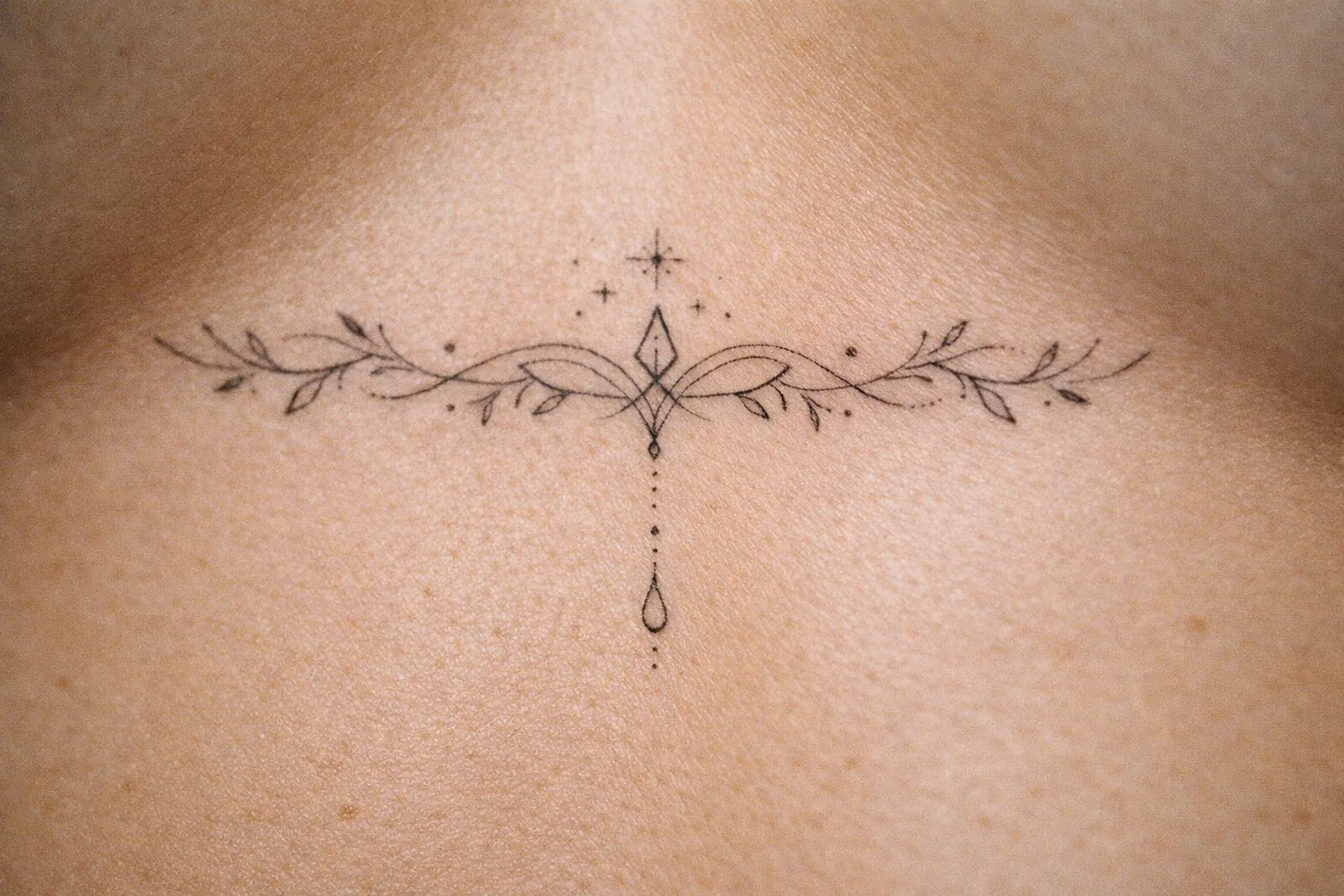
The sternum zone runs vertically from the suprasternal notch at the base of your neck down toward the solar plexus, centered between the breasts. Common mandala and ornamental designs here span 4 to 8 inches (10 to 20 cm) in height. Symmetry is everything on a centered piece. I always apply the stencil while the client is standing - lying flat shifts breast tissue and throws off the center line in ways that are obvious once the piece is healed.
Underboob and Inframammary Placement
Underboob designs follow the natural curve of the breast along the inframammary fold. Decorative arcs here commonly measure 3 to 6 inches (7.5 to 15 cm) per breast. This is the zone most vulnerable to distortion: the skin under the bust stretches with pregnancy and significant weight change, so a crescent moon or lace arc that looks crisp now can warp later. If a pregnancy is in your plans, consider placing the design higher on the sternum or waiting.
Side and Ribcage Placement
Side and ribcage pieces extend from the outer breast toward the axilla and can run 4 to 10 inches (10 to 25 cm). This is often the sharpest zone to sit through, and larger pieces mean longer sessions. Vertical botanicals and script quotes running along the ribs work well here because the shape follows the body’s natural line rather than fighting it.
NAC and Full-Chest Placement for Survivors
Nipple-areola complex tattoos are sized to match the opposite areola or personal preference, often 3 to 5 cm in diameter to recreate symmetry after mastectomy. Full-chest scar-cover work tracks along mastectomy incisions and is scaled to span both scar lines across the chest. These two placements get their own dedicated section below, because timing and artist selection work completely differently for them.
How Much Does a Breast-Area Tattoo Hurt?
Breast, sternum, and ribcage tattoos rank among the higher-pain placements on the body. The skin is thin, there’s little padding, and needle vibration transmits straight into the breastbone. On a relative scale: ribcage ≈ sternum > inner bicep > thigh > outer forearm.
Expect a sharp, burning scratch on the surface, a deep vibration when the needle passes over bone, and a radiating ache during longer sessions. The underboob fold is slightly more padded than the central sternum, so it’s marginally easier - but “easier” is doing a lot of work in that sentence. The side ribcage is consistently the sharpest of the three.
What makes it worse: dehydration, skipping a meal, heightened skin sensitivity around your menstrual cycle, and long session length. What helps: eat a full meal one to two hours before, bring water and a sugary snack, and split long designs into shorter appointments.
Numbing cream is worth asking about, but confirm the policy first. Some artists allow 4 to 5% lidocaine applied about 60 minutes before; others won’t tattoo over numbed skin because it changes how the skin takes ink. And numbing isn’t a guarantee - a NAC tattooing case series in Annals of Medicine and Surgery reported that three of the first ten patients tattooed under topical anesthetic cream complained of pain during the procedure and needed local anesthesia, which led that team to stop using cream in favor of local infiltration (10).
One survivor-specific note: if you have altered sensation after surgery, you may feel reduced or atypical pain in operated areas. Less physical sensation doesn’t automatically mean less emotionally intense. Talk it through with your artist before the session so there are no surprises.
Design Ideas for Aesthetic Breast Tattoos
The best design for this placement depends entirely on the zone and how you want it to age. Fine-line and ornamental styles dominate the requests I see for this area in 2025 and 2026. Here’s how the choices break down by zone.
Sternum and Cleavage Designs
The flat, symmetrical breastbone is built for centered work:
- Mandalas and ornamental dotwork - symmetrical, 4 to 8 inches, the most common request for this zone
- Fine-line florals - peonies, lotuses, botanical vines running vertically down the sternum
- Geometric frames and negative-space compositions
- Script or a single word centered on the breastbone
On meaning: the lotus and mandala carry South Asian and Buddhist origins tied to awakening and balance. A snake or ouroboros reads as cycles and renewal. Florals shift by species - peonies in Japanese irezumi signal wealth and bravery, which is a different register than a delicate Western fine-line rose. Pick imagery with a cultural origin you actually understand rather than borrowing a sacred motif for its shape alone.
Underboob and Side-Ribcage Designs
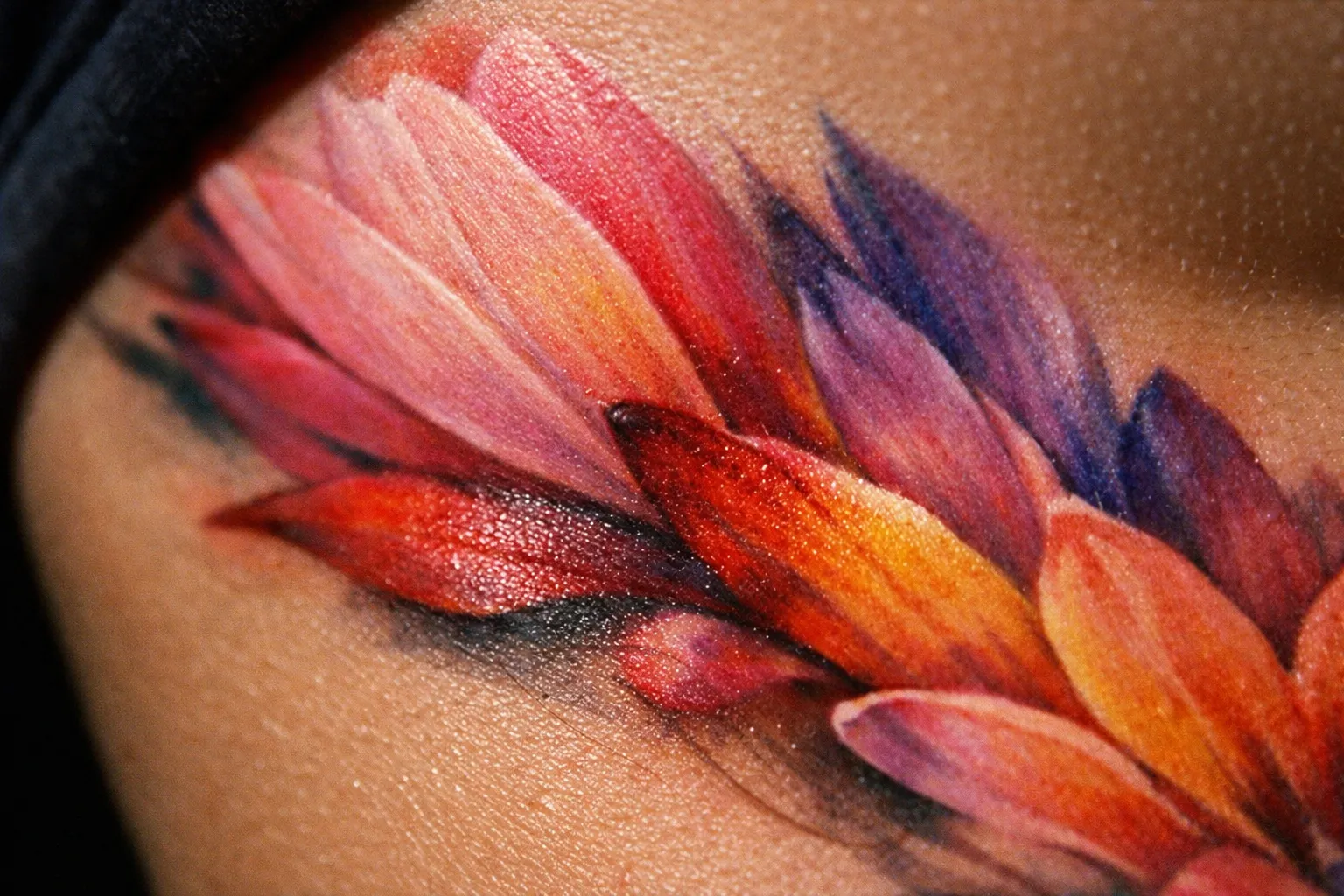
Under the bust, designs arc along the inframammary fold: moth, butterfly, or bee motifs centered under the breast, crescent moons, and lace-style ornamental work. The moth and butterfly read as transformation across several traditions. Along the side ribs, vertical botanicals (ferns, single stems, branches), wave compositions, and script quotes follow the body’s line naturally.
Now the aging reality, because this placement is not forgiving. According to tattoo-aging guides from AI For Tattoo, the chest and breasts are among the faster-aging sites - fine-line work often needs touch-ups every 3 to 5 years, and chest tattoos age faster than most due to body-shape changes, pregnancy, and gravity. Ink longevity comparisons from Inkjin put it in numbers: black and dark grey can go 10 to 20 years without a refresh, while pastel colors like light pink and lavender fade 30 to 50% faster and often need a touch-up within the first five years. Fine-line details can blur within 5 to 10 years as ink spreads slightly in the dermis.
The practical takeaway: if longevity matters to you, choose black or dark grey over pastels, ask your artist for slightly wider line spacing, and budget for a touch-up around year five. Blackwork holds up well here too, but high-saturation solid black over delicate or previously treated skin can heal patchy - plan for at least one touch-up.
Survivor Ink - Post-Mastectomy, Scar-Cover, and NAC Tattoos
Survivor tattooing is now documented as part of survivorship care, not a fringe extra. The American Cancer Society estimates over 4 million breast cancer survivors are alive in the United States, and changes in physical appearance affect 31 to 67% of survivors - a large population for whom body-image interventions genuinely matter (7).
The mental-health data is encouraging. Studies report 95.3% satisfaction with nipple-areola appearance after medical tattooing, and comparative research found significantly fewer depressive symptoms and lower perceived stress in tattooed versus non-tattooed survivors (7)(3). A 2025-2026 review frames NAC tattooing as a “promising, minimally invasive intervention within survivorship care” (3). The framing that matters here: tattooing restores physical integrity and improves body-image distress. It doesn’t erase what happened, and it isn’t meant to.
This context also applies to transgender and non-binary individuals after top surgery. The same timing rules and specialist requirements hold.
3D Areola Tattoos: What They Look Like and How They Work
A well-executed 3D NAC tattoo uses multi-tone shading - typically several custom-mixed pigments matched to your skin undertone - to create the illusion of depth and projection on a flat reconstructed breast. Healed results at six months or more can be strikingly realistic. The customization is what does the work: studies report consistent satisfaction with nipple appearance specifically when artists mix color to the individual undertone rather than reaching for a generic ink.
Not everyone wants photorealism. Minimalist versions use a simple circle or a symbolic motif in place of dimensional shading, and that’s an equally valid choice.
Most patients complete two sessions over 8 to 12 weeks: the initial tattoo, a 6 to 8 week healing gap, then a refinement appointment. Real-world satisfaction is high across cohorts: a French study of 98 women reported 97% overall satisfaction with nipple-areola reconstruction (12), and an Italian series of 169 patients treated across 309 sessions found 90% satisfaction with only three minor complications and no serious adverse events (11).
Decorative Scar-Cover Art: Florals, Birds, and Botanical Designs
Decorative scar-cover tattoos place florals, birds, waves, or geometric designs along mastectomy lines to transform how the scar reads - not to hide that it exists. The best of this work follows the direction of the scar rather than fighting it, letting a stem or a wing run with the incision line instead of cutting across it.
A staged approach works especially well on scar tissue: outline first, then shading, then refinement, with sessions spaced 6 to 8 weeks apart. That spacing lets both you and the artist see how the scar accepts ink before committing to larger fills. Scar tissue doesn’t always take pigment evenly, and it’s better to learn that on a small area than a full chest panel.
Symbolic and Commemorative Designs
Not every survivor tattoo is large or reconstructive. Pink ribbons, meaningful dates, quotes, and personal symbols marking treatment milestones tend to be smaller and can sit on the chest or anywhere else you want them visible. These are often a first step - something that marks what happened without the timeline demands of NAC or full scar-cover work. If the chest feels like too much or the timing isn’t right yet, an inner-arm date or a small ribbon on the forearm carries the same reference with none of the scar-maturity constraints.
Timing Rules - When Is It Safe to Get Tattooed?
Timing is the single most consequential decision for any breast-area tattoo involving surgery. Get it wrong and you’re looking at poor pigment retention, blowouts, or infection. For cosmetic breast tattoos with no surgery involved, there’s no special waiting period beyond standard tattoo readiness - just healthy, uninfected skin.
Everything changes once surgery is in the picture. For non-operated chest skin near a surgical site, several professional sources advise waiting 6 to 8 weeks to 3 months minimum after general healing. For scar-cover and NAC work, the waits are far longer, and the reasons are biological.
Timing by Scenario: A Quick-Reference Breakdown
How Long to Wait Before Tattooing - By Scenario
| Cosmetic breast tattoo (no surgery) | Post-surgery, non-scar chest skin | Scar-cover tattoo (surgical scar) | NAC / 3D areola tattoo | After radiation to the chest | |
|---|---|---|---|---|---|
| Minimum Wait | None beyond standard readiness | 6-8 weeks | 12 months | 12 months post-final surgery | 6-12 months post-radiation |
| Recommended Wait | N/A | 3 months | 18-24 months | 12-18 months | 12 months |
| Medical Clearance Needed? | No | Advisable | Yes | Yes (surgeon/oncologist) | Yes |
| Key Risk Factor | Standard skin health | Proximity to healing tissue | Scar maturity, keloid risk | Implant type, radiation history | Infection risk, tissue fragility |
Why Radiated Skin Needs Extra Caution
Radiated tissue carries a measurably higher complication risk, so it needs a longer wait and a specialist artist. An 11-year institutional review of 539 patients undergoing NAC tattooing found a 2.2% tattoo-related infection rate overall - uncommon, but with previous radiation and prepectoral implant-based reconstruction both identified as independent predictors of infection. Radiation history carried roughly four times the odds of a tattoo-related infection in that series, and the mean time to infection was 6.5 days post-tattoo (6).
Because of this, oncologic centers often delay areola micropigmentation 6 to 12 months post-radiation, and some professionals recommend around 12 months after chemotherapy and radiotherapy before any tattooing. If you have a prepectoral implant, disclose the implant type to both your surgeon and your artist - it’s a known risk factor, not a detail to skip.
The non-negotiable across every survivor scenario: get explicit clearance from your reconstructive surgeon or oncologist before booking. No reputable paramedical tattooist will proceed without it. When you assess a scar’s readiness, run the checklist - color stable, texture settled, non-tender, unchanged for months - and if any box is unchecked, wait.
Choosing the Right Artist for This Placement
The skill set for aesthetic breast tattoos and the skill set for survivor ink are not the same thing, and vetting works differently for each.
For aesthetic breast tattoos, look for healed chest and sternum work in the portfolio - not just fresh photos. Fresh work always looks crisp; healed photos at six months or more show whether the artist’s lines actually hold on thin, mobile skin. Match the style to what you want (fine-line and ornamental are different specialties), and confirm the studio uses single-use needles, a visible autoclave, and barrier film.
For NAC and scar-cover work, the bar is higher. Seek paramedical or oncology-trained tattooists experienced with scar tissue. Oncology centers such as Memorial Sloan Kettering explicitly recommend working with specialists who coordinate with your surgical team, rather than cosmetic studios without medical experience. In some healthcare systems, this work is done by trained nurses in an outpatient setting - the French satisfaction study reported tattooing performed safely by trained nurses without hospital admission (12). Cancer charities such as Breastcancer.org maintain vetted provider lists that distinguish clinical paramedical providers from artistic tattooists.
How to Vet an Artist for Survivor or Scar-Cover Work
About 1 hourSteps to find and confirm the right tattooist for NAC or scar-cover tattoos.
- 1
Search for specialists
Look for paramedical or oncology-trained tattooists via cancer charity vetted lists or survivorship clinic referrals.
- 2
Request healed portfolios
Ask for photos of healed NAC or scar-cover work at 6+ months post-session, not just fresh tattoos.
- 3
Ask about experience
Confirm if they've worked with radiated skin and how they coordinate with surgical teams.
- 4
Confirm infection control
Ensure the studio uses single-use needles, autoclave logs, and barrier film.
- 5
Get medical clearance
Obtain written clearance from your reconstructive surgeon or oncologist before booking.
- 6
Book a consultation first
Schedule a consultation (not a tattoo appointment) to discuss scar readiness, session count, and staging.
Red flags across the board: refusal to show healed work, pressure to deposit before a consultation, prices well below market, and no discussion of scar readiness or your medical history. For complex work, split it into outline, shading, and refinement sessions spaced 6 to 8 weeks apart so you can see how the tissue accepts ink before committing to larger fills.
Healing and Aftercare for Breast-Area Tattoos
Breast-area tattoos follow the standard healing timeline, but bra friction is the placement-specific factor most generic guides miss entirely.
- Day 1 to 3: Plasma seeping and swelling. Keep the original dressing on as instructed, then wash with lukewarm water and fragrance-free soap and pat dry. Apply a thin layer of fragrance-free ointment or moisturizer two to three times daily.
- Week 1: Peeling and itching. Don’t pick or rub. Switch to soft bralettes without underwire, front-clasp bras, and loose cotton tops. No swimming.
- Week 2 to 4: Surface skin closes around day 10 to 14. Once peeling stops, apply fragrance-free mineral SPF 30+ - UV is the biggest long-term enemy of chest ink. Pastel or lighter ink may look patchy in this window; it usually settles by week six.
- Week 6 to 8: Full healing for medium pieces. Underwire and tight bras are safe again. Schedule a touch-up evaluation around this point.
On bras specifically: for the first two weeks, stick to soft bralettes, front-clasp bras, and loose cotton, and avoid seams or lace across fresh linework. For underboob designs, skip underwire for at least four weeks - the wire sits directly on the healing arc and will rub ink off or irritate it.
For survivors, follow your artist’s instructions precisely, especially over or near scar tissue. Infection risk is real and front-loaded: in the 11-year NAC review, the mean time to infection was 6.5 days after tattooing, and infections were more likely in radiated and prepectoral implant-based reconstructions (6). Any unusual heat, swelling, or discharge in that early window warrants prompt contact with a healthcare professional.
Frequently Asked Questions
Frequently Asked Questions
- How painful is a tattoo on your breast?
- Breast, sternum, and ribcage tattoos rank among the higher-pain placements. The skin is thin, there's minimal padding over the breastbone, and the needle vibration transmits directly into the bone. Expect a sharp burning scratch on the surface and a deep ache during longer sessions. The underboob fold is slightly more padded than the central sternum but still uncomfortable. Eating beforehand, staying hydrated, and confirming numbing cream options with your artist are the most practical ways to manage it.
- What do tattooed nipples look like?
- A well-executed 3D NAC tattoo uses multi-tone shading - typically three to five custom-mixed pigments matched to your skin undertone - to create the illusion of depth and projection. Healed results at 6+ months can be remarkably realistic. Minimalist versions use simple circles or symbolic motifs rather than photorealistic shading. Most patients complete two sessions: the initial tattoo and a refinement appointment 6-8 weeks later. Outcomes vary by artist skill, skin type, and whether the area received radiation.
- How long after a mastectomy can I get a tattoo?
- For NAC or scar-cover tattoos, most paramedical specialists recommend waiting 12-18 months after the final reconstruction surgery. If the area received radiation, add another 6-12 months minimum. Scars should be stable in color, flat, non-tender, and unchanged for several months before any tattooing. Always get explicit clearance from your reconstructive surgeon or oncologist - especially if you have implants or a history of radiation.
- What is the most feminine spot for a tattoo?
- "Most feminine" is subjective, but the placements most commonly requested for their combination of concealability and visual impact are the sternum/underboob, side ribs, spine, hip, and inner arm. The sternum and underboob are particularly popular because designs follow the body's natural curves and remain hidden under everyday clothing.
- Can I tattoo over mastectomy scars?
- Yes, but timing and artist selection matter enormously. Scars need to be fully matured - stable in color, flat, non-tender, and unchanged for months - which typically means waiting at least 12 months, often 18-24 months for surgical scars. Radiated skin requires extra caution and a longer wait. Choose an artist experienced with scar tissue, and get medical clearance from your surgeon first.
- Will a breast tattoo distort with pregnancy or weight changes?
- Designs on the central sternum itself are relatively stable because the bone doesn't change. Underboob and inframammary designs are more vulnerable - the skin in that area stretches with pregnancy and significant weight fluctuation. If you're planning a pregnancy, consider placing the design higher on the sternum or waiting until afterward.
- Are NAC tattoos covered by insurance?
- In some healthcare systems, NAC reconstruction - including tattooing - is classified as medically necessary following mastectomy and may be partially or fully covered. Coverage varies widely by country, insurer, and reconstruction pathway. Ask your oncology or reconstructive team about what's included in your reconstruction plan before assuming out-of-pocket costs.
- What should I wear to a breast tattoo appointment?
- A front-clasp bra or soft sports bra you don't mind getting ink on, plus a loose button-up shirt or oversized top. Avoid underwire on the day - it'll be uncomfortable during a long session lying on your back. For underboob work, some artists prefer you go without a bra entirely during the session.
What to Think About Before You Book
Three decisions drive whether a breast tattoo works out, and none of them is the design itself.
Placement and timing is the big one. Whether you’re choosing a sternum mandala for how it looks or planning scar-cover work after reconstruction, the timeline is the most consequential variable you control. Rush it and the ink won’t hold and the infection risk climbs; respect it and the result lasts.
Artist selection is not one skill set but two. For aesthetic work, judge the healed portfolio and the style match. For survivor ink, judge paramedical training and how the artist coordinates with your medical team. A great fine-line artist and a paramedical NAC specialist are not interchangeable.
Aftercare logistics come down to friction. Soft bralette, no underwire for four weeks, fragrance-free everything, and mineral SPF 30+ once peeling stops. That covers most of it.
If you’re a survivor weighing NAC or scar-cover work, the research on satisfaction and mental-health outcomes is genuinely encouraging - satisfaction rates sit in the 90s across multiple cohorts. The timing rules and specialist requirements exist for real biological reasons, not bureaucratic ones. Get your clearance, choose a vetted artist, and the wait is worth it.