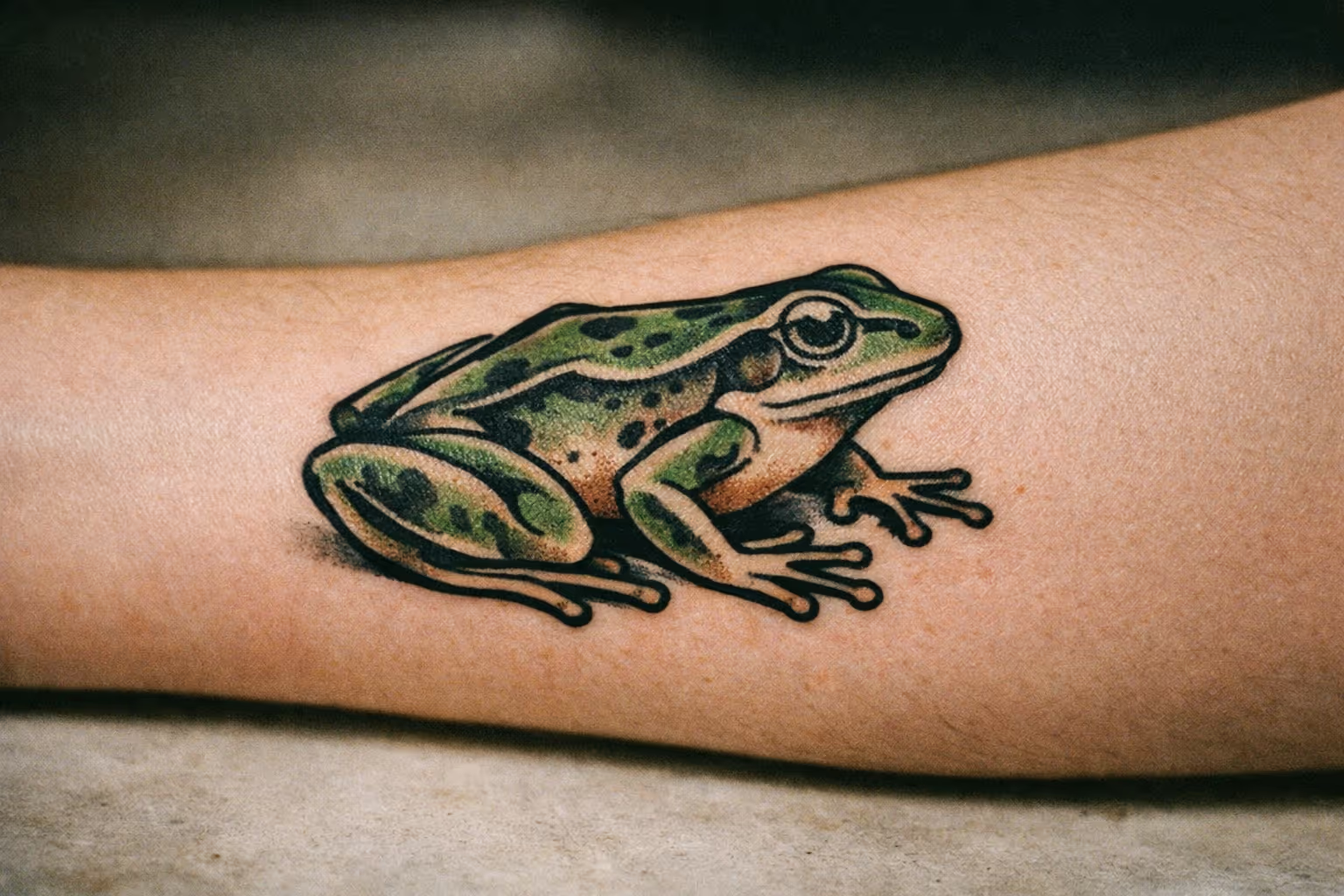
A frog tattoo is one of the rare motifs where the linework decision outweighs the color one: thick, confident outlines still read at twenty years, while a color-heavy frog goes muddy far sooner. It’s also a symbol people assume they understand and usually don’t - what it says depends entirely on the details you add, from a coin to the Japanese kaeru. Here’s what a frog tattoo actually means, and how to build one that lasts.
✓ Pros
- Versatile motif that works across multiple styles - American traditional, Japanese irezumi, minimalist blackwork, and color realism
- Strong symbolic range: luck and prosperity, transformation and rebirth, or safe travel and return - pick the thread that fits
- Scales well from a 1-inch wrist piece to a 6-inch calf composition with supporting elements
- American traditional version ages exceptionally well thanks to thick outlines and solid color blocks
✗ Cons
- Color versions (greens, yellows, reds) are UV-sensitive and require consistent sun protection to stay vivid
- Small frogs with too much interior detail lose definition within a few years - silhouette simplicity is non-negotiable at 1-3 inches
- The bone frog carries specific U.S. Navy SEAL cultural weight - wrong context reads as appropriation, not decoration
- Japanese irezumi frogs need a larger canvas (3-6+ inches) and a longer session (2-6+ hours) to handle supporting elements without crowding
What a Frog Tattoo Actually Means
There’s no single fixed meaning here, so don’t let anyone sell you one. Frog symbolism breaks into three main threads:
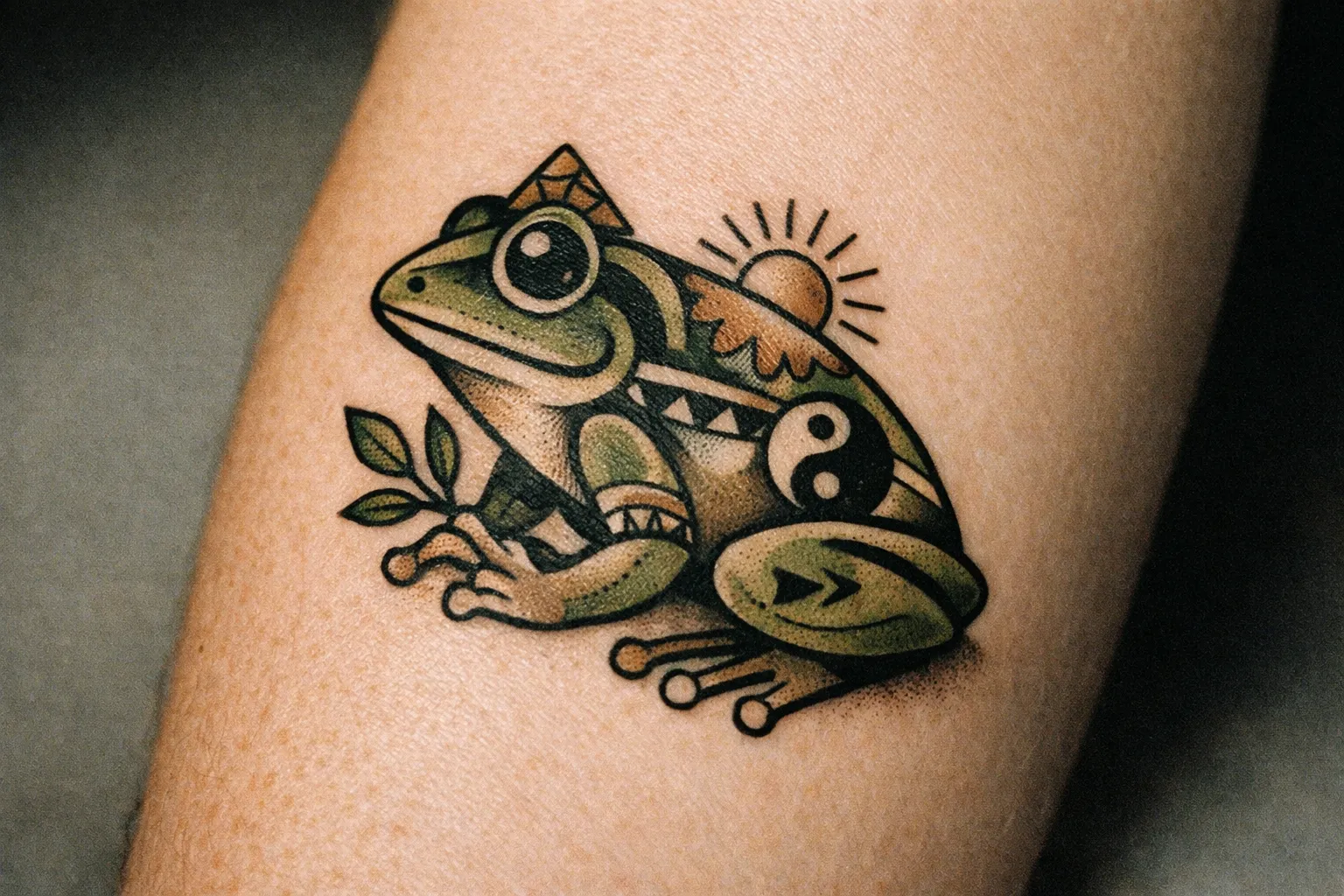
Luck and prosperity. In Japanese tattoo culture the frog is tied to abundance, money, success, and good fortune (2). This is why you’ll often see it paired with a coin - the imagery reinforces the wealth reading (5). If “lucky” is your goal, the coin motif does the heavy lifting.
Transformation and rebirth. The frog’s biology - tadpole to adult - is the core argument for the change-and-evolution meaning (4). It moves between water and land, which is why so many cultures read it as a creature of passage and resilience. If transformation is your reason, a tadpole-to-frog progression reads more clearly than a single adult frog, because metamorphosis is the actual visual metaphor.
Return and protection. This is the Japanese kaeru angle. Because the word also means “return,” the design became a symbol for traveling safely and coming home - the phrase buji kaeru connects the frog with homecoming and travel protection (1). Recovery from hardship, a promise to survive, safe travel: all of that lives here (1)(2).
These threads aren’t mutually exclusive, but cramming all three into one tattoo muddies the message. Pick the one that matters to you and let the design lean into it.
Japanese Frog Tattoo Traditions: Kaeru, Coins, and Irezumi
Frog imagery shows up across Japanese literature, folklore, and irezumi, with references in Japanese literature dating back as far as the Heian period (794-1185) (3). In the irezumi tradition, the meaning centers on return, life, rebirth, prosperity, and safety (1).
What makes a Japanese frog tattoo distinct is the supporting cast. The frog rarely sits alone - it’s set against waves, lotus, coins, or warrior elements. Each of those shifts the reading:
- Coins or money imagery push the abundance and fortune meaning (5).
- Waves reinforce the travel and protection angle.
- Lotus ties it to rebirth.
When clients come in asking for a Japanese frog, I always ask which thread they’re after - because “a cool Japanese frog” and “a kaeru piece tied to safe travel” are two different briefs and they produce two different tattoos. Tell your artist the word kaeru or bring a culturally grounded reference, not just “a cute frog.” Treating the motif as a generic cute animal strips out the safe-travel, rebirth, and prosperity symbolism that makes it worth getting in the first place (1)(2).
For a Japanese-style frog, expect a larger canvas. The outer forearm, calf, or upper arm handle the supporting elements - waves, coins - without crowding. A detailed irezumi frog with surrounding work realistically runs 3-6+ inches and a session of 2 to 6+ hours. Pain-wise, calf and outer forearm sit on the milder end. Wrap toward the inner arm or shin and it climbs noticeably.
Traditional: Bold Flash That Ages Well
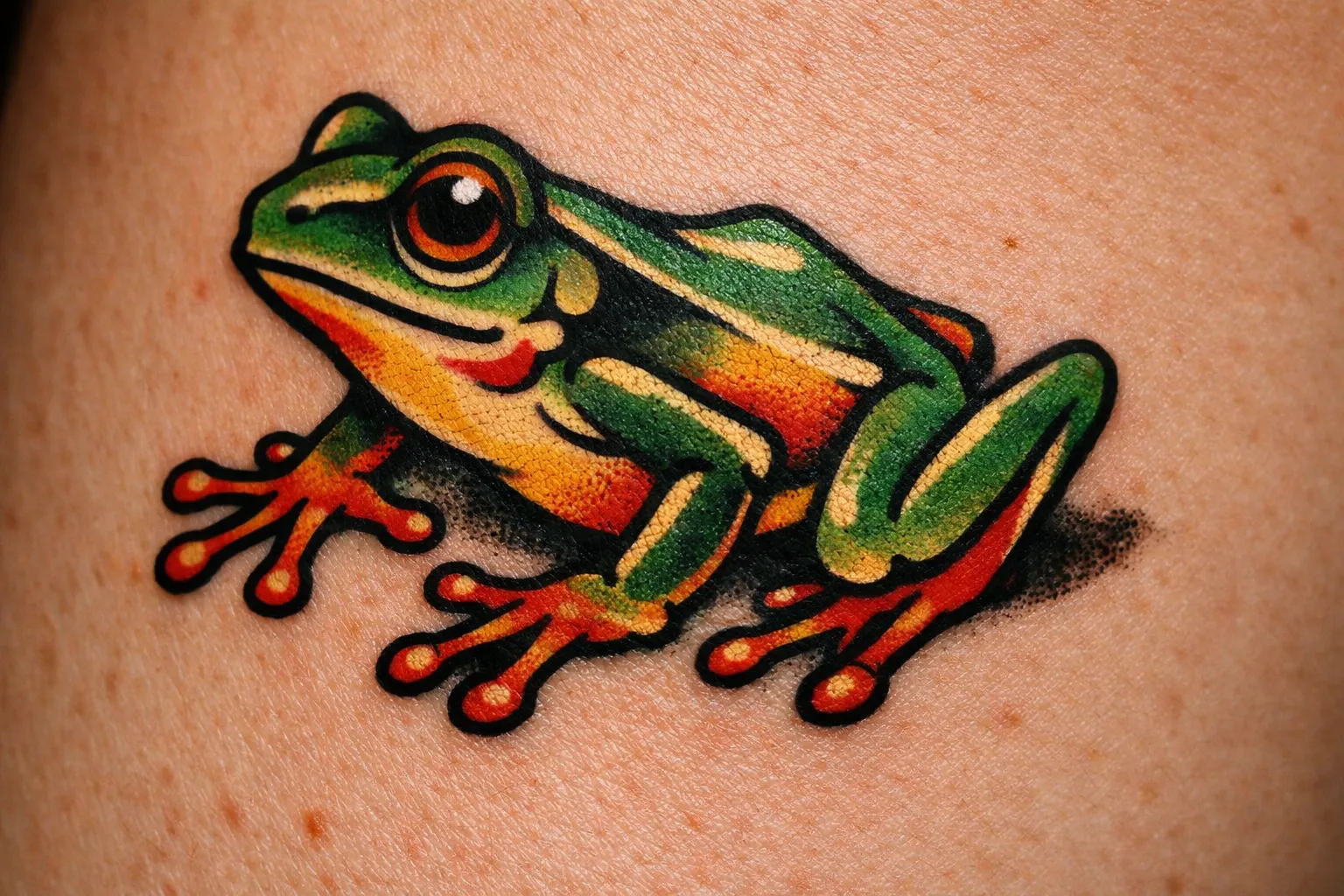
A traditional frog tattoo - American traditional, specifically - is built on two technical hallmarks: thick black outlines and a limited, high-contrast color palette (think the classic red, green, gold, black). That combination is exactly why this style ages better than almost anything else. Bold lines hold their shape as the skin softens over the years, and solid color blocks don’t blur the way fine gradients do.
The common pitfall is an artist who treats “traditional” as a vibe rather than a technique - thin outlines, muddy color mixing, no real contrast. That defeats the entire point. A real traditional frog should be readable across a room.
I’ve seen a lot of “traditional-ish” frogs that looked fresh and punchy on day one and turned into a green smear by year five. The outline is load-bearing. If it’s not thick enough to hold the color in place as the skin ages, the whole design softens into something unrecognizable.
This style suits a frog perched on a lily pad, holding a banner, or framed with simple botanical filler. Good placements include the outer forearm, upper arm, or calf at 3-5 inches. Traditional flash is designed to be seen, so don’t tuck it somewhere it’ll never get looked at.
Tree: Color-First and Playful
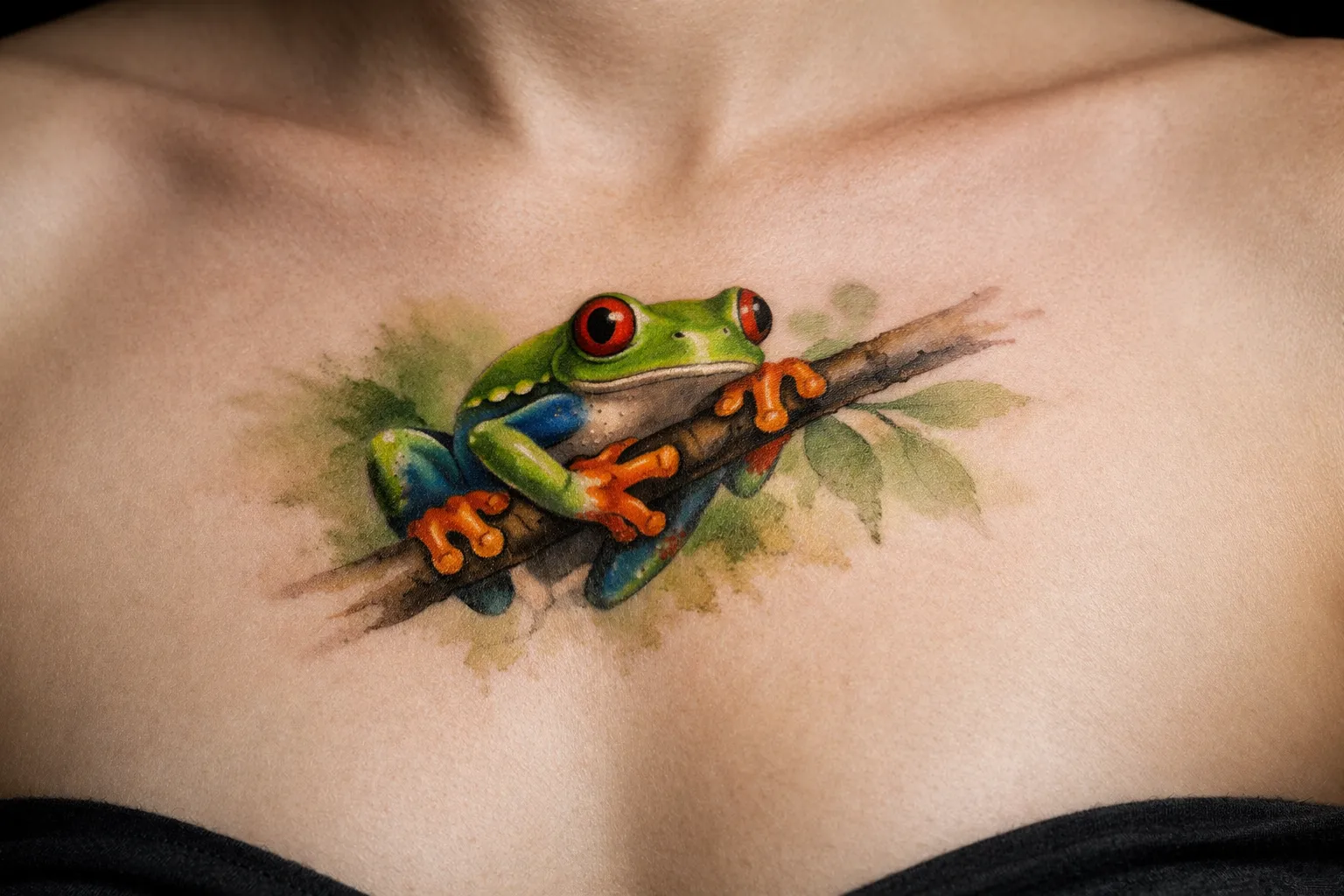
A tree frog tattoo is the choice when you care more about visual punch than cultural symbolism. The appeal is the palette - bright greens, yellows, blues, sometimes the red-eyed treefrog’s signature contrast. This is a nature-first, playful design rather than a loaded symbol.
Two things to know before you commit to all that color:
- Color fades faster than black, and green, yellow, and red inks are particularly UV-sensitive. A tree frog on your forearm or calf will need consistent sun protection to stay vivid.
- Detailed color realism wants a more experienced artist and more space - usually 3+ inches minimum to render the texture and color transitions cleanly.
If you love the look but want lower maintenance, ask for a stylized or blackwork-with-spot-color version. You keep the tree frog shape and lose some of the fade risk.
Small: Keeping It Clean at 1-3 Inches
A small frog tattoo is a strong first tattoo and a budget-friendly one. These typically fit in 1-3 inches, which makes the wrist, ankle, behind-the-ear, or forearm all viable placements. Behind-the-ear works for the simplest silhouettes only - think a single crouching frog outline, nothing more. The forearm gives you more real estate and better longevity because the skin there is relatively flat and low-flex compared to the wrist or ankle.
The trap with tiny frogs is detail. Frogs have small faces, long toes, and thin limb lines - pack too much in and it turns to mush within a few years. I’ve touched up small frogs that looked sharp on day one and were already losing definition by year three, almost always because the original artist pushed too much interior detail into too small a space. Fine-line micro realism is the worst offender here - the style looks stunning fresh and can look like a smudge by year five on a high-movement spot. Some practical rules:
- Keep the silhouette simple. A clean outline reads forever; fussy interior detail does not.
- Preserve 1-2 mm of breathing room between key lines so they don’t merge as the ink spreads.
- A frog with a slightly turned head and visible hind legs reads better at small scale than a front-facing frog with detailed fingers.
- Avoid high-friction, high-flex spots like fingers and the side of the wrist if you’re using thin fine-line work - those areas blur and fade fastest.
Black ink at small scale ages more predictably than micro color, so if longevity matters more than brightness, go with a clean blackwork frog.
Frog and Mushroom Tattoo: Whimsical Nature Scenes
A frog and mushroom Tattoo is a narrative composition rather than a single symbol - it leans into cottagecore and woodland themes. The frog sits on or under a mushroom cap, sometimes with ferns, moss, or small flowers filling the scene. There’s no deep cultural symbolism baked into this pairing the way there is with a Japanese kaeru piece - it’s an aesthetic choice, and that’s a perfectly valid reason to get a tattoo.
Because it’s a scene and not just a silhouette, it needs room to breathe. Plan for 3-5 inches on the forearm, calf, or upper arm. The calf is particularly good for this composition - the muscle gives you a naturally curved canvas that suits a rounded scene, and it’s one of the lower-pain placements compared to the ribcage or inner arm. The biggest mistake here is overloading the background. Too many elements and the frog stops being the subject, and the whole thing reads as a busy nature collage. Pick the frog and one or two supporting pieces - a single mushroom, a sprig of greenery - and let the rest be negative space.
This works well in soft color or in illustrative blackwork with light shading. Blackwork ages better; color gives you the storybook feel.
Bone Frog: A Navy SEAL Tribute, Not Decoration
The bone frog is a separate category and worth understanding before you choose it. It’s a skeletal frog tied to U.S. Navy SEAL culture, used as a symbol of acceptance, remembrance, and service identity (6). Within the SEAL community it carries weight - it’s a tribute to fallen teammates and a marker of brotherhood. The design itself is typically rendered in black and grey, with the frog skeleton posed in a crouching or spread position, sometimes accompanied by a trident or memorial date.
If you don’t have a direct connection to that culture, think hard about whether it’s the right design for you. People who recognize it will read it as a service-specific symbol, full stop. That’s not a hypothetical - veterans and active-duty personnel notice it immediately, and the conversation that follows can be uncomfortable if your answer is “I just liked the look.” Confirm with your artist whether you’re getting it as a memorial tribute or purely decorative, because the meaning travels with the image (6). The bone frog is already designed to be subdued and somewhat discreet, which suits placements like the upper arm or shoulder at 2-4 inches - large enough to render the skeletal detail cleanly, small enough to keep it personal rather than showy.
Frog vs. Toad: A Detail Worth Getting Right
These get confused, and the swap changes your tattoo’s message. Frogs are usually drawn with longer legs and smoother skin; toads are stockier and warty (5). If your reference is a frog but your artist renders a toad - or vice versa - the symbolism and the look both shift. Bring a clear reference photo so there’s no ambiguity, especially at small sizes where a few line choices decide which animal it reads as.
Choosing an Artist and Caring
Match the artist to the style. A clean small blackwork frog, a bold traditional piece, and a detailed Japanese irezumi frog are three different skill sets - and an artist who excels at one may genuinely struggle with another. Scour portfolios for healed work, not just fresh photos - healed shots tell you how their lines hold up over time. A traditional frog that still looks crisp and readable two years post-heal is a better signal than a stunning fresh photo. For color realism on a tree frog, prioritize artists with a deep color portfolio specifically, and look for healed color work in particular because that’s where most color artists fall short.
Come prepared with clear reference images and placement photos, and confirm the design stays legible at your intended size before the needle touches skin. If an artist can’t sketch a rough thumbnail at your target size and show you it reads cleanly, that’s a red flag worth taking seriously before you commit.
Aftercare timeline:
- Day 1-3: Keep it clean. Wash gently with fragrance-free soap and lukewarm water two to three times a day, pat dry, and apply a thin layer of fragrance-free moisturizer. Expect some plasma and ink weeping early on - that’s normal.
- Week 1: Stay on the wash-and-moisturize routine. It will start to flake and peel. Do not pick or scratch - let it shed on its own, or you risk pulling out color and patchy healing.
- Week 2-4: The surface heals but the deeper layers are still settling. Keep moisturizing, and once it’s fully closed, protect it from the sun. UV is the number-one cause of fading, and color frogs - greens, yellows, reds - are the most vulnerable. Use sun-protective clothing or, once healed, a high-SPF sunscreen.
A color tree frog will need ongoing sun discipline to stay bright. A black-ink small frog is far more forgiving long term.
Pricing and Sizing: How Big Is a $100 Tattoo?
Most U.S. shops have a minimum charge in the $100-$150 range, and that minimum covers very small, simple work. A $100 tattoo is realistically a simple blackwork frog around 1-3 inches - a clean silhouette, no heavy detail, somewhere like the wrist or ankle. That’s not a hard rule; it depends entirely on your local shop minimum and the complexity.
Step up to detailed color work and you’re looking at $200-$500+, scaling with size, color, and the artist’s reputation and city. A few things that move the price:
- Color and detail cost more than simple black line work.
- Session time matters - a small black frog runs 30-90 minutes; a Japanese-style frog with waves and coins runs 2-6+ hours.
- Tipping is customary at many studios - budget 15-20% on top of the quoted price.
Get a quote before you book. Frog complexity varies wildly, and an artist needs to see your reference to price it honestly.
Frequently Asked Questions
- What is the frog tattoo meaning?
- The frog tattoo carries three main meanings depending on the design: luck and prosperity (often paired with a coin in Japanese tradition), transformation and rebirth (visualized as tadpole to adult metamorphosis), and return or protection (the Japanese wordplay *kaeru* meaning both frog and to return). It's best to pick one thread to focus the design.
- How big is a $100 tattoo?
- At most U.S. studios, $100 covers a simple blackwork design about 1-3 inches, like a small frog silhouette on the wrist, ankle, or forearm. Adding color or detail increases the price quickly depending on local rates and complexity.
- How can I ensure my frog tattoo ages well?
- Choose styles with thick outlines like American traditional for longevity, keep small tattoos simple with minimal detail, and protect color tattoos from sun exposure using sun-protective clothing or high-SPF sunscreen after healing.
- Is the bone frog tattoo appropriate if I'm not in the Navy SEAL community?
- The bone frog is a specific symbol tied to U.S. Navy SEAL culture and service identity. If you don't have a direct connection, it may be misread as a service-specific tribute. Discuss your intent clearly with your artist before proceeding.