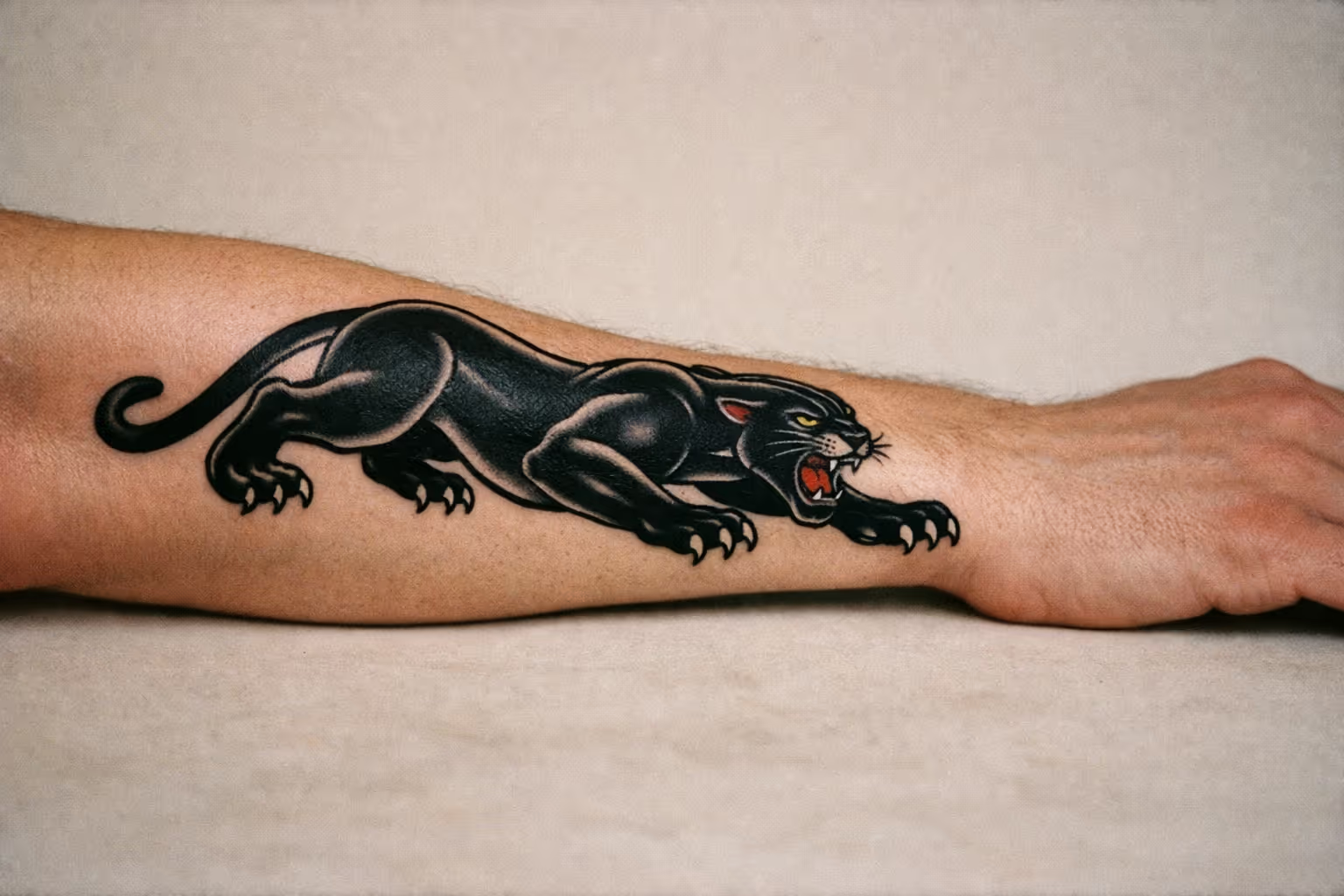
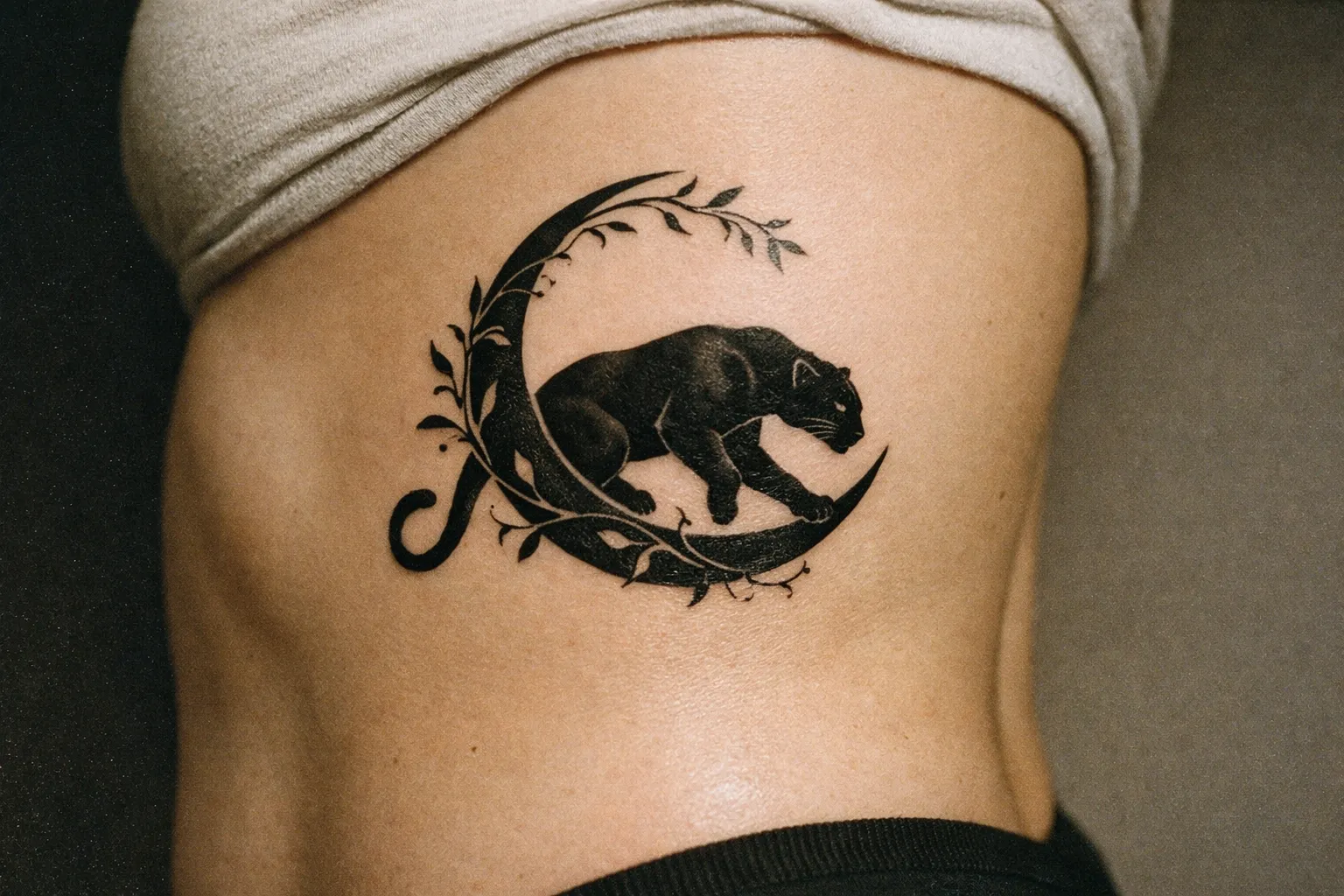
A black panther tattoo is one of the rare designs where the traditional version outlasts the realistic one. A flat-black, bold-outline panther - the crawling classic - holds its shape for decades; a soft realistic gradient softens and blurs far faster, and packed black fill is the first thing to go patchy. Style choice here is a longevity decision, not just a look. Here’s what wrecks the black fill, the S-curve placement that flatters it, and what it costs.
Where the Black Panther Tattoo’s Crawling Pose Came From
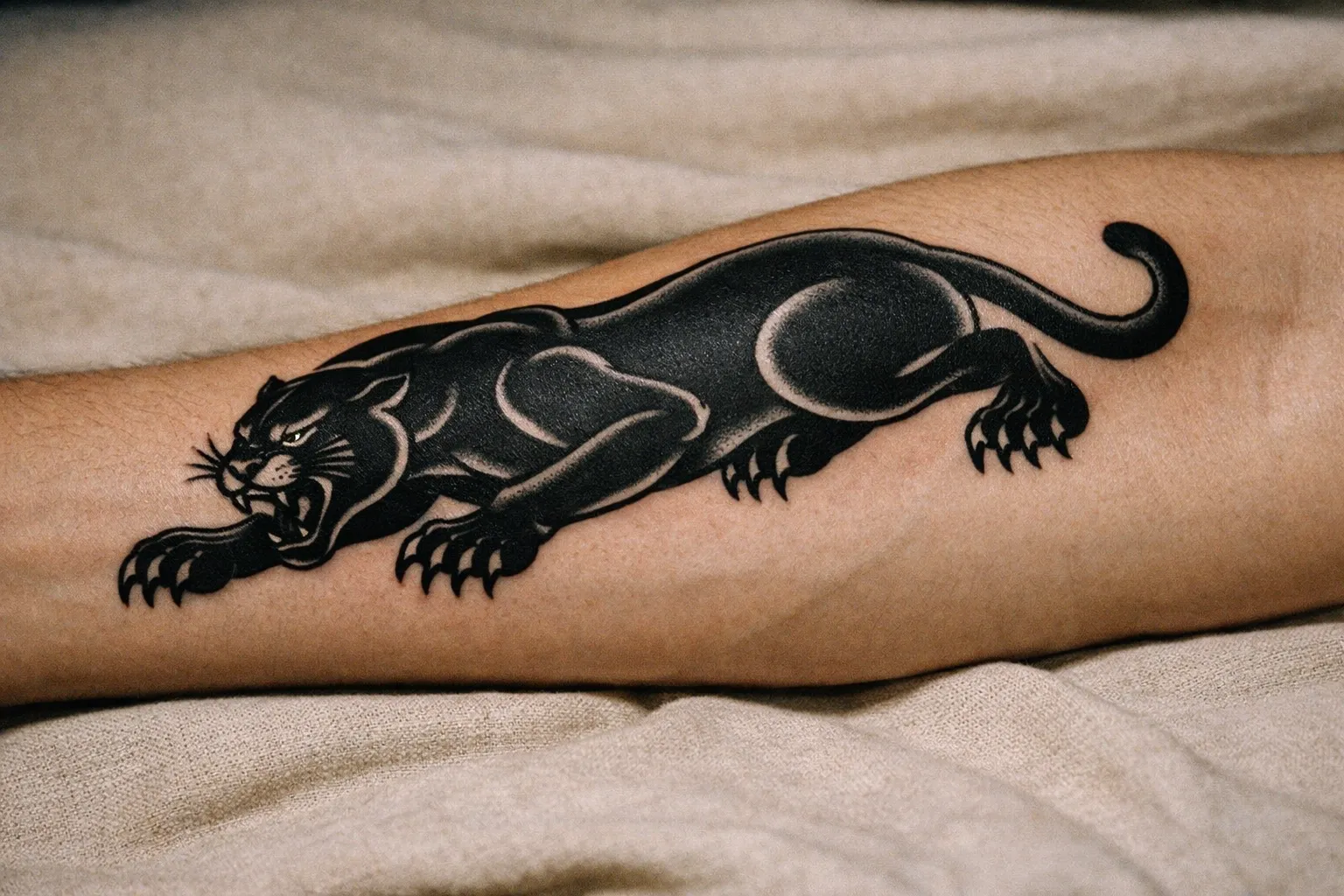
The crawling panther didn’t appear out of nowhere. The design most modern artists copy traces back to an illustration in Marie Schubert’s Minute Myths and Legends (1934), which made its way onto American flash sheets by the 1940s (2). From there it became a parlor wall fixture - bold, repeatable, and flexible enough to fit almost any limb.
Panthers carried symbolic weight long before tattooing got hold of them. Big cats appear in art going back over 3,000 years, from Roman bronze sculptures to imperial Chinese uniforms in the Ming and Qing dynasties (1). That long lineage is part of why the image feels heavier than a typical animal flash design.
The motif peaked among U.S. soldiers during the World War II tattoo boom and again with 1950s and ’60s greasers (2). Those wearers gave the panther its outlaw edge - rebellion, defiance, a little danger. The dense black fill also made it a practical cover-up for older, botched tattoos and scars, which is part of why it stuck around (4). A design that covers mistakes and looks good doing it earns its place on the wall.
Why the design held up
The crawling panther survived 80-plus years for technical reasons, not sentimental ones. The silhouette is bold and reads at a distance. The S-curve of the body follows the natural flow of an arm or leg. There’s enough solid black to age well and enough open posture to drop onto almost any placement. I keep returning to it because, structurally, it just works(2).
✓ Pros
- Bold silhouette that reads clearly from a distance
- S-curve design flows naturally with limbs
- Solid black fill ages well and covers older tattoos or scars
- Flexible placement options across limbs and torso
✗ Cons
- Patchy black fill ages poorly if artist lacks skill
- Realistic styles with gradients require high skill and age less gracefully
Panther Tattoo Meaning and Symbolism
Across most traditions, the Panther tattoo meaning lands on the same cluster of ideas: strength, power, resilience, courage, stealth, independence, and protection (1)(3)(7). Some wearers lean into the mystery and sensuality of the animal; others into its rebellious, outlaw history. None of those readings are wrong - the panther has carried all of them at different points.
A few clarifications worth making, because the symbolism gets muddied online:
- Cultural origin matters. The American traditional panther is a 20th-century U.S. tattoo motif, distinct from the 1960s Black Panther Party imagery and from Marvel’s Black Panther character portraits. Those are separate niches. A classic crawling flash panther carries none of that political or pop-culture baggage unless you deliberately build it in (2)(6).
- The meaning has shifted. In its heyday the panther signaled biker and greaser rebellion. Today it reads more often as personal resilience - overcoming something rather than threatening someone.
What does a black panther mean spiritually?
In modern spiritual and shamanic frameworks, the black panther is often treated as a spirit guide of protection. The common associations are night vision read as insight, feminine power, and transformation or rebirth (3)(5). People drawn to the totem reading usually go for a realistic panther head paired with cosmic elements - stars, a moon, sometimes an ouroboros ring to signal cyclical change. If that’s your angle, say so to your artist up front, because it changes the styling entirely.
Realistic Animal vs. Traditional Panther: How the Style Changes Everything
There’s a real difference between a Black Panther animal tattoo rendered realistically and a flat-black traditional Panther tattoo, and it changes everything from cost to how the piece ages.
Biologically, black panthers aren’t their own species - they’re melanistic leopards in Africa and Asia, or melanistic jaguars in the Americas (3). Most tattoo designs blend features rather than committing to one animal: a hint of rosettes, a jaguar’s heavier jaw, the lean leopard frame. I’ve seen artists go deep on the anatomy research and I’ve seen them just draw a big black cat. The latter usually looks fine. The former only matters if you’re going realistic.
- Realistic black panther animal tattoo: fur texture, detailed eyes, smooth black-and-grey shading with white highlights. Reads as a real cat. Demands an artist who can blend gradients cleanly.
- traditional Panther tattoo: 70-90% solid black fill, heavy single-pass outlines (often a 5-9 needle liner), limited accent color in the mouth, claws, and eyes. Reads as an icon, not a photo.
The traditional version ages better. Solid black with bold lines holds saturation for decades. Realism with fine gradients softens over time and is less forgiving of a mediocre artist.
Styles of Black Panther Tattoo
American traditional panther
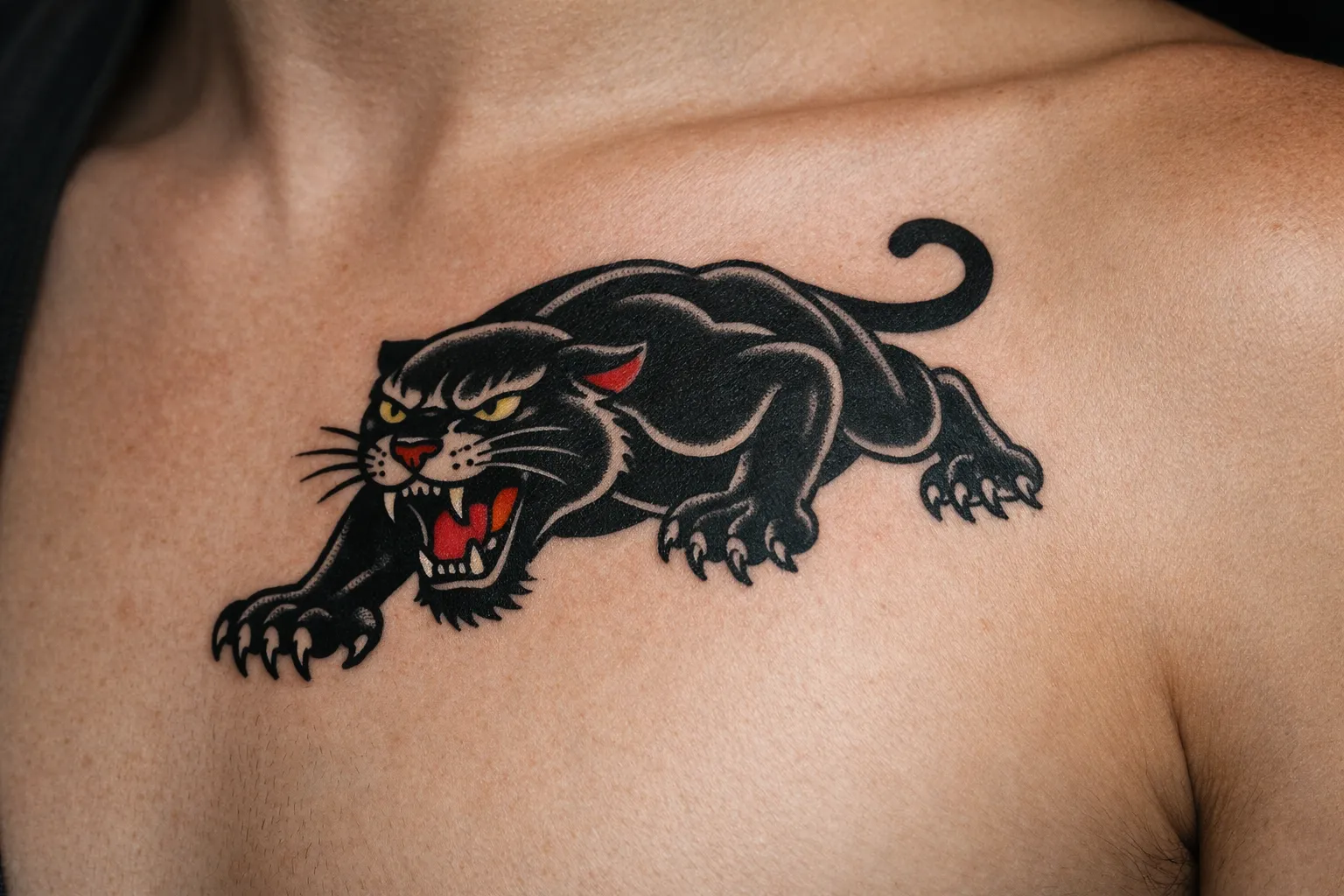
Two hallmarks define it: thick black outlines and a limited palette. The classic crawling pose, heavy fill, red tongue, yellow eyes, claws extended. This is the most durable option and the best choice for a first panther.
The common pitfall when artists do it badly is patchy, undersaturated black that goes grey and blotchy within a few years. Always check healed photos, not just fresh ones (7). Fresh black looks great on almost everyone. Healed black tells you whether the artist can actually pack it.
Neo-traditional panther
Same boldness, more range. Color gradients, richer backgrounds - flowers, daggers, snakes - and slightly more stylized anatomy. A solid middle ground between flash and full illustration. The risk is overcrowding; let the panther stay bold and push the detail into the background elements.
Realistic black panther
Full black-and-grey, fur texture, believable eyes. Best for wildlife or spirit-totem themes. Use negative space for whiskers and the highlight along the spine rather than leaning on white ink, which fades faster than the black around it. I’ve watched white ink highlights disappear inside two years on forearm pieces. It’s not worth the risk.
Blackwork and tribal panther
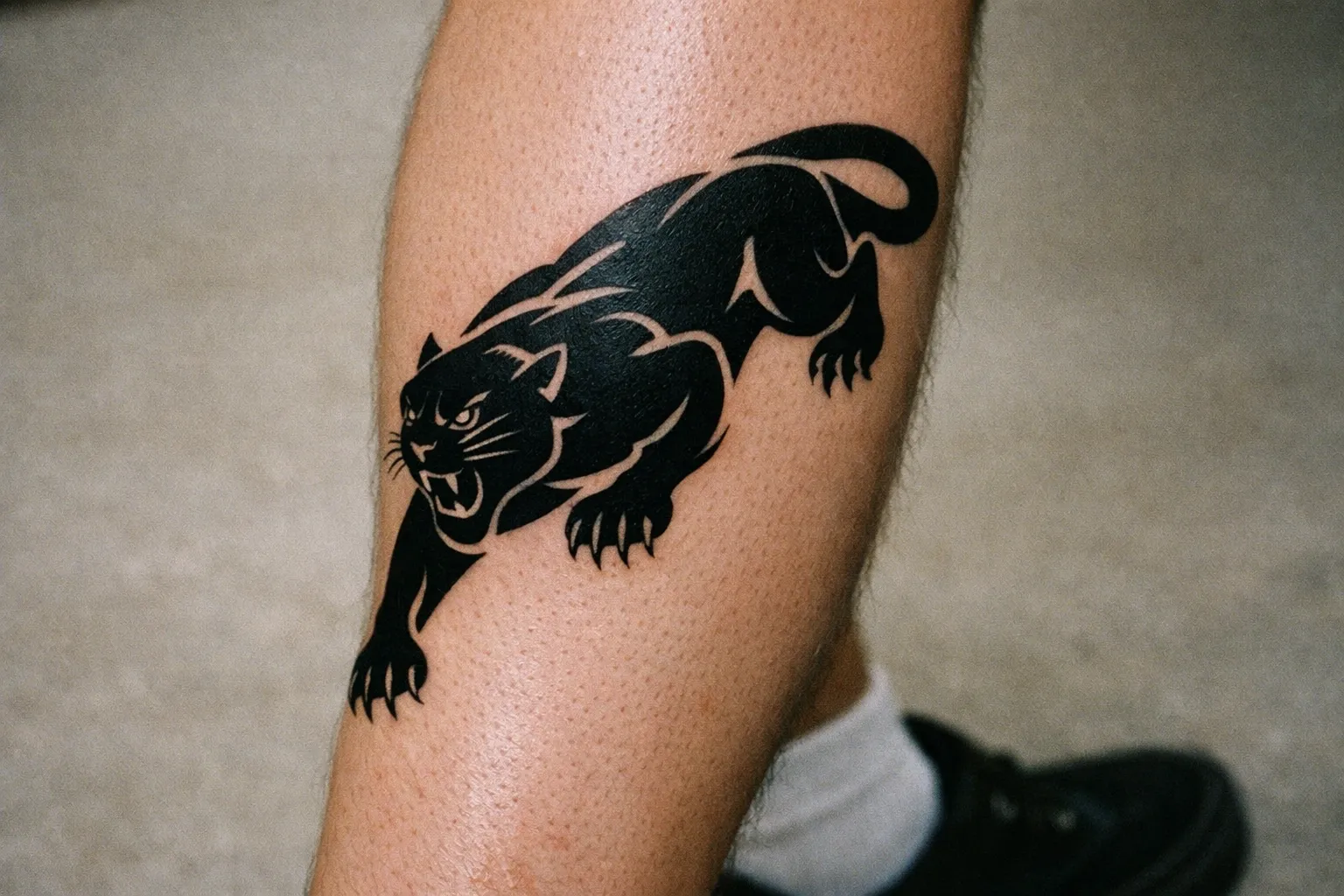
Simplified silhouette or abstracted shapes, heavy solid black, sometimes integrating geometric or Polynesian-influenced patterns. Tends to run larger. If you’re borrowing Polynesian motifs, get an artist who understands them - those patterns carry their own cultural meaning and shouldn’t be used as decoration.
Is a Panther Tattoo Masculine or Feminine?
The honest answer: it’s gender-neutral, and the styling decides the read. Historically the panther was marketed to men - sailors, soldiers, greasers (2)(4). It’s now worn across all genders, and the perceived masculinity or femininity comes almost entirely from the surrounding elements.
- Leans masculine: roaring or attacking pose, daggers, skulls, claws deep in the figure, bold limited palette.
- Leans feminine: crawling or stalking pose paired with flowers - roses or peonies - softer curves, often placed on the thigh, hip, or ribs.
The cat itself is neutral. The accessories aren’t. Decide the read you want, then build the design to match.
Sizing and Placement
Placement is where most panther tattoos succeed or fail, because the design depends on flow. The body of a crawling panther wants to follow a natural S-curve. Drop it down the outer forearm or shin, up the side of the ribs, or diagonally across the thigh, and it moves with you. Lay it horizontally across a vertical limb and it looks frozen and awkward every time you flex.
I’ve seen clients come in with a reference photo where the panther is stretched across the chest horizontally, and nine times out of ten we end up rotating it once they see it mocked up on the body. The S-curve isn’t optional - it’s the whole reason the design works.
Size ranges, by placement:
- Small / flash (3-5 inches): forearm or calf. Keep detail minimal - heavy black under 3 inches blurs over time.
- Medium (6-9 inches): upper arm, thigh, or ribs. Room for color accents and shading.
- Large (10-14+ inches): back, full flank, or thigh for crawling scenes or multi-animal compositions.
Direction matters too: a panther facing toward your hand or foot reads as forward motion; facing inward, it reads as guarding the heart or torso. On ribs the pain runs higher than the forearm or outer thigh - the ribcage is bony, thin-skinned, and close to the lungs, so longer sessions there get rough. Plan placement around how long you can actually sit.
What a Panther Tattoo Costs and How Long It Takes
Prices vary by region and artist, but the rough brackets:
- Small traditional panther (3-4”): $150-$300, usually shop minimum plus an hour or two.
- Medium crawling panther (6-9”) with color: $300-$700, at common big-city rates of $150-$250/hour.
- Large back or side piece (10-14”+): $800-$2,000+ across one to three sessions.
- Realistic black panther portrait by a specialist: $600-$1,500, since realism artists sit at the top of the local market.
Time investment runs 1-2 hours for a small traditional piece, 2-4 hours for a medium one with shading and color, and 5-10 hours across multiple sessions for large or highly detailed work.
A few logistics: most reputable studios require you to be 18+ with ID, though some jurisdictions permit 16-17 with guardian consent. Disclose conditions like diabetes or blood-clotting disorders. Walk-in flash panthers can often happen same day; a custom piece with a sought-after traditional or realism artist runs 1-6 months of lead time, usually with a $50-$200 non-refundable deposit applied toward the final cost.
Pairing the Panther with Related Motifs
If you’re planning a larger piece or a half-sleeve, the panther pairs naturally with several classic motifs. These are also the “related interests” image platforms tend to surface alongside panther tattoos - and they connect for real reasons, not just algorithmic ones.
Ouroboros - the cyclical universe
The ouroboros, a snake or dragon eating its own tail, comes out of ancient Egyptian and Greek symbolism and represents the cyclical nature of the universe - eternal return, life-death-rebirth (4). Wrapped around or behind a panther, it reinforces a survival-and-renewal reading. Good pairing if your panther is about coming out the other side of something. Designs that lean into transformation and duality - like a persephone tattoo - often use similar cyclical imagery for the same reason.
Foo dogs - Japanese guardian lions
Foo dogs (shishi or komainu) are mythological lion-dogs in Chinese and Japanese tradition, tattooed in Irezumi style as protective guardians. They usually pair with dragons or tigers rather than panthers, but in a larger Japanese-influenced composition you can set guardianship (foo dog) against predatory stealth (panther). This is body-suit planning territory - get an artist with real Irezumi experience, because the rules of that style aren’t optional.
Bert Grimm’s flash vocabulary
Bert Grimm helped standardize the American traditional flash vocabulary in mid-20th-century U.S. shops - grinning suns, crying hearts, eagles, and panthers. If you’re building a traditional sleeve around a panther, drawing the surrounding fillers from that same vocabulary keeps the piece cohesive. The common mistake is bolting a modern fine-line panther onto an old-school background; the styles fight each other and neither wins. A magnolia tattoo in a neo-traditional style, for instance, can complement a panther’s bold lines without clashing the way fine-line florals do.
Testing Your Design Before You Commit
Before you sit for permanent ink, you can run a low-stakes trial. Flash prints, temporary tattoos, and apparel featuring crawling panthers are widely sold, and there’s a practical use for them beyond decoration: print the design at actual size, cut it out, and tape it to the spot you’re considering. Wear it for a day. Check how it flows when you bend the limb, how it looks in the mirror, whether the size feels right.
Temporary versions do the same job for a few days and tell you how visible the placement actually is in your daily life - useful if your job has any opinion about visible ink. This is the cheapest way to catch a placement mistake before it’s permanent.
Aftercare: Keeping the Black Saturated
Dense black is the whole point of a panther, so aftercare matters more here than on a fine-line piece. Muddy, scabbed black ruins the design. I’ve seen beautiful traditional panthers come back at the touch-up looking like someone sandpapered them because the client over-moisturized with a scented lotion in week one.
Day 1-3: Most contemporary studios now use a second-skin transparent adhesive film for the first 24-72 hours, which lowers infection risk and helps black retention in heavy-fill areas. Follow your artist’s removal timing. Once it’s off, wash gently with fragrance-free soap and pat - never rub - dry.
Week 1: Wash twice daily and apply a thin layer of fragrance-free moisturizer or a tattoo balm. Thin is the operative word. Over-moisturizing, or using anything scented, causes irritation, scabbing, and blowouts that blur your solid black. Expect itching by the end of this stretch. Don’t scratch.
Week 2-4: Let flaking and any light scabbing fall off on their own. Picking pulls ink and leaves patchy spots in the fill. Surface healing wraps up around days 7-14, but full internal healing takes 4-6 weeks.
Through that whole window and after, UV is the enemy of black. Intense sun in the first 4-6 weeks fades black and heals it unevenly, especially on shoulders and forearms. Long-term, keep the piece out of direct sun or under sun-protective clothing, and use SPF once it’s healed. Skip swimming and soaking baths until full healing - submerging a fresh tattoo invites infection and ink loss.
Frequently Asked Questions
- What does a black panther tattoo symbolize?
- It symbolizes strength, power, resilience, courage, stealth, independence, and protection. Historically, it also carried rebellion and outlaw associations from mid-20th-century American culture.
- Which tattoo means depression?
- There is no universal depression tattoo. Common symbols include semicolons or black dogs. The black panther tattoo usually represents overcoming struggle rather than ongoing illness.
- What does a black panther mean spiritually?
- Spiritually, it is seen as a spirit guide of protection, linked to insight, feminine power, and transformation. This meaning is often expressed through realistic designs with cosmic elements.
- Is a black panther tattoo masculine or feminine?
- The panther itself is gender-neutral. Styling and surrounding elements determine the read: daggers and attacking poses lean masculine, flowers and stalking poses lean feminine.
- How do I test placement before committing to a black panther tattoo?
- Print the design at actual size, tape it to the intended spot, and wear it for a day to check flow and visibility. Temporary tattoos can also help preview placement in daily life.
- Why does the black panther tattoo age better in traditional style?
- Traditional panthers use solid black fill and bold outlines that retain saturation longer, whereas realistic styles with fine shading fade faster and require a highly skilled artist.
- What aftercare is crucial for keeping the black panther tattoo saturated?
- Use second-skin adhesive film for the first 1-3 days, wash with fragrance-free soap, apply thin layers of fragrance-free moisturizer, avoid picking flakes, and protect from UV exposure with clothing or SPF.
The Bottom Line
A black panther tattoo earns its reputation: bold, durable, and flexible enough to mean rebellion, protection, or hard-won survival depending on how you build it. For longevity, the traditional route wins - solid black fill, heavy outlines, a placement that follows your body’s S-curve down the forearm, shin, or ribs. Vet your artist on healed photos, not just fresh ones, since patchy black is the failure mode that shows up years later, not the day after the session.
Keep it out of the sun while it heals, moisturize thin and fragrance-free, and don’t pick the flakes. Get those three things right and the panther holds its black for decades.